Make Review (2026): Workflow Automation Pricing, Pros & Cons
Bottom line
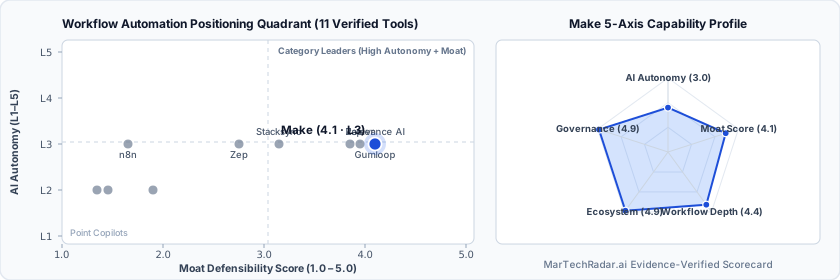
Make is a Web SaaS tool for Workflow Automation (No-Code Marketing Workflow Automation) in Agent & Marketing Ops. Pricing: Free plan · $12–$38/mo · Enterprise plan. Best suited to B2B SaaS and DTC / eCommerce. Editor ratings: AI autonomy L3 (conditional automation); moat score 4.1/5.0 (Proprietary moat). Fact-checked by MarTechRadar Research Desk on Oct 14, 2026.
Visual workflow orchestration platform connecting APIs, databases, and AI agents through a node-based integration engine.
Is Make worth it in 2026? Buyer fit & when to walk away
Choose Make if (Best Fit)
- Target ICP & Stack Fit: You operate as B2B SaaS and DTC / eCommerce requiring a Web SaaS deployment for Workflow Automation, with verified ecosystem connectivity for Salesforce, HubSpot, Slack, Twilio Segment.
- L3 Architecture & Defensibility: Deep ecosystem moat underpinned by an expansive library of over 3,000 application connectors, granular visual scenario debugging, and transactional multi-step execution graphs that manage nested payload schemas without custom code.
- Commercial Model Fit: Your procurement budget aligns with Free plan · $12–$38/mo · Enterprise plan and want a self-serve free tier for zero-cost initial validation.
Walk away from Make if (Deal-Breakers)
- Walk away if your workflow cannot tolerate high-throughput operational throttling: Complex multi-branch scenarios experience execution queue latency and downstream API rate-limiting when handling high-frequency webhook bursts, requiring manual batching logic.
- Walk away if dynamic schema drift sensitivity is a deal-breaker for your team: Unannounced upstream payload alterations cause silent scenario execution failures unless strict error-handling directives, such as rollback or break routines, are manually assigned per node.
Make pricing, free plan & scorecard at a glance
| Pricing | Free plan · $12–$38/mo · Enterprise planVendor pricing page |
|---|---|
| Free plan | Yes |
| Delivery | Web SaaS |
| Audience | B2B SaaS, DTC / eCommerce |
| AI autonomy level | L3 · Conditional automationEditor-verified |
| Moat tier & score | 4.1 / 5.0 · Proprietary moatEditor-verified |
| Funding | Undisclosed |
| Company size | 201-500 employees |
| Ecosystem integrations | Salesforce, HubSpot, Slack, Twilio Segment |
| Compliance & governance | SOC 2, GDPR |
| Governance & docs | Trust & Security ↗ · System Status ↗ · API & Docs ↗ · Changelog ↗ · Privacy ↗ |
| Headquarters | Prague, Praha 8 |
| Founded | 2016 |
| Last verified | Oct 14, 2026 |
Make pros & cons: strengths vs. operational limitations
Pros: core strengths & capabilities
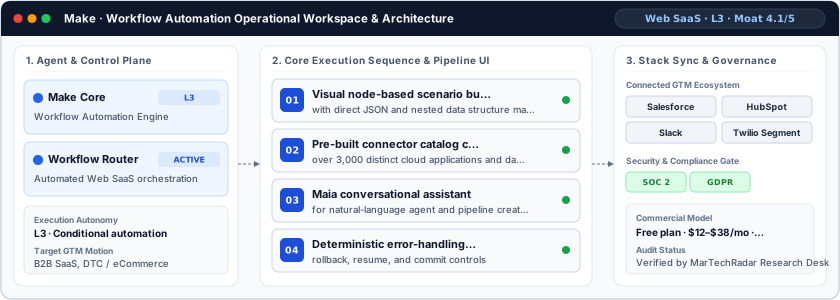
- Visual node-based scenario builder: with direct JSON and nested data structure manipulation
- Pre-built connector catalog covering: over 3,000 distinct cloud applications and databases
- Maia conversational assistant: for natural-language agent and pipeline creation
- Deterministic error-handling directives including: rollback, resume, and commit controls
Cons: operational limitations & risks
- High-Throughput Operational Throttling: Complex multi-branch scenarios experience execution queue latency and downstream API rate-limiting when handling high-frequency webhook bursts, requiring manual batching logic.
- Dynamic Schema Drift Sensitivity: Unannounced upstream payload alterations cause silent scenario execution failures unless strict error-handling directives, such as rollback or break routines, are manually assigned per node.
- Long-Running Agent Execution Timeouts: Extended asynchronous polling loops and multi-step LLM operations risk running into default gateway timeout thresholds without explicit webhook-based callback architecture.
Make TCO & deal-breaker stress test
Simulate 12-month stepped TCO, hidden cost multipliers, contract lock-in exposure, and stack failure modes using only facts verified by MarTechRadar Research Desk on 2026-10-14 · Capture SHA 180156ef.
Make aligns with your 5-seat / $800/mo profile. Review the walk-away triggers and contract levers below before deployment.
- Moat Score
- 4.1 / 5.0
- AI Autonomy
- L3
- Free Tier / Trial
- Free plan
Triggered audit signals & failure modes
- Published Self-Serve Entry FloorVerified Pricing Ledger
Make publishes a transparent entry point (Free plan · $12–$38/mo · Enterprise plan) with a free tier for initial validation before committing.
- Tier Fit for 5-Seat Scale: Teams ($38/mo (10k credits))Verified Tier Schedule
10,000 credits/mo baseline with multi-user team roles, shared scenario templates, and team permissions.
- Primary Operational Bottleneck: High-Throughput Operational ThrottlingAudit by MarTechRadar Research Desk
Complex multi-branch scenarios experience execution queue latency and downstream API rate-limiting when handling high-frequency webhook bursts, requiring manual batching logic.
Test a custom Make budget or stack constraint
Lower 5-seat floor (~$37/mo vs. $38 / mo)
Lower 5-seat floor (~$20/mo vs. $38 / mo)
Make integrations, API, security & compliance stack
Make AI moat & Workflow Automation positioning
Deep ecosystem moat underpinned by an expansive library of over 3,000 application connectors, granular visual scenario debugging, and transactional multi-step execution graphs that manage nested payload schemas without custom code.
Make in-depth review, pricing & architecture analysis
Editor sign-off: Oct 14, 2026. How profiles are made.
What is Make? Overview & background
Architecturally positioned at the intersection of integration-platform-as-a-service (iPaaS) and automated execution pipelines, Make operates as an orchestration backplane for asynchronous operational data. Headquartered in Prague, Praha 8 and established in 2016, the platform addresses technical marketing operations teams, systems architects, and revops leaders requiring granular data transformation without bespoke code maintenance. By abstracting raw webhook listeners and multi-step API payloads into visual directed graphs, Make serves as an operational connective layer across fragmented commercial stacks.
How Make works: architecture & workflow
At its operational core, Make utilizes an asynchronous event engine functioning at Level 3 conditional autonomy. Ingestion pipelines process incoming webhooks, polling triggers, or manual dispatches across a catalog of over 3,000 pre-configured connectors. The runtime routes JSON payloads through sequential, router-split, or iterator-aggregator nodes, enabling deterministic field mapping and inline data transformation. Through Maia, the architecture incorporates agentic automation capabilities, allowing operators to construct functional workflows via prompt-driven interface synthesis while maintaining transactional control over execution loops, alongside native workflow integrations for Salesforce, HubSpot, and Slack under verified SOC 2 Type II and GDPR governance controls.
Make limitations, drawbacks & risks
Operational considerations and platform boundaries include:
- High-Throughput Operational Throttling: Complex multi-branch scenarios experience execution queue latency and downstream API rate-limiting when handling high-frequency webhook bursts, requiring manual batching logic.
- Dynamic Schema Drift Sensitivity: Unannounced upstream payload alterations cause silent scenario execution failures unless strict error-handling directives, such as rollback or break routines, are manually assigned per node.
- Long-Running Agent Execution Timeouts: Extended asynchronous polling loops and multi-step LLM operations risk running into default gateway timeout thresholds without explicit webhook-based callback architecture.
Make pricing, plans & cost breakdown
Commercial procurement follows a tiered usage framework anchored by monthly execution credits across scenario runs. Evaluation commences on a Free plan at $0 per month (1,000 credits per month across 3,000+ app connectors). Self-serve paid packages scale at the 10,000-credit baseline across Core at $12 per month (unlocking the Make API and unlimited active scenarios), Pro at $21 per month (priority execution and full-text log search), and Teams at $38 per month (multi-user team roles and shared scenario templates), alongside custom Enterprise agreements structured around high-concurrency quotas, single sign-on, and 24/7 enterprise governance SLAs.
| Plan / Tier | Verified Price & Billing | Included Scope & Contract Terms | |
|---|---|---|---|
| Free | $0/mo | 1,000 execution credits/mo across 3,000+ app connectors and 2 active scenarios. | |
| Core | $12/mo (10k credits) | 10,000 credits/mo baseline, unlimited active scenarios, 1-minute scheduling, and Make API access. | |
| Pro | $21/mo (10k credits) | 10,000 credits/mo baseline, priority scenario execution, custom variables, and full-text execution log search. | |
| Teams | $38/mo (10k credits) | 10,000 credits/mo baseline with multi-user team roles, shared scenario templates, and team permissions. | |
| Enterprise | Custom quote | Custom high-volume credit pools, enterprise app connectors, SSO, audit logs, and 24/7 support. | |
| Contract Watchout: Annual Billing Headline vs. Monthly Premium | The vendor pricing page advertises an annual-billing discount (Save 15%); month-to-month billing carries a higher effective monthly rate. | ||
How Make compares vs. competitors & alternatives
Within the workflow orchestration landscape, Make competes directly against specialized systems such as Cassidy AI, Gumloop, and Relevance AI within the Workflow Automation segment. While Gumloop and Relevance AI focus heavily on low-code agentic LLM chains, Make preserves distinct advantages in deterministic enterprise connectivity, native API depth, and visual JSON parsing. Cassidy AI tailors its workflows directly to internal knowledge management, whereas Make targets horizontal RevOps integration, suiting enterprise technical teams demanding structural precision over purely probabilistic automation.
Direct competitors & market radar
Top algorithmic competitors based on category positioning, capability overlap, and ICP alignment.
Frequently asked questions about Make
How much does Make cost in 2026?
Make pricing: Free plan · $12–$38/mo · Enterprise plan. A permanent free plan is available. Published tiers: Free ($0/mo); Core ($12/mo (10k credits)); Pro ($21/mo (10k credits)); Teams ($38/mo (10k credits)); Enterprise (Custom quote). Commercial procurement follows a tiered usage framework anchored by monthly execution credits across scenario runs. Evaluation commences on a Free plan at $0 per month (1,000 credits per month across 3,000+ app connectors).
What are the top Make alternatives in Workflow Automation?
Verified Workflow Automation alternatives include Gumloop (From $37/mo), Relevance AI (Custom / enterprise pricing), Cassidy AI (Custom / enterprise pricing), Zapier (Free plan · $19.99–$69/mo). Within the workflow orchestration landscape, Make competes directly against specialized systems such as Cassidy AI, Gumloop, and Relevance AI within the Workflow Automation segment.
What are the main limitations and trade-offs of Make?
Operational considerations and platform boundaries include: High-Throughput Operational Throttling: Complex multi-branch scenarios experience execution queue latency and downstream API rate-limiting when handling high-frequency webhook bursts, requiring manual batching logic. Walk away if your workflow cannot tolerate high-throughput operational throttling: Complex multi-branch scenarios experience execution queue latency and downstream API rate-limiting when handling high-frequency webhook bursts, requiring manual batching logic.
Verified sources & evidence trail
- Official product domain: https://make.com
- Commercial pricing verification: https://www.make.com/en/pricing
- Verified corporate entity profiles (
sameAs): LinkedIn Company Profile · Crunchbase Entity Record - First-party governance & documentation links: Trust & Security · System Status · API & Docs · Changelog · Privacy
- Editor sign-off: Oct 14, 2026 (how profiles are made).
