Marvis Review (2026): AI SDR Pricing, Limits & Alternatives
Bottom line
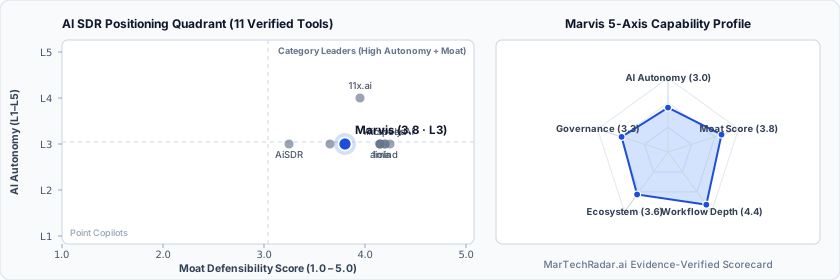
Marvis is a Web SaaS tool for AI SDR (Autonomous B2B Sales Agents & AI BDRs) in AI SDR & Outbound. Pricing: Custom / enterprise pricing. Best suited to B2B Sales Leaders, SDR/BDR Teams and Revenue Operations (RevOps). Editor ratings: AI autonomy L3 (conditional automation); moat score 3.8/5.0 (Proprietary moat). Fact-checked by Julie Brot on Oct 12, 2026.
Autonomous operations platform deploying purpose-built AI agents to execute commercial workflows and multi-step business interactions.
Marvis buyer fit verdict: when to choose vs. when to walk away
Choose Marvis if (Best Fit)
- Target ICP & Stack Fit: You operate as B2B Sales Leaders, SDR/BDR Teams and Revenue Operations (RevOps) requiring a Web SaaS deployment for AI SDR, with verified ecosystem connectivity for Outreach.
- L3 Architecture & Defensibility: Defensibility stems from domain-specific agent orchestration graphs and integration adapters for high-touch service and sales workflows.
- Commercial Model Fit: Your procurement budget aligns with Custom / enterprise pricing.
Walk away from Marvis if (Deal-Breakers)
- Walk away if you require transparent self-serve monthly billing or your budget ceiling is under $1,000/mo (Marvis requires sales-gated custom quoting).
- Walk away if your workflow cannot tolerate integration schema brittle maintenance: Agentic task execution relies on strict mapping against target CRM and ERP endpoints, where undocumented schema alterations or field validations disrupt automated pipeline runs.
- Walk away if mailbox deliverability degradation is a deal-breaker for your team: High-velocity outbound engagement conducted by autonomous agents risks domain reputation damage without continuous external warming and DKIM alignment enforcement.
Marvis key facts & scorecard
| Pricing | Custom / enterprise pricing |
|---|---|
| Free plan | No / not disclosed |
| Delivery | Web SaaS |
| Audience | B2B Sales Leaders, SDR/BDR Teams, Revenue Operations (RevOps) |
| AI autonomy level | L3 · Conditional automationEditor-verified |
| Moat tier & score | 3.8 / 5.0 · Proprietary moatEditor-verified |
| Funding | Bootstrapped |
| Total funding | BootstrappedBacked by Founders |
| Ecosystem integrations | Outreach |
| Headquarters | United States |
| Founded | 2023 |
| Last verified |
Marvis pros & cons: strengths vs. operational limitations
Pros: core strengths & capabilities
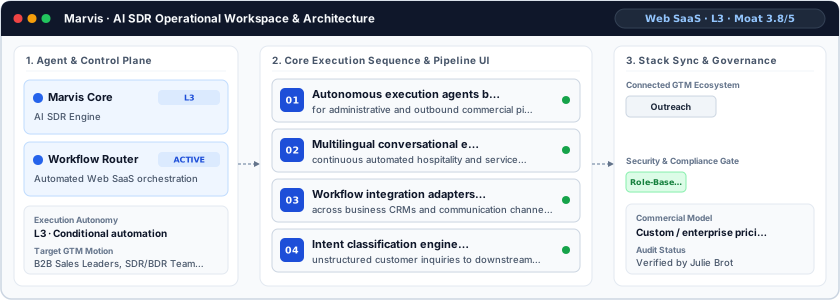
- Autonomous execution agents built: for administrative and outbound commercial pipelines
- Multilingual conversational engine supporting: continuous automated hospitality and service interactions
- Workflow integration adapters routing context: across business CRMs and communication channels
- Intent classification engine mapping: unstructured customer inquiries to downstream enterprise actions
Cons: operational limitations & risks
- Integration schema brittle maintenance: Agentic task execution relies on strict mapping against target CRM and ERP endpoints, where undocumented schema alterations or field validations disrupt automated pipeline runs.
- Mailbox deliverability degradation: High-velocity outbound engagement conducted by autonomous agents risks domain reputation damage without continuous external warming and DKIM alignment enforcement.
- Semantic classification boundaries: Complex multi-intent prospect responses often fall outside deterministic playbook logic, triggering forced escalation loops that increase manual human intervention overhead.
Marvis TCO & deal-breaker stress test
Simulate 12-month stepped TCO, hidden cost multipliers, contract lock-in exposure, and stack failure modes using only facts verified by Julie Brot on · Capture SHA 9b617505.
Marvis triggers high-severity friction under your 5-seat / $800/mo constraints. Benchmark the verified subtrack alternatives below before committing.
| Plan / Tier | Verified Rate | Scale Fit | Scope & Quota Notes |
|---|---|---|---|
| Enterprise / Custom | Custom quote | 15–50+ seats (Enterprise SLA) | Sales-negotiated annual contract for custom volume, SSO/RBAC governance, and dedicated SLA. |
- Moat Score
- 3.8 / 5.0
- AI Autonomy
- L3
- Free Tier / Trial
- None disclosed
Triggered audit signals & failure modes
- Opaque Enterprise Quoting vs. SMB/Mid-Market BudgetVerified Pricing Ledger
Marvis does not disclose a public self-serve floor (Custom / enterprise pricing). Buyers with a $800/mo cap face high sales-qualification friction.
- Sales-Gated Contract TermsFact-checked by Julie Brot
Marvis distributes its software via an enterprise licensing structure. Commercial pricing is available on request through tailored enterprise sales quotes based on organizational scale and seats.
- Primary Operational Bottleneck: Integration schema brittle maintenanceAudit by Julie Brot
Agentic task execution relies on strict mapping against target CRM and ERP endpoints, where undocumented schema alterations or field validations disrupt automated pipeline runs.
Hidden TCO Multipliers & Quota Gates
- Integration schema brittle maintenance: Agentic task execution relies on strict mapping against target CRM and ERP endpoints, where undocumented schema alterations or field validations disrupt automated pipeline runs.
- Mailbox deliverability degradation: High-velocity outbound engagement conducted by autonomous agents risks domain reputation damage without continuous external warming and DKIM alignment enforcement.
When to Walk Away & Negotiation Levers
- Walk away if you require transparent self-serve monthly billing or your budget ceiling is under $1,000/mo (Marvis requires sales-gated custom quoting).
- Walk away if your workflow cannot tolerate integration schema brittle maintenance: Agentic task execution relies on strict mapping against target CRM and ERP endpoints, where undocumented schema alterations or field validations disrupt automated pipeline runs.
- Walk away if mailbox deliverability degradation is a deal-breaker for your team: High-velocity outbound engagement conducted by autonomous agents risks domain reputation damage without continuous external warming and DKIM alignment enforcement.
- Demand a 30- to 60-day paid pilot opt-out clause in the Marvis order form before signing a 12-month enterprise commitment.
- Require a sandbox proof-of-concept testing integration schema brittle maintenance against your live CRM/data schema before annual sign-off.
Ask a custom procurement or TCO stress-test question about Marvis
Lower 5-seat floor (~$39/mo vs. Custom Quote) · Transparent self-serve entry without mandatory annual lock-in
Lower 5-seat floor (~$100/mo vs. Custom Quote) · Transparent self-serve entry without mandatory annual lock-in
Marvis key entities, modules & ecosystem stack
Marvis moat & subtrack positioning
Defensibility stems from domain-specific agent orchestration graphs and integration adapters for high-touch service and sales workflows.
Editorial review
Fact-checked by Julie Brot (Enterprise SaaS Governance & Procurement Editor) on .
Background
To bridge the operational gap between conversational generation and transactional execution, Marvis was established in 2023 in the United States as an artificial intelligence automation vendor. Designed primarily for revenue operations directors and commercial team leaders, Marvis deploys autonomous agentic systems to handle repetitive outbound coordination, inquiry triage, and routine administrative workflows. The platform targets business teams seeking to eliminate manual pipeline operations without expanding human headcounts.
How Marvis works
Marvis operates as an L3 conditional-autonomy execution engine. The platform ingests asynchronous signals across inbound email, web forms, and messaging channels through webhooks and API polling. Incoming payloads pass through an intent classification layer that extracts operational entities, references organizational routing logic, and selects pre-configured agent playbooks. From there, Marvis invokes downstream connectors to query records, draft dynamic correspondence, and update commercial databases, retaining human intervention checkpoints for non-standard edge cases.
Limitations
Operational considerations and platform boundaries include:
- Integration schema brittle maintenance: Agentic task execution relies on strict mapping against target CRM and ERP endpoints, where undocumented schema alterations or field validations disrupt automated pipeline runs.
- Mailbox deliverability degradation: High-velocity outbound engagement conducted by autonomous agents risks domain reputation damage without continuous external warming and DKIM alignment enforcement.
- Semantic classification boundaries: Complex multi-intent prospect responses often fall outside deterministic playbook logic, triggering forced escalation loops that increase manual human intervention overhead.
Marvis pricing
Marvis distributes its software via an enterprise licensing structure. Commercial pricing is available on request through tailored enterprise sales quotes based on organizational scale and seats. Contracts typically account for required implementation engineering, custom agent configurations, and platform usage volumes. Engagements require direct vendor onboarding rather than self-service provisioning, ensuring custom system alignment prior to deployment.
How Marvis compares
Within the autonomous sales and operations domain, Marvis contends against specialized vendors such as 11x.ai, 1mind, and Actively AI. While 11x.ai concentrates on dedicated synthetic sales development reps and Actively AI emphasizes automated lead qualification pipelines, Marvis provides a broader operational agent architecture adaptable to varied commercial environments. Marvis fits mid-market and enterprise organizations seeking workflow execution flexibility across both customer-facing outreach and operational triage.
Direct competitors & market radar
Top algorithmic competitors based on category positioning, capability overlap, and ICP alignment.
Frequently asked questions about Marvis
How much does Marvis cost and does it require a custom enterprise quote?
Published pricing summary for Marvis: Custom / enterprise pricing. A permanent free plan is not disclosed for Marvis. Marvis distributes its software via an enterprise licensing structure. Commercial pricing is available on request through tailored enterprise sales quotes based on organizational scale and seats.
How does Marvis work and how autonomous is its AI architecture?
Autonomous operations platform deploying purpose-built AI agents to execute commercial workflows and multi-step business interactions. Within AI SDR (Autonomous B2B Sales Agents & AI BDRs), MarTechRadar rates its execution architecture at L3 · Conditional automation with a verified Moat Score of 3.8 / 5.0 (Proprietary moat). Defensibility stems from domain-specific agent orchestration graphs and integration adapters for high-touch service and sales workflows.
What are the main limitations of Marvis and when should buyers walk away?
Based on our editorial technical audit, key operational considerations and boundaries for Marvis include: (1) Integration schema brittle maintenance: Agentic task execution relies on strict mapping against target CRM and ERP endpoints, where undocumented schema alterations or field validations disrupt automated pipeline runs. (2) Mailbox deliverability degradation: High-velocity outbound engagement conducted by autonomous agents risks domain reputation damage without continuous external warming and DKIM alignment enforcement. (3) Semantic classification boundaries: Complex multi-intent prospect responses often fall outside deterministic playbook logic, triggering forced escalation loops that increase manual human intervention overhead. Primary procurement walk-away rule: Walk away if you require transparent self-serve monthly billing or your budget ceiling is under $1,000/mo (Marvis requires sales-gated custom quoting).
What integrations, compliance certifications, and contract terms apply to Marvis?
Verified ecosystem and stack integrations include Outreach. Key TCO multiplier to watch: Integration schema brittle maintenance (Agentic task execution relies on strict mapping against target CRM and ERP endpoints, where undocumented schema alterations or field validations disrupt automated pipeline runs.) Before signing a contract, procurement teams should demand a 30- to 60-day paid pilot opt-out clause in the Marvis order form before signing a 12-month enterprise commitment.
What are the best Marvis alternatives and head-to-head competitors in 2026?
Top fact-checked alternatives to Marvis in AI SDR (Autonomous B2B Sales Agents & AI BDRs) include Snov.io (From $39/mo), RocketReach (From $6/mo), Salesflare (From $1/mo), Swan AI (From $100/mo · Enterprise plan). Within the autonomous sales and operations domain, Marvis contends against specialized vendors such as 11x.ai, 1mind, and Actively AI.
Verified sources & evidence trail
- Official product domain: https://hellomarvis.com/
- Commercial pricing verification: Verified against official vendor pricing policy (Custom / enterprise pricing)
- Verified corporate entity profiles (
sameAs): LinkedIn Company Profile · Crunchbase Entity Record - Editorial audit sign-off: Fact-checked by Julie Brot on under the MarTechRadar Evidence-Ledger Protocol.