Airspeed Review (2026): AI SDR Pricing, Limits & Alternatives
Bottom line
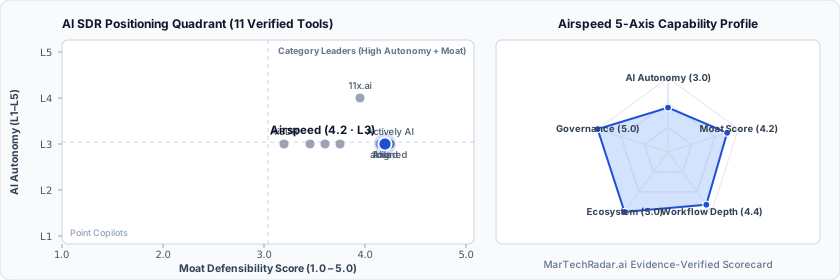
Airspeed is a Web SaaS tool for AI SDR (Autonomous B2B Sales Agents & AI BDRs) in AI SDR & Outbound. Pricing: Custom / enterprise pricing. Best suited to B2B Sales Leaders, SDR/BDR Teams and Revenue Operations (RevOps). Editor ratings: AI autonomy L3 (conditional automation); moat score 4.2/5.0 (Proprietary moat). Fact-checked by Tim Fenolz on Oct 12, 2026.
Commercial revenue intelligence system turning conversational buyer data into automated CRM hygiene, deal execution telemetry, and structured rep coaching.
Airspeed buyer fit verdict: when to choose vs. when to walk away
Choose Airspeed if (Best Fit)
- Target ICP & Stack Fit: You operate as B2B Sales Leaders, SDR/BDR Teams and Revenue Operations (RevOps) requiring a Web SaaS deployment for AI SDR, with verified ecosystem connectivity for Salesforce, HubSpot, Slack, Microsoft Teams.
- L3 Architecture & Defensibility: Proprietary conversation entity extraction mapping acoustic buyer signals directly into relational CRM schemas, supported by deep bi-directional CRM integration layers and $25.4M in dedicated institutional capital.
- Commercial Model Fit: Your procurement budget aligns with Custom / enterprise pricing.
Walk away from Airspeed if (Deal-Breakers)
- Walk away if you require transparent self-serve monthly billing or your budget ceiling is under $1,000/mo (Airspeed requires sales-gated custom quoting).
- Walk away if your workflow cannot tolerate custom schema alignment: The autonomous field extraction requires continuous schema mapping maintenance when enterprise CRM configurations feature complex custom objects, validation rules, or nested dependencies.
- Walk away if multi-speaker diarization degradation is a deal-breaker for your team: Acoustic signal clarity drops significantly in hybrid conference room settings where cross-talk impairs speaker attribution, causing incomplete entity extraction.
Airspeed key facts & scorecard
| Pricing | Custom / enterprise pricing |
|---|---|
| Free plan | No / not disclosed |
| Delivery | Web SaaS |
| Audience | B2B Sales Leaders, SDR/BDR Teams, Revenue Operations (RevOps) |
| AI autonomy level | L3 · Conditional automationEditor-verified |
| Moat tier & score | 4.2 / 5.0 · Proprietary moatEditor-verified |
| Funding | Series A |
| Total funding | $25.4MBacked by Creator Fund, Atlantic Bridge |
| Founders | Adam Liska, Devang Agrawal |
| Company size | 51-200 employees |
| Ecosystem integrations | Salesforce, HubSpot, Slack, Microsoft Teams, Twilio Segment |
| Compliance & governance | SOC 2, GDPR, HIPAA |
| Governance & docs | Trust & Security ↗ · API & Docs ↗ · Changelog ↗ · Terms ↗ · Privacy ↗ |
| Headquarters | London, England |
| Founded | 2022 |
| Last verified |
Airspeed pros & cons: strengths vs. operational limitations
Pros: core strengths & capabilities
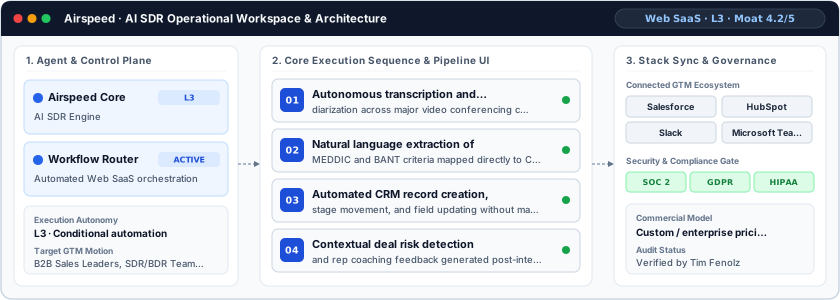
- Autonomous transcription and speaker: diarization across major video conferencing clients
- Natural language extraction of: MEDDIC and BANT criteria mapped directly to CRM deal fields
- Automated CRM record creation,: stage movement, and field updating without manual rep input
- Contextual deal risk detection: and rep coaching feedback generated post-interaction
Cons: operational limitations & risks
- Custom Schema Alignment: The autonomous field extraction requires continuous schema mapping maintenance when enterprise CRM configurations feature complex custom objects, validation rules, or nested dependencies.
- Multi-Speaker Diarization Degradation: Acoustic signal clarity drops significantly in hybrid conference room settings where cross-talk impairs speaker attribution, causing incomplete entity extraction.
- CRM API Rate Ceiling Friction: Synchronous high-volume writes across broad enterprise sales organizations can encounter external CRM API throttling during peak operational hours.
Airspeed TCO & deal-breaker stress test
Simulate 12-month stepped TCO, hidden cost multipliers, contract lock-in exposure, and stack failure modes using only facts verified by Tim Fenolz on · Capture SHA 1be257f8.
Airspeed triggers high-severity friction under your 5-seat / $800/mo constraints. Benchmark the verified subtrack alternatives below before committing.
| Plan / Tier | Verified Rate | Scale Fit | Scope & Quota Notes |
|---|---|---|---|
| Enterprise / Custom | Custom quote | 15–50+ seats (Enterprise SLA) | Sales-negotiated annual contract for custom volume, SSO/RBAC governance, and dedicated SLA. |
- Moat Score
- 4.2 / 5.0
- AI Autonomy
- L3
- Free Tier / Trial
- None disclosed
Triggered audit signals & failure modes
- Opaque Enterprise Quoting vs. SMB/Mid-Market BudgetVerified Pricing Ledger
Airspeed does not disclose a public self-serve floor (Custom / enterprise pricing). Buyers with a $800/mo cap face high sales-qualification friction.
- Sales-Gated Contract TermsFact-checked by Tim Fenolz
Commercial pricing is available on request through tailored enterprise sales quotes based on organizational scale and seats. Contracts typically require annual commitments scaled according to active sales rep capacity, meeting ingest volume, and data governance requirements.
- Primary Operational Bottleneck: Custom Schema AlignmentAudit by Tim Fenolz
The autonomous field extraction requires continuous schema mapping maintenance when enterprise CRM configurations feature complex custom objects, validation rules, or nested dependencies.
Hidden TCO Multipliers & Quota Gates
- Custom Schema Alignment: The autonomous field extraction requires continuous schema mapping maintenance when enterprise CRM configurations feature complex custom objects, validation rules, or nested dependencies.
- Multi-Speaker Diarization Degradation: Acoustic signal clarity drops significantly in hybrid conference room settings where cross-talk impairs speaker attribution, causing incomplete entity extraction.
When to Walk Away & Negotiation Levers
- Walk away if you require transparent self-serve monthly billing or your budget ceiling is under $1,000/mo (Airspeed requires sales-gated custom quoting).
- Walk away if your workflow cannot tolerate custom schema alignment: The autonomous field extraction requires continuous schema mapping maintenance when enterprise CRM configurations feature complex custom objects, validation rules, or nested dependencies.
- Walk away if multi-speaker diarization degradation is a deal-breaker for your team: Acoustic signal clarity drops significantly in hybrid conference room settings where cross-talk impairs speaker attribution, causing incomplete entity extraction.
- Demand a 30- to 60-day paid pilot opt-out clause in the Airspeed order form before signing a 12-month enterprise commitment.
- Require a sandbox proof-of-concept testing custom schema alignment against your live CRM/data schema before annual sign-off.
Ask a custom procurement or TCO stress-test question about Airspeed
Verified AI SDR peer (Custom / enterprise pricing · Moat 4.2/5.0)
Verified AI SDR peer (Custom / enterprise pricing · Moat 4.2/5.0)
Airspeed key entities, modules & ecosystem stack
Airspeed moat & subtrack positioning
Proprietary conversation entity extraction mapping acoustic buyer signals directly into relational CRM schemas, supported by deep bi-directional CRM integration layers and $25.4M in dedicated institutional capital.
Editorial review
Fact-checked by Tim Fenolz (Lead AdTech, Programmatic & Attribution Analyst) on .
Background
Airspeed was established in 2022 in London, England, to automate the administrative overhead that burdens commercial revenue teams following prospect interactions. Having raised $25.4M in venture capital, the company targets revenue operations leaders, sales directors, and enterprise account executives struggling with inconsistent CRM hygiene. Rather than functioning as a standard passive call recorder, the system positions itself as an active commercial intelligence layer that transforms raw prospect dialogue into structured deal actions, pipeline telemetry, and contextual rep coaching.
How Airspeed works
The platform operates as an L3 autonomous revenue system ingesting audio and video streams via native meeting bot integrations across conferencing providers. Its processing engine runs automated speech diarization paired with fine-tuned large language models configured for commercial qualification frameworks. The mechanism isolates pipeline signals, including budget constraints, procurement roadmaps, and decision-maker objections, before mapping them directly to CRM schema properties. Operating bidirectionally, it autonomously populates pipeline stages, updates custom CRM attributes, and drafts follow-up cadences without requiring manual rep data entry, alongside native workflow integrations for Salesforce, HubSpot, Slack, and Microsoft Teams under verified GDPR and HIPAA governance controls.
Limitations
Operational considerations and platform boundaries include:
- Custom Schema Alignment: The autonomous field extraction requires continuous schema mapping maintenance when enterprise CRM configurations feature complex custom objects, validation rules, or nested dependencies.
- Multi-Speaker Diarization Degradation: Acoustic signal clarity drops significantly in hybrid conference room settings where cross-talk impairs speaker attribution, causing incomplete entity extraction.
- CRM API Rate Ceiling Friction: Synchronous high-volume writes across broad enterprise sales organizations can encounter external CRM API throttling during peak operational hours.
Airspeed pricing
Commercial pricing is available on request through tailored enterprise sales quotes based on organizational scale and seats. Contracts typically require annual commitments scaled according to active sales rep capacity, meeting ingest volume, and data governance requirements. Enterprise tiers include dedicated implementation services for bespoke CRM schema mapping, SOC 2 Type II compliance controls, and administrative management dashboards.
How Airspeed compares
Within the autonomous sales landscape, Airspeed competes alongside systems like 11x.ai, 1mind, and Actively AI within the AI SDR segment. While 11x.ai emphasizes fully autonomous outbound pipeline generation via digital worker agents, Airspeed focuses on downstream deal progression and administrative automation for human-led deals. Compared to Actively AI and 1mind, which center around top-of-funnel inbound qualification and pipeline activation, Airspeed delivers deeper native CRM field writing and post-call execution, serving mid-market and enterprise organizations with complex MEDDIC sales cycles.
Direct competitors & market radar
Top algorithmic competitors based on category positioning, capability overlap, and ICP alignment.
Frequently asked questions about Airspeed
How much does Airspeed cost and does it require a custom enterprise quote?
Published pricing summary for Airspeed: Custom / enterprise pricing. A permanent free plan is not disclosed for Airspeed. Commercial pricing is available on request through tailored enterprise sales quotes based on organizational scale and seats. Contracts typically require annual commitments scaled according to active sales rep capacity, meeting ingest volume, and data governance requirements.
How does Airspeed work and how autonomous is its AI architecture?
Commercial revenue intelligence system turning conversational buyer data into automated CRM hygiene, deal execution telemetry, and structured rep coaching. Within AI SDR (Autonomous B2B Sales Agents & AI BDRs), MarTechRadar rates its execution architecture at L3 · Conditional automation with a verified Moat Score of 4.2 / 5.0 (Proprietary moat). Proprietary conversation entity extraction mapping acoustic buyer signals directly into relational CRM schemas, supported by deep bi-directional CRM integration layers and $25.4M in dedicated institutional capital. Corporate profile: Founded by Adam Liska, Devang Agrawal, operating at 51-200 employees scale.
What are the main limitations of Airspeed and when should buyers walk away?
Based on our editorial technical audit, key operational considerations and boundaries for Airspeed include: (1) Custom Schema Alignment: The autonomous field extraction requires continuous schema mapping maintenance when enterprise CRM configurations feature complex custom objects, validation rules, or nested dependencies. (2) Multi-Speaker Diarization Degradation: Acoustic signal clarity drops significantly in hybrid conference room settings where cross-talk impairs speaker attribution, causing incomplete entity extraction. (3) CRM API Rate Ceiling Friction: Synchronous high-volume writes across broad enterprise sales organizations can encounter external CRM API throttling during peak operational hours. Primary procurement walk-away rule: Walk away if you require transparent self-serve monthly billing or your budget ceiling is under $1,000/mo (Airspeed requires sales-gated custom quoting).
What integrations, compliance certifications, and contract terms apply to Airspeed?
Verified ecosystem and stack integrations include Salesforce, HubSpot, Slack, Microsoft Teams, Twilio Segment. Documented security and governance attestations include SOC 2, GDPR, HIPAA. First-party governance and developer endpoints verified on domain include: Trust/Security (https://www.goairspeed.com/security), API Docs (https://docs.goairspeed.com). Key TCO multiplier to watch: Custom Schema Alignment (The autonomous field extraction requires continuous schema mapping maintenance when enterprise CRM configurations feature complex custom objects, validation rules, or nested dependencies.) Before signing a contract, procurement teams should demand a 30- to 60-day paid pilot opt-out clause in the Airspeed order form before signing a 12-month enterprise commitment.
What are the best Airspeed alternatives and head-to-head competitors in 2026?
Top fact-checked alternatives to Airspeed in AI SDR (Autonomous B2B Sales Agents & AI BDRs) include Clari Copilot (Custom / enterprise pricing), Gong.io (Custom / enterprise pricing), Curvo AI (Custom / enterprise pricing), DeltaGen (Custom / enterprise pricing). Within the autonomous sales landscape, Airspeed competes alongside systems like 11x.ai, 1mind, and Actively AI within the AI SDR segment.
Verified sources & evidence trail
- Official product domain: https://www.goairspeed.com/
- Commercial pricing verification: Verified against official vendor pricing policy (Custom / enterprise pricing)
- Verified corporate entity profiles (
sameAs): LinkedIn Company Profile · Crunchbase Entity Record - First-party governance & documentation links: Trust & Security · API & Docs · Changelog · Terms · Privacy
- Editorial audit sign-off: Fact-checked by Tim Fenolz on under the MarTechRadar Evidence-Ledger Protocol.