Gong.io Review (2026): AI Calling Pricing, Pros & Cons
Bottom line
Gong.io is a Web SaaS tool for AI Calling (Conversational Voice Calling Agents) in AI SDR & Outbound. Pricing: Custom / enterprise pricing. Best suited to B2B SaaS, DTC / eCommerce and Enterprise Brands. Editor ratings: AI autonomy L3 (conditional automation); moat score 4.5/5.0 (Proprietary moat (category leader)). Fact-checked by MarTechRadar Research Desk on Oct 14, 2026.
Revenue AI operating system that captures multi-channel sales interactions to automate deal execution, pipeline forecasting, and conversational intelligence.
Is Gong.io worth it in 2026? Buyer fit & when to walk away
Choose Gong.io if (Best Fit)
- Target ICP & Stack Fit: You operate as B2B SaaS, DTC / eCommerce and Enterprise Brands requiring a Web SaaS deployment for AI Calling, with verified ecosystem connectivity for Twilio Segment.
- L3 Architecture & Defensibility: Proprietary conversational dataset derived from billions of spoken and written enterprise interactions, coupled with mature integrations across telephony, video, and CRM ecosystems that create high switching costs.
- Commercial Model Fit: Your procurement budget aligns with Custom / enterprise pricing.
Walk away from Gong.io if (Deal-Breakers)
- Walk away if you need published self-serve pricing: Gong.io is sold by custom quote.
- Walk away if your workflow cannot tolerate telephony latency and webhook sync constraints: High-volume call centers experience processing lags when transcribing simultaneous multi-hour calls, introducing latency between call completion and CRM pipeline record synchronization.
- Walk away if consent architecture overhead is a deal-breaker for your team: Multi-region enterprise operations face dual-party recording compliance barriers, requiring intricate policy routing to avoid automated bot dropouts across restrictive legal jurisdictions.
Gong.io pricing, free plan & scorecard at a glance
| Pricing | Custom / enterprise pricing |
|---|---|
| Free plan | No / not disclosed |
| Delivery | Web SaaS |
| Audience | B2B SaaS, DTC / eCommerce, Enterprise Brands |
| AI autonomy level | L3 · Conditional automationEditor-verified |
| Moat tier & score | 4.5 / 5.0 · Proprietary moat (category leader)Editor-verified |
| Funding | Venture-backed |
| Total funding | $583M |
| Founders | Amit Bendov, Eilon Reshef |
| Company size | 1,001-5,000 employees |
| Ecosystem integrations | Twilio Segment |
| Governance & docs | Trust & Security ↗ · System Status ↗ · Privacy ↗ |
| Headquarters | San Francisco, California |
| Founded | 2015 |
| Last verified | Oct 14, 2026 |
Gong.io pros & cons: strengths vs. operational limitations
Pros: core strengths & capabilities
- Autonomous transcription and interaction: capture across telephony, video conferencing, and email
- Predictive pipeline risk scoring and deal health analytics
- Automated meeting briefs, action: item extraction, and CRM field synchronization
- Conversation intelligence tracking competitor: mentions, objection trends, and rep performance
Cons: operational limitations & risks
- Telephony Latency and Webhook Sync Constraints: High-volume call centers experience processing lags when transcribing simultaneous multi-hour calls, introducing latency between call completion and CRM pipeline record synchronization.
- Consent Architecture Overhead: Multi-region enterprise operations face dual-party recording compliance barriers, requiring intricate policy routing to avoid automated bot dropouts across restrictive legal jurisdictions.
- Custom Vocabulary Ingestion Failures: Niche B2B product acronyms and non-standard contract nomenclature frequently fail out-of-the-box acoustic parsing, necessitating ongoing manual semantic dictionary maintenance.
Gong.io TCO & deal-breaker stress test
Simulate 12-month stepped TCO, hidden cost multipliers, contract lock-in exposure, and stack failure modes using only facts verified by MarTechRadar Research Desk on 2026-10-14.
Gong.io triggers high-severity friction under your 5-seat / $800/mo constraints. Benchmark the verified subtrack alternatives below before committing.
- Moat Score
- 4.5 / 5.0
- AI Autonomy
- L3
- Free Tier / Trial
- None disclosed
Triggered audit signals & failure modes
- Opaque Enterprise Quoting vs. SMB/Mid-Market BudgetVerified Pricing Ledger
Gong.io does not disclose a public self-serve floor (Custom / enterprise pricing). Buyers with a $800/mo cap face high sales-qualification friction.
- Sales-Gated Contract TermsFact-checked by MarTechRadar Research Desk
The vendor structures commercial access around an enterprise annual subscription framework consisting of a base platform fee combined with named-user licensing tiers.
- Primary Operational Bottleneck: Custom Vocabulary Ingestion FailuresAudit by MarTechRadar Research Desk
Niche B2B product acronyms and non-standard contract nomenclature frequently fail out-of-the-box acoustic parsing, necessitating ongoing manual semantic dictionary maintenance.
Test a custom Gong.io budget or stack constraint
Lower 5-seat floor (~$100/mo vs. Custom Quote) · Transparent self-serve entry without mandatory annual lock-in
Lower 5-seat floor (~$299/mo vs. Custom Quote) · Transparent self-serve entry without mandatory annual lock-in
Gong.io integrations, API, security & compliance stack
Gong.io AI moat & AI Calling positioning
Proprietary conversational dataset derived from billions of spoken and written enterprise interactions, coupled with mature integrations across telephony, video, and CRM ecosystems that create high switching costs.
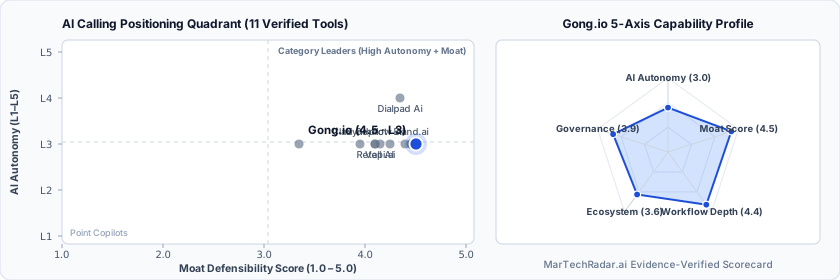
Gong.io in-depth review, pricing & architecture analysis
Editor sign-off: Oct 14, 2026. How profiles are made.
What is Gong.io? Overview & background
Established in 2015 and headquartered in San Francisco, California, Gong.io emerged to reconstruct revenue workflows by replacing subjective rep reporting with objective conversational telemetry. Backed by $583M in venture funding, the company targets Chief Revenue Officers, revenue operations executives, and commercial sales teams requiring unified execution intelligence across deal lifecycles. Operating as a revenue intelligence platform, it addresses the core operational disconnect between customer-facing discourse and systemic CRM record-keeping.
How Gong.io works: architecture & workflow
Gong.io ingests unstructured audio, video, and text streams via calendar integrations, telephony protocols, video conferencing bots, and corporate email APIs. The ingestion pipeline processes raw audio through domain-tuned acoustic and speech recognition models, isolating speakers and mapping utterances to conversation timelines. Downstream natural language processing engines extract semantic markers including competitor mentions, pricing pushback, churn signals, and execution gaps. The system maps these signals against historical pipeline milestones, functioning with contextual conditional autonomy by generating structured meeting summaries, updating CRM opportunity fields, and recommending follow-up workflows without manual intervention, alongside native workflow integrations for HubSpot.
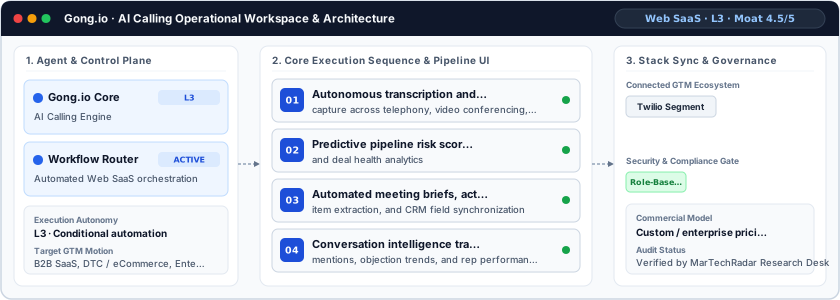
Gong.io limitations, drawbacks & risks
Operational considerations and platform boundaries include:
- Telephony Latency and Webhook Sync Constraints: High-volume call centers experience processing lags when transcribing simultaneous multi-hour calls, introducing latency between call completion and CRM pipeline record synchronization.
- Consent Architecture Overhead: Multi-region enterprise operations face dual-party recording compliance barriers, requiring intricate policy routing to avoid automated bot dropouts across restrictive legal jurisdictions.
- Custom Vocabulary Ingestion Failures: Niche B2B product acronyms and non-standard contract nomenclature frequently fail out-of-the-box acoustic parsing, necessitating ongoing manual semantic dictionary maintenance.
Gong.io pricing, plans & cost breakdown
The vendor structures commercial access around an enterprise annual subscription framework consisting of a base platform fee combined with named-user licensing tiers. Standard production connectors into existing enterprise tech stacks are included without standalone connector fees. Commercial pricing is available on request through tailored enterprise sales quotes based on organizational scale and seats, requiring direct engagement with their sales team for customized volume bands.
| Plan / Tier | Verified Price & Billing | Included Scope & Contract Terms |
|---|---|---|
| Enterprise / Custom | Custom quote | Custom-quoted plan; terms come from the vendor's sales team. |
How Gong.io compares vs. competitors & alternatives
Within the voice calling and revenue intelligence domain, Gong.io contrasts sharply with programmable agent builders and direct telephony providers within the AI Calling segment. While Bland.ai focuses on synthetic outbound autonomous voice agents executing scripted phone calls, and Consio delivers conversational automation, Gong.io operates as an analytical and operational layer across human conversations. Compared to Dialpad Ai, which pairs native unified-communications-as-a-service telephony with real-time transcription, Gong.io functions independently of proprietary carrier infrastructure. It remains optimized for enterprise sales organizations prioritizing cross-platform deal visibility and pipeline risk governance over raw telephony provisioning.
Direct competitors & market radar
Top algorithmic competitors based on category positioning, capability overlap, and ICP alignment.
Frequently asked questions about Gong.io
Does Gong.io publish pricing or require an enterprise quote?
Gong.io pricing: Custom / enterprise pricing. No free plan is publicly disclosed. The vendor structures commercial access around an enterprise annual subscription framework consisting of a base platform fee combined with named-user licensing tiers.
What are the top Gong.io alternatives in AI Calling?
Verified AI Calling alternatives include Workato (Free plan · $100/mo · Enterprise plan), Bland.ai (Free plan · $299/mo · Enterprise plan), Momentum (Custom / enterprise pricing), Dialpad Ai ($15–$25/seat/mo · Enterprise plan). Within the voice calling and revenue intelligence domain, Gong.io contrasts sharply with programmable agent builders and direct telephony providers within the AI Calling segment.
What are the main limitations and trade-offs of Gong.io?
Operational considerations and platform boundaries include: Telephony Latency and Webhook Sync Constraints: High-volume call centers experience processing lags when transcribing simultaneous multi-hour calls, introducing latency between call completion and CRM pipeline record synchronization. Walk away if you need published self-serve pricing: Gong.io is sold by custom quote.
Verified sources & evidence trail
- Official product domain: https://gong.io
- Commercial pricing verification: Verified against official vendor pricing policy (Custom / enterprise pricing)
- Verified corporate entity profiles (
sameAs): LinkedIn Company Profile · Crunchbase Entity Record - First-party governance & documentation links: Trust & Security · System Status · Privacy
- Editor sign-off: Oct 14, 2026 (how profiles are made).
