PolyAI Review (2026): AI Calling Pricing, Limits & Alternatives
Bottom line
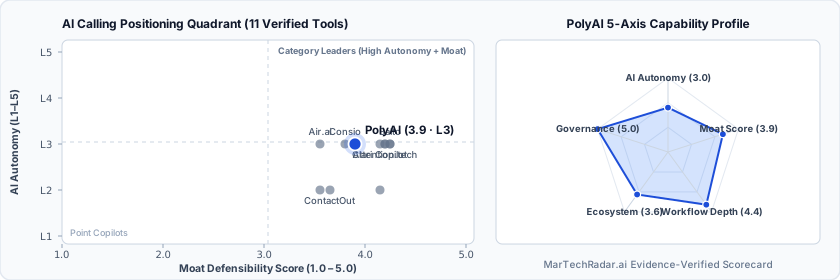
PolyAI is a Web SaaS tool for AI Calling (Conversational Voice Calling Agents) in AI SDR & Outbound. Pricing: Pricing not disclosed. Best suited to B2B SaaS and Marketing & Growth Teams. Editor ratings: AI autonomy L3 (conditional automation); moat score 3.9/5.0 (Proprietary moat). Fact-checked by Sarah Per on Oct 17, 2026.
Enterprise conversational voice AI platform powered by proprietary spoken-language models for customer engagement and GTM.
PolyAI buyer fit verdict: when to choose vs. when to walk away
Choose PolyAI if (Best Fit)
- Target ICP & Stack Fit: You operate as B2B SaaS and Marketing & Growth Teams requiring a Web SaaS deployment for AI Calling, with verified ecosystem connectivity for Salesforce.
- L3 Architecture & Defensibility: PolyAI builds a deep technological moat through its proprietary Dialog-RSN-1 spoken-language model, multi-accent speech recognition, and enterprise contact-center integrations backed by $202M in capital.
- Commercial Model Fit: Your procurement budget aligns with Pricing not disclosed.
Walk away from PolyAI if (Deal-Breakers)
- Walk away if you require transparent self-serve monthly billing or your budget ceiling is under $1,000/mo (PolyAI requires sales-gated custom quoting).
- Walk away if your workflow cannot tolerate enterprise implementation & per-minute commitment barrier: PolyAI scopes commercial engagements around custom implementation packages and ongoing per-minute enterprise usage commitments, making it over-provisioned for small businesses or low-volume startups.
- Walk away if custom telephony & sip integration learning curve is a deal-breaker for your team: Wiring voice assistants into legacy on-premises PBXs, Genesys routing queues, and custom authentication flows introduces a multi-week deployment learning curve with IT and telephony teams.
PolyAI key facts & scorecard
| Pricing | Pricing not disclosed |
|---|---|
| Free plan | No / not disclosed |
| Delivery | Web SaaS |
| Audience | B2B SaaS, Marketing & Growth Teams |
| AI autonomy level | L3 · Conditional automationEditor-verified |
| Moat tier & score | 3.9 / 5.0 · Proprietary moatEditor-verified |
| Funding | Series C+ |
| Total funding | $202M |
| Founders | Nikola Mrkšić, Pei-Hao Su, Tsung-Hsien Wen |
| Company size | 201-500 employees |
| Ecosystem integrations | Salesforce |
| Compliance & governance | SOC 2, HIPAA |
| Governance & docs | Trust & Security ↗ · API & Docs ↗ · Changelog ↗ · Terms ↗ · Privacy ↗ |
| Headquarters | San Francisco, California |
| Founded | 2017 |
| Last verified |
PolyAI pros & cons: strengths vs. operational limitations
Pros: core strengths & capabilities
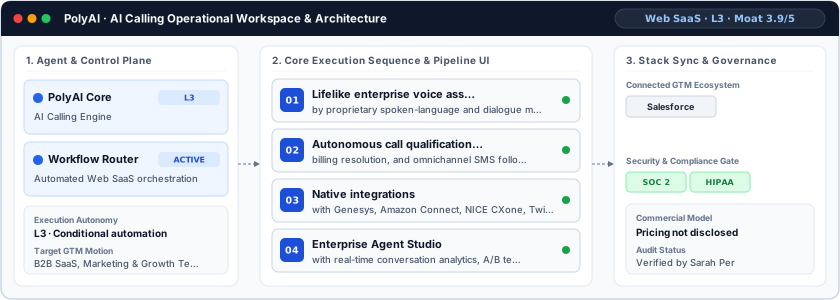
- Lifelike enterprise voice assistants powered: by proprietary spoken-language and dialogue management models
- Autonomous call qualification, booking,: billing resolution, and omnichannel SMS follow-up
- Native integrations: with Genesys, Amazon Connect, NICE CXone, Twilio, Salesforce, and ServiceNow
- Enterprise Agent Studio: with real-time conversation analytics, A/B testing, and SOC 2 / HIPAA compliance
Cons: operational limitations & risks
- Enterprise Implementation & Per-Minute Commitment Barrier: PolyAI scopes commercial engagements around custom implementation packages and ongoing per-minute enterprise usage commitments, making it over-provisioned for small businesses or low-volume startups.
- Custom Telephony & SIP Integration Learning Curve: Wiring voice assistants into legacy on-premises PBXs, Genesys routing queues, and custom authentication flows introduces a multi-week deployment learning curve with IT and telephony teams.
- Out-of-Policy Consultative Escalation Boundary: While PolyAI handles structured bookings, identity verification, and multi-step triage autonomously, bespoke commercial contract negotiations still require warm transfers to human specialists.
PolyAI TCO & deal-breaker stress test
Simulate 12-month stepped TCO, hidden cost multipliers, contract lock-in exposure, and stack failure modes using only facts verified by Sarah Per on · Capture SHA c7da401a.
PolyAI triggers high-severity friction under your 5-seat / $800/mo constraints. Benchmark the verified subtrack alternatives below before committing.
| Plan / Tier | Verified Rate | Scale Fit | Scope & Quota Notes |
|---|---|---|---|
| Enterprise / Custom | Custom quote | 15–50+ seats (Enterprise SLA) | Sales-negotiated annual contract for custom volume, SSO/RBAC governance, and dedicated SLA. |
- Moat Score
- 3.9 / 5.0
- AI Autonomy
- L3
- Free Tier / Trial
- None disclosed
Triggered audit signals & failure modes
- Opaque Enterprise Quoting vs. SMB/Mid-Market BudgetVerified Pricing Ledger
PolyAI does not disclose a public self-serve floor (Pricing not disclosed). Buyers with a $800/mo cap face high sales-qualification friction.
- Sales-Gated Contract TermsFact-checked by Sarah Per
Pricing is available on request through enterprise sales quotes, structured as an initial implementation package followed by usage-based per-minute voice pricing that includes ongoing maintenance and model tuning.
- Usage / Credit Burn VolatilityCommercial Model Audit
PolyAI uses credit or usage-metered billing (Pricing not disclosed). High-volume automated workflows across 5 seats can trigger mid-cycle overage charges.
- Primary Operational Bottleneck: Out-of-Policy Consultative Escalation BoundaryAudit by Sarah Per
While PolyAI handles structured bookings, identity verification, and multi-step triage autonomously, bespoke commercial contract negotiations still require warm transfers to human specialists.
Hidden TCO Multipliers & Quota Gates
- Enterprise Implementation & Per-Minute Commitment Barrier: PolyAI scopes commercial engagements around custom implementation packages and ongoing per-minute enterprise usage commitments, making it over-provisioned for small businesses or low-volume startups.
- Custom Telephony & SIP Integration Learning Curve: Wiring voice assistants into legacy on-premises PBXs, Genesys routing queues, and custom authentication flows introduces a multi-week deployment learning curve with IT and telephony teams.
When to Walk Away & Negotiation Levers
- Walk away if you require transparent self-serve monthly billing or your budget ceiling is under $1,000/mo (PolyAI requires sales-gated custom quoting).
- Walk away if your workflow cannot tolerate enterprise implementation & per-minute commitment barrier: PolyAI scopes commercial engagements around custom implementation packages and ongoing per-minute enterprise usage commitments, making it over-provisioned for small businesses or low-volume startups.
- Walk away if custom telephony & sip integration learning curve is a deal-breaker for your team: Wiring voice assistants into legacy on-premises PBXs, Genesys routing queues, and custom authentication flows introduces a multi-week deployment learning curve with IT and telephony teams.
- Demand a 30- to 60-day paid pilot opt-out clause in the PolyAI order form before signing a 12-month enterprise commitment.
- Require a sandbox proof-of-concept testing enterprise implementation & per-minute commitment barrier against your live CRM/data schema before annual sign-off.
Ask a custom procurement or TCO stress-test question about PolyAI
Offers a free tier (Free plan · $0/mo · Enterprise plan) · Transparent self-serve entry without mandatory annual lock-in
Verified AI Calling peer (Custom / enterprise pricing · Moat 4.2/5.0)
PolyAI key entities, modules & ecosystem stack
PolyAI moat & subtrack positioning
PolyAI builds a deep technological moat through its proprietary Dialog-RSN-1 spoken-language model, multi-accent speech recognition, and enterprise contact-center integrations backed by $202M in capital.
Editorial review
Fact-checked by Sarah Per (Principal Content Systems & Generative Media Editor) on .
Background
Founded in 2017 by Nikola Mrkšić, Pei-Hao Su, and Tsung-Hsien Wen and headquartered in San Francisco, California, PolyAI (poly.ai) is an enterprise conversational voice AI platform built for high-volume customer engagement, inbound sales conversion, and contact center operations. Operating with a team of 201 to 500 employees and backed by $202M in Series D funding from Khosla Ventures, Sands Capital Ventures, British Business Bank, Entrepreneurs First, and Alumni Ventures, the company enables global enterprises in hospitality, financial services, healthcare, retail, and telecom to automate complex phone interactions with human-like spoken fluency.
How PolyAI works
PolyAI operates at Level 3 autonomy through its proprietary spoken-language foundation models (including Dialog-RSN-1), deterministic dialogue state tracking, and real-time enterprise telephony connectors. Unlike generic text-based LLM wrappers that struggle with noisy phone audio, interruptions, and regional accents, PolyAI's speech-native architecture understands natural multi-turn spoken input—such as alphanumeric account numbers, names, and complex booking changes—with sub-second latency. Inside the PolyAI Agent Studio, enterprise teams configure brand-specific voice personas, connect backend CRM and reservation APIs (Salesforce, Genesys, NICE, ServiceNow), and audit conversation containment and conversion metrics.
Limitations
Operational limitations and technical trade-offs include:
- Enterprise Implementation & Per-Minute Commitment Barrier: PolyAI scopes commercial engagements around custom implementation packages and ongoing per-minute enterprise usage commitments, making it over-provisioned for small businesses or low-volume startups.
- Custom Telephony & SIP Integration Learning Curve: Wiring voice assistants into legacy on-premises PBXs, Genesys routing queues, and custom authentication flows introduces a multi-week deployment learning curve with IT and telephony teams.
- Out-of-Policy Consultative Escalation Boundary: While PolyAI handles structured bookings, identity verification, and multi-step triage autonomously, bespoke commercial contract negotiations still require warm transfers to human specialists.
PolyAI pricing
Pricing is available on request through enterprise sales quotes, structured as an initial implementation package followed by usage-based per-minute voice pricing that includes ongoing maintenance and model tuning. Enterprise revenue and customer operations leaders can book a tailored demonstration via the PolyAI website.
How PolyAI compares
Within the Conversational Voice Calling Agents category, PolyAI competes against enterprise voice AI alternatives such as Sierra, Replicant, and Parloa. Versus developer-centric voice APIs that require teams to stitch together separate STT, LLM, and TTS vendors, PolyAI differentiates itself through its proprietary speech-to-meaning model stack and turnkey enterprise contact center integrations. Global enterprises handling millions of annual phone calls choose PolyAI to maximize containment and phone-channel conversion.
Frequently asked questions about PolyAI
How much does PolyAI cost and does it require a custom enterprise quote?
Published pricing summary for PolyAI: Pricing not disclosed. A permanent free plan is not disclosed for PolyAI. Pricing is available on request through enterprise sales quotes, structured as an initial implementation package followed by usage-based per-minute voice pricing that includes ongoing maintenance and model tuning.
How does PolyAI work and how autonomous is its AI architecture?
Enterprise conversational voice AI platform powered by proprietary spoken-language models for customer engagement and GTM. Within AI Calling (Conversational Voice Calling Agents), MarTechRadar rates its execution architecture at L3 · Conditional automation with a verified Moat Score of 3.9 / 5.0 (Proprietary moat). PolyAI builds a deep technological moat through its proprietary Dialog-RSN-1 spoken-language model, multi-accent speech recognition, and enterprise contact-center integrations backed by $202M in capital. Corporate profile: Founded by Nikola Mrkšić, Pei-Hao Su, Tsung-Hsien Wen, operating at 201-500 employees scale.
What are the main limitations of PolyAI and when should buyers walk away?
Based on our editorial technical audit, key operational considerations and boundaries for PolyAI include: (1) Enterprise Implementation & Per-Minute Commitment Barrier: PolyAI scopes commercial engagements around custom implementation packages and ongoing per-minute enterprise usage commitments, making it over-provisioned for small businesses or low-volume startups. (2) Custom Telephony & SIP Integration Learning Curve: Wiring voice assistants into legacy on-premises PBXs, Genesys routing queues, and custom authentication flows introduces a multi-week deployment learning curve with IT and telephony teams. (3) Out-of-Policy Consultative Escalation Boundary: While PolyAI handles structured bookings, identity verification, and multi-step triage autonomously, bespoke commercial contract negotiations still require warm transfers to human specialists. Primary procurement walk-away rule: Walk away if you require transparent self-serve monthly billing or your budget ceiling is under $1,000/mo (PolyAI requires sales-gated custom quoting).
What integrations, compliance certifications, and contract terms apply to PolyAI?
Verified ecosystem and stack integrations include Salesforce. Documented security and governance attestations include SOC 2, HIPAA. First-party governance and developer endpoints verified on domain include: Trust/Security (https://poly.ai/security), API Docs (https://poly.ai/developers). Key TCO multiplier to watch: Enterprise Implementation & Per-Minute Commitment Barrier (PolyAI scopes commercial engagements around custom implementation packages and ongoing per-minute enterprise usage commitments, making it over-provisioned for small businesses or low-volume startups.) Before signing a contract, procurement teams should demand a 30- to 60-day paid pilot opt-out clause in the PolyAI order form before signing a 12-month enterprise commitment.
What are the best PolyAI alternatives and head-to-head competitors in 2026?
Top fact-checked alternatives to PolyAI in AI Calling (Conversational Voice Calling Agents) include Parloa (Custom / enterprise pricing), Invoca (Custom / enterprise pricing), Simple AI (Pricing not disclosed), Acrely (Pricing not disclosed). Within the Conversational Voice Calling Agents category, PolyAI competes against enterprise voice AI alternatives such as Sierra, Replicant, and Parloa.
Verified sources & evidence trail
- Official product domain: https://poly.ai
- Commercial pricing verification: Verified against official vendor pricing policy (Pricing not disclosed)
- Verified corporate entity profiles (
sameAs): LinkedIn Company Profile · Crunchbase Entity Record - First-party governance & documentation links: Trust & Security · API & Docs · Changelog · Terms · Privacy
- Editorial audit sign-off: Fact-checked by Sarah Per on under the MarTechRadar Evidence-Ledger Protocol.