Air.ai Review (2026): AI Calling Pricing, Pros & Cons
Bottom line
Air.ai is a Web SaaS tool for AI Calling (Conversational Voice Calling Agents) in AI SDR & Outbound. Pricing: Custom / enterprise pricing. Best suited to Marketing Agencies. Editor ratings: AI autonomy L3 (conditional automation); moat score 3.3/5.0 (Workflow-embedded (strong)). Fact-checked by MarTechRadar Research Desk on Oct 14, 2026.
Autonomous conversational voice engine executing multi-turn inbound and outbound phone calls using low-latency neural speech pipelines.
Is Air.ai worth it in 2026? Buyer fit & when to walk away
Choose Air.ai if (Best Fit)
- Target ICP & Stack Fit: You operate as Marketing Agencies requiring a Web SaaS deployment for AI Calling.
- L3 Architecture & Defensibility: Defensibility centers on real-time turn-taking heuristics, sub-second speech-to-speech inference pipelines, and proprietary telephony orchestration layers capable of sustaining complex conversational context over extended calls.
- Commercial Model Fit: Your procurement budget aligns with Custom / enterprise pricing.
Walk away from Air.ai if (Deal-Breakers)
- Walk away if you need published self-serve pricing: Air.ai is sold by custom quote.
- Walk away if your workflow cannot tolerate telephony latency and network jitter: Packet loss or transport lag on standard PSTN connections occasionally degrades turn-taking synchronization, triggering accidental conversational collisions.
- Walk away if deterministic branching drift is a deal-breaker for your team: Open-domain LLM generation paths risk semantic deviation from compliance scripts during complex multi-part regulatory disclosures.
Air.ai pricing, free plan & scorecard at a glance
| Pricing | Custom / enterprise pricing |
|---|---|
| Free plan | No / not disclosed |
| Delivery | Web SaaS |
| Audience | Marketing Agencies |
| AI autonomy level | L3 · Conditional automationEditor-verified |
| Moat tier & score | 3.3 / 5.0 · Workflow-embedded (strong)Editor-verified |
| Funding | Venture-backed |
| Company size | 201-500 employees |
| Governance & docs | Privacy ↗ |
| Headquarters | Arlington, VA |
| Founded | 2022 |
| Last verified | Oct 14, 2026 |
Air.ai pros & cons: strengths vs. operational limitations
Pros: core strengths & capabilities
- Full-duplex speech recognition pipeline: with sub-second response latency
- Dynamic conversational state manager: for extended multi-turn phone calls
- Voice synthesis engine supporting: human conversational cadence and intonation
- Telephony integration framework supporting: inbound routing and automated outbound campaigns
Cons: operational limitations & risks
- Telephony Latency and Network Jitter: Packet loss or transport lag on standard PSTN connections occasionally degrades turn-taking synchronization, triggering accidental conversational collisions.
- Deterministic Branching Drift: Open-domain LLM generation paths risk semantic deviation from compliance scripts during complex multi-part regulatory disclosures.
- Integration and State Reconciliation Lag: Asynchronous bi-directional CRM record updates can lead to duplicate outbound dials during rapid pipeline ingestion bursts.
Air.ai TCO & deal-breaker stress test
Simulate 12-month stepped TCO, hidden cost multipliers, contract lock-in exposure, and stack failure modes using only facts verified by MarTechRadar Research Desk on 2026-10-14.
Air.ai triggers high-severity friction under your 5-seat / $800/mo constraints. Benchmark the verified subtrack alternatives below before committing.
- Moat Score
- 3.3 / 5.0
- AI Autonomy
- L3
- Free Tier / Trial
- None disclosed
Triggered audit signals & failure modes
- Opaque Enterprise Quoting vs. SMB/Mid-Market BudgetVerified Pricing Ledger
Air.ai does not disclose a public self-serve floor (Custom / enterprise pricing). Buyers with a $800/mo cap face high sales-qualification friction.
- Sales-Gated Contract TermsFact-checked by MarTechRadar Research Desk
Commercial pricing is available on request through tailored enterprise sales quotes based on organizational scale and seats. Contracts typically balance committed platform access fees with consumed voice minute volume across active telephony channels.
- Primary Operational Bottleneck: Telephony Latency and Network JitterAudit by MarTechRadar Research Desk
Packet loss or transport lag on standard PSTN connections occasionally degrades turn-taking synchronization, triggering accidental conversational collisions.
Test a custom Air.ai budget or stack constraint
Lower 5-seat floor (~$60/mo vs. Custom Quote) · Transparent self-serve entry without mandatory annual lock-in
Lower 5-seat floor (~$13/mo vs. Custom Quote) · Transparent self-serve entry without mandatory annual lock-in
Air.ai AI moat & AI Calling positioning
Defensibility centers on real-time turn-taking heuristics, sub-second speech-to-speech inference pipelines, and proprietary telephony orchestration layers capable of sustaining complex conversational context over extended calls.
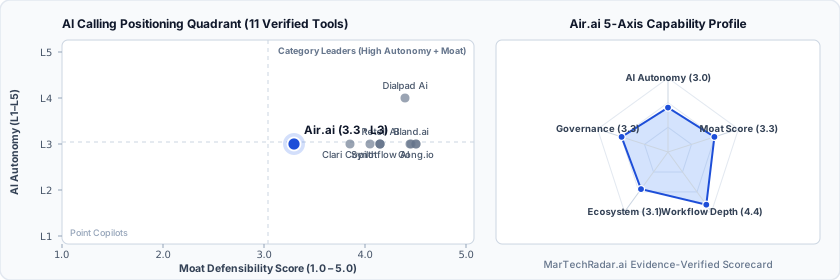
Air.ai in-depth review, pricing & architecture analysis
Editor sign-off: Oct 14, 2026. How profiles are made.
What is Air.ai? Overview & background
Established in 2022 in Arlington, VA, Air.ai addresses the throughput bottlenecks of human-staffed call centers by deploying autonomous voice agents capable of handling complex phone conversations. Directed at revenue operations leads, enterprise contact center directors, and high-velocity acquisition teams, the platform replaces manual dialer queues with software-driven outbound calling and automated inbound triage. Operating within the conversational voice calling agent domain, the system enables continuous telephonic outreach without linear human headcount expansion.
How Air.ai works: architecture & workflow
Operating at an L3 autonomy tier, Air.ai couples low-latency streaming automatic speech recognition, generative language model inference, and neural text-to-speech synthesis into a unified audio-processing pipeline. Incoming audio packets are parsed via full-duplex WebRTC or SIP trunks to track vocal inflections and acoustic pauses. The orchestration engine maintains conversational state across extended dialogue turns, handling mid-sentence prospect interruptions, dynamic objection trees, and CRM-synced call disposition actions without human operator intervention.
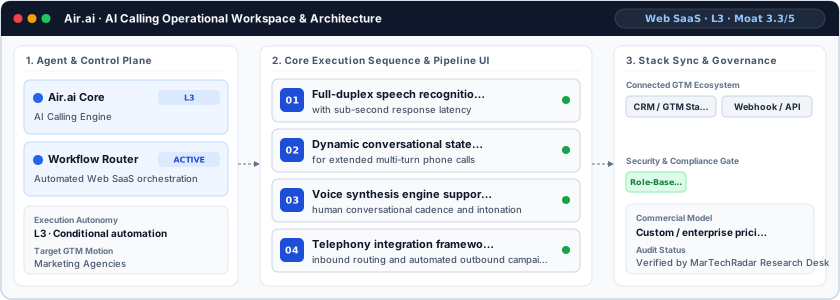
Air.ai limitations, drawbacks & risks
Operational considerations and platform boundaries include:
- Telephony Latency and Network Jitter: Packet loss or transport lag on standard PSTN connections occasionally degrades turn-taking synchronization, triggering accidental conversational collisions.
- Deterministic Branching Drift: Open-domain LLM generation paths risk semantic deviation from compliance scripts during complex multi-part regulatory disclosures.
- Integration and State Reconciliation Lag: Asynchronous bi-directional CRM record updates can lead to duplicate outbound dials during rapid pipeline ingestion bursts.
Air.ai pricing, plans & cost breakdown
Commercial pricing is available on request through tailored enterprise sales quotes based on organizational scale and seats. Contracts typically balance committed platform access fees with consumed voice minute volume across active telephony channels. Deployments also require technical provisioning for enterprise telephony trunking and dedicated carrier line configurations.
| Plan / Tier | Verified Price & Billing | Included Scope & Contract Terms |
|---|---|---|
| Enterprise / Custom | Custom quote | Custom-quoted plan; terms come from the vendor's sales team. |
How Air.ai compares vs. competitors & alternatives
Compared to Bland.ai's developer-first API architecture and Consio's structured conversational workflows, Air.ai prioritizes pre-configured call center operations designed for immediate SDR automation within the AI Calling segment. Dialpad Ai incorporates voice intelligence alongside human agents, whereas Air.ai replaces the operator during direct calls. The solution fits mid-market and enterprise organizations running high-volume outbound lead qualification and inbound customer support operations.
Direct competitors & market radar
Top algorithmic competitors based on category positioning, capability overlap, and ICP alignment.
Frequently asked questions about Air.ai
Does Air.ai publish pricing or require an enterprise quote?
Air.ai pricing: Custom / enterprise pricing. No free plan is publicly disclosed. Commercial pricing is available on request through tailored enterprise sales quotes based on organizational scale and seats.
What are the top Air.ai alternatives in AI Calling?
Verified AI Calling alternatives include Soona ($13–$149/mo), Mailshake (From $12/mo), Invoca (Custom / enterprise pricing), Thoughtly (Usage-based pricing). Compared to Bland.ai's developer-first API architecture and Consio's structured conversational workflows, Air.ai prioritizes pre-configured call center operations designed for immediate SDR automation within the AI Calling segment.
What are the main limitations and trade-offs of Air.ai?
Operational considerations and platform boundaries include: Telephony Latency and Network Jitter: Packet loss or transport lag on standard PSTN connections occasionally degrades turn-taking synchronization, triggering accidental conversational collisions. Walk away if you need published self-serve pricing: Air.ai is sold by custom quote.
Verified sources & evidence trail
- Official product domain: https://air.ai
- Commercial pricing verification: Verified against official vendor pricing policy (Custom / enterprise pricing)
- Verified corporate entity profiles (
sameAs): LinkedIn Company Profile · Crunchbase Entity Record - First-party governance & documentation links: Privacy
- Editor sign-off: Oct 14, 2026 (how profiles are made).
