Dialpad Ai Review (2026): AI Calling Pricing, Limits & Alternatives
Bottom line
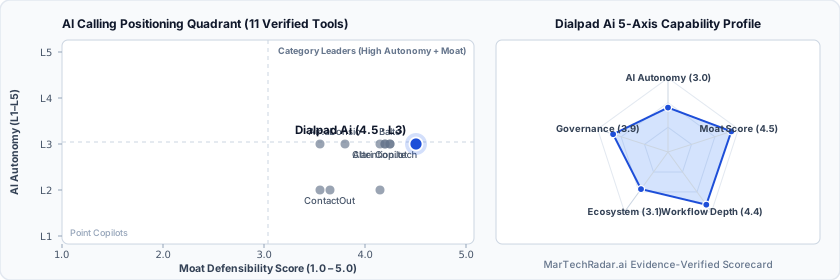
Dialpad Ai is a Web SaaS tool for AI Calling (Conversational Voice Calling Agents) in AI SDR & Outbound. Pricing: $15–$25/seat/mo · Enterprise plan. Best suited to B2B SaaS, DTC / eCommerce and Enterprise Brands. Editor ratings: AI autonomy L3 (conditional automation); moat score 4.5/5.0 (Proprietary moat (category leader)). Fact-checked by Jiacky Lee on Oct 11, 2026.
Cloud-native unified communications and contact center platform providing real-time speech recognition, live agent coaching, and automated call summaries.
Dialpad Ai buyer fit verdict: when to choose vs. when to walk away
Choose Dialpad Ai if (Best Fit)
- Target ICP & Stack Fit: You operate as B2B SaaS, DTC / eCommerce and Enterprise Brands requiring a Web SaaS deployment for AI Calling.
- L3 Architecture & Defensibility: Proprietary real-time automatic speech recognition and conversational NLP models trained on billions of voice minutes, tightly integrated into a carrier-grade global telecom telephony mesh.
- Commercial Model Fit: Your procurement budget aligns with $15–$25/seat/mo · Enterprise plan.
Walk away from Dialpad Ai if (Deal-Breakers)
- Walk away if your workflow requires uncapped enterprise volume on the $15–$25/seat/mo · Enterprise plan entry plan without upgrading tiers.
- Walk away if your workflow cannot tolerate acoustic transcription degradation: High ambient background noise and packet loss over degraded cellular SIP links noticeably increase word error rates across domain-specific jargon.
- Walk away if telephony latency overhead is a deal-breaker for your team: Chaining real-time transcription, LLM intent parsing, and synthetic voice generation can introduce perceptible conversational latency during complex branching turns.
Dialpad Ai key facts & scorecard
| Pricing | $15–$25/seat/mo · Enterprise planVendor pricing page |
|---|---|
| Free plan | No / not disclosed |
| Delivery | Web SaaS |
| Audience | B2B SaaS, DTC / eCommerce, Enterprise Brands |
| AI autonomy level | L3 · Conditional automationEditor-verified |
| Moat tier & score | 4.5 / 5.0 · Proprietary moat (category leader)Editor-verified |
| Funding | Series C+ |
| Total funding | $450MBacked by ICONIQ Capital, SoftBank, Andreessen Horowitz |
| Founders | Alex Cornell, Brian Peterson, Craig Walker, John Rector |
| Company size | 1,001-5,000 employees |
| Governance & docs | Trust & Security ↗ · System Status ↗ · Changelog ↗ |
| Headquarters | San Ramon, California |
| Founded | 2011 |
| Last verified |
Dialpad Ai pros & cons: strengths vs. operational limitations
Pros: core strengths & capabilities
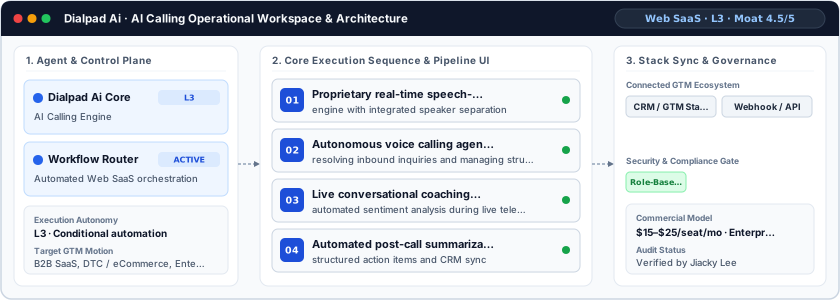
- Proprietary real-time speech-to-text transcription: engine with integrated speaker separation
- Autonomous voice calling agents: resolving inbound inquiries and managing structured workflows
- Live conversational coaching and: automated sentiment analysis during live telephony sessions
- Automated post-call summarization capturing: structured action items and CRM sync
Cons: operational limitations & risks
- Acoustic transcription degradation: High ambient background noise and packet loss over degraded cellular SIP links noticeably increase word error rates across domain-specific jargon.
- Telephony latency overhead: Chaining real-time transcription, LLM intent parsing, and synthetic voice generation can introduce perceptible conversational latency during complex branching turns.
- Custom taxonomy maintenance: Maintaining dynamic entity recognition schemas for specialized product catalogs requires ongoing manual prompt tuning and dictionary configuration.
Dialpad Ai TCO & deal-breaker stress test
Simulate 12-month stepped TCO, hidden cost multipliers, contract lock-in exposure, and stack failure modes using only facts verified by Jiacky Lee on · Capture SHA 8f497fc4.
Dialpad Ai aligns with your 5-seat / $800/mo profile. Review the walk-away triggers and contract levers below before deployment.
| Plan / Tier | Verified Rate | Scale Fit | Scope & Quota Notes |
|---|---|---|---|
| Entry / Starter | $15/seat/mo | 1–2 seats | Verified $15/seat/mo published rate on vendor pricing schedule. |
| Growth / Professional | $25/seat/mo | 5 seats | Verified $25/seat/mo published rate on vendor pricing schedule. |
| Enterprise / Custom | Custom quote | 15–50+ seats (Enterprise SLA) | Sales-negotiated annual contract for custom volume, SSO/RBAC governance, and dedicated SLA. |
- Moat Score
- 4.5 / 5.0
- AI Autonomy
- L3
- Free Tier / Trial
- None disclosed
Triggered audit signals & failure modes
- Published Self-Serve Entry FloorVerified Pricing Ledger
Dialpad Ai publishes a transparent entry point ($15–$25/seat/mo · Enterprise plan) for initial validation before committing.
- Linear Per-Seat Scaling (5 Seats × $15/seat/mo)Commercial Model Audit
Base license scales linearly with operator headcount ($75/mo for 5 seats on Entry / Starter).
- Primary Operational Bottleneck: Acoustic transcription degradationAudit by Jiacky Lee
High ambient background noise and packet loss over degraded cellular SIP links noticeably increase word error rates across domain-specific jargon.
Hidden TCO Multipliers & Quota Gates
- Per-Seat Linear Scaling: Dialpad Ai prices licenses on a per-user/seat basis ($15–$25/seat/mo · Enterprise plan); expanding from 2 to 15+ operators multiplies base recurring spend linearly.
- Annual Billing Headline vs. Monthly Premium: Headline entry rates reflect annual billing commitments; month-to-month flexibility carries a higher effective monthly rate or requires annual prepayment.
When to Walk Away & Negotiation Levers
- Walk away if your workflow requires uncapped enterprise volume on the $15–$25/seat/mo · Enterprise plan entry plan without upgrading tiers.
- Walk away if your workflow cannot tolerate acoustic transcription degradation: High ambient background noise and packet loss over degraded cellular SIP links noticeably increase word error rates across domain-specific jargon.
- Walk away if telephony latency overhead is a deal-breaker for your team: Chaining real-time transcription, LLM intent parsing, and synthetic voice generation can introduce perceptible conversational latency during complex branching turns.
- Validate exact quota thresholds (seats, credits, or API calls) included in Dialpad Ai's $15–$25/seat/mo · Enterprise plan tier before converting from monthly to annual billing.
- Require a sandbox proof-of-concept testing acoustic transcription degradation against your live CRM/data schema before annual sign-off.
Ask a custom procurement or TCO stress-test question about Dialpad Ai
Fits within $800/mo budget (Free plan · $299/mo · Enterprise plan)
Verified AI Calling peer (From $0.10/mo · Moat 3.8/5.0)
Dialpad Ai moat & subtrack positioning
Proprietary real-time automatic speech recognition and conversational NLP models trained on billions of voice minutes, tightly integrated into a carrier-grade global telecom telephony mesh.
Editorial review
Fact-checked by Jiacky Lee (Managing Editor, AI Autonomy & Moat Methodology) on .
Background
Established in 2011 in San Ramon, California, Dialpad Ai represents a unified cloud communications architecture built to decouple business voice from legacy private branch exchange hardware. Backed by $450M in total venture capital funding, the company targets contact center directors and enterprise revenue operations leaders requiring embedded artificial intelligence within real-time telephony. The platform consolidates unified communications as a service and contact center operations into a centralized, programmable media mesh designed for automated conversational voice call workflows.
How Dialpad Ai works
At its technical core, Dialpad Ai deploys a proprietary dual-channel automatic speech recognition pipeline optimized for sub-second telephony stream ingestion via WebRTC and SIP trunking. Inbound audio streams are processed using neural transcription models that generate live utterance tokens, feeding natural language understanding and large language models for real-time sentiment scoring and intent recognition. The L3 autonomous agent engine evaluates conversational states against enterprise rule trees, executing real-time call dispositioning and trigger-based CRM data writebacks without human latency.
Limitations
Operational considerations and platform boundaries include:
- Acoustic transcription degradation: High ambient background noise and packet loss over degraded cellular SIP links noticeably increase word error rates across domain-specific jargon.
- Telephony latency overhead: Chaining real-time transcription, LLM intent parsing, and synthetic voice generation can introduce perceptible conversational latency during complex branching turns.
- Custom taxonomy maintenance: Maintaining dynamic entity recognition schemas for specialized product catalogs requires ongoing manual prompt tuning and dictionary configuration.
Dialpad Ai pricing
Dialpad Ai structures its licensing on a tiered per-seat subscription. Standard entry tiers run at $15 per user per month billed annually, while expanded operational tiers scale to $25 per user per month billed annually. Enterprise deployments require custom agreements to provision advanced autonomous voice agent allowances, custom API throughput, and carrier trunking volume.
How Dialpad Ai compares
Relative to developer-first conversational voice engines like Bland.ai, enterprise orchestrators like Parloa, and virtual agent platforms like Consio, Dialpad Ai prioritizes native telephony infrastructure over pure API headless flexibility. While Bland.ai provides raw latency tuning for programmatic outbound flows, Dialpad Ai delivers a production-ready operational console with built-in supervision. It is optimal for enterprises requiring integrated contact center workflows alongside automated calling.
Direct competitors & market radar
Top algorithmic competitors based on category positioning, capability overlap, and ICP alignment.
Frequently asked questions about Dialpad Ai
How much does Dialpad Ai cost per seat and does it have a free plan?
Published pricing summary for Dialpad Ai: $15–$25/seat/mo · Enterprise plan. A permanent free plan is not disclosed for Dialpad Ai. Verified tier schedule: Entry / Starter ($15/seat/mo for 1–2 seats); Growth / Professional ($25/seat/mo for 5 seats); Enterprise / Custom (Custom quote for 15–50+ seats (Enterprise SLA)). Dialpad Ai structures its licensing on a tiered per-seat subscription. Standard entry tiers run at $15 per user per month billed annually, while expanded operational tiers scale to $25 per user per month billed annually.
How does Dialpad Ai work and how autonomous is its AI architecture?
Cloud-native unified communications and contact center platform providing real-time speech recognition, live agent coaching, and automated call summaries. Within AI Calling (Conversational Voice Calling Agents), MarTechRadar rates its execution architecture at L3 · Conditional automation with a verified Moat Score of 4.5 / 5.0 (Proprietary moat (category leader)). Proprietary real-time automatic speech recognition and conversational NLP models trained on billions of voice minutes, tightly integrated into a carrier-grade global telecom telephony mesh. Corporate profile: Founded by Alex Cornell, Brian Peterson, Craig Walker, John Rector, operating at 1,001-5,000 employees scale.
What are the main limitations of Dialpad Ai and when should buyers walk away?
Based on our editorial technical audit, key operational considerations and boundaries for Dialpad Ai include: (1) Acoustic transcription degradation: High ambient background noise and packet loss over degraded cellular SIP links noticeably increase word error rates across domain-specific jargon. (2) Telephony latency overhead: Chaining real-time transcription, LLM intent parsing, and synthetic voice generation can introduce perceptible conversational latency during complex branching turns. (3) Custom taxonomy maintenance: Maintaining dynamic entity recognition schemas for specialized product catalogs requires ongoing manual prompt tuning and dictionary configuration. Primary procurement walk-away rule: Walk away if your workflow requires uncapped enterprise volume on the $15–$25/seat/mo · Enterprise plan entry plan without upgrading tiers.
What integrations, compliance certifications, and contract terms apply to Dialpad Ai?
First-party governance and developer endpoints verified on domain include: Trust/Security (https://www.dialpad.com/jp/trust), Status (https://status.dialpad.com). Key TCO multiplier to watch: Per-Seat Linear Scaling (Dialpad Ai prices licenses on a per-user/seat basis ($15–$25/seat/mo · Enterprise plan); expanding from 2 to 15+ operators multiplies base recurring spend linearly.) Before signing a contract, procurement teams should validate exact quota thresholds (seats, credits, or API calls) included in Dialpad Ai's $15–$25/seat/mo · Enterprise plan tier before converting from monthly to annual billing.
What are the best Dialpad Ai alternatives and head-to-head competitors in 2026?
Top fact-checked alternatives to Dialpad Ai in AI Calling (Conversational Voice Calling Agents) include Bland.ai (Free plan · $299/mo · Enterprise plan), Consio (From $0.10/mo), Clari Copilot (Custom / enterprise pricing), Gong.io (Custom / enterprise pricing). Relative to developer-first conversational voice engines like Bland.ai, enterprise orchestrators like Parloa, and virtual agent platforms like Consio, Dialpad Ai prioritizes native telephony infrastructure over pure API headless flexibility.
Verified sources & evidence trail
- Official product domain: https://dialpad.com
- Commercial pricing verification: https://www.dialpad.com/pricing/
- Verified corporate entity profiles (
sameAs): LinkedIn Company Profile · Crunchbase Entity Record - First-party governance & documentation links: Trust & Security · System Status · Changelog
- Editorial audit sign-off: Fact-checked by Jiacky Lee on under the MarTechRadar Evidence-Ledger Protocol.