Attention.tech Review (2026): AI Calling Pricing, Pros & Cons
Bottom line
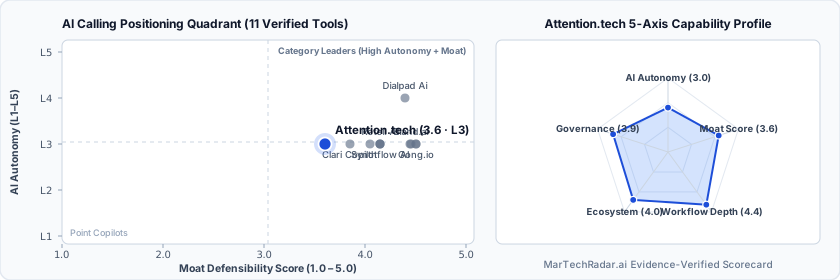
Attention.tech is a Web SaaS tool for AI Calling (Conversational Voice Calling Agents) in AI SDR & Outbound. Pricing: Custom / enterprise pricing. Best suited to B2B SaaS. Editor ratings: AI autonomy L3 (conditional automation); moat score 3.6/5.0 (Proprietary moat). Fact-checked by MarTechRadar Research Desk on Oct 14, 2026.
Attention.tech delivers conversational voice intelligence agents that transcribe sales interactions and automate downstream CRM pipeline hygiene.
Is Attention.tech worth it in 2026? Buyer fit & when to walk away
Choose Attention.tech if (Best Fit)
- Target ICP & Stack Fit: You operate as B2B SaaS requiring a Web SaaS deployment for AI Calling, with verified ecosystem connectivity for Microsoft Teams, Zoom.
- L3 Architecture & Defensibility: Proprietary semantic extraction workflows tuned to revenue vocabulary combined with automated bidirectional CRM synchronization pipelines.
- Commercial Model Fit: Your procurement budget aligns with Custom / enterprise pricing.
Walk away from Attention.tech if (Deal-Breakers)
- Walk away if you need published self-serve pricing: Attention.tech is sold by custom quote.
- Walk away if your workflow cannot tolerate schema drift vulnerability: Arbitrary additions of custom CRM validation rules frequently trigger silent synchronization failures that require administrative remediation.
- Walk away if multi-speaker diarization dropouts is a deal-breaker for your team: Dense cross-talk or degraded peripheral audio feeds cause speaker misattribution, distorting conversational sentiment and buyer intent tracking.
Attention.tech pricing, free plan & scorecard at a glance
| Pricing | Custom / enterprise pricing |
|---|---|
| Free plan | No / not disclosed |
| Delivery | Web SaaS |
| Audience | B2B SaaS |
| AI autonomy level | L3 · Conditional automationEditor-verified |
| Moat tier & score | 3.6 / 5.0 · Proprietary moatEditor-verified |
| Funding | Venture-backed |
| Total funding | $50.3M |
| Founders | Anis Bennaceur, Matthias Wickenburg |
| Company size | 51-200 employees |
| Ecosystem integrations | Microsoft Teams, Zoom |
| Headquarters | New York |
| Founded | 2021 |
| Last verified | Oct 14, 2026 |
Attention.tech pros & cons: strengths vs. operational limitations
Pros: core strengths & capabilities
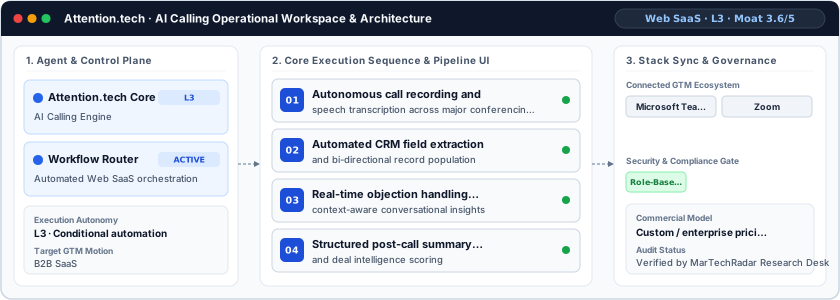
- Autonomous call recording and speech transcription across major conferencing protocols
- Automated CRM field extraction and bi-directional record population
- Real-time objection handling and context-aware conversational insights
- Structured post-call summary generation and deal intelligence scoring
Cons: operational limitations & risks
- Schema drift vulnerability: Arbitrary additions of custom CRM validation rules frequently trigger silent synchronization failures that require administrative remediation.
- Multi-speaker diarization dropouts: Dense cross-talk or degraded peripheral audio feeds cause speaker misattribution, distorting conversational sentiment and buyer intent tracking.
- Bot rejection constraints: Security controls and meeting lobby policies at regulated enterprise targets often reject passive recording bots, blocking upstream data ingestion.
Attention.tech TCO & deal-breaker stress test
Simulate 12-month stepped TCO, hidden cost multipliers, contract lock-in exposure, and stack failure modes using only facts verified by MarTechRadar Research Desk on 2026-10-14.
Attention.tech triggers high-severity friction under your 5-seat / $800/mo constraints. Benchmark the verified subtrack alternatives below before committing.
- Moat Score
- 3.6 / 5.0
- AI Autonomy
- L3
- Free Tier / Trial
- None disclosed
Triggered audit signals & failure modes
- Opaque Enterprise Quoting vs. SMB/Mid-Market BudgetVerified Pricing Ledger
Attention.tech does not disclose a public self-serve floor (Custom / enterprise pricing). Buyers with a $800/mo cap face high sales-qualification friction.
- Sales-Gated Contract TermsFact-checked by MarTechRadar Research Desk
Attention.tech distributes its software through a direct enterprise licensing model. Commercial pricing is available on request through tailored enterprise sales quotes based on organizational scale and seats.
- Primary Operational Bottleneck: Schema drift vulnerabilityAudit by MarTechRadar Research Desk
Arbitrary additions of custom CRM validation rules frequently trigger silent synchronization failures that require administrative remediation.
Test a custom Attention.tech budget or stack constraint
Lower 5-seat floor (~$299/mo vs. Custom Quote) · Transparent self-serve entry without mandatory annual lock-in
Lower 5-seat floor (~$75/mo vs. Custom Quote) · Transparent self-serve entry without mandatory annual lock-in
Attention.tech integrations, API, security & compliance stack
Attention.tech AI moat & AI Calling positioning
Proprietary semantic extraction workflows tuned to revenue vocabulary combined with automated bidirectional CRM synchronization pipelines.
Attention.tech in-depth review, pricing & architecture analysis
Editor sign-off: Oct 14, 2026. How profiles are made.
What is Attention.tech? Overview & background
Established in 2021 and headquartered in New York, Attention.tech was engineered to address a persistent revenue operations bottleneck: the chronic loss of commercial pipeline data caused by manual representative notes. With $50.3M in venture funding, the company targets enterprise sales directors and revenue operations leaders who require systematic, high-fidelity capture of spoken customer signals. In modern pipeline governance, Attention.tech functions as a specialized voice intelligence engine that extracts transaction variables directly from voice and video calls.
How Attention.tech works: architecture & workflow
Technically, the platform acts at an intermediate automation tier by orchestrating recording bots across conference systems such as Zoom, Microsoft Teams, and Google Meet. Audio streams are captured via secure WebSockets and processed through low-latency speech recognition pipelines. Fine-tuned large language models parse the transcript text against enterprise CRM schemas, identifying structured fields including budget authority, timelines, and competitor mentions. The system then writes normalized JSON payloads back into target databases like Salesforce and HubSpot without representative input.
Attention.tech limitations, drawbacks & risks
Operational considerations and platform boundaries include:
- Schema drift vulnerability: Arbitrary additions of custom CRM validation rules frequently trigger silent synchronization failures that require administrative remediation.
- Multi-speaker diarization dropouts: Dense cross-talk or degraded peripheral audio feeds cause speaker misattribution, distorting conversational sentiment and buyer intent tracking.
- Bot rejection constraints: Security controls and meeting lobby policies at regulated enterprise targets often reject passive recording bots, blocking upstream data ingestion.
Attention.tech pricing, plans & cost breakdown
Attention.tech distributes its software through a direct enterprise licensing model. Commercial pricing is available on request through tailored enterprise sales quotes based on organizational scale and seats. Deployments typically require annual subscription commitments tailored to representative volume, technical support tiers, and integration requirements. Production instances incorporate governance baselines, security compliance certifications, and dedicated solutions engineering support for initial CRM field mapping.
| Plan / Tier | Verified Price & Billing | Included Scope & Contract Terms |
|---|---|---|
| Enterprise / Custom | Custom quote | Custom-quoted plan; terms come from the vendor's sales team. |
How Attention.tech compares vs. competitors & alternatives
Within the voice automation landscape, Attention.tech maintains a distinct tactical posture compared to infrastructure-first platforms like Bland.ai, conversational engines like Consio, and legacy unified communication suites like Dialpad Ai. While Bland.ai prioritizes programmatic telephony automation via raw developer APIs, Attention.tech focuses on post-call CRM ingestion. Conversely, Dialpad Ai treats speech intelligence as an extension of internal telephony hardware. Attention.tech matches mid-market to enterprise revenue organizations demanding automated CRM record precision without deploying complex telephonic scripts.
Frequently asked questions about Attention.tech
Does Attention.tech publish pricing or require an enterprise quote?
Attention.tech pricing: Custom / enterprise pricing. No free plan is publicly disclosed. Attention.tech distributes its software through a direct enterprise licensing model. Commercial pricing is available on request through tailored enterprise sales quotes based on organizational scale and seats.
What are the top Attention.tech alternatives in AI Calling?
Verified AI Calling alternatives include Superleap (Custom / enterprise pricing), Fathom Video (Custom / enterprise pricing), Phonely AI (Custom / enterprise pricing), Kaspr (Custom / enterprise pricing). Within the voice automation landscape, Attention.tech maintains a distinct tactical posture compared to infrastructure-first platforms like Bland.ai, conversational engines like Consio, and legacy unified communication suites like Dialpad Ai.
What are the main limitations and trade-offs of Attention.tech?
Operational considerations and platform boundaries include: Schema drift vulnerability: Arbitrary additions of custom CRM validation rules frequently trigger silent synchronization failures that require administrative remediation. Walk away if you need published self-serve pricing: Attention.tech is sold by custom quote.
Verified sources & evidence trail
- Official product domain: https://attention.tech
- Commercial pricing verification: Verified against official vendor pricing policy (Custom / enterprise pricing)
- Verified corporate entity profiles (
sameAs): LinkedIn Company Profile · Crunchbase Entity Record - Editor sign-off: Oct 14, 2026 (how profiles are made).
