Synthflow AI Review (2026): AI Calling Pricing, Pros & Cons
Bottom line
Synthflow AI is a Web SaaS tool for AI Calling (Conversational Voice Calling Agents) in AI SDR & Outbound. Pricing: From $30,000/yr. Best suited to B2B SaaS. Editor ratings: AI autonomy L3 (conditional automation); moat score 4.1/5.0 (Proprietary moat). Fact-checked by MarTechRadar Research Desk on Oct 15, 2026.
No-code enterprise voice AI platform that automates inbound customer service and outbound phone outreach via real-time speech orchestration and native.
Is Synthflow AI worth it in 2026? Buyer fit & when to walk away
Choose Synthflow AI if (Best Fit)
- Target ICP & Stack Fit: You operate as B2B SaaS requiring a Web SaaS deployment for AI Calling, with verified ecosystem connectivity for Salesforce, HubSpot, Zapier.
- L3 Architecture & Defensibility: Synthflow AI pairs a no-code visual workflow orchestrator with high-concurrency telephony infrastructure, lowering development barriers for non-technical operations teams while maintaining low latency across sub-second speech pipelines.
- Commercial Model Fit: Your procurement budget aligns with From $30,000/yr.
Walk away from Synthflow AI if (Deal-Breakers)
- Walk away if your workflow cannot tolerate telephony latency jitter: Network hops across third-party SIP providers and distributed LLM inference points can generate conversational turn-taking latency, causing occasional voice collisions.
- Walk away if deterministic fallback failures is a deal-breaker for your team: Unexpected acoustic noise or non-linear customer interjections can bypass the visual logic tree, requiring strict human operator transfer fallbacks.
Synthflow AI pricing, free plan & scorecard at a glance
| Pricing | From $30,000/yrVendor pricing page |
|---|---|
| Free plan | No / not disclosed |
| Delivery | Web SaaS |
| Audience | B2B SaaS |
| AI autonomy level | L3 · Conditional automationEditor-verified |
| Moat tier & score | 4.1 / 5.0 · Proprietary moatEditor-verified |
| Funding | Venture-backed |
| Total funding | $29M |
| Founders | Hakob Astabatsyan |
| Company size | 51-200 employees |
| Ecosystem integrations | Salesforce, HubSpot, Zapier |
| Compliance & governance | SOC 2, GDPR, HIPAA |
| Governance & docs | System Status ↗ · API & Docs ↗ · Changelog ↗ · Privacy ↗ |
| Headquarters | Berlin, DE |
| Founded | 2023 |
| Last verified | Oct 15, 2026 |
Synthflow AI pros & cons: strengths vs. operational limitations
Pros: core strengths & capabilities
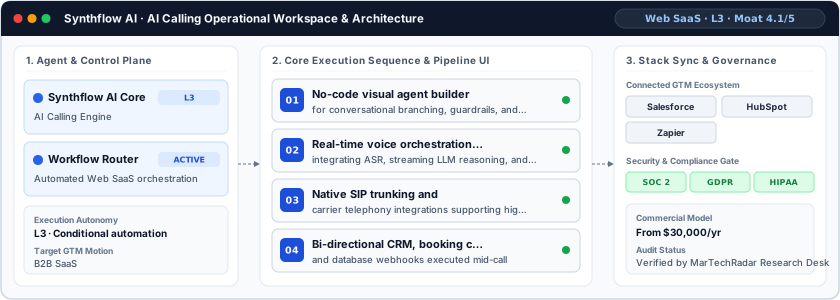
- No-code visual agent builder: for conversational branching, guardrails, and deterministic logic
- Real-time voice orchestration pipeline: integrating ASR, streaming LLM reasoning, and neural TTS
- Native SIP trunking and carrier telephony integrations supporting high concurrent call volumes
- Bi-directional CRM, booking calendar, and database webhooks executed mid-call
Cons: operational limitations & risks
- Telephony Latency Jitter: Network hops across third-party SIP providers and distributed LLM inference points can generate conversational turn-taking latency, causing occasional voice collisions.
- Deterministic Fallback Failures: Unexpected acoustic noise or non-linear customer interjections can bypass the visual logic tree, requiring strict human operator transfer fallbacks.
- Webhook Execution Delays: Mid-call API lookups for CRM and calendar records suffer degradation if third-party endpoints fail to return responses within sub-second thresholds.
Synthflow AI TCO & deal-breaker stress test
Simulate 12-month stepped TCO, hidden cost multipliers, contract lock-in exposure, and stack failure modes using only facts verified by MarTechRadar Research Desk on 2026-10-15 · Capture SHA 92fefb23.
Synthflow AI triggers high-severity friction under your 5-seat / $800/mo constraints. Benchmark the verified subtrack alternatives below before committing.
- Moat Score
- 4.1 / 5.0
- AI Autonomy
- L3
- Free Tier / Trial
- None disclosed
Triggered audit signals & failure modes
- Budget Ceiling Breached ($2,500/mo vs. $800/mo cap)Verified Pricing Ledger
At 5 seats, Synthflow AI's verified entry floor (From $30,000/yr) exceeds your $800/mo budget before add-ons or overages.
- Annual Contract Lock-in Risk DetectedFact-checked by MarTechRadar Research Desk
Synthflow AI licenses its platform under dedicated enterprise contracts structured around operational scale.
- Primary Operational Bottleneck: Telephony Latency JitterAudit by MarTechRadar Research Desk
Network hops across third-party SIP providers and distributed LLM inference points can generate conversational turn-taking latency, causing occasional voice collisions.
Test a custom Synthflow AI budget or stack constraint
Lower 5-seat floor (~$299/mo vs. $30,000 / yr upfront) · Transparent self-serve entry without mandatory annual lock-in
Lower 5-seat floor (~$500/mo vs. $30,000 / yr upfront) · Transparent self-serve entry without mandatory annual lock-in
Synthflow AI integrations, API, security & compliance stack
Synthflow AI AI moat & AI Calling positioning
Synthflow AI pairs a no-code visual workflow orchestrator with high-concurrency telephony infrastructure, lowering development barriers for non-technical operations teams while maintaining low latency across sub-second speech pipelines.
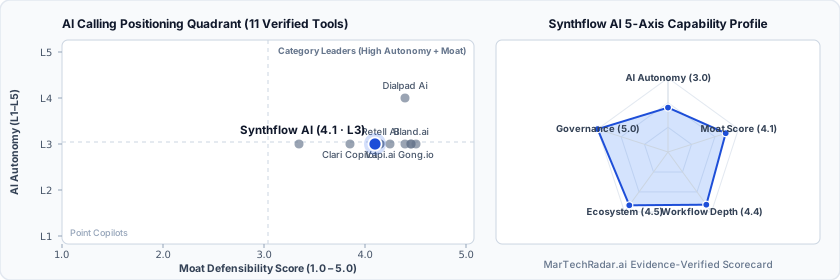
Synthflow AI in-depth review, pricing & architecture analysis
Editor sign-off: Oct 15, 2026. How profiles are made.
What is Synthflow AI? Overview & background
Established in 2023 in Berlin, DE, Synthflow AI entered the conversational automation sector backed by $29M in total venture capital funding. The platform provides an enterprise voice automation system tailored for contact center executives, sales operations leaders, and revenue teams seeking to deploy conversational voice calling agents. By pairing a visual flow designer with robust speech infrastructure, Synthflow AI eliminates custom backend development, enabling organizations to handle inbound qualification, appointment booking, and customer triaging across standard telecommunication channels.
How Synthflow AI works: architecture & workflow
At the operational layer, the platform functions at an L3 autonomy tier, executing bidirectional telephone conversations with human-in-the-loop escalation paths. The runtime pipeline coordinates automated speech recognition (ASR), large language model reasoning, and neural text-to-speech (TTS) engines over WebRTC and SIP trunks. The visual logic builder translates branching conditional rules into dynamic prompts, allowing agents to query external REST APIs mid-conversation for CRM contact lookups or live calendar slot bookings before executing deterministic tool invocations, alongside native workflow integrations for Salesforce, HubSpot, and Zapier under verified SOC 2, GDPR, and HIPAA governance controls.
Synthflow AI limitations, drawbacks & risks
Operational considerations and platform boundaries include:
- Telephony Latency Jitter: Network hops across third-party SIP providers and distributed LLM inference points can generate conversational turn-taking latency, causing occasional voice collisions.
- Deterministic Fallback Failures: Unexpected acoustic noise or non-linear customer interjections can bypass the visual logic tree, requiring strict human operator transfer fallbacks.
- Webhook Execution Delays: Mid-call API lookups for CRM and calendar records suffer degradation if third-party endpoints fail to return responses within sub-second thresholds.
Synthflow AI pricing, plans & cost breakdown
Synthflow AI licenses its platform under dedicated enterprise contracts structured around operational scale. Commercial agreements start from $30000 per year, with final pricing scoped across allocated call volumes, concurrent line capacity, telephony infrastructure requirements, custom integrations, and SLA tiers. Deployments incorporate custom concurrency planning, routing architectures, native or BYO-SIP setups, and ongoing security provisions.
How Synthflow AI compares vs. competitors & alternatives
Synthflow AI competes against developer-centric conversational providers like Bland.ai, full-suite telephony systems like Dialpad Ai, and specialized voice providers like Consio within the AI Calling segment, and is frequently benchmarked by buyers against Vapi.ai. While Bland.ai targets software engineers through code-first API calls and raw programmatic prompts, Synthflow AI differentiates via its visual drag-and-drop workflow canvas for non-technical teams. Dialpad Ai provides broader unified communications across existing human contact centers, whereas Synthflow AI focuses on autonomous telephone execution for enterprise teams seeking turn-key voice automation. Teams evaluating verified options alongside Dialpad Ai and Bland.ai should weigh its workflow integration depth and contract structure against daily volume requirements.
Direct competitors & market radar
Top algorithmic competitors based on category positioning, capability overlap, and ICP alignment.
Frequently asked questions about Synthflow AI
How much does Synthflow AI cost in 2026?
Synthflow AI pricing: From $30,000/yr. No free plan is publicly disclosed. Synthflow AI licenses its platform under dedicated enterprise contracts structured around operational scale.
What are the top Synthflow AI alternatives in AI Calling?
Verified AI Calling alternatives include Bland.ai (Free plan · $299/mo · Enterprise plan), Vapi.ai (Usage-based pricing), Voiceflow (Custom / enterprise pricing), telli (Custom / enterprise pricing). Synthflow AI competes against developer-centric conversational providers like Bland.ai, full-suite telephony systems like Dialpad Ai, and specialized voice providers like Consio within the AI Calling segment, and is frequently benchmarked by buyers against Vapi.ai.
What are the main limitations and trade-offs of Synthflow AI?
Operational considerations and platform boundaries include: Telephony Latency Jitter: Network hops across third-party SIP providers and distributed LLM inference points can generate conversational turn-taking latency, causing occasional voice collisions. Walk away if your workflow cannot tolerate telephony latency jitter: Network hops across third-party SIP providers and distributed LLM inference points can generate conversational turn-taking latency, causing occasional voice collisions.
Verified sources & evidence trail
- Official product domain: https://synthflow.ai
- Commercial pricing verification: https://synthflow.ai/pricing
- Verified corporate entity profiles (
sameAs): LinkedIn Company Profile · Crunchbase Entity Record - First-party governance & documentation links: System Status · API & Docs · Changelog · Privacy
- Editor sign-off: Oct 15, 2026 (how profiles are made).
