Zapier Review (2026): Workflow Automation Pricing, Pros & Cons
Bottom line
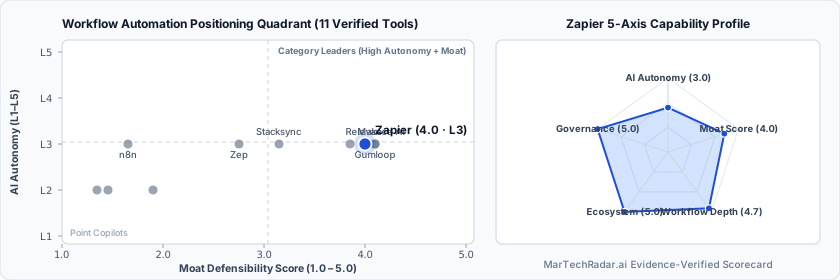
Zapier is a Web SaaS tool for Workflow Automation (No-Code Marketing Workflow Automation) in Agent & Marketing Ops. Pricing: Free plan · $19.99–$69/mo. Best suited to B2B SaaS, DTC / eCommerce and Enterprise Brands. Editor ratings: AI autonomy L3 (conditional automation); moat score 4.0/5.0 (Proprietary moat). Fact-checked by MarTechRadar Research Desk on Oct 6, 2026.
No-code automation and integration platform orchestrating multi-step workflows, agentic AI tasks, and data synchronization across thousands of SaaS apps.
Is Zapier worth it in 2026? Buyer fit & when to walk away
Choose Zapier if (Best Fit)
- Target ICP & Stack Fit: You operate as B2B SaaS, DTC / eCommerce and Enterprise Brands requiring a Web SaaS deployment for Workflow Automation, with verified ecosystem connectivity for Salesforce, HubSpot, Slack, Microsoft Teams.
- L3 Architecture & Defensibility: Substantial long-tail ecosystem of over 7,000 pre-built API connectors, robust workflow schema standardization, and established brand equity that creates high switching costs for business operational logic.
- Commercial Model Fit: Your procurement budget aligns with Free plan · $19.99–$69/mo and want a self-serve free tier for zero-cost initial validation.
Walk away from Zapier if (Deal-Breakers)
- Walk away if your workflow cannot tolerate high-volume payload latency: Event queues can encounter execution lag during enterprise-scale batch operations, making the platform unsuited for real-time sub-second transactional data streaming.
- Walk away if nested json schema brittleness is a deal-breaker for your team: Complex multi-object arrays and non-standard API responses often require manual JavaScript or Python code steps, negating pure visual workflow maintainability.
Zapier pricing, free plan & scorecard at a glance
| Pricing | Free plan · $19.99–$69/moVendor pricing page |
|---|---|
| Free plan | Yes |
| Delivery | Web SaaS |
| Audience | B2B SaaS, DTC / eCommerce, Enterprise Brands |
| AI autonomy level | L3 · Conditional automationEditor-verified |
| Moat tier & score | 4.0 / 5.0 · Proprietary moatEditor-verified |
| Funding | Seed |
| Total funding | $1.4MBacked by Sequoia Capital, Bessemer Venture Partners, SV Angel, Y Combinator, Launchbay Capital |
| Founders | Bryan Helmig, Mike Knoop, Wade Foster |
| Company size | 501-1,000 employees |
| Ecosystem integrations | Salesforce, HubSpot, Slack, Microsoft Teams, Twilio Segment, Model Context Protocol (MCP) |
| Compliance & governance | SOC 2, GDPR, CCPA |
| Governance & docs | API & Docs ↗ · Privacy ↗ |
| Headquarters | San Francisco, United States |
| Founded | 2011 |
| Last verified | Oct 6, 2026 |
Zapier pros & cons: strengths vs. operational limitations
Pros: core strengths & capabilities
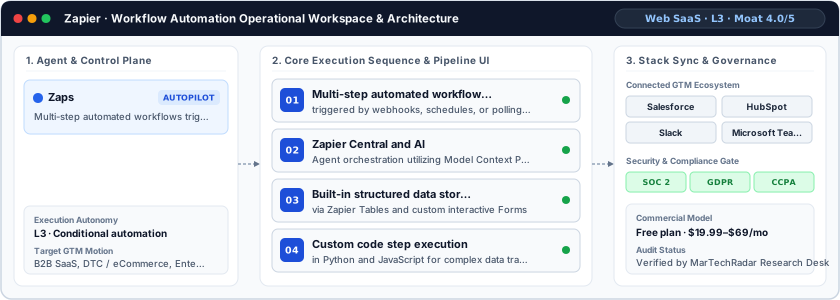
- Multi-step automated workflows (Zaps): triggered by webhooks, schedules, or polling events
- Zapier Central and AI: Agent orchestration utilizing Model Context Protocol (MCP)
- Built-in structured data storage: via Zapier Tables and custom interactive Forms
- Custom code step execution: in Python and JavaScript for complex data transformations
Cons: operational limitations & risks
- High-Volume Payload Latency: Event queues can encounter execution lag during enterprise-scale batch operations, making the platform unsuited for real-time sub-second transactional data streaming.
- Nested JSON Schema Brittleness: Complex multi-object arrays and non-standard API responses often require manual JavaScript or Python code steps, negating pure visual workflow maintainability.
- Downstream Rate Limit Propagation: Rapid execution loops can saturate third-party SaaS rate limits, creating task dropouts and requiring manual error-replay governance across large marketing pipelines.
Zapier TCO & deal-breaker stress test
Simulate 12-month stepped TCO, hidden cost multipliers, contract lock-in exposure, and stack failure modes using only facts verified by MarTechRadar Research Desk on 2026-10-06 · Capture SHA d89013bb.
Zapier aligns with your 5-seat / $800/mo profile. Review the walk-away triggers and contract levers below before deployment.
- Moat Score
- 4.0 / 5.0
- AI Autonomy
- L3
- Free Tier / Trial
- Free plan
Triggered audit signals & failure modes
- Published Self-Serve Entry FloorVerified Pricing Ledger
Zapier publishes a transparent entry point (Free plan · $19.99–$69/mo) with a free tier for initial validation before committing.
- Tier Fit for 5-Seat Scale: Team ($69/mo (annual))Verified Tier Schedule
25 users included, shared app connections, shared workspaces, and Premier Support.
- Primary Operational Bottleneck: High-Volume Payload LatencyAudit by MarTechRadar Research Desk
Event queues can encounter execution lag during enterprise-scale batch operations, making the platform unsuited for real-time sub-second transactional data streaming.
Test a custom Zapier budget or stack constraint
Lower 5-seat floor (~$12/mo vs. $69 / mo)
Lower 5-seat floor (~$37/mo vs. $69 / mo)
Zapier integrations, API, security & compliance stack
Multi-step automated workflows triggered by webhooks, schedules, or polling events
Zapier AI moat & Workflow Automation positioning
Substantial long-tail ecosystem of over 7,000 pre-built API connectors, robust workflow schema standardization, and established brand equity that creates high switching costs for business operational logic.
Zapier in-depth review, pricing & architecture analysis
Editor sign-off: Oct 6, 2026. How profiles are made.
What is Zapier? Overview & background
Headquartered in San Francisco, United States, Zapier was founded in 2011 on just $1.4M in seed capital, bootstrapping its way to software prominence by converting brittle point-to-point API integration into accessible visual logic. Built primarily for growth marketers, revenue operations specialists, and operational architects, the platform functions as an orchestration layer across commercial software. Rather than writing bespoke backend middleware, go-to-market teams use the platform to unify disconnected cloud tools without dedicated developer resources.
How Zapier works: architecture & workflow
Under the hood, Zapier operates an event-driven engine driven by webhook listeners and configurable polling cycles. When an external application emits a payload, the orchestration pipeline normalizes the incoming JSON, evaluates multi-path filter trees, and executes linear or branching actions across downstream endpoints. At Level 3 autonomy, the platform incorporates agentic reasoning via Zapier Tables, Forms, and Model Context Protocol (MCP) endpoints, allowing Large Language Model steps to parse unstructured payloads, execute conditional tool calls, and dynamically populate data schemas across connected SaaS environments, alongside native workflow integrations for Salesforce, HubSpot, Slack, and Microsoft Teams under verified SOC 2 Type II, GDPR, and CCPA governance controls.
Zapier limitations, drawbacks & risks
Operational considerations and platform boundaries include:
- High-Volume Payload Latency: Event queues can encounter execution lag during enterprise-scale batch operations, making the platform unsuited for real-time sub-second transactional data streaming.
- Nested JSON Schema Brittleness: Complex multi-object arrays and non-standard API responses often require manual JavaScript or Python code steps, negating pure visual workflow maintainability.
- Downstream Rate Limit Propagation: Rapid execution loops can saturate third-party SaaS rate limits, creating task dropouts and requiring manual error-replay governance across large marketing pipelines.
Zapier pricing, plans & cost breakdown
Commercial access is structured around task consumption tiers across automated workflows. A baseline free tier allows entry-level exploration, while standard commercial subscriptions scale from $19.99 to $69 per month based on allocated task counts, multi-step capabilities, and execution polling frequencies. Higher-volume deployments and specialized AI agent execution consume shared task pools, with enterprise agreements unlocking custom task quotas, single sign-on governance, and administrative oversight.
| Plan / Tier | Verified Price & Billing | Included Scope & Contract Terms | |
|---|---|---|---|
| Free | $0/mo | 100 tasks/mo across 2-step Zaps, Zapier Tables & Interfaces basics. | |
| Professional | $19.99/mo (annual) | Multi-step Zaps, webhooks, custom logic paths, and premium apps for 1 user. | |
| Team | $69/mo (annual) | 25 users included, shared app connections, shared workspaces, and Premier Support. | |
| Enterprise | Custom quote | Unlimited users, SAML SSO, granular admin permissions, annual task limits, and audit logs. | |
| Contract Watchout: Annual Billing Headline vs. Monthly Premium | The vendor pricing page advertises an annual-billing discount (Save 33%); month-to-month billing carries a higher effective monthly rate. | ||
How Zapier compares vs. competitors & alternatives
In contrast to specialized AI workflow builders like Gumloop, Cassidy AI, and Relevance AI—which prioritize complex chain-of-thought prompt graphs, vector extraction, and autonomous agent loops—Zapier retains its core advantage through its library of thousands of validated API endpoints within the Workflow Automation segment. While newer competitors provide deeper prompt chaining and unstructured data extraction natively, Zapier remains the operational choice for mid-market and enterprise operations teams prioritizing broad SaaS ecosystem coverage, reliable endpoint maintenance, and governance over experimental LLM orchestration.
Direct competitors & market radar
Top algorithmic competitors based on category positioning, capability overlap, and ICP alignment.
Frequently asked questions about Zapier
How much does Zapier cost in 2026?
Zapier pricing: Free plan · $19.99–$69/mo. A permanent free plan is available. Published tiers: Free ($0/mo); Professional ($19.99/mo (annual)); Team ($69/mo (annual)); Enterprise (Custom quote). Commercial access is structured around task consumption tiers across automated workflows.
What are the top Zapier alternatives in Workflow Automation?
Verified Workflow Automation alternatives include Workato (Free plan · $100/mo · Enterprise plan), Gumloop (From $37/mo), Relevance AI (Custom / enterprise pricing), Cassidy AI (Custom / enterprise pricing). In contrast to specialized AI workflow builders like Gumloop, Cassidy AI, and Relevance AI—which prioritize complex chain-of-thought prompt graphs, vector extraction, and autonomous agent loops—Zapier retains its core advantage through its library of thousands of validated API endpoints within the Workflow Automation segment.
What are the main limitations and trade-offs of Zapier?
Operational considerations and platform boundaries include: High-Volume Payload Latency: Event queues can encounter execution lag during enterprise-scale batch operations, making the platform unsuited for real-time sub-second transactional data streaming. Walk away if your workflow cannot tolerate high-volume payload latency: Event queues can encounter execution lag during enterprise-scale batch operations, making the platform unsuited for real-time sub-second transactional data streaming.
Verified sources & evidence trail
- Official product domain: https://zapier.com
- Commercial pricing verification: https://zapier.com/pricing
- Verified corporate entity profiles (
sameAs): LinkedIn Company Profile · Crunchbase Entity Record - First-party governance & documentation links: API & Docs · Privacy
- Editor sign-off: Oct 6, 2026 (how profiles are made).
