HubSpot Breeze Review (2026): Enterprise AI Marketing Pricing, Pros & Cons
Bottom line
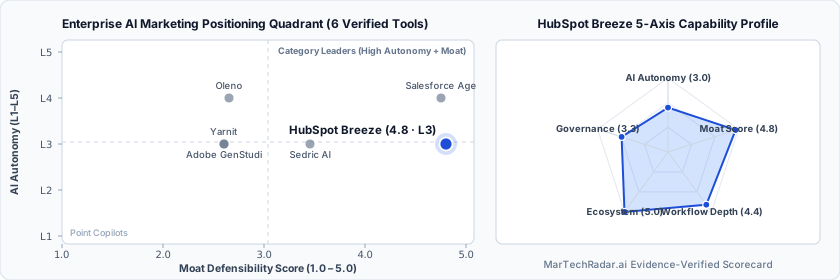
HubSpot Breeze is a Web SaaS tool for Enterprise AI Marketing (Enterprise Marketing OS & Ecosystem Agents) in Agent & Marketing Ops. Pricing: Custom / enterprise pricing. Best suited to B2B SaaS, DTC / eCommerce and Enterprise Brands. Editor ratings: AI autonomy L3 (conditional automation); moat score 4.8/5.0 (Proprietary moat (category leader)). Fact-checked by MarTechRadar Research Desk on Oct 12, 2026.
Embedded marketing and revenue AI agent layer natively integrated into the HubSpot Customer Platform for content, social, and operational orchestration.
Is HubSpot Breeze worth it in 2026? Buyer fit & when to walk away
Choose HubSpot Breeze if (Best Fit)
- Target ICP & Stack Fit: You operate as B2B SaaS, DTC / eCommerce and Enterprise Brands requiring a Web SaaS deployment for Enterprise AI Marketing, with verified ecosystem connectivity for Salesforce, Microsoft Teams, Twilio Segment, Amplitude.
- L3 Architecture & Defensibility: Deep structural integration into HubSpot's proprietary Smart CRM schema, coupled with pre-built multi-agent workflows across 300,000+ active platform tenants.
- Commercial Model Fit: Your procurement budget aligns with Custom / enterprise pricing and want a self-serve free tier for zero-cost initial validation.
Walk away from HubSpot Breeze if (Deal-Breakers)
- Walk away if you need published self-serve pricing: HubSpot Breeze is sold by custom quote.
- Walk away if your workflow cannot tolerate CRM data hygiene dependency: Agent accuracy degrades rapidly if foundational CRM properties exhibit missing lifecycles, duplicated contact objects, or fragmented historical touchpoints.
- Walk away if multi-tenant API consumption caps is a deal-breaker for your team: High-throughput operational enrichment and continuous generative batch runs encounter credit limits and platform throttling under high-velocity campaign execution.
HubSpot Breeze pricing, free plan & scorecard at a glance
| Pricing | Custom / enterprise pricingVendor pricing page |
|---|---|
| Free plan | Yes |
| Delivery | Web SaaS |
| Audience | B2B SaaS, DTC / eCommerce, Enterprise Brands |
| AI autonomy level | L3 · Conditional automationEditor-verified |
| Moat tier & score | 4.8 / 5.0 · Proprietary moat (category leader)Editor-verified |
| Funding | Public company |
| Total funding | Public companyBacked by Public |
| Ecosystem integrations | Salesforce, Microsoft Teams, Twilio Segment, Amplitude, Google Search Console, Atlassian Jira |
| Governance & docs | Trust & Security ↗ · API & Docs ↗ · Privacy ↗ |
| Headquarters | Cambridge, Massachusetts, United States |
| Founded | 2006 |
| Last verified | Oct 12, 2026 |
HubSpot Breeze pros & cons: strengths vs. operational limitations
Pros: core strengths & capabilities
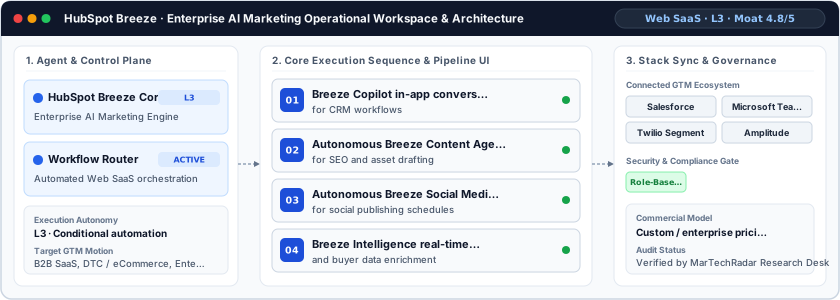
- Breeze Copilot in-app conversational assistant: for CRM workflows
- Autonomous Breeze Content Agent: for SEO and asset drafting
- Autonomous Breeze Social Media Agent: for social publishing schedules
- Breeze Intelligence real-time company and buyer data enrichment
Cons: operational limitations & risks
- CRM Data Hygiene Dependency: Agent accuracy degrades rapidly if foundational CRM properties exhibit missing lifecycles, duplicated contact objects, or fragmented historical touchpoints.
- Multi-Tenant API Consumption Caps: High-throughput operational enrichment and continuous generative batch runs encounter credit limits and platform throttling under high-velocity campaign execution.
- Cross-Ecosystem Portability Constraints: Autonomous actions and logic graphs remain tightly bounded within HubSpot-hosted properties, limiting autonomous execution inside external operational databases.
HubSpot Breeze TCO & deal-breaker stress test
Simulate 12-month stepped TCO, hidden cost multipliers, contract lock-in exposure, and stack failure modes using only facts verified by MarTechRadar Research Desk on 2026-10-12 · Capture SHA de150192.
HubSpot Breeze is viable for 5 seats, but requires commercial or technical verification on the flagged items below.
- Moat Score
- 4.8 / 5.0
- AI Autonomy
- L3
- Free Tier / Trial
- Free plan
Triggered audit signals & failure modes
- Opaque Enterprise Quoting vs. SMB/Mid-Market BudgetVerified Pricing Ledger
HubSpot Breeze does not disclose a public self-serve floor (Custom / enterprise pricing). Buyers with a $800/mo cap face high sales-qualification friction.
- Published Self-Serve Entry FloorVerified Pricing Ledger
HubSpot Breeze publishes a transparent entry point (Custom / enterprise pricing) with a free tier for initial validation before committing.
- Primary Operational Bottleneck: Multi-Tenant API Consumption CapsAudit by MarTechRadar Research Desk
High-throughput operational enrichment and continuous generative batch runs encounter credit limits and platform throttling under high-velocity campaign execution.
Test a custom HubSpot Breeze budget or stack constraint
Lower 5-seat floor (~$220/mo vs. Custom Quote)
Lower 5-seat floor (~$300/mo vs. Custom Quote)
HubSpot Breeze integrations, API, security & compliance stack
HubSpot Breeze AI moat & Enterprise AI Marketing positioning
Deep structural integration into HubSpot's proprietary Smart CRM schema, coupled with pre-built multi-agent workflows across 300,000+ active platform tenants.
HubSpot Breeze in-depth review, pricing & architecture analysis
Editor sign-off: Oct 12, 2026. How profiles are made.
What is HubSpot Breeze? Overview & background
Established in 2006 in Cambridge, Massachusetts, United States, HubSpot introduced HubSpot Breeze as the native intelligence layer across its cloud ecosystem. Designed for growth-focused marketing leaders, revenue operations directors, and customer experience teams, Breeze embeds artificial intelligence directly into the central CRM substrate. Rather than deploying disconnected third-party assistants, organizations leverage Breeze to orchestrate cross-functional revenue workflows, automating routine generation tasks while synchronizing operational context across sales, marketing, and customer service teams.
How HubSpot Breeze works: architecture & workflow
At its architectural foundation, Breeze executes on top of the HubSpot Smart CRM data layer, converting structured object graphs, lifecycle stages, and historical behavioral events into contextual agent inputs. Operating at an L3 autonomy profile, Breeze employs specialized agent instances—including content creation and social orchestration agents—that synthesize cross-channel data to draft collateral, update lead profiles, and suggest intervention plays. The execution loop combines continuous CRM event triggers, automated record enrichment, and deterministic workflow rules with generative model endpoints, allowing agents to execute complex inbound tasks with bounded human verification, alongside native workflow integrations for Microsoft Teams, Google Search Console, Amplitude, and Jira.
HubSpot Breeze limitations, drawbacks & risks
Operational considerations and platform boundaries include:
- CRM Data Hygiene Dependency: Agent accuracy degrades rapidly if foundational CRM properties exhibit missing lifecycles, duplicated contact objects, or fragmented historical touchpoints.
- Multi-Tenant API Consumption Caps: High-throughput operational enrichment and continuous generative batch runs encounter credit limits and platform throttling under high-velocity campaign execution.
- Cross-Ecosystem Portability Constraints: Autonomous actions and logic graphs remain tightly bounded within HubSpot-hosted properties, limiting autonomous execution inside external operational databases.
HubSpot Breeze pricing, plans & cost breakdown
HubSpot Breeze aligns its commercial structure with the broader platform modularity. Base capabilities and exploratory access are introduced via a free tier at $0, while advanced autonomous agents, scaled enrichment credits, and enterprise governance require custom enterprise pricing tied to upper-tier platform subscriptions.
| Plan / Tier | Verified Price & Billing | Included Scope & Contract Terms | |
|---|---|---|---|
| Free / Sandbox | $0 | Free plan or free tier offered by the vendor. | |
| Enterprise / Custom | Custom quote | Custom-quoted plan; terms come from the vendor's sales team. | |
| Contract Watchout: Annual Billing Headline vs. Monthly Premium | The vendor pricing page advertises an annual-billing discount (Save up to 65%); month-to-month billing carries a higher effective monthly rate. | ||
How HubSpot Breeze compares vs. competitors & alternatives
Within the enterprise marketing ecosystem, Breeze competes directly against Salesforce Agentforce and Adobe GenStudio within the Enterprise AI Marketing segment. While Salesforce Agentforce caters to complex, custom enterprise schemas requiring heavy developer orchestration and Adobe GenStudio emphasizes enterprise-grade digital asset governance and creative production pipelines, HubSpot Breeze optimizes for operational deployment speed and out-of-the-box CRM cohesion. It serves mid-market to upper-mid-market enterprises committed to consolidated inbound marketing operations without extensive systems integration overhead.
Direct competitors & market radar
Top algorithmic competitors based on category positioning, capability overlap, and ICP alignment.
Frequently asked questions about HubSpot Breeze
Does HubSpot Breeze publish pricing or require an enterprise quote?
HubSpot Breeze pricing: Custom / enterprise pricing. A permanent free plan is available. Published tiers: Free / Sandbox ($0); Enterprise / Custom (Custom quote). HubSpot Breeze aligns its commercial structure with the broader platform modularity.
What are the top HubSpot Breeze alternatives in Enterprise AI Marketing?
Verified Enterprise AI Marketing alternatives include Attio ($44–$99/seat/mo), Salesforce Agentforce (Custom / enterprise pricing), Reevo (Custom / enterprise pricing), Monaco ($10,000 usage-based). Within the enterprise marketing ecosystem, Breeze competes directly against Salesforce Agentforce and Adobe GenStudio within the Enterprise AI Marketing segment.
What are the main limitations and trade-offs of HubSpot Breeze?
Operational considerations and platform boundaries include: CRM Data Hygiene Dependency: Agent accuracy degrades rapidly if foundational CRM properties exhibit missing lifecycles, duplicated contact objects, or fragmented historical touchpoints. Walk away if you need published self-serve pricing: HubSpot Breeze is sold by custom quote.
Verified sources & evidence trail
- Official product domain: https://hubspot.com/breeze
- Commercial pricing verification: https://www.hubspot.com/pricing/marketing?hubs_content=www.hubspot.com%2Fproducts%2Fartificial-intelligence&hubs_content-cta=nav-pricing&wfoid=27c592089f.1791721552
- Verified corporate entity profiles (
sameAs): LinkedIn Company Profile · Crunchbase Entity Record - First-party governance & documentation links: Trust & Security · API & Docs · Privacy
- Editor sign-off: Oct 12, 2026 (how profiles are made).
