Zero Review (2026): AI Marketing Agent Pricing, Limits & Alternatives
Bottom line
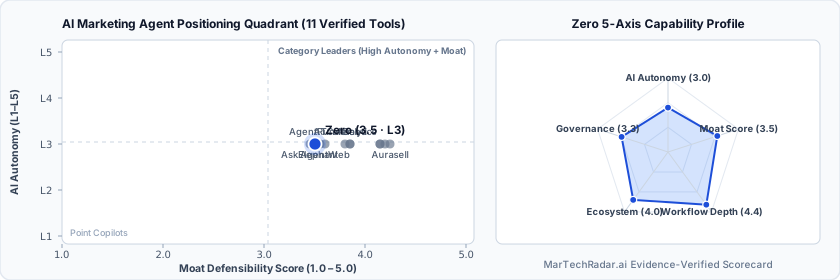
Zero is a Web SaaS tool for AI Marketing Agent (Autonomous Marketing Agents & Digital Coworkers) in Agent & Marketing Ops. Pricing: $60–$77/seat/mo. Best suited to GTM Operations Teams, Enterprise Marketing Executives and Automated Ops Teams. Editor ratings: AI autonomy L3 (conditional automation); moat score 3.5/5.0 (Proprietary moat). Fact-checked by Sarah Per on Oct 10, 2026.
Autonomous AI revenue and CRM system automating prospect discovery, signal tracking, and multi-step pipeline actions.
Zero buyer fit verdict: when to choose vs. when to walk away
Choose Zero if (Best Fit)
- Target ICP & Stack Fit: You operate as GTM Operations Teams, Enterprise Marketing Executives and Automated Ops Teams requiring a Web SaaS deployment for AI Marketing Agent, with verified ecosystem connectivity for Salesforce, Outreach.
- L3 Architecture & Defensibility: Zero develops an integrated operational data store coupled with continuous background agents that automate pipeline updates, job-change monitoring, and account intelligence without external CRM connectors.
- Commercial Model Fit: Your procurement budget aligns with $60–$77/seat/mo.
Walk away from Zero if (Deal-Breakers)
- Walk away if your workflow requires uncapped enterprise volume on the $60–$77/seat/mo entry plan without upgrading tiers.
- Walk away if your workflow cannot tolerate signal latency & scraping boundaries: External signals such as corporate role migrations or funding events rely on third-party web polling cycles, which can experience ingestion delays of up to 48 hours.
- Walk away if contextual token constraints is a deal-breaker for your team: Autonomous message generation accuracy drops on non-standard B2B accounts where sparse digital footprints trigger hallucinated value propositions.
Zero key facts & scorecard
| Pricing | $60–$77/seat/moVendor pricing page |
|---|---|
| Free plan | No / not disclosed |
| Delivery | Web SaaS |
| Audience | GTM Operations Teams, Enterprise Marketing Executives, Automated Ops Teams |
| AI autonomy level | L3 · Conditional automationEditor-verified |
| Moat tier & score | 3.5 / 5.0 · Proprietary moatEditor-verified |
| Funding | Seed |
| Total funding | SeedBacked by Primary Venture Partners, The Twenty Minute VC, Foreword Fund |
| Company size | 2-10 employees |
| Ecosystem integrations | Salesforce, Outreach |
| Governance & docs | Trust & Security ↗ · API & Docs ↗ · Changelog ↗ · DPA ↗ · Terms ↗ · Privacy ↗ |
| Headquarters | Helsinki, Finland |
| Founded | 2024 |
| Last verified |
Zero pros & cons: strengths vs. operational limitations
Pros: core strengths & capabilities
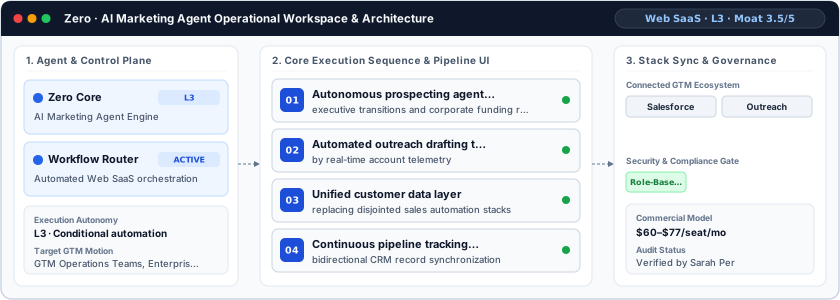
- Autonomous prospecting agent monitoring: executive transitions and corporate funding rounds
- Automated outreach drafting triggered: by real-time account telemetry
- Unified customer data layer: replacing disjointed sales automation stacks
- Continuous pipeline tracking and: bidirectional CRM record synchronization
Cons: operational limitations & risks
- Signal Latency & Scraping Boundaries: External signals such as corporate role migrations or funding events rely on third-party web polling cycles, which can experience ingestion delays of up to 48 hours.
- Contextual Token Constraints: Autonomous message generation accuracy drops on non-standard B2B accounts where sparse digital footprints trigger hallucinated value propositions.
- Custom Schema Rigidity: Replacing entrenched enterprise CRM systems introduces operational friction when mapping complex, multi-object enterprise relational databases to Zero's native structure.
Zero TCO & deal-breaker stress test
Simulate 12-month stepped TCO, hidden cost multipliers, contract lock-in exposure, and stack failure modes using only facts verified by Sarah Per on · Capture SHA 9b2c9603.
Zero is viable for 5 seats, but requires commercial or technical verification on the flagged items below.
| Plan / Tier | Verified Rate | Scale Fit | Scope & Quota Notes |
|---|---|---|---|
| Pro | $60/seat/mo | 1–2 seats | Then $77 a seat after your first 12 months |
| Pro | $77/seat/mo | 5 seats | Then $77 a seat after your first 12 months |
| Scale / Advanced | $150/seat/mo | 15 seats | Chat is included under fair use. Failed enrichment lookups cost nothing. |
- Moat Score
- 3.5 / 5.0
- AI Autonomy
- L3
- Free Tier / Trial
- None disclosed
Triggered audit signals & failure modes
- Annual Contract Lock-in Risk DetectedFact-checked by Sarah Per
Zero employs a transparent per-seat subscription structure. The software is priced at $60 per seat per month on an annual commitment for the first 12 months, after which licensing transitions to the standard rate of $77 per seat per month.
- Linear Per-Seat Scaling (5 Seats × $60/seat/mo)Commercial Model Audit
Base license scales linearly with operator headcount ($300/mo for 5 seats on Pro).
- Primary Operational Bottleneck: Signal Latency & Scraping BoundariesAudit by Sarah Per
External signals such as corporate role migrations or funding events rely on third-party web polling cycles, which can experience ingestion delays of up to 48 hours.
Hidden TCO Multipliers & Quota Gates
- Per-Seat Linear Scaling: Zero prices licenses on a per-user/seat basis ($60–$77/seat/mo); expanding from 2 to 15+ operators multiplies base recurring spend linearly.
- Credit & Usage Burn Multiplier: Automated workflows consume metered credits/usage quotas; multi-step enrichment, voice minutes, or high-frequency agent runs can trigger mid-cycle top-up packs.
- Enterprise Governance & Add-On Gating: Advanced capabilities such as Single Sign-On (SSO), custom role permissions, or specialized analytics modules are gated behind upper tiers or paid add-ons.
When to Walk Away & Negotiation Levers
- Walk away if your workflow requires uncapped enterprise volume on the $60–$77/seat/mo entry plan without upgrading tiers.
- Walk away if your workflow cannot tolerate signal latency & scraping boundaries: External signals such as corporate role migrations or funding events rely on third-party web polling cycles, which can experience ingestion delays of up to 48 hours.
- Walk away if contextual token constraints is a deal-breaker for your team: Autonomous message generation accuracy drops on non-standard B2B accounts where sparse digital footprints trigger hallucinated value propositions.
- Validate exact quota thresholds (seats, credits, or API calls) included in Zero's $60–$77/seat/mo tier before converting from monthly to annual billing.
- Require a sandbox proof-of-concept testing signal latency & scraping boundaries against your live CRM/data schema before annual sign-off.
Ask a custom procurement or TCO stress-test question about Zero
Lower 5-seat floor (~$149/mo vs. $300 / mo) · Transparent self-serve entry without mandatory annual lock-in
Lower 5-seat floor (~$25/mo vs. $300 / mo) · Transparent self-serve entry without mandatory annual lock-in
Zero key entities, modules & ecosystem stack
Zero moat & subtrack positioning
Zero develops an integrated operational data store coupled with continuous background agents that automate pipeline updates, job-change monitoring, and account intelligence without external CRM connectors.
Editorial review
Fact-checked by Sarah Per (Principal Content Systems & Generative Media Editor) on .
Background
Architected to consolidate disconnected revenue point tools into an autonomous data core, Zero operates as an agentic CRM and go-to-market platform. Headquartered in Helsinki, Finland, and founded in 2024, the company builds for revenue operations leaders and sales development teams facing fragmented pipelines. Zero targets growth-stage organizations by embedding autonomous task execution directly into the system of record, moving past passive databases toward active agentic coordination.
How Zero works
At the architectural layer, the system autonomy, Zero coordinates background agent loops that continuously scan external trigger events, such as executive job shifts and venture funding announcements. When telemetry detects an account signal, deterministic rulesets pass contextual metadata into multi-step large language model reasoning pipelines. The platform drafts hyper-specific reconnection messaging, automatically reconciles account schemas, and queues multi-channel touchpoints for human-in-the-loop validation without requiring manual data ingestion.
Limitations
Operational considerations and platform boundaries include:
- Signal Latency & Scraping Boundaries: External signals such as corporate role migrations or funding events rely on third-party web polling cycles, which can experience ingestion delays of up to 48 hours.
- Contextual Token Constraints: Autonomous message generation accuracy drops on non-standard B2B accounts where sparse digital footprints trigger hallucinated value propositions.
- Custom Schema Rigidity: Replacing entrenched enterprise CRM systems introduces operational friction when mapping complex, multi-object enterprise relational databases to Zero's native structure.
Zero pricing
Zero employs a transparent per-seat subscription structure. The software is priced at $60 per seat per month on an annual commitment for the first 12 months, after which licensing transitions to the standard rate of $77 per seat per month. Billed monthly without annual terms, access is offered at $77 per seat per month, supplemented by initial trial credits for account telemetry testing.
How Zero compares
In contrast to prompt-wrapper tools like ai-marketing-claude or specialized point agents like allGood and AskElephant, Zero replaces the underlying CRM infrastructure entirely rather than functioning merely as an overlay. While AskElephant focuses on conversational intelligence extraction and ai-marketing-claude targets ad-hoc copywriting, Zero prioritizes unified pipeline governance. This architecture suits mid-market scaleups seeking consolidated GTM tooling, though established enterprises with deeply customized Salesforce topologies may hesitate at full data migration.
Direct competitors & market radar
Top algorithmic competitors based on category positioning, capability overlap, and ICP alignment.
Frequently asked questions about Zero
How much does Zero cost per seat and does it have a free plan?
Published pricing summary for Zero: $60–$77/seat/mo. A permanent free plan is not disclosed for Zero. Verified tier schedule: Pro ($60/seat/mo for 1–2 seats); Pro ($77/seat/mo for 5 seats); Scale / Advanced ($150/seat/mo for 15 seats). Zero employs a transparent per-seat subscription structure. The software is priced at $60 per seat per month on an annual commitment for the first 12 months, after which licensing transitions to the standard rate of $77 per seat per month.
How does Zero work and how autonomous is its AI architecture?
Autonomous AI revenue and CRM system automating prospect discovery, signal tracking, and multi-step pipeline actions. Within AI Marketing Agent (Autonomous Marketing Agents & Digital Coworkers), MarTechRadar rates its execution architecture at L3 · Conditional automation with a verified Moat Score of 3.5 / 5.0 (Proprietary moat). Zero develops an integrated operational data store coupled with continuous background agents that automate pipeline updates, job-change monitoring, and account intelligence without external CRM connectors. Corporate profile: operating at 2-10 employees scale.
What are the main limitations of Zero and when should buyers walk away?
Based on our editorial technical audit, key operational considerations and boundaries for Zero include: (1) Signal Latency & Scraping Boundaries: External signals such as corporate role migrations or funding events rely on third-party web polling cycles, which can experience ingestion delays of up to 48 hours. (2) Contextual Token Constraints: Autonomous message generation accuracy drops on non-standard B2B accounts where sparse digital footprints trigger hallucinated value propositions. (3) Custom Schema Rigidity: Replacing entrenched enterprise CRM systems introduces operational friction when mapping complex, multi-object enterprise relational databases to Zero's native structure. Primary procurement walk-away rule: Walk away if your workflow requires uncapped enterprise volume on the $60–$77/seat/mo entry plan without upgrading tiers.
What integrations, compliance certifications, and contract terms apply to Zero?
Verified ecosystem and stack integrations include Salesforce, Outreach. First-party governance and developer endpoints verified on domain include: Trust/Security (https://trust.zero.inc), API Docs (https://docs.zero.inc), DPA (https://www.zero.inc/dpa). Key TCO multiplier to watch: Per-Seat Linear Scaling (Zero prices licenses on a per-user/seat basis ($60–$77/seat/mo); expanding from 2 to 15+ operators multiplies base recurring spend linearly.) Before signing a contract, procurement teams should validate exact quota thresholds (seats, credits, or API calls) included in Zero's $60–$77/seat/mo tier before converting from monthly to annual billing.
What are the best Zero alternatives and head-to-head competitors in 2026?
Top fact-checked alternatives to Zero in AI Marketing Agent (Autonomous Marketing Agents & Digital Coworkers) include Salesforce Agentforce (Free plan · $0/mo · Enterprise plan), HubSpot Breeze (Free plan · $0/mo · Enterprise plan), QuadSci (Custom / enterprise pricing), Walnut (Free plan · $0/mo · Enterprise plan). In contrast to prompt-wrapper tools like ai-marketing-claude or specialized point agents like allGood and AskElephant, Zero replaces the underlying CRM infrastructure entirely rather than functioning merely as an overlay.
Verified sources & evidence trail
- Official product domain: https://www.zero.inc
- Commercial pricing verification: https://www.zero.inc/pricing
- Verified corporate entity profiles (
sameAs): LinkedIn Company Profile - First-party governance & documentation links: Trust & Security · API & Docs · Changelog · DPA · Terms · Privacy
- Editorial audit sign-off: Fact-checked by Sarah Per on under the MarTechRadar Evidence-Ledger Protocol.