ATC Analytics Review (2026): AI Marketing Agent Pricing, Limits & Alternatives
Bottom line
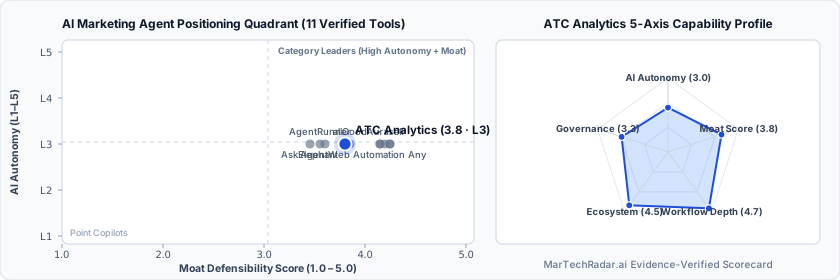
ATC Analytics is a Web SaaS tool for AI Marketing Agent (Autonomous Marketing Agents & Digital Coworkers) in Agent & Marketing Ops. Pricing: From $100/mo. Best suited to GTM Operations Teams, Enterprise Marketing Executives and Automated Ops Teams. Editor ratings: AI autonomy L3 (conditional automation); moat score 3.8/5.0 (Proprietary moat). Fact-checked by Julie Brot on Oct 11, 2026.
Autonomous prospect intelligence engine synthesizing corporate disclosures, organizational hierarchies, and technical pain points into tactical account.
ATC Analytics buyer fit verdict: when to choose vs. when to walk away
Choose ATC Analytics if (Best Fit)
- Target ICP & Stack Fit: You operate as GTM Operations Teams, Enterprise Marketing Executives and Automated Ops Teams requiring a Web SaaS deployment for AI Marketing Agent, with verified ecosystem connectivity for Snowflake, Amazon Redshift, Twilio Segment.
- L3 Architecture & Defensibility: Moat relies on proprietary account context graph generation and native Model Context Protocol (MCP) integrations that bridge structured public disclosures directly into conversational AI environments.
- Commercial Model Fit: Your procurement budget aligns with From $100/mo.
Walk away from ATC Analytics if (Deal-Breakers)
- Walk away if your workflow requires uncapped enterprise volume on the From $100/mo entry plan without upgrading tiers.
- Walk away if your workflow cannot tolerate private market ingestion gaps: Extraction fidelity degrades significantly when evaluating early-stage or privately held organizations lacking essential public reporting, regulatory filings, or extensive public footprints.
- Walk away if model context protocol latency is a deal-breaker for your team: Running multi-agent retrieval queries via external LLM interfaces introduces API execution overhead and schema serialization delays during deep account synthesis.
ATC Analytics key facts & scorecard
| Pricing | From $100/moVendor pricing page |
|---|---|
| Free plan | No / not disclosed |
| Delivery | Web SaaS |
| Audience | GTM Operations Teams, Enterprise Marketing Executives, Automated Ops Teams |
| AI autonomy level | L3 · Conditional automationEditor-verified |
| Moat tier & score | 3.8 / 5.0 · Proprietary moatEditor-verified |
| Funding | Seed |
| Founders | Ben Wilson, Scott Sandbo, Steve Lidberg |
| Company size | 11-50 employees |
| Ecosystem integrations | Snowflake, Amazon Redshift, Twilio Segment |
| Governance & docs | Terms ↗ · Privacy ↗ |
| Headquarters | Portland, Oregon, United States |
| Founded | 2023 |
| Last verified |
ATC Analytics pros & cons: strengths vs. operational limitations
Pros: core strengths & capabilities
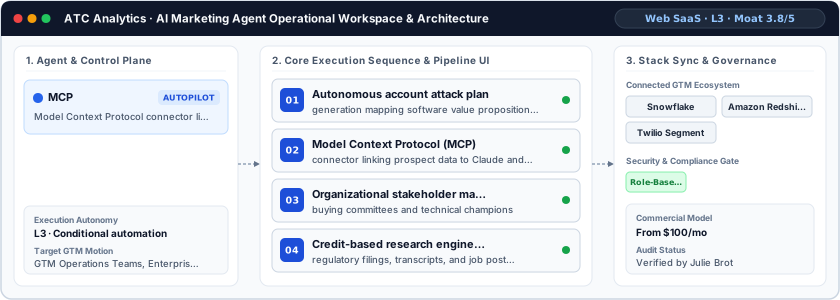
- Autonomous account attack plan: generation mapping software value propositions to corporate pain points
- Model Context Protocol (MCP): connector linking prospect data to Claude and ChatGPT workflows
- Organizational stakeholder mapping identifying: buying committees and technical champions
- Credit-based research engine synthesizing: regulatory filings, transcripts, and job postings
Cons: operational limitations & risks
- Private Market Ingestion Gaps: Extraction fidelity degrades significantly when evaluating early-stage or privately held organizations lacking essential public reporting, regulatory filings, or extensive public footprints.
- Model Context Protocol Latency: Running multi-agent retrieval queries via external LLM interfaces introduces API execution overhead and schema serialization delays during deep account synthesis.
- Credit Burn Asymmetry: High-touch synthesis workflows, such as multi-layer buying committee mapping, rapidly deplete consumable credit pools compared to standard single-credit firmographic queries.
ATC Analytics TCO & deal-breaker stress test
Simulate 12-month stepped TCO, hidden cost multipliers, contract lock-in exposure, and stack failure modes using only facts verified by Julie Brot on · Capture SHA 1352fc42.
ATC Analytics is viable for 5 seats, but requires commercial or technical verification on the flagged items below.
| Plan / Tier | Verified Rate | Scale Fit | Scope & Quota Notes |
|---|---|---|---|
| Entry / Starter | $100/mo | 1–2 seats | 20% lower credit cost |
| Growth / Professional | $200/mo | 5 seats | 40% lower credit cost |
| Scale / Advanced | $300/mo | 15 seats | What credits unlock |
- Moat Score
- 3.8 / 5.0
- AI Autonomy
- L3
- Free Tier / Trial
- None disclosed
Triggered audit signals & failure modes
- Published Self-Serve Entry FloorVerified Pricing Ledger
ATC Analytics publishes a transparent entry point (From $100/mo) for initial validation before committing.
- Usage / Credit Burn VolatilityCommercial Model Audit
ATC Analytics uses credit or usage-metered billing (From $100/mo). High-volume automated workflows across 5 seats can trigger mid-cycle overage charges.
- Tier Fit for 5-Seat Scale: Growth / Professional ($200/mo)Verified Tier Schedule
40% lower credit cost
- Primary Operational Bottleneck: Credit Burn AsymmetryAudit by Julie Brot
High-touch synthesis workflows, such as multi-layer buying committee mapping, rapidly deplete consumable credit pools compared to standard single-credit firmographic queries.
Hidden TCO Multipliers & Quota Gates
- Credit & Usage Burn Multiplier: Automated workflows consume metered credits/usage quotas; multi-step enrichment, voice minutes, or high-frequency agent runs can trigger mid-cycle top-up packs.
- Private Market Ingestion Gaps: Extraction fidelity degrades significantly when evaluating early-stage or privately held organizations lacking essential public reporting, regulatory filings, or extensive public footprints.
- Model Context Protocol Latency: Running multi-agent retrieval queries via external LLM interfaces introduces API execution overhead and schema serialization delays during deep account synthesis.
When to Walk Away & Negotiation Levers
- Walk away if your workflow requires uncapped enterprise volume on the From $100/mo entry plan without upgrading tiers.
- Walk away if your workflow cannot tolerate private market ingestion gaps: Extraction fidelity degrades significantly when evaluating early-stage or privately held organizations lacking essential public reporting, regulatory filings, or extensive public footprints.
- Walk away if model context protocol latency is a deal-breaker for your team: Running multi-agent retrieval queries via external LLM interfaces introduces API execution overhead and schema serialization delays during deep account synthesis.
- Validate exact quota thresholds (seats, credits, or API calls) included in ATC Analytics's From $100/mo tier before converting from monthly to annual billing.
- Require a sandbox proof-of-concept testing private market ingestion gaps against your live CRM/data schema before annual sign-off.
Ask a custom procurement or TCO stress-test question about ATC Analytics
Lower 5-seat floor (~$10/mo vs. $200 / mo)
Fits within $800/mo budget ($99–$119/seat/mo)
ATC Analytics key entities, modules & ecosystem stack
Model Context Protocol connector linking prospect data to Claude and ChatGPT workflows
ATC Analytics moat & subtrack positioning
Moat relies on proprietary account context graph generation and native Model Context Protocol (MCP) integrations that bridge structured public disclosures directly into conversational AI environments.
Editorial review
Fact-checked by Julie Brot (Enterprise SaaS Governance & Procurement Editor) on .
Background
To execute enterprise outbound sales effectively, go-to-market teams must isolate specific operational bottlenecks rather than rely on superficial intent data. Established in 2023 in Portland, Oregon, United States, ATC Analytics builds autonomous prospect intelligence tools for enterprise sales development representatives, account executives, and revenue operations leaders. The platform structures complex corporate telemetry into actionable sales strategies, replacing manual account research with algorithmic problem discovery.
How ATC Analytics works
At an L3 autonomy tier, ATC Analytics functions as an autonomous research coworker via its web-based Prospect Hub and Model Context Protocol integrations for external agents like Claude and ChatGPT. The pipeline ingests unstructured public disclosures, financial reports, hiring patterns, and executive commentary. Its extraction layer constructs an account-specific problem graph, cross-referencing target operational pain points against vendor solution capabilities to generate automated attack plans, stakeholder maps, and next-best actions without manual querying, alongside native workflow integrations for Snowflake, Amazon Redshift, Tableau, and Power BI.
Limitations
Operational considerations and platform boundaries include:
- Private Market Ingestion Gaps: Extraction fidelity degrades significantly when evaluating early-stage or privately held organizations lacking essential public reporting, regulatory filings, or extensive public footprints.
- Model Context Protocol Latency: Running multi-agent retrieval queries via external LLM interfaces introduces API execution overhead and schema serialization delays during deep account synthesis.
- Credit Burn Asymmetry: High-touch synthesis workflows, such as multi-layer buying committee mapping, rapidly deplete consumable credit pools compared to standard single-credit firmographic queries.
ATC Analytics pricing
ATC Analytics operates on a usage-based credit ledger supplemented by subscription tiers starting from $100 per month. The commercial model incorporates 50 free recurring monthly credits, while scaled research operations and higher-touch workflows consume variable credit allocations based on pipeline depth. Base tiers provide access to the core Prospect Hub interface, external agent connectors, and automated attack plan generation.
How ATC Analytics compares
Within the autonomous marketing and sales agent landscape, ATC Analytics competes directly against ai-marketing-claude, allGood, and AskElephant within the AI Marketing Agent segment. While ai-marketing-claude emphasizes conversational copywriting and AskElephant focuses on conversational intelligence summarization, ATC Analytics differentiates through structured account attack planning and direct Model Context Protocol integration. It is architected for enterprise software sales teams seeking deterministic account research rather than generic copy generation.
Frequently asked questions about ATC Analytics
How much does ATC Analytics cost and what pricing tiers are available?
Published pricing summary for ATC Analytics: From $100/mo. A permanent free plan is not disclosed for ATC Analytics. Verified tier schedule: Entry / Starter ($100/mo for 1–2 seats); Growth / Professional ($200/mo for 5 seats); Scale / Advanced ($300/mo for 15 seats). ATC Analytics operates on a usage-based credit ledger supplemented by subscription tiers starting from $100 per month. The commercial model incorporates 50 free recurring monthly credits, while scaled research operations and higher-touch workflows consume variable credit allocations based on pipeline depth.
How does ATC Analytics work and how autonomous is its AI architecture?
Autonomous prospect intelligence engine synthesizing corporate disclosures, organizational hierarchies, and technical pain points into tactical account. Within AI Marketing Agent (Autonomous Marketing Agents & Digital Coworkers), MarTechRadar rates its execution architecture at L3 · Conditional automation with a verified Moat Score of 3.8 / 5.0 (Proprietary moat). Moat relies on proprietary account context graph generation and native Model Context Protocol (MCP) integrations that bridge structured public disclosures directly into conversational AI environments. Corporate profile: Founded by Ben Wilson, Scott Sandbo, Steve Lidberg, operating at 11-50 employees scale.
What are the main limitations of ATC Analytics and when should buyers walk away?
Based on our editorial technical audit, key operational considerations and boundaries for ATC Analytics include: (1) Private Market Ingestion Gaps: Extraction fidelity degrades significantly when evaluating early-stage or privately held organizations lacking essential public reporting, regulatory filings, or extensive public footprints. (2) Model Context Protocol Latency: Running multi-agent retrieval queries via external LLM interfaces introduces API execution overhead and schema serialization delays during deep account synthesis. (3) Credit Burn Asymmetry: High-touch synthesis workflows, such as multi-layer buying committee mapping, rapidly deplete consumable credit pools compared to standard single-credit firmographic queries. Primary procurement walk-away rule: Walk away if your workflow requires uncapped enterprise volume on the From $100/mo entry plan without upgrading tiers.
What integrations, compliance certifications, and contract terms apply to ATC Analytics?
Verified ecosystem and stack integrations include Snowflake, Amazon Redshift, Twilio Segment. Key TCO multiplier to watch: Credit & Usage Burn Multiplier (Automated workflows consume metered credits/usage quotas; multi-step enrichment, voice minutes, or high-frequency agent runs can trigger mid-cycle top-up packs.) Before signing a contract, procurement teams should validate exact quota thresholds (seats, credits, or API calls) included in ATC Analytics's From $100/mo tier before converting from monthly to annual billing.
What are the best ATC Analytics alternatives and head-to-head competitors in 2026?
Top fact-checked alternatives to ATC Analytics in AI Marketing Agent (Autonomous Marketing Agents & Digital Coworkers) include allGood (Custom / enterprise pricing), AskElephant ($99–$119/seat/mo), Aurasell (From $15,000/yr), Bardeen (From $10/mo). Within the autonomous marketing and sales agent landscape, ATC Analytics competes directly against ai-marketing-claude, allGood, and AskElephant within the AI Marketing Agent segment.
Verified sources & evidence trail
- Official product domain: https://www.atcintel.com/
- Commercial pricing verification: https://atcintel.com/pricing
- Verified corporate entity profiles (
sameAs): LinkedIn Company Profile · Crunchbase Entity Record - First-party governance & documentation links: Terms · Privacy
- Editorial audit sign-off: Fact-checked by Julie Brot on under the MarTechRadar Evidence-Ledger Protocol.