Gumloop Review (2026): Workflow Automation Pricing, Pros & Cons
Bottom line
Gumloop is a Web SaaS tool for Workflow Automation (No-Code Marketing Workflow Automation) in Agent & Marketing Ops. Pricing: From $37/mo. Best suited to B2B SaaS and Creators / Solo. Editor ratings: AI autonomy L3 (conditional automation); moat score 4.1/5.0 (Proprietary moat). Fact-checked by MarTechRadar Research Desk on Oct 11, 2026.
No-code AI workflow orchestrator and agent builder enabling technical marketing and operations teams to automate data extraction and web research.
Is Gumloop worth it in 2026? Buyer fit & when to walk away
Choose Gumloop if (Best Fit)
- Target ICP & Stack Fit: You operate as B2B SaaS and Creators / Solo requiring a Web SaaS deployment for Workflow Automation, with verified ecosystem connectivity for Salesforce, HubSpot, Slack, Microsoft Teams.
- L3 Architecture & Defensibility: Gumloop combines managed headless browser automation, multi-model LLM routing, and a dual visual-code execution runtime that resists workflow fragility better than conventional trigger-action utilities.
- Commercial Model Fit: Your procurement budget aligns with From $37/mo.
Walk away from Gumloop if (Deal-Breakers)
- Walk away if your workflow cannot tolerate browser automation fragility: Dynamic DOM mutations, anti-bot protections, and authentication captchas on target websites can intermittently break Gumloop Browser execution paths, necessitating continuous selector maintenance.
- Walk away if credit consumption volatility is a deal-breaker for your team: Complex looping nodes running multi-step reasoning models can exhaust monthly orchestration credits rapidly when processing large asynchronous batch datasets.
Gumloop pricing, free plan & scorecard at a glance
| Pricing | From $37/moVendor pricing page |
|---|---|
| Free plan | No / not disclosed |
| Delivery | Web SaaS |
| Audience | B2B SaaS, Creators / Solo |
| AI autonomy level | L3 · Conditional automationEditor-verified |
| Moat tier & score | 4.1 / 5.0 · Proprietary moatEditor-verified |
| Funding | Seed |
| Total funding | $70.1MBacked by BoxGroup, Nexus Venture Partners, Benchmark, Y Combinator |
| Founders | Max Brodeur-Urbas, Rahul Behal |
| Company size | 11-50 employees |
| Ecosystem integrations | Salesforce, HubSpot, Slack, Microsoft Teams |
| Compliance & governance | SOC 2, GDPR |
| Governance & docs | Trust & Security ↗ · API & Docs ↗ · Changelog ↗ · Terms ↗ · Privacy ↗ |
| Headquarters | San Francisco, California |
| Founded | 2023 |
| Last verified | Oct 11, 2026 |
Gumloop pros & cons: strengths vs. operational limitations
Pros: core strengths & capabilities
- Visual node-based agent orchestration canvas: with conditional branching and looping
- Managed headless Gumloop Browser: for automated web scraping and authenticated account research
- Multi-LLM gateway supporting over: 35 foundation models with bring-your-own-key infrastructure
- Company Brain knowledge integration: with bidirectional GitHub skill synchronization
Cons: operational limitations & risks
- Browser Automation Fragility: Dynamic DOM mutations, anti-bot protections, and authentication captchas on target websites can intermittently break Gumloop Browser execution paths, necessitating continuous selector maintenance.
- Credit Consumption Volatility: Complex looping nodes running multi-step reasoning models can exhaust monthly orchestration credits rapidly when processing large asynchronous batch datasets.
- LLM Latency Accumulation: Chaining sequential inference calls across third-party model providers introduces cumulative network latency, making synchronous real-time user-facing applications impractical.
Gumloop TCO & deal-breaker stress test
Simulate 12-month stepped TCO, hidden cost multipliers, contract lock-in exposure, and stack failure modes using only facts verified by MarTechRadar Research Desk on 2026-10-11 · Capture SHA 8806e506.
Gumloop is viable for 5 seats, but requires commercial or technical verification on the flagged items below.
- Moat Score
- 4.1 / 5.0
- AI Autonomy
- L3
- Free Tier / Trial
- None disclosed
Triggered audit signals & failure modes
- Published Self-Serve Entry FloorVerified Pricing Ledger
Gumloop publishes a transparent entry point (From $37/mo) for initial validation before committing.
- Usage / Credit Burn VolatilityCommercial Model Audit
Gumloop uses credit or usage-metered billing (From $37/mo). High-volume automated workflows across 5 seats can trigger mid-cycle overage charges.
- Primary Operational Bottleneck: Credit Consumption VolatilityAudit by MarTechRadar Research Desk
Complex looping nodes running multi-step reasoning models can exhaust monthly orchestration credits rapidly when processing large asynchronous batch datasets.
Test a custom Gumloop budget or stack constraint
Lower 5-seat floor (~$12/mo vs. From $37 / mo)
Lower 5-seat floor (~$20/mo vs. From $37 / mo)
Gumloop integrations, API, security & compliance stack
Gumloop AI moat & Workflow Automation positioning
Gumloop combines managed headless browser automation, multi-model LLM routing, and a dual visual-code execution runtime that resists workflow fragility better than conventional trigger-action utilities.
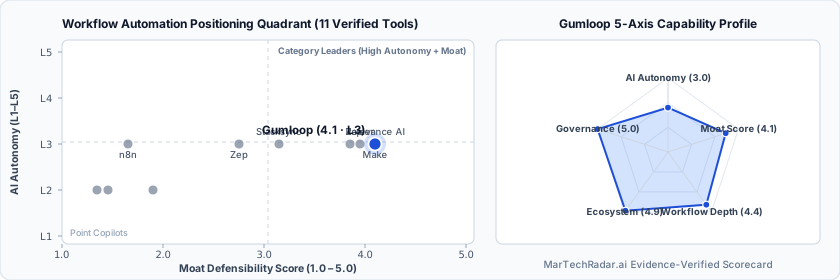
Gumloop in-depth review, pricing & architecture analysis
Editor sign-off: Oct 11, 2026. How profiles are made.
What is Gumloop? Overview & background
Architected to replace rigid trigger-action pipelines with autonomous agent systems, Gumloop operates as a visual workflow orchestration runtime for growth, marketing, and operations teams. Established in 2023 and headquartered in San Francisco, California, the platform has secured $70.1M in venture capital funding. Rather than forcing non-technical operators to write bespoke scraping scripts or maintain Python microservices, Gumloop enables technical marketers to chain large language models, data transformation nodes, and automated web interactions into reproducible data pipelines.
How Gumloop works: architecture & workflow
At its architectural core, Gumloop executes directed acyclic graphs combining API integrations, custom code nodes, and generative foundation models across more than 35 supported endpoints. The platform incorporates Gumloop Browser, a dedicated headless automation environment that navigates dynamic web interfaces, executes authenticated session tasks, and extracts unstructured data into structured schemas. Ingestion pipelines normalize inputs across CRM webhooks, CSV files, and enterprise knowledge bases, enabling multi-step agents to summarize, classify, or synthesize copy before routing outputs to external business systems, alongside native workflow integrations for Salesforce, HubSpot, Slack, and Microsoft Teams under verified SOC 2 Type II and GDPR governance controls.
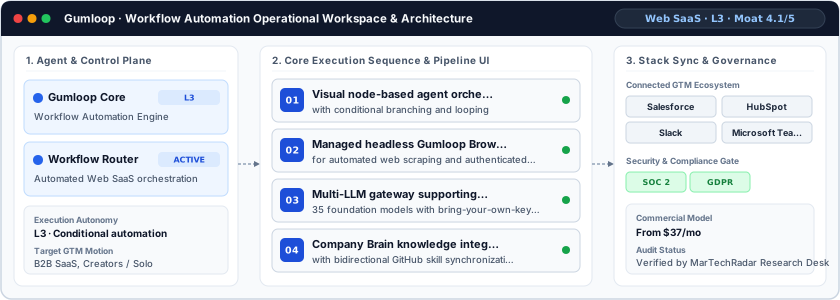
Gumloop limitations, drawbacks & risks
Operational considerations and platform boundaries include:
- Browser Automation Fragility: Dynamic DOM mutations, anti-bot protections, and authentication captchas on target websites can intermittently break Gumloop Browser execution paths, necessitating continuous selector maintenance.
- Credit Consumption Volatility: Complex looping nodes running multi-step reasoning models can exhaust monthly orchestration credits rapidly when processing large asynchronous batch datasets.
- LLM Latency Accumulation: Chaining sequential inference calls across third-party model providers introduces cumulative network latency, making synchronous real-time user-facing applications impractical.
Gumloop pricing, plans & cost breakdown
Gumloop packages its platform under a usage-based software subscription model starting at $37 per month on the Pro plan. This base entry tier includes unlimited seats and agents alongside 20,000 monthly execution credits and access to standard foundation models. Upgrades scale into negotiated Enterprise agreements that unlock custom credit volumes, lower orchestration fees, tailored proxies, and direct GitHub skill synchronization for distributed software development workflows.
| Plan / Tier | Verified Price & Billing | Target Seat / Scale Fit | Included Scope & Contract Terms |
|---|---|---|---|
| Pro | $37/mo | Unlimited seats | Verified $37/mo Pro tier from vendor pricing schedule. |
How Gumloop compares vs. competitors & alternatives
Within the no-code automation ecosystem, Gumloop distinguishes itself from legacy trigger platforms like Zapier by offering native multi-LLM reasoning and programmatic headless browser interactions instead of simple linear API relays within the Workflow Automation segment. While Cassidy AI focuses heavily on contextual knowledge base assistants and Relevance AI targets multi-agent workforce orchestration, Gumloop balances agentic autonomy with deterministic data extraction. It remains optimal for technical growth marketing teams seeking high-throughput web enrichment and pipeline automation without engineering overhead.
Direct competitors & market radar
Top algorithmic competitors based on category positioning, capability overlap, and ICP alignment.
Frequently asked questions about Gumloop
How much does Gumloop cost in 2026?
Gumloop pricing: From $37/mo. No free plan is publicly disclosed. Gumloop packages its platform under a usage-based software subscription model starting at $37 per month on the Pro plan.
What are the top Gumloop alternatives in Workflow Automation?
Verified Workflow Automation alternatives include Zapier (Free plan · $19.99–$69/mo), Relevance AI (Custom / enterprise pricing), Cassidy AI (Custom / enterprise pricing), Make (Free plan · $12–$38/mo · Enterprise plan). Within the no-code automation ecosystem, Gumloop distinguishes itself from legacy trigger platforms like Zapier by offering native multi-LLM reasoning and programmatic headless browser interactions instead of simple linear API relays within the Workflow Automation segment.
What are the main limitations and trade-offs of Gumloop?
Operational considerations and platform boundaries include: Browser Automation Fragility: Dynamic DOM mutations, anti-bot protections, and authentication captchas on target websites can intermittently break Gumloop Browser execution paths, necessitating continuous selector maintenance. Walk away if your workflow cannot tolerate browser automation fragility: Dynamic DOM mutations, anti-bot protections, and authentication captchas on target websites can intermittently break Gumloop Browser execution paths, necessitating continuous selector maintenance.
Verified sources & evidence trail
- Official product domain: https://gumloop.com
- Commercial pricing verification: https://www.gumloop.com/pricing
- Verified corporate entity profiles (
sameAs): LinkedIn Company Profile · Crunchbase Entity Record - First-party governance & documentation links: Trust & Security · API & Docs · Changelog · Terms · Privacy
- Editor sign-off: Oct 11, 2026 (how profiles are made).
