Relevance AI Review (2026): Workflow Automation Pricing, Pros & Cons
Bottom line
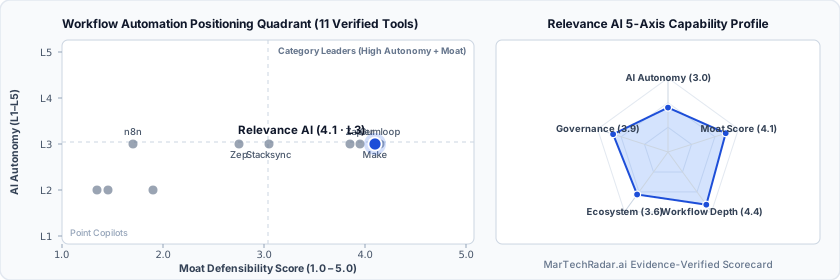
Relevance AI is a Web SaaS tool for Workflow Automation (No-Code Marketing Workflow Automation) in Agent & Marketing Ops. Pricing: Custom / enterprise pricing. Best suited to B2B SaaS, DTC / eCommerce and Enterprise Brands. Editor ratings: AI autonomy L3 (conditional automation); moat score 4.1/5.0 (Proprietary moat). Fact-checked by MarTechRadar Research Desk on Oct 12, 2026.
No-code enterprise orchestration platform enabling teams to build, deploy, and monitor collaborative multi-agent autonomous workforces across operational.
Is Relevance AI worth it in 2026? Buyer fit & when to walk away
Choose Relevance AI if (Best Fit)
- Target ICP & Stack Fit: You operate as B2B SaaS, DTC / eCommerce and Enterprise Brands requiring a Web SaaS deployment for Workflow Automation, with verified ecosystem connectivity for Zapier.
- L3 Architecture & Defensibility: Defensibility centers on its proprietary Invent solutions engine, pre-built multi-agent coordination frameworks, enterprise evaluation sandboxes, and deep native tool integration matrices.
- Commercial Model Fit: Your procurement budget aligns with Custom / enterprise pricing.
Walk away from Relevance AI if (Deal-Breakers)
- Walk away if you need published self-serve pricing: Relevance AI is sold by custom quote.
- Walk away if your workflow cannot tolerate multi-agent cascading latency: Chained reasoning cycles across multiple cooperating agents introduce cumulative API round-trip overhead, making real-time interactive user-facing workflows impractical compared to deterministic scripts.
- Walk away if downstream tool schema drift is a deal-breaker for your team: When third-party enterprise API endpoints alter parameter requirements or authentication states, dynamic agent function calls fail without explicit prompt retraining or schema reconfiguration.
Relevance AI pricing, free plan & scorecard at a glance
| Pricing | Custom / enterprise pricing |
|---|---|
| Free plan | No / not disclosed |
| Delivery | Web SaaS |
| Audience | B2B SaaS, DTC / eCommerce, Enterprise Brands |
| AI autonomy level | L3 · Conditional automationEditor-verified |
| Moat tier & score | 4.1 / 5.0 · Proprietary moatEditor-verified |
| Funding | Series B |
| Total funding | $42MBacked by Insight Partners |
| Founders | Daniel Palmer, Daniel Vassilev, Jacky Koh |
| Company size | 51-200 employees |
| Ecosystem integrations | Zapier |
| Governance & docs | Trust & Security ↗ · API & Docs ↗ · Changelog ↗ · Privacy ↗ |
| Headquarters | San Francisco, California |
| Founded | 2020 |
| Last verified | Oct 12, 2026 |
Relevance AI pros & cons: strengths vs. operational limitations
Pros: core strengths & capabilities
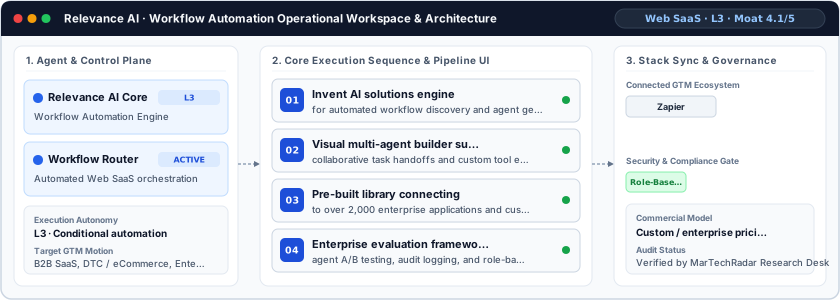
- Invent AI solutions engine: for automated workflow discovery and agent generation
- Visual multi-agent builder supporting: collaborative task handoffs and custom tool execution
- Pre-built library connecting: to over 2,000 enterprise applications and custom APIs
- Enterprise evaluation framework featuring: agent A/B testing, audit logging, and role-based access controls
Cons: operational limitations & risks
- Multi-Agent Cascading Latency: Chained reasoning cycles across multiple cooperating agents introduce cumulative API round-trip overhead, making real-time interactive user-facing workflows impractical compared to deterministic scripts.
- Downstream Tool Schema Drift: When third-party enterprise API endpoints alter parameter requirements or authentication states, dynamic agent function calls fail without explicit prompt retraining or schema reconfiguration.
- Context Window Compaction Risk: Extended operational loops handling high-volume operational documents run into context token limits, causing loss of critical intermediate state variables during multi-agent handoffs.
Relevance AI TCO & deal-breaker stress test
Simulate 12-month stepped TCO, hidden cost multipliers, contract lock-in exposure, and stack failure modes using only facts verified by MarTechRadar Research Desk on 2026-10-12.
Relevance AI triggers high-severity friction under your 5-seat / $800/mo constraints. Benchmark the verified subtrack alternatives below before committing.
- Moat Score
- 4.1 / 5.0
- AI Autonomy
- L3
- Free Tier / Trial
- None disclosed
Triggered audit signals & failure modes
- Opaque Enterprise Quoting vs. SMB/Mid-Market BudgetVerified Pricing Ledger
Relevance AI does not disclose a public self-serve floor (Custom / enterprise pricing). Buyers with a $800/mo cap face high sales-qualification friction.
- Sales-Gated Contract TermsFact-checked by MarTechRadar Research Desk
Commercial procurement operates through bespoke contractual tiers rather than self-service usage bands. Enterprise licensing requires direct sales engagement to tailor quotes based on organizational scale, agent concurrency requirements, and dedicated workspace provisioning.
- Primary Operational Bottleneck: Multi-Agent Cascading LatencyAudit by MarTechRadar Research Desk
Chained reasoning cycles across multiple cooperating agents introduce cumulative API round-trip overhead, making real-time interactive user-facing workflows impractical compared to deterministic scripts.
Test a custom Relevance AI budget or stack constraint
Lower 5-seat floor (~$12/mo vs. Custom Quote) · Transparent self-serve entry without mandatory annual lock-in
Lower 5-seat floor (~$37/mo vs. Custom Quote) · Transparent self-serve entry without mandatory annual lock-in
Relevance AI integrations, API, security & compliance stack
Relevance AI AI moat & Workflow Automation positioning
Defensibility centers on its proprietary Invent solutions engine, pre-built multi-agent coordination frameworks, enterprise evaluation sandboxes, and deep native tool integration matrices.
Relevance AI in-depth review, pricing & architecture analysis
Editor sign-off: Oct 12, 2026. How profiles are made.
What is Relevance AI? Overview & background
Relevance AI approaches workflow automation from a distributed multi-agent paradigm rather than linear execution chains. Founded in 2020 in San Francisco, California, the company has raised $42M in venture capital to construct an orchestration layer for digital workforces. Built for marketing operations directors, revenue operations leaders, and systems architects, the platform addresses enterprise operational throughput by converting procedural tasks into specialized digital workers rather than relying on deterministic triggers.
How Relevance AI works: architecture & workflow
Operating at an L3 autonomy profile, Relevance AI functions through its proprietary Invent engine to decompose unstructured operational processes into modular sub-tasks. The platform allows technical users to configure multi-agent swarms equipped with defined system prompts, external memory buffers, and programmatic capabilities. Ingestion pipelines link structured enterprise data and dynamic webhooks into contextual vectors, enabling agents to execute reasoning loops, query third-party APIs, and hand off execution payloads to downstream specialist agents without human intervention during normal operating conditions, alongside native workflow integrations for Databricks under verified SOC 2 Type II and GDPR governance controls.
Relevance AI limitations, drawbacks & risks
Operational considerations and platform boundaries include:
- Multi-Agent Cascading Latency: Chained reasoning cycles across multiple cooperating agents introduce cumulative API round-trip overhead, making real-time interactive user-facing workflows impractical compared to deterministic scripts.
- Downstream Tool Schema Drift: When third-party enterprise API endpoints alter parameter requirements or authentication states, dynamic agent function calls fail without explicit prompt retraining or schema reconfiguration.
- Context Window Compaction Risk: Extended operational loops handling high-volume operational documents run into context token limits, causing loss of critical intermediate state variables during multi-agent handoffs.
Relevance AI pricing, plans & cost breakdown
Commercial procurement operates through bespoke contractual tiers rather than self-service usage bands. Enterprise licensing requires direct sales engagement to tailor quotes based on organizational scale, agent concurrency requirements, and dedicated workspace provisioning. Packages include enterprise governance controls such as single sign-on, audit logging, evaluation sandboxes, and dedicated account support, alongside pooled compute credits for multi-agent execution.
| Plan / Tier | Verified Price & Billing | Target Seat / Scale Fit | Included Scope & Contract Terms |
|---|---|---|---|
| Enterprise / Custom | Custom quote | Unlimited seats | Custom-quoted plan; terms come from the vendor's sales team. |
How Relevance AI compares vs. competitors & alternatives
Relevance AI differentiates from deterministic automation tools like Zapier by replacing fixed boolean triggers with autonomous agent reasoning loops. When evaluated against specialized AI workflow builders like Gumloop and Cassidy AI, Relevance AI offers broader multi-agent collaboration frameworks and deeper operational autonomy, though it demands higher architectural rigor during deployment. The platform best serves mid-market to enterprise organizations seeking to build persistent, complex cognitive workflows across distributed go-to-market systems.
Direct competitors & market radar
Top algorithmic competitors based on category positioning, capability overlap, and ICP alignment.
Frequently asked questions about Relevance AI
Does Relevance AI publish pricing or require an enterprise quote?
Relevance AI pricing: Custom / enterprise pricing. No free plan is publicly disclosed. Commercial procurement operates through bespoke contractual tiers rather than self-service usage bands.
What are the top Relevance AI alternatives in Workflow Automation?
Verified Workflow Automation alternatives include Zapier (Free plan · $19.99–$69/mo), Gumloop (From $37/mo), Cassidy AI (Custom / enterprise pricing), Make (Free plan · $12–$38/mo · Enterprise plan). Relevance AI differentiates from deterministic automation tools like Zapier by replacing fixed boolean triggers with autonomous agent reasoning loops.
What are the main limitations and trade-offs of Relevance AI?
Operational considerations and platform boundaries include: Multi-Agent Cascading Latency: Chained reasoning cycles across multiple cooperating agents introduce cumulative API round-trip overhead, making real-time interactive user-facing workflows impractical compared to deterministic scripts. Walk away if you need published self-serve pricing: Relevance AI is sold by custom quote.
Verified sources & evidence trail
- Official product domain: https://relevanceai.com
- Commercial pricing verification: Verified against official vendor pricing policy (Custom / enterprise pricing)
- Verified corporate entity profiles (
sameAs): LinkedIn Company Profile · Crunchbase Entity Record - First-party governance & documentation links: Trust & Security · API & Docs · Changelog · Privacy
- Editor sign-off: Oct 12, 2026 (how profiles are made).
