Zep Review (2026): Workflow Automation Pricing, Pros & Cons
Bottom line
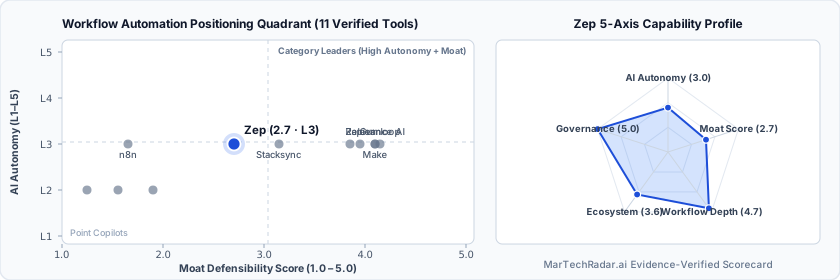
Zep is a Cloud SaaS Platform tool for Workflow Automation (No-Code Marketing Workflow Automation) in Agent & Marketing Ops. Pricing: $25–$375/mo · Enterprise plan. Best suited to B2B Marketing and Growth & Revenue Teams. Editor ratings: AI autonomy L3 (conditional automation); moat score 2.7/5.0 (Workflow-embedded). Fact-checked by MarTechRadar Research Desk on Oct 26, 2026.
Unified context layer and temporal knowledge graph platform giving enterprise AI agents long-term memory across conversations and business data.
Is Zep worth it in 2026? Buyer fit & when to walk away
Choose Zep if (Best Fit)
- Target ICP & Stack Fit: You operate as B2B Marketing and Growth & Revenue Teams requiring a Cloud SaaS Platform deployment for Workflow Automation, with verified ecosystem connectivity for Model Context Protocol (MCP).
- L3 Architecture & Defensibility: Zep commands a strong enterprise AI memory moat through its Graphiti temporal knowledge graph engine, Context MCP Server, sub-200ms memory retrieval across chat and CRM data, SOC 2 Type II/HIPAA compliance, and $2.3M in Pre-Seed funding from Y Combinator and Engineering Capital.
- Commercial Model Fit: Your procurement budget aligns with $25–$375/mo · Enterprise plan.
Walk away from Zep if (Deal-Breakers)
- Walk away if your workflow requires uncapped enterprise volume on the $25–$375/mo · Enterprise plan entry plan without upgrading tiers.
- Walk away if your workflow cannot tolerate primary operational trade-off: In practical enterprise deployments, the primary trade-off is that Zep is a developer-centric context and memory infrastructure platform (starting at $125/month on the self-serve Flex plan) rather than a turnkey end-user CRM or no-code email marketing GUI.
- Walk away if functional scope boundary is a deal-breaker for your team: Zep is not built for visual ad banner creation, cold B2B contact scraping, or social media post scheduling.
Zep pricing, free plan & scorecard at a glance
| Pricing | $25–$375/mo · Enterprise planVendor pricing page |
|---|---|
| Free plan | No / not disclosed |
| Delivery | Cloud SaaS Platform |
| Audience | B2B Marketing, Growth & Revenue Teams |
| AI autonomy level | L3 · Conditional automationEditor-verified |
| Moat tier & score | 2.7 / 5.0 · Workflow-embeddedEditor-verified |
| Funding | Pre-seed |
| Total funding | $2.3MBacked by Y Combinator, Engineering Capital |
| Founders | Daniel Chalef |
| Company size | 11-50 employees |
| Ecosystem integrations | Model Context Protocol (MCP) |
| Compliance & governance | SOC 2, HIPAA |
| Headquarters | San Francisco, California, United States |
| Founded | 2023 |
| Last verified | Oct 26, 2026 |
Zep pros & cons: strengths vs. operational limitations
Pros: core strengths & capabilities
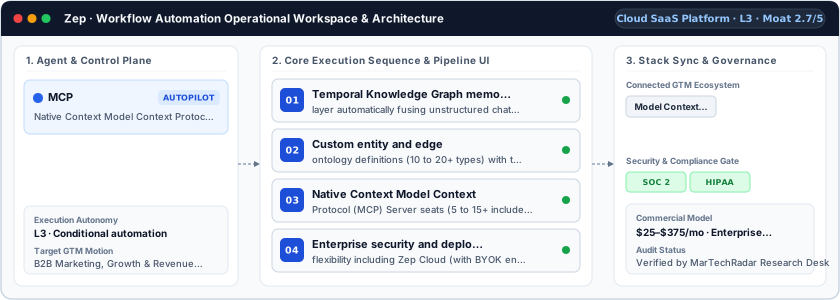
- Temporal Knowledge Graph memory: layer automatically fusing unstructured chat transcripts with structured CRM, billing, and product data
- Custom entity and edge: ontology definitions (10 to 20+ types) with temporal fact invalidation as customer preferences or account states change
- Native Context Model Context: Protocol (MCP) Server seats (5 to 15+ included) for direct integration with Claude, Cursor, and enterprise GTM agents
- Enterprise security and deployment: flexibility including Zep Cloud (with BYOK encryption) or private VPC hosting under SOC 2 Type II and HIPAA BAA
Cons: operational limitations & risks
- Primary Operational Trade-Off: In practical enterprise deployments, the primary trade-off is that Zep is a developer-centric context and memory infrastructure platform (starting at $125/month on the self-serve Flex plan) rather than a turnkey end-user CRM or no-code email marketing GUI.
- Functional Scope Boundary: Zep is not built for visual ad banner creation, cold B2B contact scraping, or social media post scheduling.
- Deployment & Governance Considerations: Additionally, organizations requiring customer-managed encryption keys (BYOK), private VPC deployment, 1-year API audit logs, or a signed HIPAA BAA and SOC 2 Type II SLA must engage on a custom Enterprise contract (with emerging-company discounts available for VC-funded startups).
Zep TCO & deal-breaker stress test
Simulate 12-month stepped TCO, hidden cost multipliers, contract lock-in exposure, and stack failure modes using only facts verified by MarTechRadar Research Desk on 2026-10-26 · Capture SHA 0721ddf5.
Zep aligns with your 5-seat / $800/mo profile. Review the walk-away triggers and contract levers below before deployment.
- Moat Score
- 2.7 / 5.0
- AI Autonomy
- L3
- Free Tier / Trial
- None disclosed
Triggered audit signals & failure modes
- Published Self-Serve Entry FloorVerified Pricing Ledger
Zep publishes a transparent entry point ($25–$375/mo · Enterprise plan) for initial validation before committing.
- Primary Operational Bottleneck: Deployment & Governance ConsiderationsAudit by MarTechRadar Research Desk
Additionally, organizations requiring customer-managed encryption keys (BYOK), private VPC deployment, 1-year API audit logs, or a signed HIPAA BAA and SOC 2 Type II SLA must engage on a custom Enterprise contract (with emerging-company discounts available for VC-funded startups).
Test a custom Zep budget or stack constraint
Lower 5-seat floor (~$20/mo vs. From $25 / mo)
Fits within $800/mo budget ($200–$4,200/mo)
Zep integrations, API, security & compliance stack
Native Context Model Context Protocol Server seats (5 to 15+ included) for direct integration with Claude, Cursor, and enterprise GTM agents
Zep AI moat & Workflow Automation positioning
Zep commands a strong enterprise AI memory moat through its Graphiti temporal knowledge graph engine, Context MCP Server, sub-200ms memory retrieval across chat and CRM data, SOC 2 Type II/HIPAA compliance, and $2.3M in Pre-Seed funding from Y Combinator and Engineering Capital.
Zep in-depth review, pricing & architecture analysis
Audited by MarTechRadar Research Desk (Evidence-Ledger Verified) on Oct 26, 2026.
What is Zep? Overview & background
Zep (operating at getzep.com) is a unified context engineering and long-term memory platform built for enterprise AI agents, conversational CX applications, and personalized sales and marketing assistants. Founded in 2023 by Daniel Chalef and headquartered in San Francisco, California, the Y Combinator (Winter 2024) company employs 11 to 50 specialists and has raised $2.3M in Pre-Seed funding backed by Y Combinator and Engineering Capital. Engineered to solve the "amnesia" and context-window bloat of production LLM agents, Zep constructs a live, evolving knowledge graph for every customer or account, capturing high-intent buyer searches for long term memory for ai agents, getzep pricing, and temporal knowledge graph for llm.
How Zep works: architecture & workflow
At the technical core of Zep is a temporal knowledge graph architecture (powered by its Graphiti engine) paired with a managed Context Model Context Protocol (MCP) Server. Unlike naive vector RAG databases that retrieve contradictory, outdated text chunks when a customer's subscription tier, shipping address, or buying stage changes, Zep continuously ingests both conversational messages and structured JSON/CRM business events, extracting custom entities and relationships with explicit validity timestamps. When a fact is superseded, Zep invalidates the old edge without deleting historical lineage, assembling a token-efficient, hallucination-resistant context block in milliseconds for downstream sales, support, or lifecycle marketing agents.
Zep limitations, drawbacks & risks
Operational considerations and platform boundaries include:
- Primary Operational Trade-Off: In practical enterprise deployments, the primary trade-off is that Zep is a developer-centric context and memory infrastructure platform (starting at $125/month on the self-serve Flex plan) rather than a turnkey end-user CRM or no-code email marketing GUI.
- Functional Scope Boundary: Zep is not built for visual ad banner creation, cold B2B contact scraping, or social media post scheduling.
- Deployment & Governance Considerations: Additionally, organizations requiring customer-managed encryption keys (BYOK), private VPC deployment, 1-year API audit logs, or a signed HIPAA BAA and SOC 2 Type II SLA must engage on a custom Enterprise contract (with emerging-company discounts available for VC-funded startups).
Zep pricing, plans & cost breakdown
Self-serve Flex at $125/month (50,000 credits, then $25/10k credits), Flex Plus at $375/month (200,000 credits, then $75/40k credits), and Custom Enterprise (BYO-key/VPC, SOC 2 Type II, HIPAA BAA). On its official pricing page (getzep.com/pricing/), Zep offers a 17% discount on annual billing across two self-serve credit plans—both including unlimited memories, retrieval, and users: Flex at $125/month (50,000 monthly credits with 30-day rollover, then $25 per 10,000 credits; 600 RPM, 5 projects, 5 Context MCP Server seats, and 10 custom entity/edge types) and Flex Plus at $375/month (200,000 monthly credits with 60-day rollover, then $75 per 40,000 credits; 1,000 RPM, 10 projects, 15 Context MCP Server seats, 20 custom entity/edge types, observations, custom extraction instructions, and webhooks), plus Custom Enterprise.
| Plan / Tier | Verified Price & Billing | Target Seat / Scale Fit | Included Scope & Contract Terms |
|---|---|---|---|
| Enterprise / Custom | Custom quote | 15–50+ seats (Enterprise SLA) | Sales-negotiated annual contract for custom volume, SSO/RBAC governance, and dedicated SLA. |
| Contract Watchout: Credit & Usage Burn Multiplier | Workflows on Zep consume metered credits or usage quotas; high-volume AI generation, batch queries, or recurring automation runs can exhaust base allocations and trigger mid-cycle top-up packs. | ||
How Zep compares vs. competitors & alternatives
In the agentic workflow infrastructure and context orchestration market, Zep competes with Mem0, LangChain/LangGraph memory modules, and Pinecone vector RAG stacks, alongside CAT-09 workflow peers such as Stacksync, Relevance AI, and Stack AI. Compared to stateless vector embeddings that cannot reason over time-series state changes or structured CRM updates, Zep differentiates itself through its temporal knowledge graph, custom entity schemas, and built-in Context MCP Server. Engineering and GTM teams building stateful customer-facing AI agents should evaluate Zep.
Frequently asked questions about Zep
How much does Zep cost in 2026?
Zep pricing: $25–$375/mo · Enterprise plan. No free plan is publicly disclosed. Self-serve Flex at $125/month (50,000 credits, then $25/10k credits), Flex Plus at $375/month (200,000 credits, then $75/40k credits), and Custom Enterprise (BYO-key/VPC, SOC 2 Type II, HIPAA BAA).
What are the top Zep alternatives in Workflow Automation?
Verified Workflow Automation alternatives include LangChain (Custom / enterprise pricing), Stacksync ($200–$4,200/mo), Stack AI (Custom / enterprise pricing), MindStudio (Free plan · $20–$24/mo · Enterprise plan). In the agentic workflow infrastructure and context orchestration market, Zep competes with Mem0, LangChain/LangGraph memory modules, and Pinecone vector RAG stacks, alongside CAT-09 workflow peers such as Stacksync, Relevance AI, and Stack AI.
Verified sources & evidence trail
- Official product domain: https://www.getzep.com
- Commercial pricing verification: https://www.getzep.com/pricing/
- Verified corporate entity profiles (
sameAs): LinkedIn Company Profile · Crunchbase Entity Record - Editorial audit sign-off: Audited by MarTechRadar Research Desk (Evidence-Ledger Verified) on Oct 26, 2026.
