Stack AI Review (2026): Workflow Automation Pricing, Pros & Cons
Bottom line
Stack AI is a Web SaaS tool for Workflow Automation (No-Code Marketing Workflow Automation) in Agent & Marketing Ops. Pricing: Custom / enterprise pricing. Best suited to B2B SaaS, DTC / eCommerce and Enterprise Brands. Editor ratings: AI autonomy L3 (conditional automation); moat score 1.4/5.0 (Thin wrapper). Fact-checked by MarTechRadar Research Desk on Oct 15, 2026.
Enterprise workflow automation platform enabling revenue and operations teams to build, deploy, and monitor custom multi-LLM pipelines via an intuitive.
Is Stack AI worth it in 2026? Buyer fit & when to walk away
Choose Stack AI if (Best Fit)
- Target ICP & Stack Fit: You operate as B2B SaaS, DTC / eCommerce and Enterprise Brands requiring a Web SaaS deployment for Workflow Automation.
- L3 Architecture & Defensibility: Defensibility rests on enterprise data governance controls, multi-model fallback routing, and native connectors linking enterprise knowledge bases directly into asynchronous execution graphs.
- Commercial Model Fit: Your procurement budget aligns with Custom / enterprise pricing.
Walk away from Stack AI if (Deal-Breakers)
- Walk away if you need published self-serve pricing: Stack AI is sold by custom quote.
- Walk away if your workflow cannot tolerate rate limiting and latency overhead: High-volume batch operations frequently hit upstream third-party model provider token ceilings, producing throughput bottlenecks when processing large-scale campaign datasets.
- Walk away if state management complexity is a deal-breaker for your team: Long-running asynchronous workflows requiring multi-step human review struggle with conversational state drift and context window truncation across extended validation loops.
Stack AI pricing, free plan & scorecard at a glance
| Pricing | Custom / enterprise pricing |
|---|---|
| Free plan | No / not disclosed |
| Delivery | Web SaaS |
| Audience | B2B SaaS, DTC / eCommerce, Enterprise Brands |
| AI autonomy level | L3 · Conditional automationEditor-verified |
| Moat tier & score | 1.4 / 5.0 · Thin wrapperEditor-verified |
| Funding | Undisclosed |
| Headquarters | United States |
| Last verified | Oct 15, 2026 |
Stack AI pros & cons: strengths vs. operational limitations
Pros: core strengths & capabilities
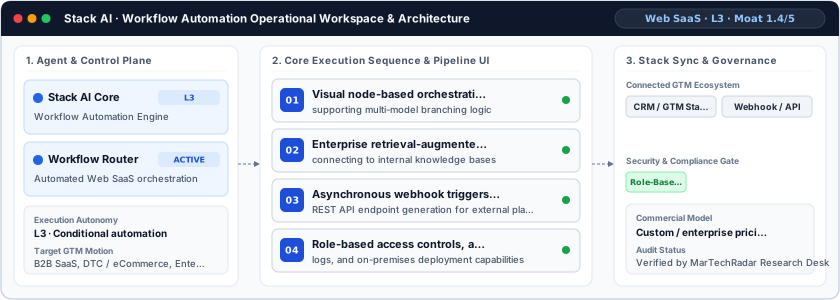
- Visual node-based orchestration canvas: supporting multi-model branching logic
- Enterprise retrieval-augmented generation pipelines: connecting to internal knowledge bases
- Asynchronous webhook triggers and REST API endpoint generation for external platforms
- Role-based access controls, audit: logs, and on-premises deployment capabilities
Cons: operational limitations & risks
- Rate Limiting and Latency Overhead: High-volume batch operations frequently hit upstream third-party model provider token ceilings, producing throughput bottlenecks when processing large-scale campaign datasets.
- State Management Complexity: Long-running asynchronous workflows requiring multi-step human review struggle with conversational state drift and context window truncation across extended validation loops.
- Schema Drift Vulnerability: Upstream payload mutations in connected CRMs or external endpoints can fail graph nodes silently without rigorous schema validation layers implemented in advance.
Stack AI TCO & deal-breaker stress test
Simulate 12-month stepped TCO, hidden cost multipliers, contract lock-in exposure, and stack failure modes using only facts verified by MarTechRadar Research Desk on 2026-10-15.
Stack AI triggers high-severity friction under your 5-seat / $800/mo constraints. Benchmark the verified subtrack alternatives below before committing.
- Moat Score
- 1.4 / 5.0
- AI Autonomy
- L3
- Free Tier / Trial
- None disclosed
Triggered audit signals & failure modes
- Opaque Enterprise Quoting vs. SMB/Mid-Market BudgetVerified Pricing Ledger
Stack AI does not disclose a public self-serve floor (Custom / enterprise pricing). Buyers with a $800/mo cap face high sales-qualification friction.
- Sales-Gated Contract TermsFact-checked by MarTechRadar Research Desk
Stack AI provides commercial licensing through custom enterprise pricing available on request via sales engagement.
- Primary Operational Bottleneck: Rate Limiting and Latency OverheadAudit by MarTechRadar Research Desk
High-volume batch operations frequently hit upstream third-party model provider token ceilings, producing throughput bottlenecks when processing large-scale campaign datasets.
Test a custom Stack AI budget or stack constraint
Lower 5-seat floor (~$25/mo vs. Custom Quote) · Transparent self-serve entry without mandatory annual lock-in
Lower 5-seat floor (~$20/mo vs. Custom Quote) · Transparent self-serve entry without mandatory annual lock-in
Stack AI AI moat & Workflow Automation positioning
Defensibility rests on enterprise data governance controls, multi-model fallback routing, and native connectors linking enterprise knowledge bases directly into asynchronous execution graphs.
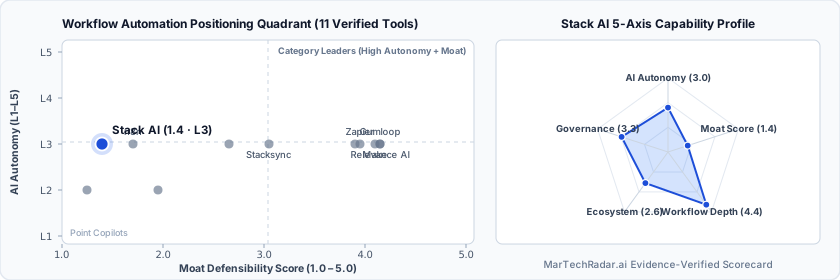
Stack AI in-depth review, pricing & architecture analysis
Editor sign-off: Oct 15, 2026. How profiles are made.
What is Stack AI? Overview & background
Modern growth engineering teams often struggle with the technical overhead of deploying custom generative models into live business systems. Headquartered in the United States, Stack AI addresses this friction by providing a visual orchestration layer that connects foundational language models with internal databases and third-party APIs. Targeted primarily at marketing operations managers, growth engineers, and technical marketers, the system bridges the gap between natural language experimentation and dependable production automation across operational marketing pipelines.
How Stack AI works: architecture & workflow
At its architectural foundation, Stack AI operates as a directed acyclic graph (DAG) engine supporting autonomous Level 3 conditional execution. Inbound data arrives through scheduled webhooks, database listeners, or direct API payloads. The execution pipeline normalizes unstructured text, routes contextual queries through vector index retrievals, and prompts selected language models via optimized API gateways. Dynamic fallbacks manage model latency, while integrated code execution blocks process mathematical transformations before pushing structured JSON payloads back into downstream production destinations.
Stack AI limitations, drawbacks & risks
Operational considerations and platform boundaries include:
- Rate Limiting and Latency Overhead: High-volume batch operations frequently hit upstream third-party model provider token ceilings, producing throughput bottlenecks when processing large-scale campaign datasets.
- State Management Complexity: Long-running asynchronous workflows requiring multi-step human review struggle with conversational state drift and context window truncation across extended validation loops.
- Schema Drift Vulnerability: Upstream payload mutations in connected CRMs or external endpoints can fail graph nodes silently without rigorous schema validation layers implemented in advance.
Stack AI pricing, plans & cost breakdown
Stack AI provides commercial licensing through custom enterprise pricing available on request via sales engagement. Packaging depends on organizational requirements, reflecting consumption metrics such as monthly active workflow runs, team seat allocations, and custom infrastructure options like dedicated VPC deployments or specialized data retention agreements.
| Plan / Tier | Verified Price & Billing | Included Scope & Contract Terms |
|---|---|---|
| Enterprise / Custom | Custom quote | Custom-quoted plan; terms come from the vendor's sales team. |
How Stack AI compares vs. competitors & alternatives
Within the workflow orchestration category, Stack AI competes alongside Gumloop, Relevance AI, and Cassidy AI. While Gumloop focuses heavily on rapid browser automation and Cassidy AI prioritizes collaborative internal knowledge workspaces, Relevance AI emphasizes autonomous agent teams. Stack AI distinguishes itself through its developer-friendly API endpoints and granular data pipeline controls, making it ideal for technical revenue teams seeking stable backend automation without managing raw infrastructure.
Frequently asked questions about Stack AI
Does Stack AI publish pricing or require an enterprise quote?
Stack AI pricing: Custom / enterprise pricing. No free plan is publicly disclosed. Stack AI provides commercial licensing through custom enterprise pricing available on request via sales engagement.
What are the top Stack AI alternatives in Workflow Automation?
Verified Workflow Automation alternatives include Zep ($25–$375/mo · Enterprise plan), MindStudio (Free plan · $20–$24/mo · Enterprise plan), aiFetchly (Free plan · $5–$30/mo), Omnicom Omni (Custom / enterprise pricing). Within the workflow orchestration category, Stack AI competes alongside Gumloop, Relevance AI, and Cassidy AI.
What are the main limitations and trade-offs of Stack AI?
Operational considerations and platform boundaries include: Rate Limiting and Latency Overhead: High-volume batch operations frequently hit upstream third-party model provider token ceilings, producing throughput bottlenecks when processing large-scale campaign datasets. Walk away if you need published self-serve pricing: Stack AI is sold by custom quote.
Verified sources & evidence trail
- Official product domain: https://stack-ai.com
- Commercial pricing verification: Verified against official vendor pricing policy (Custom / enterprise pricing)
- Editor sign-off: Oct 15, 2026 (how profiles are made).
