Stacksync Review (2026): Workflow Automation Pricing, Pros & Cons
Bottom line
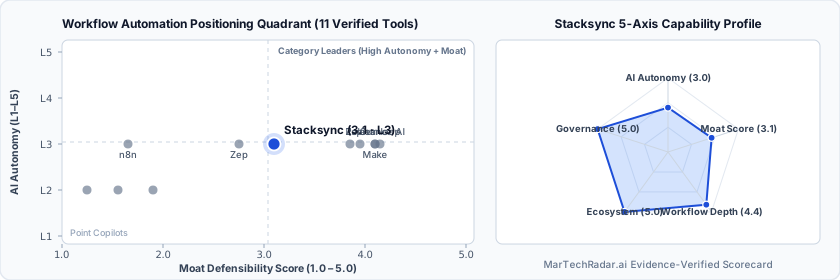
Stacksync is a Cloud SaaS Platform tool for Workflow Automation (No-Code Marketing Workflow Automation) in Agent & Marketing Ops. Pricing: $200–$4,200/mo. Best suited to B2B Marketing and Growth & Revenue Teams. Editor ratings: AI autonomy L3 (conditional automation); moat score 3.1/5.0 (Workflow-embedded (strong)). Fact-checked by MarTechRadar Research Desk on Oct 26, 2026.
Real-time, bi-directional data synchronization and MCP agent infrastructure connecting enterprise CRMs, ERPs, and cloud databases.
Is Stacksync worth it in 2026? Buyer fit & when to walk away
Choose Stacksync if (Best Fit)
- Target ICP & Stack Fit: You operate as B2B Marketing and Growth & Revenue Teams requiring a Cloud SaaS Platform deployment for Workflow Automation, with verified ecosystem connectivity for Salesforce, HubSpot, Slack, Snowflake.
- L3 Architecture & Defensibility: Stacksync builds a deep RevOps and agentic infrastructure moat through its sub-second bi-directional CRM-to-database sync engine, governed Stacksync MCP server and AI Genies, SOC 2 Type II/ISO 27001/HIPAA compliance, and Y Combinator (W24) and Pioneer Fund backing.
- Commercial Model Fit: Your procurement budget aligns with $200–$4,200/mo.
Walk away from Stacksync if (Deal-Breakers)
- Walk away if your team is at early validation stage with a <$250/mo tool budget (Stacksync starts at $200–$4,200/mo before seat or usage expansion).
- Walk away if your workflow cannot tolerate primary operational trade-off: In practical enterprise deployments, the primary trade-off is that core Platform two-way sync tiers start at $1,000/month billed annually (or $3,000/month for Pro with SOC 2/HIPAA and 3 active syncs), positioning the full sync engine for mid-market and enterprise RevOps/engineering stacks rather than hobbyist no-code zaps.
- Walk away if functional scope boundary is a deal-breaker for your team: Stacksync is not built for front-end visual ad graphic design, social media post scheduling, or standalone cold email copywriting.
Stacksync pricing, free plan & scorecard at a glance
| Pricing | $200–$4,200/moVendor pricing page |
|---|---|
| Free plan | No / not disclosed |
| Delivery | Cloud SaaS Platform |
| Audience | B2B Marketing, Growth & Revenue Teams |
| AI autonomy level | L3 · Conditional automationEditor-verified |
| Moat tier & score | 3.1 / 5.0 · Workflow-embedded (strong)Editor-verified |
| Funding | Pre-seed |
| Total funding | $500KBacked by Y Combinator, Pioneer Fund, Eight Capital |
| Founders | Alexis Favre, Ruben Burdin |
| Company size | 11-50 employees |
| Ecosystem integrations | Salesforce, HubSpot, Slack, Snowflake, Google BigQuery, Model Context Protocol (MCP) |
| Compliance & governance | SOC 2, HIPAA, ISO 27001 |
| Headquarters | San Francisco, California, United States |
| Founded | 2022 |
| Last verified | Oct 26, 2026 |
Stacksync pros & cons: strengths vs. operational limitations
Pros: core strengths & capabilities
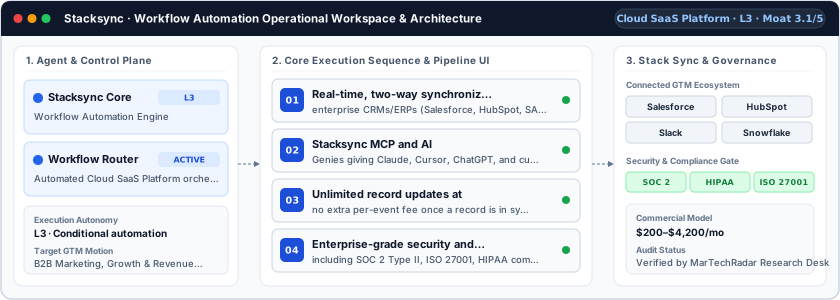
- Real-time, two-way synchronization between: enterprise CRMs/ERPs (Salesforce, HubSpot, SAP, NetSuite) and databases (Postgres, BigQuery, Snowflake, Supabase)
- Stacksync MCP and AI: Genies giving Claude, Cursor, ChatGPT, and custom agents governed, auditable read/write access to live CRM and ERP workflows
- Unlimited record updates at: no extra per-event fee once a record is in sync, eliminating CRM API rate-limit bottlenecks
- Enterprise-grade security and governance: including SOC 2 Type II, ISO 27001, HIPAA compliance, config-as-code, and multi-region processing
Cons: operational limitations & risks
- Primary Operational Trade-Off: In practical enterprise deployments, the primary trade-off is that core Platform two-way sync tiers start at $1,000/month billed annually (or $3,000/month for Pro with SOC 2/HIPAA and 3 active syncs), positioning the full sync engine for mid-market and enterprise RevOps/engineering stacks rather than hobbyist no-code zaps.
- Functional Scope Boundary: Stacksync is not built for front-end visual ad graphic design, social media post scheduling, or standalone cold email copywriting.
- Deployment & Governance Considerations: Additionally, because bi-directional sync allows database mutations to overwrite production CRM or ERP records instantaneously, teams must configure field-level write permissions, conflict resolution rules, and staging environments before enabling production write-back.
Stacksync TCO & deal-breaker stress test
Simulate 12-month stepped TCO, hidden cost multipliers, contract lock-in exposure, and stack failure modes using only facts verified by MarTechRadar Research Desk on 2026-10-26 · Capture SHA 96e6a54b.
Stacksync aligns with your 5-seat / $800/mo profile. Review the walk-away triggers and contract levers below before deployment.
- Moat Score
- 3.1 / 5.0
- AI Autonomy
- L3
- Free Tier / Trial
- None disclosed
Triggered audit signals & failure modes
- Published Self-Serve Entry FloorVerified Pricing Ledger
Stacksync publishes a transparent entry point ($200–$4,200/mo) for initial validation before committing.
- Primary Operational Bottleneck: Primary Operational Trade-OffAudit by MarTechRadar Research Desk
In practical enterprise deployments, the primary trade-off is that core Platform two-way sync tiers start at $1,000/month billed annually (or $3,000/month for Pro with SOC 2/HIPAA and 3 active syncs), positioning the full sync engine for mid-market and enterprise RevOps/engineering stacks rather than hobbyist no-code zaps.
Test a custom Stacksync budget or stack constraint
Lower 5-seat floor (~$25/mo vs. From $200 / mo)
Stacksync integrations, API, security & compliance stack
Stacksync AI moat & Workflow Automation positioning
Stacksync builds a deep RevOps and agentic infrastructure moat through its sub-second bi-directional CRM-to-database sync engine, governed Stacksync MCP server and AI Genies, SOC 2 Type II/ISO 27001/HIPAA compliance, and Y Combinator (W24) and Pioneer Fund backing.
Stacksync in-depth review, pricing & architecture analysis
Audited by MarTechRadar Research Desk (Evidence-Ledger Verified) on Oct 26, 2026.
What is Stacksync? Overview & background
Stacksync is a real-time, bi-directional data synchronization and governed AI agent infrastructure platform built for RevOps architects, GTM engineering teams, and enterprise data leaders. Founded in 2022 by Alexis Favre and Ruben Burdin and headquartered in San Francisco, California, the Y Combinator (Winter 2024) company operates with 11 to 50 employees (34 team members reported on YC) and has raised $500K in Pre-Seed funding from Y Combinator, Pioneer Fund, and Eight Capital. By keeping CRMs (such as Salesforce and HubSpot), ERPs (SAP, NetSuite), and cloud databases (Postgres, BigQuery, Snowflake) in lockstep in real time—and exposing them safely via Model Context Protocol (MCP)—Stacksync captures high-intent demand for real time two way crm database sync, stacksync pricing, and a hightouch vs census alternative for revops.
How Stacksync works: architecture & workflow
At the technical core of Stacksync is a deterministic, event-driven Change Data Capture (CDC) and conflict-resolution engine paired with Stacksync MCP and AI Genies. Unlike one-way Reverse ETL tools that batch-copy warehouse tables into CRMs on delayed schedules, Stacksync establishes a live bi-directional link in minutes with zero boilerplate code: an edit made by a sales rep in Salesforce or HubSpot updates Postgres or BigQuery within milliseconds, and backend database updates or AI enrichment scores immediately write back to the CRM while automatically handling API rate limits, retries, and schema drift. With Stacksync MCP and AI Genies, enterprises can also grant Claude, ChatGPT, Cursor, or internal GTM agents governed, policy-enforced execution rails with full audit logs under SOC 2 Type II, ISO 27001, and HIPAA compliance.
Stacksync limitations, drawbacks & risks
Operational considerations and platform boundaries include:
- Primary Operational Trade-Off: In practical enterprise deployments, the primary trade-off is that core Platform two-way sync tiers start at $1,000/month billed annually (or $3,000/month for Pro with SOC 2/HIPAA and 3 active syncs), positioning the full sync engine for mid-market and enterprise RevOps/engineering stacks rather than hobbyist no-code zaps.
- Functional Scope Boundary: Stacksync is not built for front-end visual ad graphic design, social media post scheduling, or standalone cold email copywriting.
- Deployment & Governance Considerations: Additionally, because bi-directional sync allows database mutations to overwrite production CRM or ERP records instantaneously, teams must configure field-level write permissions, conflict resolution rules, and staging environments before enabling production write-back.
Stacksync pricing, plans & cost breakdown
AI Agents (Genies) from $200/mo billed annually; Platform Starter at $1,000/mo, Pro at $3,000/mo, Managed Pro at $4,200/mo billed annually, plus usage tiers by synced records. On its official pricing page (stacksync.com/pricing), Stacksync offers an AI Agents (Genies) tier at $200/month billed annually ($200 credits included and Slack/Claude/Teams/MCP access) and an Enterprise OS tier from $5/month per app. For core two-way data synchronization (with unlimited updates per synced record), annual plans include Starter at $1,000/month (1 active sync, 50K records), Pro at $3,000/month (3 active syncs, SOC 2 Type II, ISO 27001, HIPAA, and Management API), Managed Pro at $4,200/month, and custom Enterprise plans, plus per-1,000 record overage tiers ($8 down to $0.10 per 1,000 records).
How Stacksync compares vs. competitors & alternatives
In the GTM workflow automation, CRM data integration, and agentic infrastructure market, Stacksync competes with Zapier Central for Marketing, Make.com Marketing Agents, n8n, and Reverse ETL platforms, alongside verified CAT-09 peers such as Hawky, Soku AI, and Sedric AI. Compared to fragile one-way webhook chains in Zapier or batch Reverse ETL pipelines that cannot handle sub-second two-way state consistency between Salesforce and Postgres, Stacksync differentiates itself through true bi-directional real-time sync and governed MCP agent execution. RevOps, GTM engineering, and enterprise AI teams should evaluate Stacksync as their foundational CRM data layer.
Frequently asked questions about Stacksync
How much does Stacksync cost in 2026?
Stacksync pricing: $200–$4,200/mo. No free plan is publicly disclosed. AI Agents (Genies) from $200/mo billed annually; Platform Starter at $1,000/mo, Pro at $3,000/mo, Managed Pro at $4,200/mo billed annually, plus usage tiers by synced records.
What are the top Stacksync alternatives in Workflow Automation?
Verified Workflow Automation alternatives include n8n (Free plan · €20/mo · Enterprise plan), Sedric AI (Pricing not disclosed), Agents (Usage-based pricing), Zep ($25–$375/mo · Enterprise plan). In the GTM workflow automation, CRM data integration, and agentic infrastructure market, Stacksync competes with Zapier Central for Marketing, Make.com Marketing Agents, n8n, and Reverse ETL platforms, alongside verified CAT-09 peers such as Hawky, Soku AI, and Sedric AI.
Verified sources & evidence trail
- Official product domain: https://www.stacksync.com
- Commercial pricing verification: https://www.stacksync.com/pricing
- Verified corporate entity profiles (
sameAs): LinkedIn Company Profile · Crunchbase Entity Record - Editorial audit sign-off: Audited by MarTechRadar Research Desk (Evidence-Ledger Verified) on Oct 26, 2026.
