Voiceflow Review (2026): AI Calling Pricing, Pros & Cons
Bottom line
Voiceflow is a Web SaaS tool for AI Calling (Conversational Voice Calling Agents) in AI SDR & Outbound. Pricing: Custom / enterprise pricing. Best suited to Customer Support & CX Teams and Enterprise Brands. Editor ratings: AI autonomy L3 (conditional automation); moat score 4.4/5.0 (Proprietary moat (category leader)). Fact-checked by MarTechRadar Research Desk on Oct 24, 2026.
Enterprise AI agent platform that customer support and CX teams use to build, test, and deploy conversational AI agents across chat and voice.
Is Voiceflow worth it in 2026? Buyer fit & when to walk away
Choose Voiceflow if (Best Fit)
- Target ICP & Stack Fit: You operate as Customer Support & CX Teams and Enterprise Brands requiring a Web SaaS deployment for AI Calling.
- L3 Architecture & Defensibility: Combines an enterprise AI agent platform with production APIs, SDKs, model-agnostic LLM routing, modular state management, and human handoff governance for customer support and CX teams.
- Commercial Model Fit: Your procurement budget aligns with Custom / enterprise pricing.
Walk away from Voiceflow if (Deal-Breakers)
- Walk away if you need published self-serve pricing: Voiceflow is sold by custom quote.
- Walk away if your workflow cannot tolerate state machine complexity: Large enterprise support workflows spanning hundreds of nested decision nodes and custom API calls require disciplined state architecture and version control during concurrent multi-team updates.
- Walk away if API rate limits and latency is a deal-breaker for your team: Real-time phone and voice agent deployments face cumulative latency penalties when downstream third-party LLMs or enterprise CRM webhook services experience throttling or response spikes.
Voiceflow pricing, free plan & scorecard at a glance
| Pricing | Custom / enterprise pricing |
|---|---|
| Free plan | No / not disclosed |
| Delivery | Web SaaS |
| Audience | Customer Support & CX Teams, Enterprise Brands |
| AI autonomy level | L3 · Conditional automationEditor-verified |
| Moat tier & score | 4.4 / 5.0 · Proprietary moat (category leader)Editor-verified |
| Funding | Venture-backed |
| Total funding | $39M |
| Founders | Andrew Lawrence, Braden Ream, Michael Hood, Tyler Han |
| Company size | 201-500 employees |
| Governance & docs | Trust & Security ↗ · System Status ↗ · API & Docs ↗ · Changelog ↗ · Terms ↗ · Privacy ↗ |
| Headquarters | San Francisco, California |
| Founded | 2019 |
| Last verified | Oct 24, 2026 |
Voiceflow pros & cons: strengths vs. operational limitations
Pros: core strengths & capabilities
- Enterprise AI agent builder: with APIs, SDKs, and multi-channel deployment across chat and phone
- Model-agnostic LLM router integrating: OpenAI, Anthropic, and custom enterprise endpoints
- Tier-1 customer support automation: with structured human agent handoff and response guardrails
- Enterprise governance: with workspace partitioning, role-based access, and vector knowledge retrieval
Cons: operational limitations & risks
- State Machine Complexity: Large enterprise support workflows spanning hundreds of nested decision nodes and custom API calls require disciplined state architecture and version control during concurrent multi-team updates.
- API Rate Limits and Latency: Real-time phone and voice agent deployments face cumulative latency penalties when downstream third-party LLMs or enterprise CRM webhook services experience throttling or response spikes.
- Schema Maintenance Overhead: External knowledge base synchronizations require strict periodic schema curation, as poorly formatted ingestion feeds produce fallback escalations in complex customer support branches.
Voiceflow TCO & deal-breaker stress test
Simulate 12-month stepped TCO, hidden cost multipliers, contract lock-in exposure, and stack failure modes using only facts verified by MarTechRadar Research Desk on 2026-10-24.
Voiceflow triggers high-severity friction under your 5-seat / $800/mo constraints. Benchmark the verified subtrack alternatives below before committing.
- Moat Score
- 4.4 / 5.0
- AI Autonomy
- L3
- Free Tier / Trial
- None disclosed
Triggered audit signals & failure modes
- Opaque Enterprise Quoting vs. SMB/Mid-Market BudgetVerified Pricing Ledger
Voiceflow does not disclose a public self-serve floor (Custom / enterprise pricing). Buyers with a $800/mo cap face high sales-qualification friction.
- Sales-Gated Contract TermsFact-checked by MarTechRadar Research Desk
Commercial procurement for Voiceflow operates under custom enterprise pricing available on request through tailored enterprise sales quotes based on organizational scale and usage volume.
- Primary Operational Bottleneck: State Machine ComplexityAudit by MarTechRadar Research Desk
Large enterprise support workflows spanning hundreds of nested decision nodes and custom API calls require disciplined state architecture and version control during concurrent multi-team updates.
Test a custom Voiceflow budget or stack constraint
Lower 5-seat floor (~$49/mo vs. Custom Quote) · Transparent self-serve entry without mandatory annual lock-in
Voiceflow AI moat & AI Calling positioning
Combines an enterprise AI agent platform with production APIs, SDKs, model-agnostic LLM routing, modular state management, and human handoff governance for customer support and CX teams.
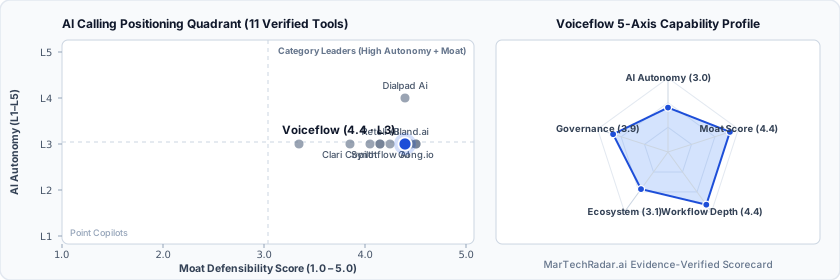
Voiceflow in-depth review, pricing & architecture analysis
Editor sign-off: Oct 24, 2026. How profiles are made.
What is Voiceflow? Overview & background
Architectural fragmentation between conversational designers and software engineers often degrades customer support rollouts into brittle codebases. Voiceflow addresses this divide as an enterprise AI agent platform for customer support and CX teams. Headquartered in San Francisco, California and founded in 2019, the organization has secured $39M in venture funding. Built for customer support organizations, CX leaders, and production engineering teams, the platform enables enterprises to build, test, and deploy AI agents across chat and voice, automating tier-1 support inquiries, handing off cleanly to human agents, and maintaining deterministic control over AI responses alongside production APIs, SDKs, and integrations.
How Voiceflow works: architecture & workflow
At its technical core, Voiceflow utilizes an agentic context and directed graph execution engine that manages conversational state transitions across chat and telephony channels. Production teams work within the platform alongside its REST APIs, SDKs, and webhook integrations, passing dialogue context through a model-agnostic routing layer that connects to major LLM providers and proprietary enterprise backends. Operating at an L3 autonomy profile, the platform executes conditional logic, resolves customer support intents, queries embedded vector knowledge bases for retrieval-augmented responses, and orchestrates structured human agent escalations. Runtime telemetry continuously tracks message latency, tier-1 containment rates, dialogue path completion, and intent confidence thresholds.
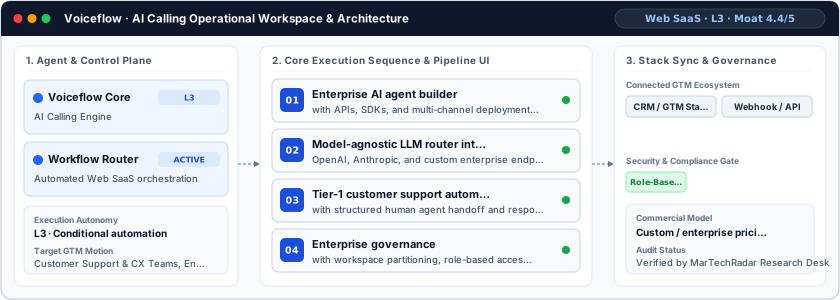
Voiceflow limitations, drawbacks & risks
Operational considerations and platform boundaries include:
- State Machine Complexity: Large enterprise support workflows spanning hundreds of nested decision nodes and custom API calls require disciplined state architecture and version control during concurrent multi-team updates.
- API Rate Limits and Latency: Real-time phone and voice agent deployments face cumulative latency penalties when downstream third-party LLMs or enterprise CRM webhook services experience throttling or response spikes.
- Schema Maintenance Overhead: External knowledge base synchronizations require strict periodic schema curation, as poorly formatted ingestion feeds produce fallback escalations in complex customer support branches.
Voiceflow pricing, plans & cost breakdown
Commercial procurement for Voiceflow operates under custom enterprise pricing available on request through tailored enterprise sales quotes based on organizational scale and usage volume. The commercial framework scales across team and enterprise deployments, adjusting parameters according to active builder seats, workspace governance requirements, and monthly conversational chat and voice volume. Evaluation options include sandbox environments with self-serve model credits, while full production contracts incorporate enterprise service level agreements, dedicated customer success engineering, and custom data processing addenda.
| Plan / Tier | Verified Price & Billing | Included Scope & Contract Terms |
|---|---|---|
| Enterprise / Custom | Custom quote | Custom-quoted plan; terms come from the vendor's sales team. |
How Voiceflow compares vs. competitors & alternatives
Within the Conversational Voice Calling Agents and CX agent ecosystem, Voiceflow differentiates through extensible API/SDK developer control and multi-model AI calling and chat orchestration compared to specialized platforms like PolyAI, Sierra AI, Retell AI, and Synthflow AI. While PolyAI focuses primarily on bespoke managed voice concierge deployments for call centers and Sierra AI targets vertical consumer brand support, Voiceflow provides an extensible enterprise AI agent platform where internal CX and engineering teams build, test, and govern their own chat and voice agents directly alongside production SDKs. Compared to SMB-oriented voice builders like Synthflow AI, Voiceflow enforces deeper enterprise workspace governance and custom API extensibility. The platform is best suited for customer support and CX organizations automating tier-1 chat and phone interactions with strict response control and clean human handoffs.
Direct competitors & market radar
Top algorithmic competitors based on category positioning, capability overlap, and ICP alignment.
Frequently asked questions about Voiceflow
Does Voiceflow publish pricing or require an enterprise quote?
Voiceflow pricing: Custom / enterprise pricing. No free plan is publicly disclosed. Commercial procurement for Voiceflow operates under custom enterprise pricing available on request through tailored enterprise sales quotes based on organizational scale and usage volume.
What are the top Voiceflow alternatives in AI Calling?
Verified AI Calling alternatives include Retell AI (Usage-based pricing), Synthflow AI (From $30,000/yr), Sierra AI (Custom / enterprise pricing), PolyAI ($49–$299/mo · Enterprise plan). Within the Conversational Voice Calling Agents and CX agent ecosystem, Voiceflow differentiates through extensible API/SDK developer control and multi-model AI calling and chat orchestration compared to specialized platforms like PolyAI, Sierra AI, Retell AI, and Synthflow AI.
What are the main limitations and trade-offs of Voiceflow?
Operational considerations and platform boundaries include: State Machine Complexity: Large enterprise support workflows spanning hundreds of nested decision nodes and custom API calls require disciplined state architecture and version control during concurrent multi-team updates. Walk away if you need published self-serve pricing: Voiceflow is sold by custom quote.
Verified sources & evidence trail
- Official product domain: https://www.voiceflow.com
- Commercial pricing verification: Verified against official vendor pricing policy (Custom / enterprise pricing)
- Verified corporate entity profiles (
sameAs): LinkedIn Company Profile · Crunchbase Entity Record - First-party governance & documentation links: Trust & Security · System Status · API & Docs · Changelog · Terms · Privacy
- Editor sign-off: Oct 24, 2026 (how profiles are made).
