Salesloft Review (2026): Cold Email Pricing, Pros & Cons
Bottom line
Salesloft is a Web SaaS tool for Cold Email (Cold Email Sequences & Mailbox Infra) in AI SDR & Outbound. Pricing: Custom / enterprise pricing. Best suited to B2B SaaS, DTC / eCommerce and Enterprise Brands. Editor ratings: AI autonomy L3 (conditional automation); moat score 4.7/5.0 (Proprietary moat (category leader)). Fact-checked by MarTechRadar Research Desk on Oct 4, 2026.
Enterprise predictive sales engagement platform orchestrating multi-channel outbound sequences, conversation intelligence, and deal workflow management.
Is Salesloft worth it in 2026? Buyer fit & when to walk away
Choose Salesloft if (Best Fit)
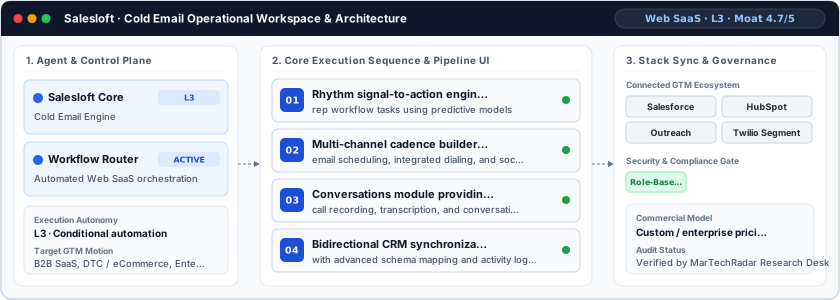
- Target ICP & Stack Fit: You operate as B2B SaaS, DTC / eCommerce and Enterprise Brands requiring a Web SaaS deployment for Cold Email, with verified ecosystem connectivity for Salesforce, HubSpot, Outreach, Twilio Segment.
- L3 Architecture & Defensibility: Proprietary Rhythm workflow engine leveraging historical CRM engagement telemetry, deep native Salesforce integration, and an integrated enterprise revenue stack spanning conversational intelligence and forecasting assets.
- Commercial Model Fit: Your procurement budget aligns with Custom / enterprise pricing.
Walk away from Salesloft if (Deal-Breakers)
- Walk away if you need published self-serve pricing: Salesloft is sold by custom quote.
- Walk away if your workflow cannot tolerate mailbox deliverability infrastructure: Unlike specialized cold outreach systems, the platform lacks native automated secondary domain purchasing, DNS rotation, and built-in programmatic mailbox warming pools, requiring external tooling for high-volume cold outreach.
- Walk away if CRM schema latency is a deal-breaker for your team: High-volume bidirectional sync with complex, highly customized Salesforce or HubSpot schemas can introduce sync queues and event-processing latency during peak operational hours.
Salesloft pricing, free plan & scorecard at a glance
| Pricing | Custom / enterprise pricingVendor pricing page |
|---|---|
| Free plan | No / not disclosed |
| Delivery | Web SaaS |
| Audience | B2B SaaS, DTC / eCommerce, Enterprise Brands |
| AI autonomy level | L3 · Conditional automationEditor-verified |
| Moat tier & score | 4.7 / 5.0 · Proprietary moat (category leader)Editor-verified |
| Funding | AcquiredAcquired by Clari |
| Total funding | $245.0MBacked by Vista Equity Partners |
| Founders | David Cummings, Kyle Porter, Rob Forman, Tim Dorr |
| Company size | 501-1,000 employees |
| Ecosystem integrations | Salesforce, HubSpot, Outreach, Twilio Segment |
| Governance & docs | Trust & Security ↗ · System Status ↗ · Changelog ↗ · Terms ↗ |
| Headquarters | Atlanta, United States |
| Founded | 2011 |
| Last verified | Oct 4, 2026 |
Salesloft pros & cons: strengths vs. operational limitations
Pros: core strengths & capabilities
- Rhythm signal-to-action engine prioritizing: rep workflow tasks using predictive models
- Multi-channel cadence builder covering: email scheduling, integrated dialing, and social touches
- Conversations module providing automated: call recording, transcription, and conversational analytics
- Bidirectional CRM synchronization: with advanced schema mapping and activity logging
Cons: operational limitations & risks
- Mailbox Deliverability Infrastructure: Unlike specialized cold outreach systems, the platform lacks native automated secondary domain purchasing, DNS rotation, and built-in programmatic mailbox warming pools, requiring external tooling for high-volume cold outreach.
- CRM Schema Latency: High-volume bidirectional sync with complex, highly customized Salesforce or HubSpot schemas can introduce sync queues and event-processing latency during peak operational hours.
- Custom Scripting Constraints: Workflow cadences offer rigid trigger branches compared to open headless orchestration tools, limiting algorithmic branching based on external webhooks or proprietary third-party intent data streams.
Salesloft TCO & deal-breaker stress test
Simulate 12-month stepped TCO, hidden cost multipliers, contract lock-in exposure, and stack failure modes using only facts verified by MarTechRadar Research Desk on 2026-10-04.
Salesloft triggers high-severity friction under your 5-seat / $800/mo constraints. Benchmark the verified subtrack alternatives below before committing.
- Moat Score
- 4.7 / 5.0
- AI Autonomy
- L3
- Free Tier / Trial
- None disclosed
Triggered audit signals & failure modes
- Opaque Enterprise Quoting vs. SMB/Mid-Market BudgetVerified Pricing Ledger
Salesloft does not disclose a public self-serve floor (Custom / enterprise pricing). Buyers with a $800/mo cap face high sales-qualification friction.
- Sales-Gated Contract TermsFact-checked by MarTechRadar Research Desk
Commercial pricing is available on request through tailored enterprise sales quotes based on organizational scale and seats.
- Primary Operational Bottleneck: Mailbox Deliverability InfrastructureAudit by MarTechRadar Research Desk
Unlike specialized cold outreach systems, the platform lacks native automated secondary domain purchasing, DNS rotation, and built-in programmatic mailbox warming pools, requiring external tooling for high-volume cold outreach.
Test a custom Salesloft budget or stack constraint
Lower 5-seat floor (~$100/mo vs. Custom Quote) · Transparent self-serve entry without mandatory annual lock-in
Lower 5-seat floor (~$100/mo vs. Custom Quote) · Transparent self-serve entry without mandatory annual lock-in
Salesloft integrations, API, security & compliance stack
Salesloft AI moat & Cold Email positioning
Proprietary Rhythm workflow engine leveraging historical CRM engagement telemetry, deep native Salesforce integration, and an integrated enterprise revenue stack spanning conversational intelligence and forecasting assets.
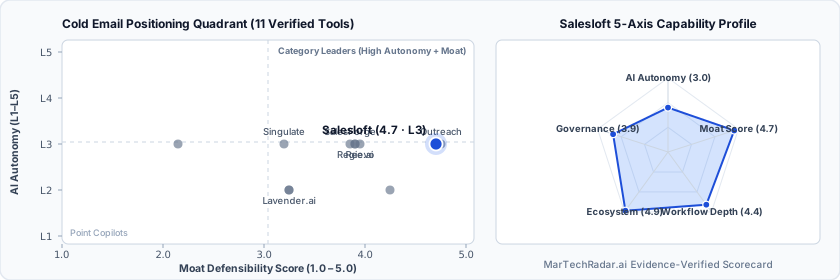
Salesloft in-depth review, pricing & architecture analysis
Editor sign-off: Oct 4, 2026. How profiles are made.
What is Salesloft? Overview & background
Backed by $245.0M in equity financing before major private equity backing and its subsequent consolidation with Clari, Salesloft was founded in 2011 in Atlanta, United States. Built for enterprise sales development representatives, revenue operations leaders, and account executives, the platform addresses multi-channel pipeline execution and opportunity management. It moves beyond basic cold outreach by coordinating inbound and outbound interactions across the entire buyer lifecycle, operating as a central execution fabric for corporate revenue teams.
How Salesloft works: architecture & workflow
At its architectural core, Salesloft relies on its Rhythm orchestration engine, which ingests buyer telemetry across email responses, call recordings, conversation transcripts, and CRM updates. Rather than deploying static linear steps, the platform prioritizes rep workflows dynamically by assigning algorithmic scores to incoming behavioral signals. Bi-directional sync connectors interface with primary CRMs to log communication events, enforce governance rules, and schedule cadence actions without manual data entry overhead.
Salesloft limitations, drawbacks & risks
Operational considerations and platform boundaries include:
- Mailbox Deliverability Infrastructure: Unlike specialized cold outreach systems, the platform lacks native automated secondary domain purchasing, DNS rotation, and built-in programmatic mailbox warming pools, requiring external tooling for high-volume cold outreach.
- CRM Schema Latency: High-volume bidirectional sync with complex, highly customized Salesforce or HubSpot schemas can introduce sync queues and event-processing latency during peak operational hours.
- Custom Scripting Constraints: Workflow cadences offer rigid trigger branches compared to open headless orchestration tools, limiting algorithmic branching based on external webhooks or proprietary third-party intent data streams.
Salesloft pricing, plans & cost breakdown
Commercial pricing is available on request through tailored enterprise sales quotes based on organizational scale and seats. Contracts operate under annual or multi-year enterprise agreements tiered by seat count and feature bundles, with access to advanced conversational intelligence, forecasting integrations, and premium governance controls requiring higher-tier platform packages.
| Plan / Tier | Verified Price & Billing | Included Scope & Contract Terms |
|---|---|---|
| Enterprise / Custom | Custom quote | Custom-quoted plan; terms come from the vendor's sales team. |
How Salesloft compares vs. competitors & alternatives
Within the outbound ecosystem, Salesloft targets enterprise sales organizations requiring strict CRM hygiene and governance within the Cold Email segment. This differs from Instantly.ai, which focuses on high-volume mailbox rotation, distributed domain networks, and automated inbox warming. Meanwhile, specialized writing copilots like Lavender.ai and Autobound.ai focus on dynamic email personalization and prompt scoring at the drafting layer rather than full-cycle pipeline execution.
Direct competitors & market radar
Top algorithmic competitors based on category positioning, capability overlap, and ICP alignment.
Frequently asked questions about Salesloft
Does Salesloft publish pricing or require an enterprise quote?
Salesloft pricing: Custom / enterprise pricing. No free plan is publicly disclosed. Commercial pricing is available on request through tailored enterprise sales quotes based on organizational scale and seats.
What are the top Salesloft alternatives in Cold Email?
Verified Cold Email alternatives include Outreach (Custom / enterprise pricing), 1mind (Custom / enterprise pricing), Rox ($100–$255/mo), Workato (Free plan · $100/mo · Enterprise plan). Within the outbound ecosystem, Salesloft targets enterprise sales organizations requiring strict CRM hygiene and governance within the Cold Email segment.
What are the main limitations and trade-offs of Salesloft?
Operational considerations and platform boundaries include: Mailbox Deliverability Infrastructure: Unlike specialized cold outreach systems, the platform lacks native automated secondary domain purchasing, DNS rotation, and built-in programmatic mailbox warming pools, requiring external tooling for high-volume cold outreach. Walk away if you need published self-serve pricing: Salesloft is sold by custom quote.
Verified sources & evidence trail
- Official product domain: https://salesloft.com
- Commercial pricing verification: https://www.salesloft.com/pricing
- Verified corporate entity profiles (
sameAs): LinkedIn Company Profile · Crunchbase Entity Record - First-party governance & documentation links: Trust & Security · System Status · Changelog · Terms
- Editor sign-off: Oct 4, 2026 (how profiles are made).
