Autobound.ai Review (2026): Cold Email Pricing, Pros & Cons
Bottom line
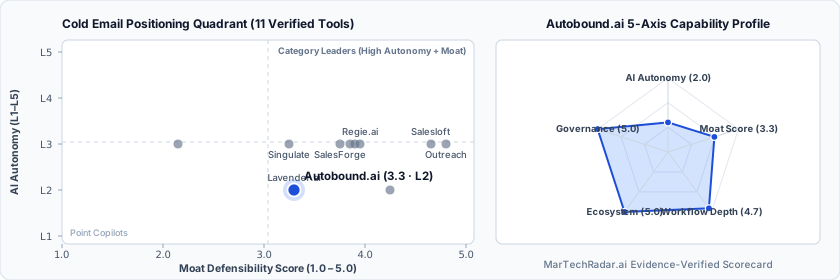
Autobound.ai is a Web SaaS tool for Cold Email (Cold Email Sequences & Mailbox Infra) in AI SDR & Outbound. Pricing: Free plan · $19–$149/mo. Best suited to B2B SaaS, DTC / eCommerce and Enterprise Brands. Editor ratings: AI autonomy L2 (workflow copilot); moat score 3.3/5.0 (Workflow-embedded (strong)). Fact-checked by MarTechRadar Research Desk on Oct 12, 2026.
B2B signal intelligence engine and generative sales copilot synthesizing live buying triggers into hyper-personalized outbound email copy via REST API.
Is Autobound.ai worth it in 2026? Buyer fit & when to walk away
Choose Autobound.ai if (Best Fit)
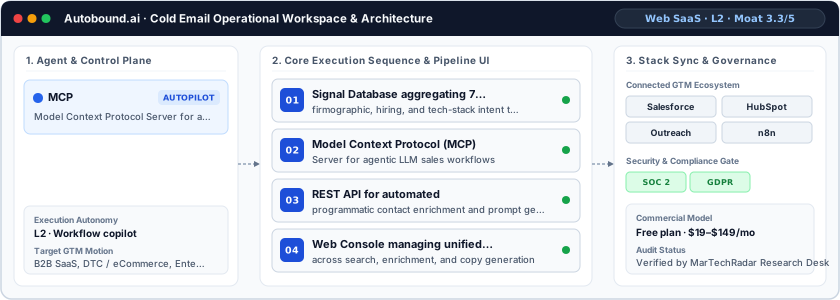
- Target ICP & Stack Fit: You operate as B2B SaaS, DTC / eCommerce and Enterprise Brands requiring a Web SaaS deployment for Cold Email, with verified ecosystem connectivity for Salesforce, HubSpot, Outreach, n8n.
- L2 Architecture & Defensibility: Deep integration of proprietary B2B signal ingestion (700+ triggers) with an extensible Model Context Protocol (MCP) server interface, bridging intent datasets directly into generative sales workflows.
- Commercial Model Fit: Your procurement budget aligns with Free plan · $19–$149/mo and want a self-serve free tier for zero-cost initial validation.
Walk away from Autobound.ai if (Deal-Breakers)
- Walk away if your workflow cannot tolerate signal latency & false positives: External intent events can experience indexing delays, occasionally generating outreach copy grounded in outdated hiring announcements or stale corporate news.
- Walk away if credit consumption volatility is a deal-breaker for your team: Multi-attribute enrichment and iterative LLM prompt re-generations draw rapidly against shared credit allocations, complicating forecasting for high-velocity outbound teams.
Autobound.ai pricing, free plan & scorecard at a glance
| Pricing | Free plan · $19–$149/moVendor pricing page |
|---|---|
| Free plan | Yes |
| Delivery | Web SaaS |
| Audience | B2B SaaS, DTC / eCommerce, Enterprise Brands |
| AI autonomy level | L2 · Workflow copilotEditor-verified |
| Moat tier & score | 3.3 / 5.0 · Workflow-embedded (strong)Editor-verified |
| Funding | Seed |
| Total funding | $4MBacked by Dundee Venture Capital |
| Founders | Daniel Wiener, Kyle Schuster, Tanner McRae |
| Company size | 2-10 employees |
| Ecosystem integrations | Salesforce, HubSpot, Outreach, n8n, Model Context Protocol (MCP) |
| Compliance & governance | SOC 2, GDPR |
| Governance & docs | Trust & Security ↗ · API & Docs ↗ · Privacy ↗ |
| Headquarters | San Francisco, CA |
| Founded | 2018 |
| Last verified | Oct 12, 2026 |
Autobound.ai pros & cons: strengths vs. operational limitations
Pros: core strengths & capabilities
- Signal Database aggregating 700+: firmographic, hiring, and tech-stack intent triggers
- Model Context Protocol (MCP): Server for agentic LLM sales workflows
- REST API for automated: programmatic contact enrichment and prompt generation
- Web Console managing unified credits: across search, enrichment, and copy generation
Cons: operational limitations & risks
- Signal Latency & False Positives: External intent events can experience indexing delays, occasionally generating outreach copy grounded in outdated hiring announcements or stale corporate news.
- Credit Consumption Volatility: Multi-attribute enrichment and iterative LLM prompt re-generations draw rapidly against shared credit allocations, complicating forecasting for high-velocity outbound teams.
- Infrastructure Decoupling: Lacking native SMTP sending pools and inbox-rotation infrastructure, Autobound requires continuous schema alignment and synchronization with external mail-dispatch tooling.
Autobound.ai TCO & deal-breaker stress test
Simulate 12-month stepped TCO, hidden cost multipliers, contract lock-in exposure, and stack failure modes using only facts verified by MarTechRadar Research Desk on 2026-10-12 · Capture SHA 989d4a4a.
Autobound.ai aligns with your 5-seat / $800/mo profile. Review the walk-away triggers and contract levers below before deployment.
- Moat Score
- 3.3 / 5.0
- AI Autonomy
- L2
- Free Tier / Trial
- Free plan
Triggered audit signals & failure modes
- Published Self-Serve Entry FloorVerified Pricing Ledger
Autobound.ai publishes a transparent entry point (Free plan · $19–$149/mo) with a free tier for initial validation before committing.
- Tier Fit for 5-Seat Scale: Teams ($149/mo)Verified Tier Schedule
Verified $149/mo Teams tier from vendor pricing schedule.
- Primary Operational Bottleneck: Credit Consumption VolatilityAudit by MarTechRadar Research Desk
Multi-attribute enrichment and iterative LLM prompt re-generations draw rapidly against shared credit allocations, complicating forecasting for high-velocity outbound teams.
Test a custom Autobound.ai budget or stack constraint
Lower 5-seat floor (~$10/mo vs. $149 / mo)
Lower 5-seat floor (~$47/mo vs. $149 / mo)
Autobound.ai integrations, API, security & compliance stack
Model Context Protocol Server for agentic LLM sales workflows
Autobound.ai AI moat & Cold Email positioning
Deep integration of proprietary B2B signal ingestion (700+ triggers) with an extensible Model Context Protocol (MCP) server interface, bridging intent datasets directly into generative sales workflows.
Autobound.ai in-depth review, pricing & architecture analysis
Editor sign-off: Oct 12, 2026. How profiles are made.
What is Autobound.ai? Overview & background
Backed by $4M in venture capital and established in 2018, Autobound.ai operates from San Francisco, CA, targeting sales development representatives, revenue operations leaders, and outbound growth agencies. The platform addresses cold email fatigue by transforming external intent signals into contextual outbound copy. Rather than relying on static mail merge templates, Autobound acts as an intelligence layer that continuously monitors prospect triggers to dynamically assemble relevant outreach messaging.
How Autobound.ai works: architecture & workflow
Autobound functions at an L2 autonomy tier, combining a signal database of over 700 buying triggers with an integrated REST API and Model Context Protocol server. The ingestion pipeline tracks corporate hiring shifts, executive movements, technological deployments, and financial filings. When a seller queries a contact via the web console or API, the engine scores contextual relevance, passes structured attributes into a generative language model, and outputs structured value propositions that align specific buyer pain points with corresponding product capabilities, alongside native workflow integrations for Salesforce, HubSpot, and n8n under verified SOC 2 Type II and GDPR governance controls.
Autobound.ai limitations, drawbacks & risks
Operational considerations and platform boundaries include:
- Signal Latency & False Positives: External intent events can experience indexing delays, occasionally generating outreach copy grounded in outdated hiring announcements or stale corporate news.
- Credit Consumption Volatility: Multi-attribute enrichment and iterative LLM prompt re-generations draw rapidly against shared credit allocations, complicating forecasting for high-velocity outbound teams.
- Infrastructure Decoupling: Lacking native SMTP sending pools and inbox-rotation infrastructure, Autobound requires continuous schema alignment and synchronization with external mail-dispatch tooling.
Autobound.ai pricing, plans & cost breakdown
Autobound operates on a credit-based subscription model. A free tier allows initial pipeline evaluation, while commercial self-serve subscriptions scale from $19 to $149 per month based on allocated credit volume. Credits govern both signal search queries and enrichment generations across the web console, REST API, and MCP endpoints, with larger operational deployments requiring enterprise agreements to support scaled programmatic API consumption.
| Plan / Tier | Verified Price & Billing | Included Scope & Contract Terms | |
|---|---|---|---|
| Free / Sandbox | $0 | Free plan or free tier offered by the vendor. | |
| Starter | $19/mo | Testing & POC | |
| Teams | $149/mo | Verified $149/mo Teams tier from vendor pricing schedule. | |
| Contract Watchout: Annual Billing Headline vs. Monthly Premium | The vendor pricing page advertises an annual-billing discount (Save 5%); month-to-month billing carries a higher effective monthly rate. | ||
How Autobound.ai compares vs. competitors & alternatives
Within the outbound ecosystem, Autobound contrasts directly with execution-focused dispatch networks and inbox infrastructure providers like Instantly.ai, which prioritize deliverability and mailbox warmups over deep external signal processing. Compared to conversational writing assistants such as Lavender.ai that evaluate drafted text within an email composer, Autobound prioritizes upfront trigger discovery via its MCP architecture. While enterprise sales suites like Outreach provide comprehensive pipeline execution, Autobound functions upstream as a specialized context-enrichment and personalization engine for signal-driven outbound teams.
Direct competitors & market radar
Top algorithmic competitors based on category positioning, capability overlap, and ICP alignment.
Frequently asked questions about Autobound.ai
How much does Autobound.ai cost in 2026?
Autobound.ai pricing: Free plan · $19–$149/mo. A permanent free plan is available. Published tiers: Free / Sandbox ($0); Starter ($19/mo); Teams ($149/mo). Autobound operates on a credit-based subscription model. A free tier allows initial pipeline evaluation, while commercial self-serve subscriptions scale from $19 to $149 per month based on allocated credit volume.
What are the top Autobound.ai alternatives in Cold Email?
Verified Cold Email alternatives include Outreach (Custom / enterprise pricing), Salesloft (Custom / enterprise pricing), Instantly.ai ($47–$358/mo · Enterprise plan), Lavender.ai (Custom / enterprise pricing). Within the outbound ecosystem, Autobound contrasts directly with execution-focused dispatch networks and inbox infrastructure providers like Instantly.ai, which prioritize deliverability and mailbox warmups over deep external signal processing.
What are the main limitations and trade-offs of Autobound.ai?
Operational considerations and platform boundaries include: Signal Latency & False Positives: External intent events can experience indexing delays, occasionally generating outreach copy grounded in outdated hiring announcements or stale corporate news. Walk away if your workflow cannot tolerate signal latency & false positives: External intent events can experience indexing delays, occasionally generating outreach copy grounded in outdated hiring announcements or stale corporate news.
Verified sources & evidence trail
- Official product domain: https://autobound.ai
- Commercial pricing verification: https://www.autobound.ai/pricing
- Verified corporate entity profiles (
sameAs): LinkedIn Company Profile · Crunchbase Entity Record - First-party governance & documentation links: Trust & Security · API & Docs · Privacy
- Editor sign-off: Oct 12, 2026 (how profiles are made).
