ZoomInfo (Copilot) Review (2026): Sales Intelligence Pricing, Pros & Cons
Bottom line
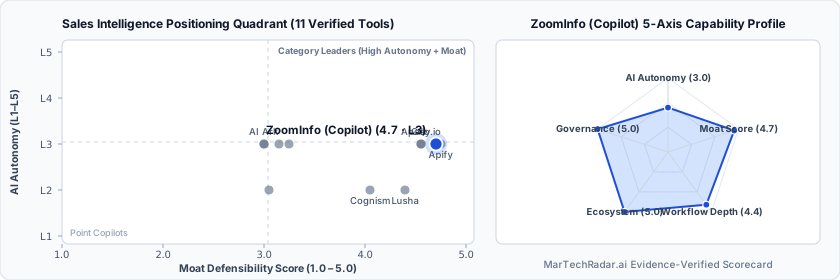
ZoomInfo (Copilot) is a Web SaaS tool for Sales Intelligence (Lead Enrichment & Waterfall Orchestration) in AI SDR & Outbound. Pricing: Custom / enterprise pricing. Best suited to B2B SaaS. Editor ratings: AI autonomy L3 (conditional automation); moat score 4.7/5.0 (Proprietary moat (category leader)). Fact-checked by MarTechRadar Research Desk on Oct 14, 2026.
ZoomInfo Copilot combines proprietary B2B data graphs with predictive account intelligence and generative AI to orchestrate targeted enterprise outreach.
Is ZoomInfo (Copilot) worth it in 2026? Buyer fit & when to walk away
Choose ZoomInfo (Copilot) if (Best Fit)
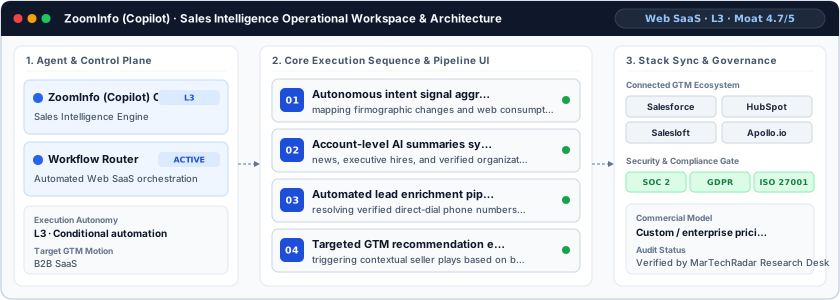
- Target ICP & Stack Fit: You operate as B2B SaaS requiring a Web SaaS deployment for Sales Intelligence, with verified ecosystem connectivity for Salesforce, HubSpot, Salesloft, Apollo.io.
- L3 Architecture & Defensibility: ZoomInfo holds a deep competitive moat via decades of proprietary phone-verified contact records, real-time corporate hierarchy graphs, and native integration into enterprise sales engagement workflows.
- Commercial Model Fit: Your procurement budget aligns with Custom / enterprise pricing.
Walk away from ZoomInfo (Copilot) if (Deal-Breakers)
- Walk away if you need published self-serve pricing: ZoomInfo (Copilot) is sold by custom quote.
- Walk away if your workflow cannot tolerate enrichment freshness latency: Rapidly shifting SMB titles and secondary contact data experience verification delays, requiring manual fallback validation for emerging startup accounts.
- Walk away if CRM sync overhead is a deal-breaker for your team: High-velocity signal ingestion can cause field-mapping collisions and duplicate record churn inside customized Salesforce or HubSpot architectures.
ZoomInfo (Copilot) pricing, free plan & scorecard at a glance
| Pricing | Custom / enterprise pricing |
|---|---|
| Free plan | No / not disclosed |
| Delivery | Web SaaS |
| Audience | B2B SaaS |
| AI autonomy level | L3 · Conditional automationEditor-verified |
| Moat tier & score | 4.7 / 5.0 · Proprietary moat (category leader)Editor-verified |
| Funding | AcquiredAcquired by DiscoverOrg |
| Total funding | $8.6M |
| Founders | Henry Schuck, Jeremy Rothman-Shore, Kosmas Karadimitriou, Yonatan Stern |
| Company size | 1,001-5,000 employees |
| Ecosystem integrations | Salesforce, HubSpot, Salesloft, Apollo.io, Snowflake, Twilio Segment |
| Compliance & governance | SOC 2, GDPR, ISO 27001 |
| Governance & docs | Trust & Security ↗ · System Status ↗ · Terms ↗ · Privacy ↗ |
| Headquarters | Vancouver, Washington |
| Founded | 2000 |
| Last verified | Oct 14, 2026 |
ZoomInfo (Copilot) pros & cons: strengths vs. operational limitations
Pros: core strengths & capabilities
- Autonomous intent signal aggregation: mapping firmographic changes and web consumption spikes to named accounts
- Account-level AI summaries synthesizing: news, executive hires, and verified organizational tech stacks
- Automated lead enrichment pipelines: resolving verified direct-dial phone numbers and corporate emails
- Targeted GTM recommendation engine: triggering contextual seller plays based on buying committee interactions
Cons: operational limitations & risks
- Enrichment Freshness Latency: Rapidly shifting SMB titles and secondary contact data experience verification delays, requiring manual fallback validation for emerging startup accounts.
- CRM Sync Overhead: High-velocity signal ingestion can cause field-mapping collisions and duplicate record churn inside customized Salesforce or HubSpot architectures.
- Custom Logic Rigidity: Autonomous recommendation rules offer limited programmatic flexibility for teams attempting complex, multi-provider waterfall enrichment chains outside the ZoomInfo catalog.
ZoomInfo (Copilot) TCO & deal-breaker stress test
Simulate 12-month stepped TCO, hidden cost multipliers, contract lock-in exposure, and stack failure modes using only facts verified by MarTechRadar Research Desk on 2026-10-14.
ZoomInfo (Copilot) triggers high-severity friction under your 5-seat / $800/mo constraints. Benchmark the verified subtrack alternatives below before committing.
- Moat Score
- 4.7 / 5.0
- AI Autonomy
- L3
- Free Tier / Trial
- None disclosed
Triggered audit signals & failure modes
- Opaque Enterprise Quoting vs. SMB/Mid-Market BudgetVerified Pricing Ledger
ZoomInfo (Copilot) does not disclose a public self-serve floor (Custom / enterprise pricing). Buyers with a $800/mo cap face high sales-qualification friction.
- Sales-Gated Contract TermsFact-checked by MarTechRadar Research Desk
ZoomInfo Copilot operates under an enterprise licensing structure where commercial pricing is available on request through tailored enterprise sales quotes based on organizational scale and seats.
- Primary Operational Bottleneck: Enrichment Freshness LatencyAudit by MarTechRadar Research Desk
Rapidly shifting SMB titles and secondary contact data experience verification delays, requiring manual fallback validation for emerging startup accounts.
Test a custom ZoomInfo (Copilot) budget or stack constraint
Lower 5-seat floor (~$54/mo vs. Custom Quote) · Transparent self-serve entry without mandatory annual lock-in
Lower 5-seat floor (~$245/mo vs. Custom Quote) · Transparent self-serve entry without mandatory annual lock-in
ZoomInfo (Copilot) integrations, API, security & compliance stack
ZoomInfo (Copilot) AI moat & Sales Intelligence positioning
ZoomInfo holds a deep competitive moat via decades of proprietary phone-verified contact records, real-time corporate hierarchy graphs, and native integration into enterprise sales engagement workflows.
ZoomInfo (Copilot) in-depth review, pricing & architecture analysis
Editor sign-off: Oct 14, 2026. How profiles are made.
What is ZoomInfo (Copilot)? Overview & background
Established in 2000 and headquartered in Vancouver, Washington, ZoomInfo secured $8.6M in early funding before its pivotal acquisition by DiscoverOrg, subsequently transforming into an enterprise data infrastructure established platform. Designed for revenue operations leaders and enterprise sales executives, ZoomInfo Copilot shifts the company's core asset—an extensive B2B intelligence database—from passive directory lookup to an active, signal-driven orchestration system for go-to-market teams.
How ZoomInfo (Copilot) works: architecture & workflow
At the architectural layer, the system conditional autonomy, ZoomInfo Copilot continuously ingests first-party CRM telemetry alongside third-party intent indicators, IP-to-firmographic mappings, and job change feeds. Its algorithmic processing layer maps these dynamic events across an integrated corporate entity graph. Once intent thresholds trigger, Copilot synthesizes relevant buyer context via generative models, automatically generating prioritized target lists, enriched contact payloads with verified direct dials, and contextual outbound messaging recommendations for sales reps, alongside native workflow integrations for Snowflake and Salesloft under verified SOC 2 Type II, GDPR, and ISO 27001 governance controls.
ZoomInfo (Copilot) limitations, drawbacks & risks
Operational considerations and platform boundaries include:
- Enrichment Freshness Latency: Rapidly shifting SMB titles and secondary contact data experience verification delays, requiring manual fallback validation for emerging startup accounts.
- CRM Sync Overhead: High-velocity signal ingestion can cause field-mapping collisions and duplicate record churn inside customized Salesforce or HubSpot architectures.
- Custom Logic Rigidity: Autonomous recommendation rules offer limited programmatic flexibility for teams attempting complex, multi-provider waterfall enrichment chains outside the ZoomInfo catalog.
ZoomInfo (Copilot) pricing, plans & cost breakdown
ZoomInfo Copilot operates under an enterprise licensing structure where commercial pricing is available on request through tailored enterprise sales quotes based on organizational scale and seats. Contracts typically require annual or multi-year commitments tiered by data consumption limits, credit allowances for direct dials, and selected application modules across sales and marketing teams.
| Plan / Tier | Verified Price & Billing | Included Scope & Contract Terms |
|---|---|---|
| Enterprise / Custom | Custom quote | Custom-quoted plan; terms come from the vendor's sales team. |
How ZoomInfo (Copilot) compares vs. competitors & alternatives
While agile waterfall orchestrators like Clay provide modular multi-vendor enrichment chaining, and platforms such as Apollo.io deliver cost-effective outbound sequencing for small teams, ZoomInfo Copilot distinguishes itself through superior direct-dial phone verification depth and enterprise-grade governance within the Sales Intelligence segment. Unlike AI Ark, ZoomInfo pairs substantial proprietary identity records with native execution tools, making it best suited for established mid-market and enterprise sales organizations demanding high data compliance and account intelligence.
Direct competitors & market radar
Top algorithmic competitors based on category positioning, capability overlap, and ICP alignment.
Frequently asked questions about ZoomInfo (Copilot)
Does ZoomInfo (Copilot) publish pricing or require an enterprise quote?
ZoomInfo (Copilot) pricing: Custom / enterprise pricing. No free plan is publicly disclosed. ZoomInfo Copilot operates under an enterprise licensing structure where commercial pricing is available on request through tailored enterprise sales quotes based on organizational scale and seats.
What are the top ZoomInfo (Copilot) alternatives in Sales Intelligence?
Verified Sales Intelligence alternatives include Clay (Free plan · $54–$180/mo), Apollo.io (Free plan · $49–$119/seat/mo · Enterprise plan), Cognism (Custom / enterprise pricing), Lusha (Custom / enterprise pricing). While agile waterfall orchestrators like Clay provide modular multi-vendor enrichment chaining, and platforms such as Apollo.io deliver cost-effective outbound sequencing for small teams, ZoomInfo Copilot distinguishes itself through superior direct-dial phone verification depth and enterprise-grade governance within the Sales Intelligence segment.
What are the main limitations and trade-offs of ZoomInfo (Copilot)?
Operational considerations and platform boundaries include: Enrichment Freshness Latency: Rapidly shifting SMB titles and secondary contact data experience verification delays, requiring manual fallback validation for emerging startup accounts. Walk away if you need published self-serve pricing: ZoomInfo (Copilot) is sold by custom quote.
Verified sources & evidence trail
- Official product domain: https://zoominfo.com
- Commercial pricing verification: Verified against official vendor pricing policy (Custom / enterprise pricing)
- Verified corporate entity profiles (
sameAs): LinkedIn Company Profile · Crunchbase Entity Record - First-party governance & documentation links: Trust & Security · System Status · Terms · Privacy
- Editor sign-off: Oct 14, 2026 (how profiles are made).
