Apify Review (2026): Sales Intelligence Pricing, Limits & Alternatives
Bottom line
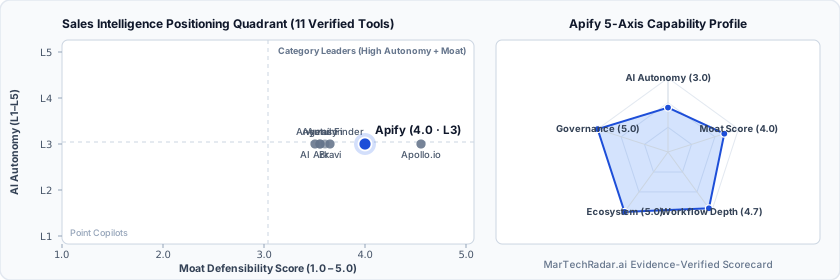
Apify is a SaaS Platform tool for Sales Intelligence (Lead Enrichment & Waterfall Orchestration) in AI SDR & Outbound. Pricing: Free plan · $0/mo · Enterprise plan. Best suited to B2B Marketing & GTM Teams. Editor ratings: AI autonomy L3 (conditional automation); moat score 4.0/5.0 (Proprietary moat). Fact-checked by Tim Fenolz on Oct 23, 2026.
Cloud web scraping and browser automation marketplace offering 2,000+ ready-to-run Actors and MCP servers for GTM lead extraction and AI agents.
Apify buyer fit verdict: when to choose vs. when to walk away
Choose Apify if (Best Fit)
- Target ICP & Stack Fit: You operate as B2B Marketing & GTM Teams requiring a SaaS Platform deployment for Sales Intelligence, with verified ecosystem connectivity for Salesforce, HubSpot, Pipedrive, Outreach.
- L3 Architecture & Defensibility: Apify commands a deep developer and GTM data-extraction moat through its marketplace of thousands of community-maintained scraping Actors, managed anti-blocking proxy infrastructure, and native Model Context Protocol (MCP) server for AI agents.
- Commercial Model Fit: Your procurement budget aligns with Free plan · $0/mo · Enterprise plan and want a self-serve free tier for zero-cost initial validation.
Walk away from Apify if (Deal-Breakers)
- Walk away if your workflow requires uncapped enterprise volume on the Free plan · $0/mo · Enterprise plan entry plan without upgrading tiers.
- Walk away if your workflow cannot tolerate compute unit & residential proxy cost unpredictability: Because complex headless browser Actors and residential proxy traffic consume metered compute units and gigabytes ($8/GB to $19/month+ depending on tier), poorly optimized recursive crawls can exhaust monthly prepaid credits rapidly.
- Walk away if third-party actor maintenance dependency is a deal-breaker for your team: Many popular GTM and social scrapers in the Apify Store are built by independent community developers; when target websites alter their DOM structure or anti-bot defenses, workflows face temporary breakage bottlenecks until the maintainer patches the Actor.
Apify key facts & scorecard
| Pricing | Free plan · $0/mo · Enterprise planVendor pricing page |
|---|---|
| Free plan | Yes |
| Delivery | SaaS Platform |
| Audience | B2B Marketing & GTM Teams |
| AI autonomy level | L3 · Conditional automationEditor-verified |
| Moat tier & score | 4.0 / 5.0 · Proprietary moatEditor-verified |
| Funding | Seed |
| Total funding | $3.5MBacked by Y Combinator, J&T Ventures, Reflex Capital, INCOMMING ventures |
| Founders | Jakub Balada, Jan Čurn |
| Company size | 201-500 employees |
| Ecosystem integrations | Salesforce, HubSpot, Pipedrive, Outreach, Slack, LinkedIn |
| Compliance & governance | SOC 2, GDPR, CCPA |
| Headquarters | Prague, Hlavni mesto Praha, Czech Republic |
| Founded | 2016 |
| Last verified |
Apify pros & cons: strengths vs. operational limitations
Pros: core strengths & capabilities
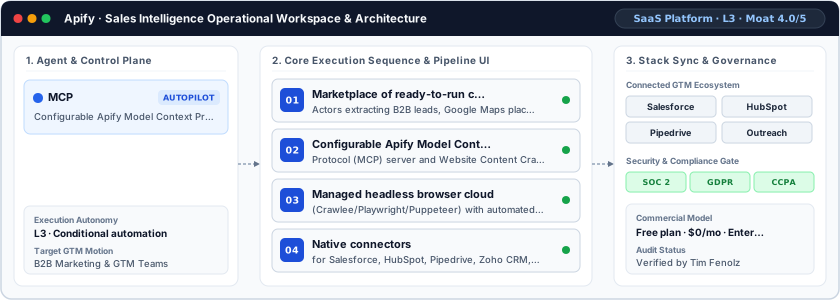
- Marketplace of ready-to-run cloud: Actors extracting B2B leads, Google Maps places, e-commerce catalogs, and social media profiles
- Configurable Apify Model Context: Protocol (MCP) server and Website Content Crawler feeding clean Markdown into LLM and RAG agents
- Managed headless browser cloud: (Crawlee/Playwright/Puppeteer) with automated residential and datacenter proxy rotation
- Native connectors: for Salesforce, HubSpot, Pipedrive, Zoho CRM, Clay, Make, n8n, Zapier, Slack, Airtable, and LangChain under SOC 2 compliance
Cons: operational limitations & risks
- Compute Unit & Residential Proxy Cost Unpredictability: Because complex headless browser Actors and residential proxy traffic consume metered compute units and gigabytes ($8/GB to $19/month+ depending on tier), poorly optimized recursive crawls can exhaust monthly prepaid credits rapidly.
- Third-Party Actor Maintenance Dependency: Many popular GTM and social scrapers in the Apify Store are built by independent community developers; when target websites alter their DOM structure or anti-bot defenses, workflows face temporary breakage bottlenecks until the maintainer patches the Actor.
- Not a Turnkey Outbound Sequencer: Apify is a data extraction and orchestration infrastructure layer rather than an end-user email sender, creating integration overhead for non-technical marketers who must pair it with Clay, n8n, or a CRM to execute outreach.
Are you a founder, co-founder, or product/growth lead at Apify? Verify your official @apify.com email to publish a factual architectural response or 2026 roadmap update below these limitations.
Apify TCO & deal-breaker stress test
Simulate 12-month stepped TCO, hidden cost multipliers, contract lock-in exposure, and stack failure modes using only facts verified by Tim Fenolz on · Capture SHA 4f7e731e.
Apify is viable for 5 seats, but requires commercial or technical verification on the flagged items below.
| Plan / Tier | Verified Rate | Scale Fit | Scope & Quota Notes |
|---|---|---|---|
| Free / Sandbox | $0 | 1–2 seats (Evaluation) | Entry free tier with capped usage or feature quotas for initial workflow testing. |
| Entry / Starter | $0.01/mo | 1–2 seats | Verified $0.01/mo published rate on vendor pricing schedule. |
| Growth / Professional | $0.05/mo | 5 seats | Verified $0.05/mo published rate on vendor pricing schedule. |
| Scale / Advanced | $0.13/mo | 15 seats | Verified $0.13/mo published rate on vendor pricing schedule. |
- Moat Score
- 4.0 / 5.0
- AI Autonomy
- L3
- Free Tier / Trial
- Free plan
Triggered audit signals & failure modes
- Opaque Enterprise Quoting vs. SMB/Mid-Market BudgetVerified Pricing Ledger
Apify does not disclose a public self-serve floor (Free plan · $0/mo · Enterprise plan). Buyers with a $800/mo cap face high sales-qualification friction.
- Published Self-Serve Entry FloorVerified Pricing Ledger
Apify publishes a transparent entry point (Free plan · $0/mo · Enterprise plan) with a free tier for initial validation before committing.
- Tier Fit for 5-Seat Scale: Entry / Starter ($0.01/mo)Verified Tier Schedule
Verified $0.01/mo published rate on vendor pricing schedule.
- Primary Operational Bottleneck: Compute Unit & Residential Proxy Cost UnpredictabilityAudit by Tim Fenolz
Because complex headless browser Actors and residential proxy traffic consume metered compute units and gigabytes ($8/GB to $19/month+ depending on tier), poorly optimized recursive crawls can exhaust monthly prepaid credits rapidly.
Hidden TCO Multipliers & Quota Gates
- Credit & Usage Burn Multiplier: Automated workflows consume metered credits/usage quotas; multi-step enrichment, voice minutes, or high-frequency agent runs can trigger mid-cycle top-up packs.
- Compute Unit & Residential Proxy Cost Unpredictability: Because complex headless browser Actors and residential proxy traffic consume metered compute units and gigabytes ($8/GB to $19/month+ depending on tier), poorly optimized recursive crawls can exhaust monthly prepaid credits rapidly.
- Third-Party Actor Maintenance Dependency: Many popular GTM and social scrapers in the Apify Store are built by independent community developers; when target websites alter their DOM structure or anti-bot defenses, workflows face temporary breakage bottlenecks until the maintainer patches the Actor.
When to Walk Away & Negotiation Levers
- Walk away if your workflow requires uncapped enterprise volume on the Free plan · $0/mo · Enterprise plan entry plan without upgrading tiers.
- Walk away if your workflow cannot tolerate compute unit & residential proxy cost unpredictability: Because complex headless browser Actors and residential proxy traffic consume metered compute units and gigabytes ($8/GB to $19/month+ depending on tier), poorly optimized recursive crawls can exhaust monthly prepaid credits rapidly.
- Walk away if third-party actor maintenance dependency is a deal-breaker for your team: Many popular GTM and social scrapers in the Apify Store are built by independent community developers; when target websites alter their DOM structure or anti-bot defenses, workflows face temporary breakage bottlenecks until the maintainer patches the Actor.
- Validate exact quota thresholds (seats, credits, or API calls) included in Apify's Free plan · $0/mo · Enterprise plan tier before converting from monthly to annual billing.
- Require a sandbox proof-of-concept testing compute unit & residential proxy cost unpredictability against your live CRM/data schema before annual sign-off.
Ask a custom procurement or TCO stress-test question about Apify
Lower 5-seat floor (~$200/mo vs. Custom Quote)
Lower 5-seat floor (~$500/mo vs. Custom Quote)
Apify key entities, modules & ecosystem stack
Configurable Apify Model Context Protocol server and Website Content Crawler feeding clean Markdown into LLM and RAG agents
Apify moat & subtrack positioning
Apify commands a deep developer and GTM data-extraction moat through its marketplace of thousands of community-maintained scraping Actors, managed anti-blocking proxy infrastructure, and native Model Context Protocol (MCP) server for AI agents.
Editorial review
Fact-checked by Tim Fenolz (Lead AdTech, Programmatic & Attribution Analyst) on .
Background
Founded in 2016 by Jakub Balada and Jan Čurn and headquartered in Prague, Hlavni mesto Praha, Czech Republic, Apify (apify.com) is a full-stack cloud web scraping, browser automation, and AI data extraction platform widely adopted by B2B growth engineers, RevOps teams, and AI agent builders. Operating with a workforce of 201-500 employees and backed by $3.5M in funding across five rounds from Y Combinator, J&T Ventures, Reflex Capital, and INCOMMING ventures, the company operates a large marketplace of pre-built serverless cloud programs called Actors. In GTM and marketing workflows, teams rely on Apify to extract real-time B2B prospect lists, local business directories, competitor pricing feeds, and social media engagement signals at scale.
How Apify works
Apify operates at Level 3 autonomy by combining its serverless Actor runtime, open-source Crawlee browser automation library, and managed proxy pool with native AI agent tooling. Growth teams can deploy thousands of ready-made Actors—such as Google Maps scrapers, LinkedIn/social signal extractors, e-commerce catalog monitors, and the Website Content Crawler—or build custom Playwright, Puppeteer, and Python scrapers that automatically bypass anti-bot protections using rotating datacenter and residential proxies. Through the configurable Apify Model Context Protocol (MCP) server, AI assistants and autonomous GTM agents in Claude, LangChain, LlamaIndex, n8n, or Make can dynamically invoke Apify Actors in real time to research target accounts, enrich leads, and pipe structured JSON/CSV outputs directly into Salesforce, HubSpot, Pipedrive, Zoho CRM, Airtable, Slack, or Intercom under SOC 2, GDPR, and CCPA compliance.
Limitations
Operational limitations and technical trade-offs include:
- Compute Unit & Residential Proxy Cost Unpredictability: Because complex headless browser Actors and residential proxy traffic consume metered compute units and gigabytes ($8/GB to $19/month+ depending on tier), poorly optimized recursive crawls can exhaust monthly prepaid credits rapidly.
- Third-Party Actor Maintenance Dependency: Many popular GTM and social scrapers in the Apify Store are built by independent community developers; when target websites alter their DOM structure or anti-bot defenses, workflows face temporary breakage bottlenecks until the maintainer patches the Actor.
- Not a Turnkey Outbound Sequencer: Apify is a data extraction and orchestration infrastructure layer rather than an end-user email sender, creating integration overhead for non-technical marketers who must pair it with Clay, n8n, or a CRM to execute outreach.
Apify pricing
Apify uses a hybrid Freemium subscription plus pay-as-you-go compute consumption model, where monthly subscription fees are credited toward Actor compute units ($0.2 to $0.6 per compute unit), residential proxies, and rented Actors. The Free plan costs $0/month and includes $5 in monthly platform credits (with 8 GB max RAM). Paid plans scale across Starter at $19/month (including $19 in usage credits), Scale at $199/month (with 128 GB RAM and lower unit overage rates down to $0.2/CU), and Business at $999/month (with 256 GB RAM, $0.16/CU compute rates, and account manager support), alongside custom Enterprise agreements offering custom SLAs and dedicated support.
How Apify compares
Within the Sales Intelligence, Enrichment & Outbound Automation ecosystem, Apify competes against web data extraction and GTM scraping platforms such as Bright Data, Phantombuster, Outscraper, and Firecrawl. Versus lightweight marketer-facing automation tools like Phantombuster that offer limited concurrency, or single-purpose directory scrapers like Outscraper, Apify differentiates itself through its developer-grade serverless cloud, multi-thousand Actor marketplace, and native Model Context Protocol (MCP) server that turns any web scraper into a callable tool for autonomous AI GTM agents.
Frequently asked questions about Apify
How much does Apify cost and what pricing tiers are available?
Published pricing summary for Apify: Free plan · $0/mo · Enterprise plan. Apify includes a free tier or sandbox entry point. Verified tier schedule: Free / Sandbox ($0 for 1–2 seats (Evaluation)); Entry / Starter ($0.01/mo for 1–2 seats); Growth / Professional ($0.05/mo for 5 seats); Scale / Advanced ($0.13/mo for 15 seats). Apify uses a hybrid Freemium subscription plus pay-as-you-go compute consumption model, where monthly subscription fees are credited toward Actor compute units ($0.2 to $0.6 per compute unit), residential proxies, and rented Actors.
How does Apify work and how autonomous is its AI architecture?
Cloud web scraping and browser automation marketplace offering 2,000+ ready-to-run Actors and MCP servers for GTM lead extraction and AI agents. Within Sales Intelligence (Lead Enrichment & Waterfall Orchestration), MarTechRadar rates its execution architecture at L3 · Conditional automation with a verified Moat Score of 4.0 / 5.0 (Proprietary moat). Apify commands a deep developer and GTM data-extraction moat through its marketplace of thousands of community-maintained scraping Actors, managed anti-blocking proxy infrastructure, and native Model Context Protocol (MCP) server for AI agents. Corporate profile: Founded by Jakub Balada, Jan Čurn, operating at 201-500 employees scale.
What are the main limitations of Apify and when should buyers walk away?
Based on our editorial technical audit, key operational considerations and boundaries for Apify include: (1) Compute Unit & Residential Proxy Cost Unpredictability: Because complex headless browser Actors and residential proxy traffic consume metered compute units and gigabytes ($8/GB to $19/month+ depending on tier), poorly optimized recursive crawls can exhaust monthly prepaid credits rapidly. (2) Third-Party Actor Maintenance Dependency: Many popular GTM and social scrapers in the Apify Store are built by independent community developers; when target websites alter their DOM structure or anti-bot defenses, workflows face temporary breakage bottlenecks until the maintainer patches the Actor. (3) Not a Turnkey Outbound Sequencer: Apify is a data extraction and orchestration infrastructure layer rather than an end-user email sender, creating integration overhead for non-technical marketers who must pair it with Clay, n8n, or a CRM to execute outreach. Primary procurement walk-away rule: Walk away if your workflow requires uncapped enterprise volume on the Free plan · $0/mo · Enterprise plan entry plan without upgrading tiers.
What integrations, compliance certifications, and contract terms apply to Apify?
Verified ecosystem and stack integrations include Salesforce, HubSpot, Pipedrive, Outreach, Slack, LinkedIn, Intercom, Zapier, Make, n8n. Documented security and governance attestations include SOC 2, GDPR, CCPA. Key TCO multiplier to watch: Credit & Usage Burn Multiplier (Automated workflows consume metered credits/usage quotas; multi-step enrichment, voice minutes, or high-frequency agent runs can trigger mid-cycle top-up packs.) Before signing a contract, procurement teams should validate exact quota thresholds (seats, credits, or API calls) included in Apify's Free plan · $0/mo · Enterprise plan tier before converting from monthly to annual billing.
What are the best Apify alternatives and head-to-head competitors in 2026?
Top fact-checked alternatives to Apify in Sales Intelligence (Lead Enrichment & Waterfall Orchestration) include Outscraper (Pricing not disclosed), Champify ($500/mo · Enterprise plan), LoneScale (Free plan · $200/mo · Enterprise plan), Captain Data (From $5/mo). Within the Sales Intelligence, Enrichment & Outbound Automation ecosystem, Apify competes against web data extraction and GTM scraping platforms such as Bright Data, Phantombuster, Outscraper, and Firecrawl.
Verified sources & evidence trail
- Official product domain: https://apify.com
- Commercial pricing verification: https://apify.com/pricing
- Verified corporate entity profiles (
sameAs): LinkedIn Company Profile · Crunchbase Entity Record - Editorial audit sign-off: Fact-checked by Tim Fenolz on under the MarTechRadar Evidence-Ledger Protocol.