Bystreet Review (2026): Sales Intelligence Pricing, Limits & Alternatives
Bottom line
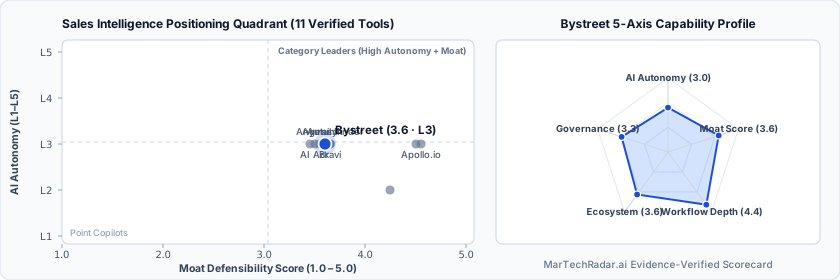
Bystreet is a Web SaaS tool for Sales Intelligence (Lead Enrichment & Waterfall Orchestration) in AI SDR & Outbound. Pricing: Custom / enterprise pricing. Best suited to B2B Sales Leaders, SDR/BDR Teams and Revenue Operations (RevOps). Editor ratings: AI autonomy L3 (conditional automation); moat score 3.6/5.0 (Proprietary moat). Fact-checked by Julie Brot on Oct 14, 2026.
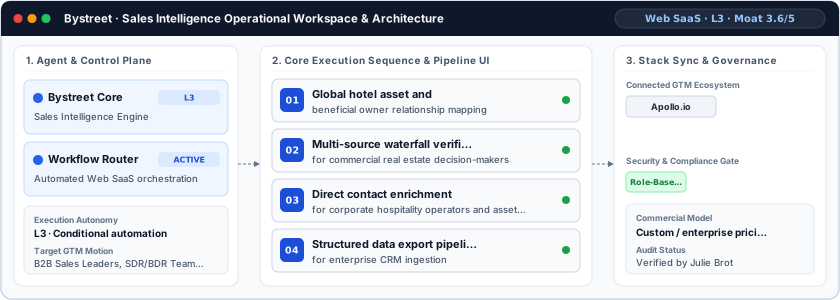
Specialized B2B lead enrichment platform mapping global hotel ownership entities and property-level decision-makers via automated waterfall data pipelines.
Bystreet buyer fit verdict: when to choose vs. when to walk away
Choose Bystreet if (Best Fit)
- Target ICP & Stack Fit: You operate as B2B Sales Leaders, SDR/BDR Teams and Revenue Operations (RevOps) requiring a Web SaaS deployment for Sales Intelligence, with verified ecosystem connectivity for Apollo.io.
- L3 Architecture & Defensibility: Bystreet establishes domain defensibility by decoupling opaque hospitality real estate holdings into verifiable beneficial ownership graphs, indexing property-level management contacts that generic B2B aggregators consistently miss.
- Commercial Model Fit: Your procurement budget aligns with Custom / enterprise pricing.
Walk away from Bystreet if (Deal-Breakers)
- Walk away if you require transparent self-serve monthly billing or your budget ceiling is under $1,000/mo (Bystreet requires sales-gated custom quoting).
- Walk away if your workflow cannot tolerate domain coverage scope: The underlying data graphs focus exclusively on commercial hospitality real estate, rendering the platform structurally non-viable for generalist B2B outbound workflows across SaaS or broader manufacturing verticals.
- Walk away if jurisdictional data latency is a deal-breaker for your team: Property ownership changes that occur through opaque offshore entities or fragmented municipal deed registries can introduce multi-week reconciliation delays before ownership transfers reflect in the primary index.
Bystreet key facts & scorecard
| Pricing | Custom / enterprise pricing |
|---|---|
| Free plan | No / not disclosed |
| Delivery | Web SaaS |
| Audience | B2B Sales Leaders, SDR/BDR Teams, Revenue Operations (RevOps) |
| AI autonomy level | L3 · Conditional automationEditor-verified |
| Moat tier & score | 3.6 / 5.0 · Proprietary moatEditor-verified |
| Funding | Pre-seed |
| Founders | Cameron Hake, Charlie Maki, Corey Anderson |
| Company size | 2-10 employees |
| Ecosystem integrations | Apollo.io |
| Governance & docs | Terms ↗ · Privacy ↗ |
| Headquarters | San Francisco, California |
| Founded | 2024 |
| Last verified |
Bystreet pros & cons: strengths vs. operational limitations
Pros: core strengths & capabilities
- Global hotel asset and: beneficial owner relationship mapping
- Multi-source waterfall verification: for commercial real estate decision-makers
- Direct contact enrichment: for corporate hospitality operators and asset managers
- Structured data export pipelines: for enterprise CRM ingestion
Cons: operational limitations & risks
- Domain Coverage Scope: The underlying data graphs focus exclusively on commercial hospitality real estate, rendering the platform structurally non-viable for generalist B2B outbound workflows across SaaS or broader manufacturing verticals.
- Jurisdictional Data Latency: Property ownership changes that occur through opaque offshore entities or fragmented municipal deed registries can introduce multi-week reconciliation delays before ownership transfers reflect in the primary index.
- Integration Pipeline Footprint: Unlike mature data suites that offer native bi-directional CRM syncing, the platform currently relies primarily on manual exports and direct sales-assisted feeds, increasing pipeline overhead for automated revenue stacks.
Bystreet TCO & deal-breaker stress test
Simulate 12-month stepped TCO, hidden cost multipliers, contract lock-in exposure, and stack failure modes using only facts verified by Julie Brot on · Capture SHA 0262571f.
Bystreet triggers high-severity friction under your 5-seat / $800/mo constraints. Benchmark the verified subtrack alternatives below before committing.
| Plan / Tier | Verified Rate | Scale Fit | Scope & Quota Notes |
|---|---|---|---|
| Enterprise / Custom | Custom quote | 15–50+ seats (Enterprise SLA) | Sales-negotiated annual contract for custom volume, SSO/RBAC governance, and dedicated SLA. |
- Moat Score
- 3.6 / 5.0
- AI Autonomy
- L3
- Free Tier / Trial
- None disclosed
Triggered audit signals & failure modes
- Opaque Enterprise Quoting vs. SMB/Mid-Market BudgetVerified Pricing Ledger
Bystreet does not disclose a public self-serve floor (Custom / enterprise pricing). Buyers with a $800/mo cap face high sales-qualification friction.
- Sales-Gated Contract TermsFact-checked by Julie Brot
Commercial procurement for Bystreet follows a private contract framework. Commercial pricing is available on request through tailored enterprise sales quotes based on organizational scale and seats.
- Primary Operational Bottleneck: Domain Coverage ScopeAudit by Julie Brot
The underlying data graphs focus exclusively on commercial hospitality real estate, rendering the platform structurally non-viable for generalist B2B outbound workflows across SaaS or broader manufacturing verticals.
Hidden TCO Multipliers & Quota Gates
- Credit & Usage Burn Multiplier: Automated workflows consume metered credits/usage quotas; multi-step enrichment, voice minutes, or high-frequency agent runs can trigger mid-cycle top-up packs.
- Domain Coverage Scope: The underlying data graphs focus exclusively on commercial hospitality real estate, rendering the platform structurally non-viable for generalist B2B outbound workflows across SaaS or broader manufacturing verticals.
- Jurisdictional Data Latency: Property ownership changes that occur through opaque offshore entities or fragmented municipal deed registries can introduce multi-week reconciliation delays before ownership transfers reflect in the primary index.
When to Walk Away & Negotiation Levers
- Walk away if you require transparent self-serve monthly billing or your budget ceiling is under $1,000/mo (Bystreet requires sales-gated custom quoting).
- Walk away if your workflow cannot tolerate domain coverage scope: The underlying data graphs focus exclusively on commercial hospitality real estate, rendering the platform structurally non-viable for generalist B2B outbound workflows across SaaS or broader manufacturing verticals.
- Walk away if jurisdictional data latency is a deal-breaker for your team: Property ownership changes that occur through opaque offshore entities or fragmented municipal deed registries can introduce multi-week reconciliation delays before ownership transfers reflect in the primary index.
- Demand a 30- to 60-day paid pilot opt-out clause in the Bystreet order form before signing a 12-month enterprise commitment.
- Require a sandbox proof-of-concept testing domain coverage scope against your live CRM/data schema before annual sign-off.
Ask a custom procurement or TCO stress-test question about Bystreet
Lower 5-seat floor (~$245/mo vs. Custom Quote) · Transparent self-serve entry without mandatory annual lock-in
Lower 5-seat floor (~$20/mo vs. Custom Quote) · Transparent self-serve entry without mandatory annual lock-in
Bystreet key entities, modules & ecosystem stack
Bystreet moat & subtrack positioning
Bystreet establishes domain defensibility by decoupling opaque hospitality real estate holdings into verifiable beneficial ownership graphs, indexing property-level management contacts that generic B2B aggregators consistently miss.
Editorial review
Fact-checked by Julie Brot (Enterprise SaaS Governance & Procurement Editor) on .
Background
Architected specifically for hospitality tech vendors, institutional investors, and commercial procurement teams, Bystreet operates as a verticalized intelligence engine targeting global hotel ownership. Established in 2024 and headquartered in San Francisco, California, the platform addresses the persistent challenge of opaque corporate entities and fragmented real estate holding structures. Commercial real estate transactions and hospitality software sales routinely stall because land titles, management groups, and on-premise operators sit behind separate corporate shells. Bystreet targets business development leaders and revenue operations practitioners who require deterministic access to underlying property assets and their true beneficial owners.
How Bystreet works
Under the hood, Bystreet ingests municipal registries, commercial real estate filings, and global corporate records into an entity resolution pipeline. Its extraction layer links individual properties—such as independent boutique assets or branded franchise locations—to their parent operating groups and beneficial stakeholders. The platform executes automated waterfall orchestration against secondary data vendors to discover, cleanse, and cross-reference professional email addresses and direct phone numbers for verified executive decision-makers. Operating with Level 3 conditional autonomy, the engine reconciles conflicting corporate ownership records before pushing validated contact schemas directly into downstream sales workflows.
Limitations
Operational considerations and platform boundaries include:
- Domain Coverage Scope: The underlying data graphs focus exclusively on commercial hospitality real estate, rendering the platform structurally non-viable for generalist B2B outbound workflows across SaaS or broader manufacturing verticals.
- Jurisdictional Data Latency: Property ownership changes that occur through opaque offshore entities or fragmented municipal deed registries can introduce multi-week reconciliation delays before ownership transfers reflect in the primary index.
- Integration Pipeline Footprint: Unlike mature data suites that offer native bi-directional CRM syncing, the platform currently relies primarily on manual exports and direct sales-assisted feeds, increasing pipeline overhead for automated revenue stacks.
Bystreet pricing
Commercial procurement for Bystreet follows a private contract framework. Commercial pricing is available on request through tailored enterprise sales quotes based on organizational scale and seats. Contracts are customized to reflect data export volumes, target geographic territories, and the density of verified owner queries required across hospitality portfolios.
How Bystreet compares
Horizontal enrichment providers like Apollo.io offer extensive contact databases across diverse tech and commercial sectors, yet they routinely misattribute franchise properties to general brand headquarters rather than local operational owners. Flexible data orchestrators like Clay allow teams to construct custom real estate scraping waterfalls, but this requires substantial operational labor to maintain custom scraper scrapers and entity-matching logic. Bystreet differentiates by hardcoding hospitality entity resolution directly into its base architecture, making it the strategic selection for enterprise hospitality suppliers who prioritize exact beneficial owner attribution over horizontal data breadth.
Frequently asked questions about Bystreet
How much does Bystreet cost and does it require a custom enterprise quote?
Published pricing summary for Bystreet: Custom / enterprise pricing. A permanent free plan is not disclosed for Bystreet. Commercial procurement for Bystreet follows a private contract framework. Commercial pricing is available on request through tailored enterprise sales quotes based on organizational scale and seats.
How does Bystreet work and how autonomous is its AI architecture?
Specialized B2B lead enrichment platform mapping global hotel ownership entities and property-level decision-makers via automated waterfall data pipelines. Within Sales Intelligence (Lead Enrichment & Waterfall Orchestration), MarTechRadar rates its execution architecture at L3 · Conditional automation with a verified Moat Score of 3.6 / 5.0 (Proprietary moat). Bystreet establishes domain defensibility by decoupling opaque hospitality real estate holdings into verifiable beneficial ownership graphs, indexing property-level management contacts that generic B2B aggregators consistently miss. Corporate profile: Founded by Cameron Hake, Charlie Maki, Corey Anderson, operating at 2-10 employees scale.
What are the main limitations of Bystreet and when should buyers walk away?
Based on our editorial technical audit, key operational considerations and boundaries for Bystreet include: (1) Domain Coverage Scope: The underlying data graphs focus exclusively on commercial hospitality real estate, rendering the platform structurally non-viable for generalist B2B outbound workflows across SaaS or broader manufacturing verticals. (2) Jurisdictional Data Latency: Property ownership changes that occur through opaque offshore entities or fragmented municipal deed registries can introduce multi-week reconciliation delays before ownership transfers reflect in the primary index. (3) Integration Pipeline Footprint: Unlike mature data suites that offer native bi-directional CRM syncing, the platform currently relies primarily on manual exports and direct sales-assisted feeds, increasing pipeline overhead for automated revenue stacks. Primary procurement walk-away rule: Walk away if you require transparent self-serve monthly billing or your budget ceiling is under $1,000/mo (Bystreet requires sales-gated custom quoting).
What integrations, compliance certifications, and contract terms apply to Bystreet?
Verified ecosystem and stack integrations include Apollo.io. Key TCO multiplier to watch: Credit & Usage Burn Multiplier (Automated workflows consume metered credits/usage quotas; multi-step enrichment, voice minutes, or high-frequency agent runs can trigger mid-cycle top-up packs.) Before signing a contract, procurement teams should demand a 30- to 60-day paid pilot opt-out clause in the Bystreet order form before signing a 12-month enterprise commitment.
What are the best Bystreet alternatives and head-to-head competitors in 2026?
Top fact-checked alternatives to Bystreet in Sales Intelligence (Lead Enrichment & Waterfall Orchestration) include octrace (Custom / enterprise pricing), Agensy (Custom / enterprise pricing), One IA (Custom / enterprise pricing), Northlight (Free plan · $0/mo · Enterprise plan). Horizontal enrichment providers like Apollo.io offer extensive contact databases across diverse tech and commercial sectors, yet they routinely misattribute franchise properties to general brand headquarters rather than local operational owners.
Verified sources & evidence trail
- Official product domain: http://www.bystreet.com
- Commercial pricing verification: Verified against official vendor pricing policy (Custom / enterprise pricing)
- Verified corporate entity profiles (
sameAs): LinkedIn Company Profile · Crunchbase Entity Record - First-party governance & documentation links: Terms · Privacy
- Editorial audit sign-off: Fact-checked by Julie Brot on under the MarTechRadar Evidence-Ledger Protocol.