Autumn Review (2026): Sales Intelligence Pricing, Limits & Alternatives
Bottom line
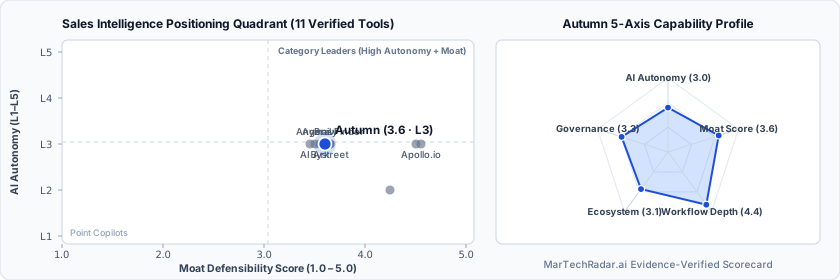
Autumn is a Web SaaS tool for Sales Intelligence (Lead Enrichment & Waterfall Orchestration) in AI SDR & Outbound. Pricing: From $20/mo. Best suited to B2B SaaS and Marketing & Growth Teams. Editor ratings: AI autonomy L3 (conditional automation); moat score 3.6/5.0 (Proprietary moat). Fact-checked by Jagmeet Sine on Oct 16, 2026.
Autonomous people and company intelligence research agents indexing 1B+ people and 100M+ companies for GTM teams.
Autumn buyer fit verdict: when to choose vs. when to walk away
Choose Autumn if (Best Fit)
- Target ICP & Stack Fit: You operate as B2B SaaS and Marketing & Growth Teams requiring a Web SaaS deployment for Sales Intelligence.
- L3 Architecture & Defensibility: Autumn AI combines an index of over 1 billion people and 100 million companies with autonomous web-research agents that synthesize qualitative buying signals into structured CRM and outbound fields.
- Commercial Model Fit: Your procurement budget aligns with From $20/mo.
Walk away from Autumn if (Deal-Breakers)
- Walk away if your workflow requires uncapped enterprise volume on the From $20/mo entry plan without upgrading tiers.
- Walk away if your workflow cannot tolerate multi-hop web research latency: While cached person and company lookups return rapidly, deep multi-step web research agents require longer execution windows per row than static SQL lookups, creating a latency trade-off for synchronous real-time form routing.
- Walk away if prompt precision & credit consumption bottleneck is a deal-breaker for your team: Broad or ambiguously phrased research prompts trigger wider web crawls that consume monthly credit pools rapidly, requiring revenue ops teams to calibrate prompt specificity carefully.
Autumn key facts & scorecard
| Pricing | From $20/moVendor pricing page |
|---|---|
| Free plan | No / not disclosed |
| Delivery | Web SaaS |
| Audience | B2B SaaS, Marketing & Growth Teams |
| AI autonomy level | L3 · Conditional automationEditor-verified |
| Moat tier & score | 3.6 / 5.0 · Proprietary moatEditor-verified |
| Funding | Seed |
| Company size | 2-10 employees |
| Governance & docs | API & Docs ↗ · Terms ↗ · Privacy ↗ |
| Headquarters | San Francisco, CA |
| Founded | 2025 |
| Last verified |
Autumn pros & cons: strengths vs. operational limitations
Pros: core strengths & capabilities
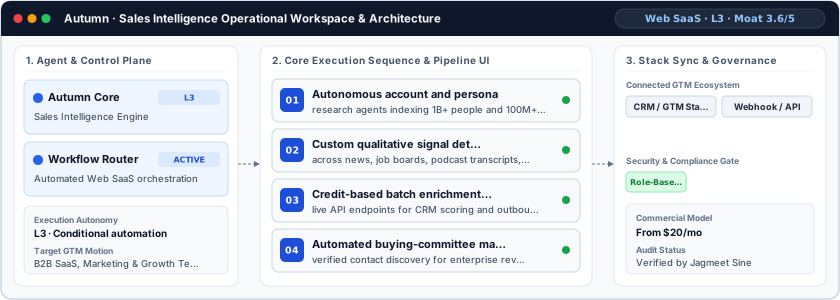
- Autonomous account and persona: research agents indexing 1B+ people and 100M+ global company profiles
- Custom qualitative signal detection: across news, job boards, podcast transcripts, and technical docs
- Credit-based batch enrichment and: live API endpoints for CRM scoring and outbound message personalization
- Automated buying-committee mapping and: verified contact discovery for enterprise revenue teams
Cons: operational limitations & risks
- Multi-Hop Web Research Latency: While cached person and company lookups return rapidly, deep multi-step web research agents require longer execution windows per row than static SQL lookups, creating a latency trade-off for synchronous real-time form routing.
- Prompt Precision & Credit Consumption Bottleneck: Broad or ambiguously phrased research prompts trigger wider web crawls that consume monthly credit pools rapidly, requiring revenue ops teams to calibrate prompt specificity carefully.
- No Built-In Multi-Channel Email Sequencer: Autumn AI focuses on deep entity intelligence, signal extraction, and contact enrichment rather than operating as an email warming or sequence-sending client, requiring downstream CRM or sequencer integration.
Autumn TCO & deal-breaker stress test
Simulate 12-month stepped TCO, hidden cost multipliers, contract lock-in exposure, and stack failure modes using only facts verified by Jagmeet Sine on · Capture SHA c49d66eb.
Autumn aligns with your 5-seat / $800/mo profile. Review the walk-away triggers and contract levers below before deployment.
| Plan / Tier | Verified Rate | Scale Fit | Scope & Quota Notes |
|---|---|---|---|
| Scale | $20/mo | 1–2 seats | Verified $20/mo tier from vendor pricing schedule. |
| Growth | $75/mo | 5 seats | 8,000 credits/mo |
| Scale | $280/mo | 15 seats | 32,000 credits/mo |
- Moat Score
- 3.6 / 5.0
- AI Autonomy
- L3
- Free Tier / Trial
- None disclosed
Triggered audit signals & failure modes
- Published Self-Serve Entry FloorVerified Pricing Ledger
Autumn publishes a transparent entry point (From $20/mo) for initial validation before committing.
- Tier Fit for 5-Seat Scale: Growth ($75/mo)Verified Tier Schedule
8,000 credits/mo
- Primary Operational Bottleneck: Prompt Precision & Credit Consumption BottleneckAudit by Jagmeet Sine
Broad or ambiguously phrased research prompts trigger wider web crawls that consume monthly credit pools rapidly, requiring revenue ops teams to calibrate prompt specificity carefully.
Hidden TCO Multipliers & Quota Gates
- Credit & Usage Burn Multiplier: Automated workflows consume metered credits/usage quotas; multi-step enrichment, voice minutes, or high-frequency agent runs can trigger mid-cycle top-up packs.
- Enterprise Governance & Add-On Gating: Advanced capabilities such as Single Sign-On (SSO), custom role permissions, or specialized analytics modules are gated behind upper tiers or paid add-ons.
When to Walk Away & Negotiation Levers
- Walk away if your workflow requires uncapped enterprise volume on the From $20/mo entry plan without upgrading tiers.
- Walk away if your workflow cannot tolerate multi-hop web research latency: While cached person and company lookups return rapidly, deep multi-step web research agents require longer execution windows per row than static SQL lookups, creating a latency trade-off for synchronous real-time form routing.
- Walk away if prompt precision & credit consumption bottleneck is a deal-breaker for your team: Broad or ambiguously phrased research prompts trigger wider web crawls that consume monthly credit pools rapidly, requiring revenue ops teams to calibrate prompt specificity carefully.
- Validate exact quota thresholds (seats, credits, or API calls) included in Autumn's From $20/mo tier before converting from monthly to annual billing.
- Require a sandbox proof-of-concept testing multi-hop web research latency against your live CRM/data schema before annual sign-off.
Ask a custom procurement or TCO stress-test question about Autumn
Lower 5-seat floor (~$13/mo vs. $75 / mo)
Lower 5-seat floor (~$20/mo vs. $75 / mo)
Autumn moat & subtrack positioning
Autumn AI combines an index of over 1 billion people and 100 million companies with autonomous web-research agents that synthesize qualitative buying signals into structured CRM and outbound fields.
Editorial review
Fact-checked by Jagmeet Sine (Senior MarTech Infrastructure & Agentic Workflow Architect) on .
Background
Built by founders Vishnu Sampathkumar and Shiv Kampani and headquartered in San Francisco, CA, Autumn AI (autumn.ai) is a people and company intelligence platform that deploys autonomous research agents to uncover qualitative buying signals, map organizational charts, and enrich prospect lists at scale. Operating with a team of 2 to 10 employees and backed by institutional accelerator investor Y Combinator (W26), the company bridges the gap between static B2B contact databases and manual account research for go-to-market teams at organizations including Brex, Rippling, and Postman.
How Autumn works
Autumn AI operates at Level 3 autonomy through a global entity graph of over 1 billion people and 100 million companies paired with multi-step autonomous web-research agents. Traditional B2B databases restrict filtering to rigid SIC/NAICS industry codes and self-reported titles; Autumn AI allows revenue operations teams to define custom qualification questions in plain English—such as whether a target account is migrating to a multi-cloud architecture, expanding its European sales footprint, or hiring its first compliance officer. The platform's agents inspect company blogs, regulatory filings, engineering changelogs, and job boards to return structured answers, source citations, and verified buying-committee contacts.
Limitations
Operational limitations and technical trade-offs include:
- Multi-Hop Web Research Latency: While cached person and company lookups return rapidly, deep multi-step web research agents require longer execution windows per row than static SQL lookups, creating a latency trade-off for synchronous real-time form routing.
- Prompt Precision & Credit Consumption Bottleneck: Broad or ambiguously phrased research prompts trigger wider web crawls that consume monthly credit pools rapidly, requiring revenue ops teams to calibrate prompt specificity carefully.
- No Built-In Multi-Channel Email Sequencer: Autumn AI focuses on deep entity intelligence, signal extraction, and contact enrichment rather than operating as an email warming or sequence-sending client, requiring downstream CRM or sequencer integration.
Autumn pricing
Autumn AI publishes transparent, credit-based subscription tiers on its official pricing page (autumn.ai/pricing). Self-serve plans start at $20/mo on the Hobby tier (2,000 monthly credits) and scale across $75/mo, $280/mo, $850/mo, and $2,400/mo plans for high-volume growth and enterprise revenue operations teams, with custom enterprise agreements available for dedicated concurrency.
How Autumn compares
Within the Buyer Intent Data & Account-Based Marketing category, Autumn AI competes against AI enrichment and web-research alternatives such as Clay, Origamis, and Crustdata. Versus formula-heavy enrichment spreadsheets like Clay that require users to stitch together multiple third-party data keys, Autumn AI differentiates itself by bundling a native 1B+ person and 100M+ company index directly with autonomous research agents under predictable credit tiers. Enterprise and mid-market GTM teams choose Autumn AI to automate qualitative account research at scale.
Frequently asked questions about Autumn
How much does Autumn cost and what pricing tiers are available?
Published pricing summary for Autumn: From $20/mo. A permanent free plan is not disclosed for Autumn. Verified tier schedule: Scale ($20/mo for 1–2 seats); Growth ($75/mo for 5 seats); Scale ($280/mo for 15 seats). Autumn AI publishes transparent, credit-based subscription tiers on its official pricing page (`autumn.ai/pricing`).
How does Autumn work and how autonomous is its AI architecture?
Autonomous people and company intelligence research agents indexing 1B+ people and 100M+ companies for GTM teams. Within Sales Intelligence (Lead Enrichment & Waterfall Orchestration), MarTechRadar rates its execution architecture at L3 · Conditional automation with a verified Moat Score of 3.6 / 5.0 (Proprietary moat). Autumn AI combines an index of over 1 billion people and 100 million companies with autonomous web-research agents that synthesize qualitative buying signals into structured CRM and outbound fields. Corporate profile: operating at 2-10 employees scale.
What are the main limitations of Autumn and when should buyers walk away?
Based on our editorial technical audit, key operational considerations and boundaries for Autumn include: (1) Multi-Hop Web Research Latency: While cached person and company lookups return rapidly, deep multi-step web research agents require longer execution windows per row than static SQL lookups, creating a latency trade-off for synchronous real-time form routing. (2) Prompt Precision & Credit Consumption Bottleneck: Broad or ambiguously phrased research prompts trigger wider web crawls that consume monthly credit pools rapidly, requiring revenue ops teams to calibrate prompt specificity carefully. (3) No Built-In Multi-Channel Email Sequencer: Autumn AI focuses on deep entity intelligence, signal extraction, and contact enrichment rather than operating as an email warming or sequence-sending client, requiring downstream CRM or sequencer integration. Primary procurement walk-away rule: Walk away if your workflow requires uncapped enterprise volume on the From $20/mo entry plan without upgrading tiers.
What integrations, compliance certifications, and contract terms apply to Autumn?
First-party governance and developer endpoints verified on domain include: API Docs (https://www.autumn.ai/docs). Key TCO multiplier to watch: Credit & Usage Burn Multiplier (Automated workflows consume metered credits/usage quotas; multi-step enrichment, voice minutes, or high-frequency agent runs can trigger mid-cycle top-up packs.) Before signing a contract, procurement teams should validate exact quota thresholds (seats, credits, or API calls) included in Autumn's From $20/mo tier before converting from monthly to annual billing.
What are the best Autumn alternatives and head-to-head competitors in 2026?
Top fact-checked alternatives to Autumn in Sales Intelligence (Lead Enrichment & Waterfall Orchestration) include Crustdata ($20 usage-based · Enterprise plan), VeriMails (From $12.50/mo), Pond (Custom / enterprise pricing), Iceflower (Custom / enterprise pricing). Within the Buyer Intent Data & Account-Based Marketing category, Autumn AI competes against AI enrichment and web-research alternatives such as Clay, Origamis, and Crustdata.
Verified sources & evidence trail
- Official product domain: https://autumn.ai
- Commercial pricing verification: https://www.autumn.ai/pricing
- Verified corporate entity profiles (
sameAs): LinkedIn Company Profile - First-party governance & documentation links: API & Docs · Terms · Privacy
- Editorial audit sign-off: Fact-checked by Jagmeet Sine on under the MarTechRadar Evidence-Ledger Protocol.