Crustdata Review (2026): Sales Intelligence Pricing, Limits & Alternatives
Bottom line
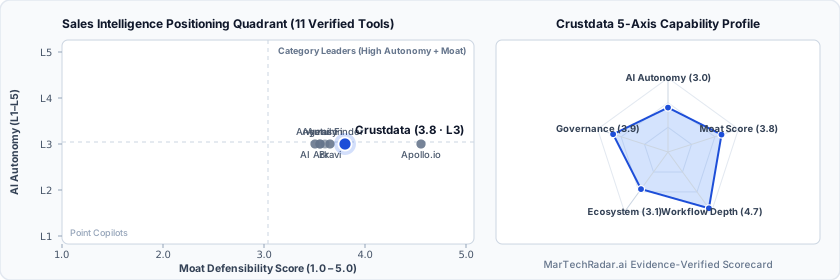
Crustdata is a Web SaaS tool for Sales Intelligence (Lead Enrichment & Waterfall Orchestration) in AI SDR & Outbound. Pricing: $20 usage-based · Enterprise plan. Best suited to B2B SaaS and Marketing & Growth Teams. Editor ratings: AI autonomy L3 (conditional automation); moat score 3.8/5.0 (Proprietary moat). Fact-checked by Jagmeet Sine on Oct 16, 2026.
Real-time people and company data layer via APIs, webhooks, and MCP servers for GTM teams and AI agents.
Crustdata buyer fit verdict: when to choose vs. when to walk away
Choose Crustdata if (Best Fit)
- Target ICP & Stack Fit: You operate as B2B SaaS and Marketing & Growth Teams requiring a Web SaaS deployment for Sales Intelligence.
- L3 Architecture & Defensibility: Crustdata builds a strong infrastructure moat through live web indexing, real-time job-change and headcount webhooks, and native Model Context Protocol (MCP) integrations that power autonomous GTM agents and enterprise revenue platforms.
- Commercial Model Fit: Your procurement budget aligns with $20 usage-based · Enterprise plan and want trial evaluation before contract sign-off.
Walk away from Crustdata if (Deal-Breakers)
- Walk away if your workflow requires uncapped enterprise volume on the $20 usage-based · Enterprise plan entry plan without upgrading tiers.
- Walk away if your workflow cannot tolerate api-first infrastructure learning curve: Because Crustdata is engineered as a programmatic data layer, webhook stream, and MCP provider rather than a standalone email-sending UI, non-technical sales reps face an integration learning curve and must consume data through Clay, Claude, or CRM workflows.
- Walk away if high-frequency polling credit bottleneck is a deal-breaker for your team: Live web-fetched endpoints and deep organizational graph queries consume more compute credits than static cached lookups, meaning engineering teams that poll endpoints repeatedly instead of subscribing to event webhooks face higher usage costs.
Crustdata key facts & scorecard
| Pricing | $20 usage-based · Enterprise planVendor pricing page |
|---|---|
| Free plan | No / not disclosed |
| Delivery | Web SaaS |
| Audience | B2B SaaS, Marketing & Growth Teams |
| AI autonomy level | L3 · Conditional automationEditor-verified |
| Moat tier & score | 3.8 / 5.0 · Proprietary moatEditor-verified |
| Funding | Seed |
| Total funding | $12M |
| Founders | Abhilash Chowdhary, Chris Pisarski, Manmohit Grewal |
| Company size | 11-50 employees |
| Governance & docs | API & Docs ↗ · Terms ↗ · Privacy ↗ |
| Headquarters | San Francisco, CA |
| Founded | 2024 |
| Last verified |
Crustdata pros & cons: strengths vs. operational limitations
Pros: core strengths & capabilities
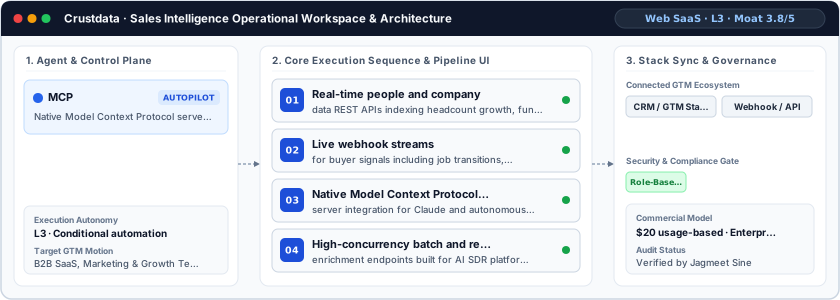
- Real-time people and company: data REST APIs indexing headcount growth, funding events, and leadership changes
- Live webhook streams: for buyer signals including job transitions, promotions, and newly posted roles
- Native Model Context Protocol (MCP): server integration for Claude and autonomous GTM and recruiting agents
- High-concurrency batch and real-time: enrichment endpoints built for AI SDR platforms and revenue operations
Cons: operational limitations & risks
- API-First Infrastructure Learning Curve: Because Crustdata is engineered as a programmatic data layer, webhook stream, and MCP provider rather than a standalone email-sending UI, non-technical sales reps face an integration learning curve and must consume data through Clay, Claude, or CRM workflows.
- High-Frequency Polling Credit Bottleneck: Live web-fetched endpoints and deep organizational graph queries consume more compute credits than static cached lookups, meaning engineering teams that poll endpoints repeatedly instead of subscribing to event webhooks face higher usage costs.
- Enterprise Annual Commitment Barrier: While developers can test endpoints immediately, full production throughput and custom SLA webhooks require four-figure monthly enterprise commitments that can be steep for pre-revenue startups.
Crustdata TCO & deal-breaker stress test
Simulate 12-month stepped TCO, hidden cost multipliers, contract lock-in exposure, and stack failure modes using only facts verified by Jagmeet Sine on · Capture SHA 142a935b.
Crustdata triggers high-severity friction under your 5-seat / $800/mo constraints. Benchmark the verified subtrack alternatives below before committing.
| Plan / Tier | Verified Rate | Scale Fit | Scope & Quota Notes |
|---|---|---|---|
| Entry / Starter | $20/mo | 1–2 seats | Real-time API access |
| Enterprise / Custom | Custom quote | 15–50+ seats (Enterprise SLA) | Sales-negotiated annual contract for custom volume, SSO/RBAC governance, and dedicated SLA. |
- Moat Score
- 3.8 / 5.0
- AI Autonomy
- L3
- Free Tier / Trial
- Free trial
Triggered audit signals & failure modes
- Annual Contract Lock-in Risk DetectedFact-checked by Jagmeet Sine
Crustdata offers developer-friendly onboarding starting with a free trial that includes $20 in API credits on its official pricing page (`crustdata.com/pricing`).
- Usage / Credit Burn VolatilityCommercial Model Audit
Crustdata uses credit or usage-metered billing ($20 usage-based · Enterprise plan). High-volume automated workflows across 5 seats can trigger mid-cycle overage charges.
- Primary Operational Bottleneck: High-Frequency Polling Credit BottleneckAudit by Jagmeet Sine
Live web-fetched endpoints and deep organizational graph queries consume more compute credits than static cached lookups, meaning engineering teams that poll endpoints repeatedly instead of subscribing to event webhooks face higher usage costs.
Hidden TCO Multipliers & Quota Gates
- Credit & Usage Burn Multiplier: Automated workflows consume metered credits/usage quotas; multi-step enrichment, voice minutes, or high-frequency agent runs can trigger mid-cycle top-up packs.
- Enterprise Governance & Add-On Gating: Advanced capabilities such as Single Sign-On (SSO), custom role permissions, or specialized analytics modules are gated behind upper tiers or paid add-ons.
When to Walk Away & Negotiation Levers
- Walk away if your workflow requires uncapped enterprise volume on the $20 usage-based · Enterprise plan entry plan without upgrading tiers.
- Walk away if your workflow cannot tolerate api-first infrastructure learning curve: Because Crustdata is engineered as a programmatic data layer, webhook stream, and MCP provider rather than a standalone email-sending UI, non-technical sales reps face an integration learning curve and must consume data through Clay, Claude, or CRM workflows.
- Walk away if high-frequency polling credit bottleneck is a deal-breaker for your team: Live web-fetched endpoints and deep organizational graph queries consume more compute credits than static cached lookups, meaning engineering teams that poll endpoints repeatedly instead of subscribing to event webhooks face higher usage costs.
- Validate exact quota thresholds (seats, credits, or API calls) included in Crustdata's $20 usage-based · Enterprise plan tier before converting from monthly to annual billing.
- Require a sandbox proof-of-concept testing api-first infrastructure learning curve against your live CRM/data schema before annual sign-off.
Ask a custom procurement or TCO stress-test question about Crustdata
Fits within $800/mo budget (From $20/mo) · Transparent self-serve entry without mandatory annual lock-in
Offers a free tier (Free plan · $0/mo · Enterprise plan) · Transparent self-serve entry without mandatory annual lock-in
Crustdata key entities, modules & ecosystem stack
Native Model Context Protocol server integration for Claude and autonomous GTM and recruiting agents
Crustdata moat & subtrack positioning
Crustdata builds a strong infrastructure moat through live web indexing, real-time job-change and headcount webhooks, and native Model Context Protocol (MCP) integrations that power autonomous GTM agents and enterprise revenue platforms.
Editorial review
Fact-checked by Jagmeet Sine (Senior MarTech Infrastructure & Agentic Workflow Architect) on .
Background
Founded in 2024 by Abhilash Chowdhary, Chris Pisarski, and Manmohit Grewal and headquartered in San Francisco, CA, Crustdata (crustdata.com) is a real-time B2B people and company data infrastructure platform built for modern sales teams, AI agent developers, recruiting platforms, and institutional investors. Operating with a team of 11 to 50 employees and backed by $12M in Seed funding from General Catalyst, SV Angel, Y Combinator (F24), Transpose Platform Management, and Pioneer Fund, the company serves as the live programmatic data layer behind AI SDRs, CRM enrichment pipelines, and automated sourcing engines that cannot rely on stale quarterly database snapshots.
How Crustdata works
Crustdata operates at Level 3 autonomy through a continuous live-web entity crawler, event-driven webhook streaming engine, and native Model Context Protocol (MCP) server architecture. Legacy B2B contact vendors often serve cached records that lag months behind actual career moves; Crustdata continuously indexes professional networks, company career pages, and financial disclosures to expose sub-second REST endpoints covering departmental headcount growth, executive tenure, verified work history, and firmographic velocity. Revenue teams and AI agents subscribe to real-time webhooks that fire when a champion changes jobs or a target account opens key requisitions, or query Crustdata directly inside Anthropic Claude via MCP.
Limitations
Operational limitations and technical trade-offs include:
- API-First Infrastructure Learning Curve: Because Crustdata is engineered as a programmatic data layer, webhook stream, and MCP provider rather than a standalone email-sending UI, non-technical sales reps face an integration learning curve and must consume data through Clay, Claude, or CRM workflows.
- High-Frequency Polling Credit Bottleneck: Live web-fetched endpoints and deep organizational graph queries consume more compute credits than static cached lookups, meaning engineering teams that poll endpoints repeatedly instead of subscribing to event webhooks face higher usage costs.
- Enterprise Annual Commitment Barrier: While developers can test endpoints immediately, full production throughput and custom SLA webhooks require four-figure monthly enterprise commitments that can be steep for pre-revenue startups.
Crustdata pricing
Crustdata offers developer-friendly onboarding starting with a free trial that includes $20 in API credits on its official pricing page (crustdata.com/pricing). Production commercial deployments are structured as custom enterprise plans starting in the four-figure monthly range, scaled by API call volume, real-time webhook subscriptions, and concurrency requirements.
How Crustdata compares
Within the Buyer Intent Data & Account-Based Marketing and B2B Data API category, Crustdata competes against programmatic data alternatives such as People Data Labs, Proxycurl, and Clearbit. Versus static batch providers like People Data Labs that rely on delayed periodic snapshots, Crustdata differentiates itself through real-time live-web indexing, sub-second job-change webhooks, and native MCP server support for AI agents. High-growth GTM engineering teams and AI SDR platforms choose Crustdata for fresh, agent-ready people and company intelligence.
Frequently asked questions about Crustdata
How does Crustdata usage and credit pricing work in 2026?
Published pricing summary for Crustdata: $20 usage-based · Enterprise plan. Crustdata does not list a permanent free tier, though trial evaluation options may be offered. Verified tier schedule: Entry / Starter ($20/mo for 1–2 seats); Enterprise / Custom (Custom quote for 15–50+ seats (Enterprise SLA)). Crustdata offers developer-friendly onboarding starting with a free trial that includes $20 in API credits on its official pricing page (`crustdata.com/pricing`).
How does Crustdata work and how autonomous is its AI architecture?
Real-time people and company data layer via APIs, webhooks, and MCP servers for GTM teams and AI agents. Within Sales Intelligence (Lead Enrichment & Waterfall Orchestration), MarTechRadar rates its execution architecture at L3 · Conditional automation with a verified Moat Score of 3.8 / 5.0 (Proprietary moat). Crustdata builds a strong infrastructure moat through live web indexing, real-time job-change and headcount webhooks, and native Model Context Protocol (MCP) integrations that power autonomous GTM agents and enterprise revenue platforms. Corporate profile: Founded by Abhilash Chowdhary, Chris Pisarski, Manmohit Grewal, operating at 11-50 employees scale.
What are the main limitations of Crustdata and when should buyers walk away?
Based on our editorial technical audit, key operational considerations and boundaries for Crustdata include: (1) API-First Infrastructure Learning Curve: Because Crustdata is engineered as a programmatic data layer, webhook stream, and MCP provider rather than a standalone email-sending UI, non-technical sales reps face an integration learning curve and must consume data through Clay, Claude, or CRM workflows. (2) High-Frequency Polling Credit Bottleneck: Live web-fetched endpoints and deep organizational graph queries consume more compute credits than static cached lookups, meaning engineering teams that poll endpoints repeatedly instead of subscribing to event webhooks face higher usage costs. (3) Enterprise Annual Commitment Barrier: While developers can test endpoints immediately, full production throughput and custom SLA webhooks require four-figure monthly enterprise commitments that can be steep for pre-revenue startups. Primary procurement walk-away rule: Walk away if your workflow requires uncapped enterprise volume on the $20 usage-based · Enterprise plan entry plan without upgrading tiers.
What integrations, compliance certifications, and contract terms apply to Crustdata?
First-party governance and developer endpoints verified on domain include: API Docs (https://docs.crustdata.com). Key TCO multiplier to watch: Credit & Usage Burn Multiplier (Automated workflows consume metered credits/usage quotas; multi-step enrichment, voice minutes, or high-frequency agent runs can trigger mid-cycle top-up packs.) Before signing a contract, procurement teams should validate exact quota thresholds (seats, credits, or API calls) included in Crustdata's $20 usage-based · Enterprise plan tier before converting from monthly to annual billing.
What are the best Crustdata alternatives and head-to-head competitors in 2026?
Top fact-checked alternatives to Crustdata in Sales Intelligence (Lead Enrichment & Waterfall Orchestration) include FINNY (Free plan · $0/mo · Enterprise plan), Persana.ai (Free plan · $0/mo · Enterprise plan), Anymail Finder (Free plan · $0/mo · Enterprise plan), Autumn (From $20/mo). Within the Buyer Intent Data & Account-Based Marketing and B2B Data API category, Crustdata competes against programmatic data alternatives such as People Data Labs, Proxycurl, and Clearbit.
Verified sources & evidence trail
- Official product domain: https://crustdata.com
- Commercial pricing verification: https://crustdata.com/pricing
- Verified corporate entity profiles (
sameAs): LinkedIn Company Profile · Crunchbase Entity Record - First-party governance & documentation links: API & Docs · Terms · Privacy
- Editorial audit sign-off: Fact-checked by Jagmeet Sine on under the MarTechRadar Evidence-Ledger Protocol.