Lemlist AI Review (2026): Cold Email Pricing, Pros & Cons
Bottom line
Lemlist AI is a Web SaaS tool for Cold Email (Cold Email Sequences & Mailbox Infra) in AI SDR & Outbound. Pricing: From $16/mo. Best suited to B2B SaaS and Creators / Solo. Editor ratings: AI autonomy L3 (conditional automation); moat score 3.9/5.0 (Proprietary moat). Fact-checked by MarTechRadar Research Desk on Oct 15, 2026.
Outbound sales engagement platform pairing autonomous multi-channel sequencing, automated mailbox warming, and dynamic visual personalization with deep.
Is Lemlist AI worth it in 2026? Buyer fit & when to walk away
Choose Lemlist AI if (Best Fit)
- Target ICP & Stack Fit: You operate as B2B SaaS and Creators / Solo requiring a Web SaaS deployment for Cold Email, with verified ecosystem connectivity for Salesforce, HubSpot, Pipedrive, LinkedIn.
- L3 Architecture & Defensibility: Defensibility stems from integrated warm-up network infrastructure (lemwarm) coupled with an evolving agentic layer (lemAgent) supporting MCP and custom CLI execution, anchored by a 650M+ lead contact graph.
- Commercial Model Fit: Your procurement budget aligns with From $16/mo.
Walk away from Lemlist AI if (Deal-Breakers)
- Walk away if your workflow cannot tolerate deliverability throttling and mailbox warming latency: New outbound domains require four to six weeks of linear sender warm-up before achieving full volume, creating immediate throughput bottlenecks for rapid go-to-market pushes.
- Walk away if dynamic asset rendering overhead is a deal-breaker for your team: Generating real-time visual screenshots and custom HTML layers introduces email payload bloat, triggering spam filters if sender domain reputation dips.
Lemlist AI pricing, free plan & scorecard at a glance
| Pricing | From $16/moVendor pricing page |
|---|---|
| Free plan | No / not disclosed |
| Delivery | Web SaaS |
| Audience | B2B SaaS, Creators / Solo |
| AI autonomy level | L3 · Conditional automationEditor-verified |
| Moat tier & score | 3.9 / 5.0 · Proprietary moatEditor-verified |
| Funding | Undisclosed |
| Founders | François Lecroart, Guillaume Moubeche, Vianney Lecroart |
| Company size | 51-200 employees |
| Ecosystem integrations | Salesforce, HubSpot, Pipedrive, LinkedIn, Zapier, Model Context Protocol (MCP) |
| Compliance & governance | SOC 2 |
| Governance & docs | API & Docs ↗ · DPA ↗ · Terms ↗ · Privacy ↗ |
| Headquarters | Paris, Île-de-France |
| Founded | 2018 |
| Last verified | Oct 15, 2026 |
Lemlist AI pros & cons: strengths vs. operational limitations
Pros: core strengths & capabilities
- Multi-channel sequencing coordinating cold: email, LinkedIn touchpoints, and cold calls
- lemAgent system: for autonomous signal detection, contact enrichment, and personalized copywriting
- lemwarm integrated deliverability infrastructure: for domain and inbox warm-up
- Dynamic visual personalization rendering: customized images and video thumbnails in cold messages
Cons: operational limitations & risks
- Deliverability Throttling and Mailbox Warming Latency: New outbound domains require four to six weeks of linear sender warm-up before achieving full volume, creating immediate throughput bottlenecks for rapid go-to-market pushes.
- Dynamic Asset Rendering Overhead: Generating real-time visual screenshots and custom HTML layers introduces email payload bloat, triggering spam filters if sender domain reputation dips.
- Multi-Channel LinkedIn Rate Limits: Automated LinkedIn touchpoints remain tightly constrained by strict platform anti-scraping policies, limiting daily connection and message volumes per seat.
Lemlist AI TCO & deal-breaker stress test
Simulate 12-month stepped TCO, hidden cost multipliers, contract lock-in exposure, and stack failure modes using only facts verified by MarTechRadar Research Desk on 2026-10-15 · Capture SHA a7cba70b.
Lemlist AI aligns with your 5-seat / $800/mo profile. Review the walk-away triggers and contract levers below before deployment.
- Moat Score
- 3.9 / 5.0
- AI Autonomy
- L3
- Free Tier / Trial
- None disclosed
Triggered audit signals & failure modes
- Published Self-Serve Entry FloorVerified Pricing Ledger
Lemlist AI publishes a transparent entry point (From $16/mo) for initial validation before committing.
- Primary Operational Bottleneck: Multi-Channel LinkedIn Rate LimitsAudit by MarTechRadar Research Desk
Automated LinkedIn touchpoints remain tightly constrained by strict platform anti-scraping policies, limiting daily connection and message volumes per seat.
Test a custom Lemlist AI budget or stack constraint
Lower 5-seat floor (~$10/mo vs. From $16 / mo)
Offers a free tier (Custom / enterprise pricing)
Lemlist AI integrations, API, security & compliance stack
Lemlist AI AI moat & Cold Email positioning
Defensibility stems from integrated warm-up network infrastructure (lemwarm) coupled with an evolving agentic layer (lemAgent) supporting MCP and custom CLI execution, anchored by a 650M+ lead contact graph.
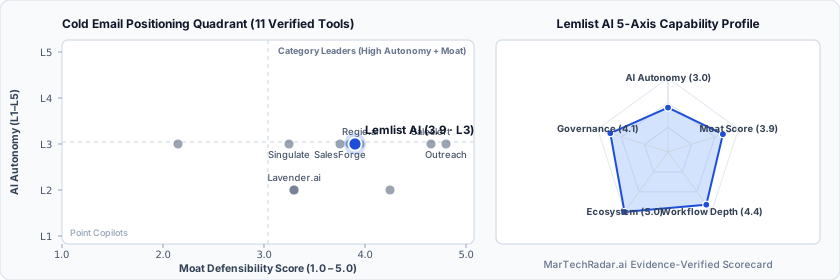
Lemlist AI in-depth review, pricing & architecture analysis
Editor sign-off: Oct 15, 2026. How profiles are made.
What is Lemlist AI? Overview & background
To capture attention in saturated inboxes, outbound sales teams must bypass legacy template blasts in favor of hyper-personalized, multi-channel cadences backed by strict deliverability tooling. Established in 2018 and headquartered in Paris, Île-de-France, Lemlist AI serves B2B sales development representatives, growth marketing teams, and outbound agencies seeking higher reply rates. The platform unifies B2B prospect discovery from a 650M+ contact database, automated enrichment, dynamic visual personalization, and algorithmic email warm-up across combined email and LinkedIn campaigns.
How Lemlist AI works: architecture & workflow
At the architectural layer, the system conditional autonomy via its lemAgent architecture, Lemlist AI ingests ICP criteria, company signals, and CRM data to identify target accounts. Its enrichment microservices verify email addresses and phone records before routing prospects into multi-channel sequences. For execution, the system leverages dynamic server-side image rendering to embed personalized visual assets—such as prospect screenshots—directly into outgoing email bodies. The engine exposes Model Context Protocol (MCP) endpoints and a CLI, allowing autonomous agents to execute research, trigger cadences, and manage sender pools programmatically, alongside native workflow integrations for Salesforce, HubSpot, Zapier, and Pipedrive under verified SOC 2 governance controls.
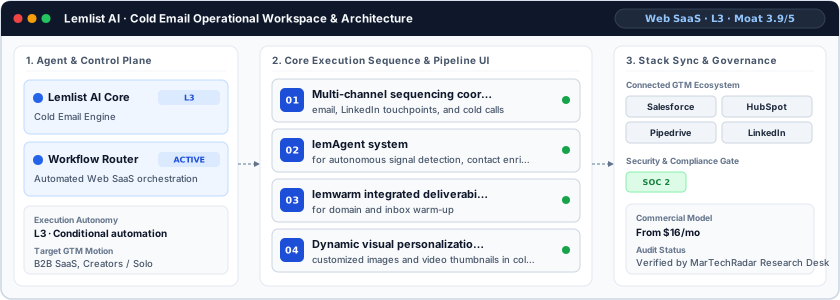
Lemlist AI limitations, drawbacks & risks
Operational considerations and platform boundaries include:
- Deliverability Throttling and Mailbox Warming Latency: New outbound domains require four to six weeks of linear sender warm-up before achieving full volume, creating immediate throughput bottlenecks for rapid go-to-market pushes.
- Dynamic Asset Rendering Overhead: Generating real-time visual screenshots and custom HTML layers introduces email payload bloat, triggering spam filters if sender domain reputation dips.
- Multi-Channel LinkedIn Rate Limits: Automated LinkedIn touchpoints remain tightly constrained by strict platform anti-scraping policies, limiting daily connection and message volumes per seat.
Lemlist AI pricing, plans & cost breakdown
Lemlist AI licenses its outbound infrastructure across self-serve monthly and discounted annual subscriptions, starting from $16/month for entry-level access. Dedicated outbound packages scale from $55 to $69 per month for email-focused configurations offering unlimited users, 50,000 monthly sends, and AI agents. Full multichannel tiers range from $87 to $109 per month, provisioning expanded sender pools per user, integrated LinkedIn steps, and advanced enrichment credits.
Direct competitors & market radar
Top algorithmic competitors based on category positioning, capability overlap, and ICP alignment.
Frequently asked questions about Lemlist AI
How much does Lemlist AI cost in 2026?
Lemlist AI pricing: From $16/mo. No free plan is publicly disclosed. Lemlist AI licenses its outbound infrastructure across self-serve monthly and discounted annual subscriptions, starting from $16/month for entry-level access.
What are the top Lemlist AI alternatives in Cold Email?
Verified Cold Email alternatives include Outreach (Custom / enterprise pricing), Singulate (Custom / enterprise pricing), Reevo (Custom / enterprise pricing), Woodpecker.co (Custom / enterprise pricing). Compared to direct category competitors like Outreach and Salesloft, Lemlist AI functions as an alternative focused on reliable workflow execution and transparent unit economics.
What are the main limitations and trade-offs of Lemlist AI?
Operational considerations and platform boundaries include: Deliverability Throttling and Mailbox Warming Latency: New outbound domains require four to six weeks of linear sender warm-up before achieving full volume, creating immediate throughput bottlenecks for rapid go-to-market pushes. Walk away if your workflow cannot tolerate deliverability throttling and mailbox warming latency: New outbound domains require four to six weeks of linear sender warm-up before achieving full volume, creating immediate throughput bottlenecks for rapid go-to-market pushes.
Verified sources & evidence trail
- Official product domain: https://lemlist.com
- Commercial pricing verification: https://www.lemlist.com/pricing
- Verified corporate entity profiles (
sameAs): LinkedIn Company Profile · Crunchbase Entity Record - First-party governance & documentation links: API & Docs · DPA · Terms · Privacy
- Editor sign-off: Oct 15, 2026 (how profiles are made).
