Rox Review (2026): AI SDR Pricing, Limits & Alternatives
Bottom line
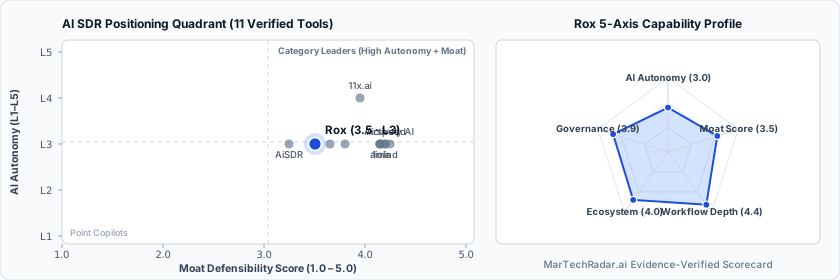
Rox is a Web SaaS tool for AI SDR (Autonomous B2B Sales Agents & AI BDRs) in AI SDR & Outbound. Pricing: $100–$255/mo. Best suited to B2B Sales Leaders, SDR/BDR Teams and Revenue Operations (RevOps). Editor ratings: AI autonomy L3 (conditional automation); moat score 3.5/5.0 (Proprietary moat). Fact-checked by Jiacky Lee on Oct 10, 2026.
Autonomous revenue agents designed for the Global 2000 and growth-stage sales teams to automate pipeline discovery, account research, and multi-channel.
Rox buyer fit verdict: when to choose vs. when to walk away
Choose Rox if (Best Fit)
- Target ICP & Stack Fit: You operate as B2B Sales Leaders, SDR/BDR Teams and Revenue Operations (RevOps) requiring a Web SaaS deployment for AI SDR, with verified ecosystem connectivity for Salesforce, HubSpot.
- L3 Architecture & Defensibility: Proprietary multi-agent orchestration architecture coupled with fine-grained account signal graphs and $50M in venture capitalization backing enterprise-grade compliance layers.
- Commercial Model Fit: Your procurement budget aligns with $100–$255/mo.
Walk away from Rox if (Deal-Breakers)
- Walk away if your workflow requires uncapped enterprise volume on the $100–$255/mo entry plan without upgrading tiers.
- Walk away if your workflow cannot tolerate domain warming and reputation overhead: High-volume autonomous outbound generation introduces severe domain reputation hazards, requiring teams to continuously maintain external secondary domains, DNS records, and warming schedules.
- Walk away if CRM schema drift is a deal-breaker for your team: Unannounced field modifications or validation rule adjustments within connected Salesforce or HubSpot instances can disrupt agent write-back routines, causing silent queue failures.
Rox key facts & scorecard
| Pricing | $100–$255/moVendor pricing page |
|---|---|
| Free plan | No / not disclosed |
| Delivery | Web SaaS |
| Audience | B2B Sales Leaders, SDR/BDR Teams, Revenue Operations (RevOps) |
| AI autonomy level | L3 · Conditional automationEditor-verified |
| Moat tier & score | 3.5 / 5.0 · Proprietary moatEditor-verified |
| Funding | Series B |
| Total funding | $50MBacked by General Catalyst, Sequoia Capital, South Park Commons |
| Founders | Avanika Narayan, Chris R., Diogo Ribeiro, Ishan Mukherjee |
| Company size | 51-200 employees |
| Ecosystem integrations | Salesforce, HubSpot |
| Governance & docs | Trust & Security ↗ · System Status ↗ · API & Docs ↗ · Privacy ↗ |
| Headquarters | San Francisco, California |
| Founded | 2024 |
| Last verified |
Rox pros & cons: strengths vs. operational limitations
Pros: core strengths & capabilities
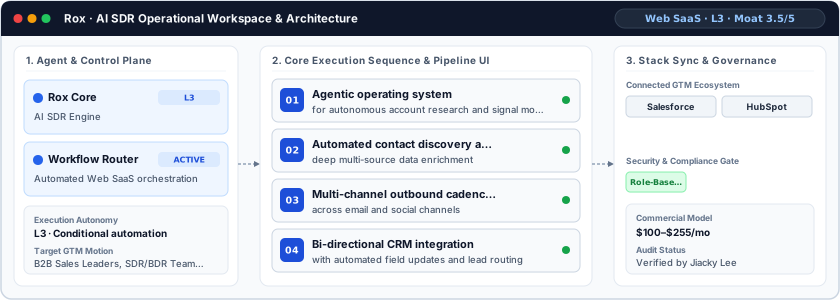
- Agentic operating system: for autonomous account research and signal monitoring
- Automated contact discovery and: deep multi-source data enrichment
- Multi-channel outbound cadence execution: across email and social channels
- Bi-directional CRM integration: with automated field updates and lead routing
Cons: operational limitations & risks
- Domain Warming and Reputation Overhead: High-volume autonomous outbound generation introduces severe domain reputation hazards, requiring teams to continuously maintain external secondary domains, DNS records, and warming schedules.
- CRM Schema Drift: Unannounced field modifications or validation rule adjustments within connected Salesforce or HubSpot instances can disrupt agent write-back routines, causing silent queue failures.
- Hallucination in Complex B2B Personas: Niche enterprise product lines with non-standard technical taxonomies occasionally trigger contextual hallucinations in generated messaging, demanding human oversight before prospect dispatch.
Rox TCO & deal-breaker stress test
Simulate 12-month stepped TCO, hidden cost multipliers, contract lock-in exposure, and stack failure modes using only facts verified by Jiacky Lee on · Capture SHA 48d9a198.
Rox aligns with your 5-seat / $800/mo profile. Review the walk-away triggers and contract levers below before deployment.
| Plan / Tier | Verified Rate | Scale Fit | Scope & Quota Notes |
|---|---|---|---|
| Entry / Starter | $100/mo | Unlimited seats (Entry credits) | 10,000 actions / month |
| Teams | $255/mo | Unlimited seats (Growth credits) | For smaller teams that want to streamline research, outreach, and deal management across their |
- Moat Score
- 3.5 / 5.0
- AI Autonomy
- L3
- Free Tier / Trial
- None disclosed
Triggered audit signals & failure modes
- Published Self-Serve Entry FloorVerified Pricing Ledger
Rox publishes a transparent entry point ($100–$255/mo) for initial validation before committing.
- Tier Fit for 5-Seat Scale: Teams ($255/mo)Verified Tier Schedule
For smaller teams that want to streamline research, outreach, and deal management across their
- Primary Operational Bottleneck: Domain Warming and Reputation OverheadAudit by Jiacky Lee
High-volume autonomous outbound generation introduces severe domain reputation hazards, requiring teams to continuously maintain external secondary domains, DNS records, and warming schedules.
Hidden TCO Multipliers & Quota Gates
- Profile / Workspace Quota Ceilings: Base tiers cap the number of connected profiles, workspaces, or contact records, forcing tier upgrades before seat limits are reached.
- Enterprise Governance & Add-On Gating: Advanced capabilities such as Single Sign-On (SSO), custom role permissions, or specialized analytics modules are gated behind upper tiers or paid add-ons.
When to Walk Away & Negotiation Levers
- Walk away if your workflow requires uncapped enterprise volume on the $100–$255/mo entry plan without upgrading tiers.
- Walk away if your workflow cannot tolerate domain warming and reputation overhead: High-volume autonomous outbound generation introduces severe domain reputation hazards, requiring teams to continuously maintain external secondary domains, DNS records, and warming schedules.
- Walk away if CRM schema drift is a deal-breaker for your team: Unannounced field modifications or validation rule adjustments within connected Salesforce or HubSpot instances can disrupt agent write-back routines, causing silent queue failures.
- Validate exact quota thresholds (seats, credits, or API calls) included in Rox's $100–$255/mo tier before converting from monthly to annual billing.
- Require a sandbox proof-of-concept testing domain warming and reputation overhead against your live CRM/data schema before annual sign-off.
Ask a custom procurement or TCO stress-test question about Rox
Lower 5-seat floor (~$29/mo vs. $255 / mo)
Lower 5-seat floor (~$220/mo vs. $255 / mo)
Rox key entities, modules & ecosystem stack
Rox moat & subtrack positioning
Proprietary multi-agent orchestration architecture coupled with fine-grained account signal graphs and $50M in venture capitalization backing enterprise-grade compliance layers.
Editorial review
Fact-checked by Jiacky Lee (Managing Editor, AI Autonomy & Moat Methodology) on .
Background
Backed by $50M in venture capital, Rox was founded in 2024 in San Francisco, California, to engineer autonomous revenue agents for enterprise organizations and modern sales development teams. The platform addresses structural efficiency bottlenecks in pipeline generation by delegating outbound research, account discovery, and prospecting cadences to synthetic revenue representatives. Operating in the autonomous B2B sales agents track, Rox targets enterprise revenue operations leaders, commercial sales executives, and pipeline development teams seeking to scale outbound engagement without proportional headcount expansion across their go-to-market organizations.
How Rox works
Rox operates at an L3 workflow autonomy level, orchestrating multi-agent systems that ingest structured CRM records, web telemetry, and intent signals. The underlying inference engine synthesizes cross-channel firmographic data to map target buying committees across defined enterprise accounts. Upon identifying priority stakeholders, the platform executes automated enrichment scripts and formulates contextual, multi-touch messaging cadences. These workflows leverage fine-tuned language models bound by deterministic guardrails, maintaining bi-directional synchronization with primary CRM databases while handling incoming qualification responses and calendar orchestration.
Limitations
Operational considerations and platform boundaries include:
- Domain Warming and Reputation Overhead: High-volume autonomous outbound generation introduces severe domain reputation hazards, requiring teams to continuously maintain external secondary domains, DNS records, and warming schedules.
- CRM Schema Drift: Unannounced field modifications or validation rule adjustments within connected Salesforce or HubSpot instances can disrupt agent write-back routines, causing silent queue failures.
- Hallucination in Complex B2B Personas: Niche enterprise product lines with non-standard technical taxonomies occasionally trigger contextual hallucinations in generated messaging, demanding human oversight before prospect dispatch.
Rox pricing
Commercial access to Rox follows a tier-based software subscription model tied directly to monthly agent operational quotas. Entry-level deployment for individual sales professionals starts at $100 per month, granting access to core research tools and up to 10,000 monthly actions. Scaled team capabilities expand through structured packages up to $255 per month, which unlock higher volume action allowances, advanced multi-channel orchestration modules, and automated contact enrichment services.
How Rox compares
Within the autonomous sales landscape, Rox competes against alternatives such as 11x.ai, 1mind, and Actively AI. While 11x.ai focuses on fully autonomous synthetic digital workers like automated SDRs, and Actively AI emphasizes personalized signal-based triggers, Rox differentiates through its balance of individual self-service availability and enterprise Global 2000 compliance frameworks. Rox represents an optimal architectural fit for mid-market and enterprise B2B sales organizations that require structured data enrichment coupled with controllable, multi-channel agent execution.
Direct competitors & market radar
Top algorithmic competitors based on category positioning, capability overlap, and ICP alignment.
Frequently asked questions about Rox
How much does Rox cost and what pricing tiers are available?
Published pricing summary for Rox: $100–$255/mo. A permanent free plan is not disclosed for Rox. Verified tier schedule: Entry / Starter ($100/mo for Unlimited seats (Entry credits)); Teams ($255/mo for Unlimited seats (Growth credits)). Commercial access to Rox follows a tier-based software subscription model tied directly to monthly agent operational quotas. Entry-level deployment for individual sales professionals starts at $100 per month, granting access to core research tools and up to 10,000 monthly actions.
How does Rox work and how autonomous is its AI architecture?
Autonomous revenue agents designed for the Global 2000 and growth-stage sales teams to automate pipeline discovery, account research, and multi-channel. Within AI SDR (Autonomous B2B Sales Agents & AI BDRs), MarTechRadar rates its execution architecture at L3 · Conditional automation with a verified Moat Score of 3.5 / 5.0 (Proprietary moat). Proprietary multi-agent orchestration architecture coupled with fine-grained account signal graphs and $50M in venture capitalization backing enterprise-grade compliance layers. Corporate profile: Founded by Avanika Narayan, Chris R., Diogo Ribeiro, Ishan Mukherjee, operating at 51-200 employees scale.
What are the main limitations of Rox and when should buyers walk away?
Based on our editorial technical audit, key operational considerations and boundaries for Rox include: (1) Domain Warming and Reputation Overhead: High-volume autonomous outbound generation introduces severe domain reputation hazards, requiring teams to continuously maintain external secondary domains, DNS records, and warming schedules. (2) CRM Schema Drift: Unannounced field modifications or validation rule adjustments within connected Salesforce or HubSpot instances can disrupt agent write-back routines, causing silent queue failures. (3) Hallucination in Complex B2B Personas: Niche enterprise product lines with non-standard technical taxonomies occasionally trigger contextual hallucinations in generated messaging, demanding human oversight before prospect dispatch. Primary procurement walk-away rule: Walk away if your workflow requires uncapped enterprise volume on the $100–$255/mo entry plan without upgrading tiers.
What integrations, compliance certifications, and contract terms apply to Rox?
Verified ecosystem and stack integrations include Salesforce, HubSpot. First-party governance and developer endpoints verified on domain include: Trust/Security (https://www.rox.com/security), Status (https://status.rox.com), API Docs (https://www.rox.com/docs). Key TCO multiplier to watch: Profile / Workspace Quota Ceilings (Base tiers cap the number of connected profiles, workspaces, or contact records, forcing tier upgrades before seat limits are reached.) Before signing a contract, procurement teams should validate exact quota thresholds (seats, credits, or API calls) included in Rox's $100–$255/mo tier before converting from monthly to annual billing.
What are the best Rox alternatives and head-to-head competitors in 2026?
Top fact-checked alternatives to Rox in AI SDR (Autonomous B2B Sales Agents & AI BDRs) include Outreach (Custom / enterprise pricing), Salesloft (Custom / enterprise pricing), Reply.io Jason AI (From $29/mo), Attio ($44–$99/seat/mo). Within the autonomous sales landscape, Rox competes against alternatives such as 11x.ai, 1mind, and Actively AI.
Verified sources & evidence trail
- Official product domain: https://rox.com
- Commercial pricing verification: https://www.rox.com/pricing
- Verified corporate entity profiles (
sameAs): LinkedIn Company Profile · Crunchbase Entity Record - First-party governance & documentation links: Trust & Security · System Status · API & Docs · Privacy
- Editorial audit sign-off: Fact-checked by Jiacky Lee on under the MarTechRadar Evidence-Ledger Protocol.