Reply.io Jason AI Review (2026): ABM Pricing, Pros & Cons
Bottom line
Reply.io Jason AI is a Web SaaS tool for ABM (Buyer Intent Data & Account-Based Marketing) in AI SDR & Outbound. Pricing: From $29/mo. Best suited to B2B SaaS, DTC / eCommerce and Enterprise Brands. Editor ratings: AI autonomy L3 (conditional automation); moat score 3.4/5.0 (Workflow-embedded (strong)). Fact-checked by MarTechRadar Research Desk on Oct 12, 2026.
Autonomous conversational AI sales assistant that generates multi-channel sequences, discovers B2B buyer profiles, and automates contextual inbound.
Is Reply.io Jason AI worth it in 2026? Buyer fit & when to walk away
Choose Reply.io Jason AI if (Best Fit)
- Target ICP & Stack Fit: You operate as B2B SaaS, DTC / eCommerce and Enterprise Brands requiring a Web SaaS deployment for ABM, with verified ecosystem connectivity for Salesforce, HubSpot, Pipedrive, Outreach.
- L3 Architecture & Defensibility: Proprietary integration between cold email deliverability infrastructure, a native database of 1B+ verified B2B profiles, and context-aware conversational response models.
- Commercial Model Fit: Your procurement budget aligns with From $29/mo.
Walk away from Reply.io Jason AI if (Deal-Breakers)
- Walk away if your workflow cannot tolerate deliverability and domain warming: Automated high-volume email dispatch remains constrained by mailbox provider throttling and DNS reputation risks, necessitating external mailbox warming cycles to prevent domain blacklisting.
- Walk away if intent classification variance is a deal-breaker for your team: Complex, multi-part buyer objections or nuanced procurement inquiries can trigger incorrect sentiment classifications, requiring manual human review to avoid off-target automated responses.
Reply.io Jason AI pricing, free plan & scorecard at a glance
| Pricing | From $29/moVendor pricing page |
|---|---|
| Free plan | No / not disclosed |
| Delivery | Web SaaS |
| Audience | B2B SaaS, DTC / eCommerce, Enterprise Brands |
| AI autonomy level | L3 · Conditional automationEditor-verified |
| Moat tier & score | 3.4 / 5.0 · Workflow-embedded (strong)Editor-verified |
| Funding | Undisclosed |
| Company size | 51-200 employees |
| Ecosystem integrations | Salesforce, HubSpot, Pipedrive, Outreach, LinkedIn, Zapier |
| Governance & docs | System Status ↗ · API & Docs ↗ · Changelog ↗ · Terms ↗ · Privacy ↗ |
| Headquarters | San Jose, California |
| Founded | 2016 |
| Last verified | Oct 12, 2026 |
Reply.io Jason AI pros & cons: strengths vs. operational limitations
Pros: core strengths & capabilities
- Autonomous multi-channel sequence generation: across email and LinkedIn
- Real-time B2B data search and contact enrichment over 1B+ profiles
- Natural language intent categorization: for handling objections and scheduling meetings
- Agentic chat interface allowing: natural language management of outbound sales workflows
Cons: operational limitations & risks
- Deliverability and Domain Warming: Automated high-volume email dispatch remains constrained by mailbox provider throttling and DNS reputation risks, necessitating external mailbox warming cycles to prevent domain blacklisting.
- Intent Classification Variance: Complex, multi-part buyer objections or nuanced procurement inquiries can trigger incorrect sentiment classifications, requiring manual human review to avoid off-target automated responses.
- Multi-Channel Rate Governance: LinkedIn automation actions are bound by platform-enforced weekly interaction thresholds, limiting true autonomous throughput compared to unconstrained SMTP channels.
Reply.io Jason AI TCO & deal-breaker stress test
Simulate 12-month stepped TCO, hidden cost multipliers, contract lock-in exposure, and stack failure modes using only facts verified by MarTechRadar Research Desk on 2026-10-12 · Capture SHA fa80be2a.
Reply.io Jason AI aligns with your 5-seat / $800/mo profile. Review the walk-away triggers and contract levers below before deployment.
- Moat Score
- 3.4 / 5.0
- AI Autonomy
- L3
- Free Tier / Trial
- None disclosed
Triggered audit signals & failure modes
- Published Self-Serve Entry FloorVerified Pricing Ledger
Reply.io Jason AI publishes a transparent entry point (From $29/mo) for initial validation before committing.
- Primary Operational Bottleneck: Deliverability and Domain WarmingAudit by MarTechRadar Research Desk
Automated high-volume email dispatch remains constrained by mailbox provider throttling and DNS reputation risks, necessitating external mailbox warming cycles to prevent domain blacklisting.
Test a custom Reply.io Jason AI budget or stack constraint
Lower 5-seat floor (~$10/mo vs. From $29 / mo)
Fits within $800/mo budget ($100–$255/mo)
Reply.io Jason AI integrations, API, security & compliance stack
Reply.io Jason AI AI moat & ABM positioning
Proprietary integration between cold email deliverability infrastructure, a native database of 1B+ verified B2B profiles, and context-aware conversational response models.
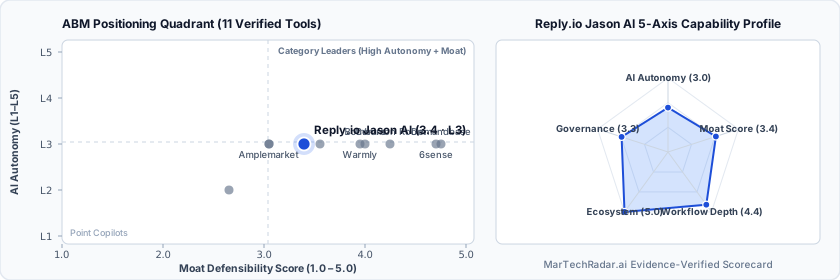
Reply.io Jason AI in-depth review, pricing & architecture analysis
Editor sign-off: Oct 12, 2026. How profiles are made.
What is Reply.io Jason AI? Overview & background
For revenue operations and commercial sales development teams seeking to scale outbound pipeline generation without linearly expanding headcount, Reply.io Jason AI functions as an autonomous conversational business development assistant. Established in 2016 in San Jose, California, Reply.io built Jason AI as an integrated agentic layer within its core engagement platform. The solution is engineered primarily for demand generation leaders and sales development representatives who require continuous lead discovery, dynamic message drafting, and rapid inbound triage across high-volume outreach channels.
How Reply.io Jason AI works: architecture & workflow
At an architectural level, Jason AI functions as an L3 semi-autonomous agent that couples prompt-engineered language models with Reply.io's underlying database of over 1 billion B2B contact records. During campaign orchestration, the agent ingests ideal customer profile guidelines and value propositions to generate multi-channel cadence logic across email and LinkedIn touchpoints. Incoming prospect responses are parsed via natural language intent classification to detect meeting interest, referrals, or specific objections. The system subsequently generates contextual responses that route either directly to the prospect or to human operators for validation, alongside native workflow integrations for Salesforce, HubSpot, Zapier, and Pipedrive.
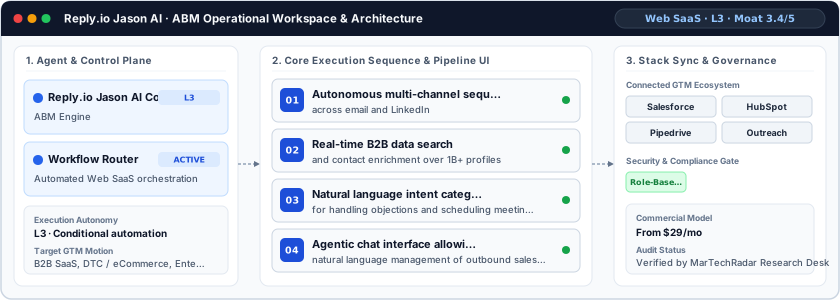
Reply.io Jason AI limitations, drawbacks & risks
Operational considerations and platform boundaries include:
- Deliverability and Domain Warming: Automated high-volume email dispatch remains constrained by mailbox provider throttling and DNS reputation risks, necessitating external mailbox warming cycles to prevent domain blacklisting.
- Intent Classification Variance: Complex, multi-part buyer objections or nuanced procurement inquiries can trigger incorrect sentiment classifications, requiring manual human review to avoid off-target automated responses.
- Multi-Channel Rate Governance: LinkedIn automation actions are bound by platform-enforced weekly interaction thresholds, limiting true autonomous throughput compared to unconstrained SMTP channels.
Reply.io Jason AI pricing, plans & cost breakdown
Commercial access to Reply.io follows a tiered subscription structure starting from $29/month for entry-level access. Pricing scales upward depending on user seat allocation, volume of active prospect contacts, and required credits for data enrichment and native email lookups. Higher tiers unlock deeper multi-channel capabilities, expanded agentic chat features, and dedicated deliverability support.
How Reply.io Jason AI compares vs. competitors & alternatives
Within the outbound engagement ecosystem, Jason AI occupies an execution-centric role when compared to data-first platforms within the ABM segment. While enterprise platforms like 6sense focus on predictive intent modeling and account-level deanonymization, Jason AI concentrates directly on message execution and automated response management. Amplemarket provides similar full-stack data and sequencing mechanics, but Jason AI delivers a lower cost barrier for early-stage teams. Meanwhile, tools like Albacross focus purely on website visitor intent capture rather than autonomous execution. Jason AI is best matched for mid-market revenue organizations requiring unified data discovery and execution without enterprise data warehouse overhead.
Direct competitors & market radar
Top algorithmic competitors based on category positioning, capability overlap, and ICP alignment.
Frequently asked questions about Reply.io Jason AI
How much does Reply.io Jason AI cost in 2026?
Reply.io Jason AI pricing: From $29/mo. No free plan is publicly disclosed. Commercial access to Reply.io follows a tiered subscription structure starting from $29/month for entry-level access.
What are the top Reply.io Jason AI alternatives in ABM?
Verified ABM alternatives include Lavender.ai (Custom / enterprise pricing), First Touch (From $10/mo), Rox ($100–$255/mo), Buena AI ($29–$97/mo). Within the outbound engagement ecosystem, Jason AI occupies an execution-centric role when compared to data-first platforms within the ABM segment.
What are the main limitations and trade-offs of Reply.io Jason AI?
Operational considerations and platform boundaries include: Deliverability and Domain Warming: Automated high-volume email dispatch remains constrained by mailbox provider throttling and DNS reputation risks, necessitating external mailbox warming cycles to prevent domain blacklisting. Walk away if your workflow cannot tolerate deliverability and domain warming: Automated high-volume email dispatch remains constrained by mailbox provider throttling and DNS reputation risks, necessitating external mailbox warming cycles to prevent domain blacklisting.
Verified sources & evidence trail
- Official product domain: https://reply.io
- Commercial pricing verification: https://reply.io/pricing/
- Verified corporate entity profiles (
sameAs): LinkedIn Company Profile - First-party governance & documentation links: System Status · API & Docs · Changelog · Terms · Privacy
- Editor sign-off: Oct 12, 2026 (how profiles are made).
