Common Room Review (2026): ABM Pricing, Pros & Cons
Bottom line
Common Room is a Web SaaS tool for ABM (Buyer Intent Data & Account-Based Marketing) in AI SDR & Outbound. Pricing: From $2,500/mo. Best suited to B2B SaaS. Editor ratings: AI autonomy L3 (conditional automation); moat score 4.2/5.0 (Proprietary moat). Fact-checked by MarTechRadar Research Desk on Oct 12, 2026.
Customer journey and buyer intelligence platform unifying community, product, and digital intent signals into actionable pipeline workflows.
Is Common Room worth it in 2026? Buyer fit & when to walk away
Choose Common Room if (Best Fit)
- Target ICP & Stack Fit: You operate as B2B SaaS requiring a Web SaaS deployment for ABM, with verified ecosystem connectivity for Salesforce, HubSpot, Outreach, Slack.
- L3 Architecture & Defensibility: Multi-source identity resolution engine bridging developer, social, and product touchpoints into unified account records paired with native automated orchestration.
- Commercial Model Fit: Your procurement budget aligns with From $2,500/mo.
Walk away from Common Room if (Deal-Breakers)
- Walk away if your workflow cannot tolerate API rate limits: High-volume data collection across third-party endpoints like GitHub and LinkedIn faces strict platform throughput caps, resulting in ingestion delays during burst community activity.
- Walk away if identity resolution drift is a deal-breaker for your team: Disparate developer aliases and non-corporate email handles can create edge-case false positives during automated contact merging, demanding periodic manual deduplication.
Common Room pricing, free plan & scorecard at a glance
| Pricing | From $2,500/moVendor pricing page |
|---|---|
| Free plan | No / not disclosed |
| Delivery | Web SaaS |
| Audience | B2B SaaS |
| AI autonomy level | L3 · Conditional automationEditor-verified |
| Moat tier & score | 4.2 / 5.0 · Proprietary moatEditor-verified |
| Funding | AcquiredAcquired by Zoom |
| Total funding | $52.9MBacked by Index Ventures, 01 Advisors, Greylock, Madrona, Next Play Ventures |
| Founders | Francis Luu, Linda Lian, Tom Kleinpeter, Viraj Mody |
| Company size | 51-200 employees |
| Ecosystem integrations | Salesforce, HubSpot, Outreach, Slack, LinkedIn, Webflow |
| Compliance & governance | GDPR |
| Governance & docs | Trust & Security ↗ · API & Docs ↗ · Terms ↗ · Privacy ↗ |
| Headquarters | Seattle, Washington |
| Founded | 2020 |
| Last verified | Oct 12, 2026 |
Common Room pros & cons: strengths vs. operational limitations
Pros: core strengths & capabilities
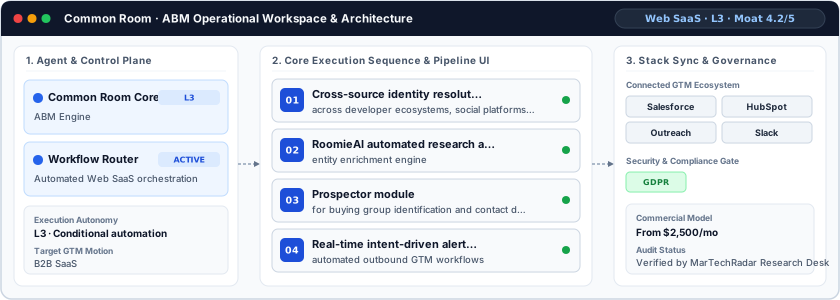
- Cross-source identity resolution: across developer ecosystems, social platforms, and CRMs
- RoomieAI automated research and entity enrichment engine
- Prospector module: for buying group identification and contact discovery
- Real-time intent-driven alerts and automated outbound GTM workflows
Cons: operational limitations & risks
- API Rate Limits: High-volume data collection across third-party endpoints like GitHub and LinkedIn faces strict platform throughput caps, resulting in ingestion delays during burst community activity.
- Identity Resolution Drift: Disparate developer aliases and non-corporate email handles can create edge-case false positives during automated contact merging, demanding periodic manual deduplication.
- Credit Consumption Caps: Fixed quotas on RoomieAI enrichment and Prospector discovery credits require strict query budgeting to avoid mid-billing-cycle prospecting throttles.
Common Room TCO & deal-breaker stress test
Simulate 12-month stepped TCO, hidden cost multipliers, contract lock-in exposure, and stack failure modes using only facts verified by MarTechRadar Research Desk on 2026-10-12 · Capture SHA 4b621c92.
Common Room triggers high-severity friction under your 5-seat / $800/mo constraints. Benchmark the verified subtrack alternatives below before committing.
- Moat Score
- 4.2 / 5.0
- AI Autonomy
- L3
- Free Tier / Trial
- None disclosed
Triggered audit signals & failure modes
- Budget Ceiling Breached ($2,500/mo vs. $800/mo cap)Verified Pricing Ledger
At 5 seats, Common Room's verified entry floor (From $2,500/mo) exceeds your $800/mo budget before add-ons or overages.
- Published Self-Serve Entry FloorVerified Pricing Ledger
Common Room publishes a transparent entry point (From $2,500/mo) for initial validation before committing.
- Primary Operational Bottleneck: Credit Consumption CapsAudit by MarTechRadar Research Desk
Fixed quotas on RoomieAI enrichment and Prospector discovery credits require strict query budgeting to avoid mid-billing-cycle prospecting throttles.
Test a custom Common Room budget or stack constraint
Lower 5-seat floor (~$29/mo vs. From $2,500 / mo)
Lower 5-seat floor (~$259/mo vs. From $2,500 / mo)
Common Room integrations, API, security & compliance stack
Common Room AI moat & ABM positioning
Multi-source identity resolution engine bridging developer, social, and product touchpoints into unified account records paired with native automated orchestration.
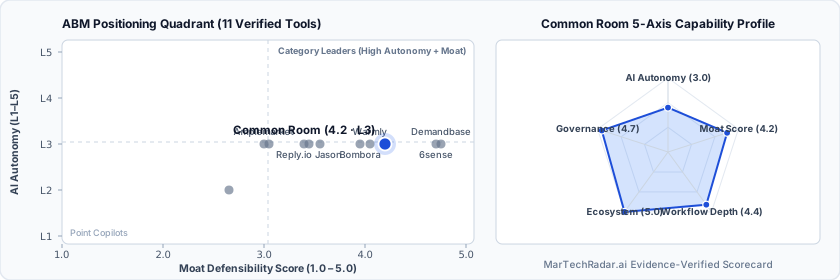
Common Room in-depth review, pricing & architecture analysis
Editor sign-off: Oct 12, 2026. How profiles are made.
What is Common Room? Overview & background
Architected to solve fragmented account identification across modern software touchpoints, Common Room was established in 2020 in Seattle, Washington. Backed by $52.9M in venture funding, the company engineers a customer journey intelligence platform positioned for revenue operations, developer relations, and marketing leadership. Rather than relying solely on traditional web cookies or static firmographics, the platform is designed to consolidate dynamic interactions across software ecosystems into unified account-level records for enterprise sales execution.
How Common Room works: architecture & workflow
At its architectural core, Common Room deploys an ingestion layer that captures activity from GitHub, Slack, Discord, LinkedIn, product analytics, and primary CRMs. An identity graph executes deterministic and probabilistic matching to resolve disparate email addresses, community handles, and developer identifiers into cohesive buyer personas. Operating at Level 3 conditional autonomy, the native RoomieAI engine correlates cross-channel engagement velocity against ICP parameters, score-ranking accounts and dispatching automated outreach sequences to pipeline tools, alongside native workflow integrations for Salesforce, HubSpot, Webflow, and Notion under verified GDPR governance controls.
Common Room limitations, drawbacks & risks
Operational considerations and platform boundaries include:
- API Rate Limits: High-volume data collection across third-party endpoints like GitHub and LinkedIn faces strict platform throughput caps, resulting in ingestion delays during burst community activity.
- Identity Resolution Drift: Disparate developer aliases and non-corporate email handles can create edge-case false positives during automated contact merging, demanding periodic manual deduplication.
- Credit Consumption Caps: Fixed quotas on RoomieAI enrichment and Prospector discovery credits require strict query budgeting to avoid mid-billing-cycle prospecting throttles.
Common Room pricing, plans & cost breakdown
Commercial procurement operates on an annual subscription tiers framework. Entry into the platform begins at $2500/month on the Essential tier, which covers 5 seats, up to 100k contacts, and dedicated allocations of 5k RoomieAI research credits and 2.5k Prospector credits. Higher tiers scale into custom pricing agreements accommodating increased seat counts, broader contact capacities, and dedicated customer success resources.
| Plan / Tier | Verified Price & Billing | Included Scope & Contract Terms |
|---|---|---|
| Essential | $2500/mo | Up to 100k contacts |
How Common Room compares vs. competitors & alternatives
Within the account-based intelligence market, Common Room addresses touchpoints that legacy platforms overlook within the ABM segment, and is frequently benchmarked by buyers against Lusha. While 6sense specializes in broad programmatic display networks and IP-based anonymous web traffic, Common Room captures direct, high-signal developer and product community activity. Albacross focuses primarily on basic European IP deanonymization, and Amplemarket functions primarily as an outbound sales dialer. Common Room remains ideal for technical B2B organizations running product-led or developer-centric sales motions.
Direct competitors & market radar
Top algorithmic competitors based on category positioning, capability overlap, and ICP alignment.
Frequently asked questions about Common Room
How much does Common Room cost in 2026?
Common Room pricing: From $2,500/mo. No free plan is publicly disclosed. Commercial procurement operates on an annual subscription tiers framework.
What are the top Common Room alternatives in ABM?
Verified ABM alternatives include 6sense (Custom / enterprise pricing), Demandbase (Custom / enterprise pricing), Lusha (Custom / enterprise pricing), Warmly (From $10,000/yr). Within the account-based intelligence market, Common Room addresses touchpoints that legacy platforms overlook within the ABM segment, and is frequently benchmarked by buyers against Lusha.
What are the main limitations and trade-offs of Common Room?
Operational considerations and platform boundaries include: API Rate Limits: High-volume data collection across third-party endpoints like GitHub and LinkedIn faces strict platform throughput caps, resulting in ingestion delays during burst community activity. Walk away if your workflow cannot tolerate API rate limits: High-volume data collection across third-party endpoints like GitHub and LinkedIn faces strict platform throughput caps, resulting in ingestion delays during burst community activity.
Verified sources & evidence trail
- Official product domain: https://commonroom.io
- Commercial pricing verification: https://www.commonroom.io/pricing/
- Verified corporate entity profiles (
sameAs): LinkedIn Company Profile · Crunchbase Entity Record - First-party governance & documentation links: Trust & Security · API & Docs · Terms · Privacy
- Editor sign-off: Oct 12, 2026 (how profiles are made).
