Bombora vs Common Room
Reviewed by MarTechRadar Research Desk. Pricing & entity snapshots verified Oct 12, 2026.
Bombora (API / SDK) and Common Room (Web SaaS) both compete in Buyer Intent Data & Account-Based Marketing. On pricing, Bombora lists Custom / enterprise pricing (no free plan disclosed), whereas Common Room lists From $2,500/mo (no free plan disclosed). Technically, Bombora is rated L3 · Conditional automation with a 4.0/5.0 (Proprietary moat) moat, while Common Room is rated L3 · Conditional automation with a 4.2/5.0 (Proprietary moat) moat. Corporate profile: Bombora (founded 2014, HQ New York, $20M funding) vs. Common Room (founded 2020, HQ Seattle, Washington, $52.9M funding). Both profiles are verified by the MarTechRadar Research Desk (Oct 12, 2026). At a 5-seat team baseline, Bombora starts at Custom quote vs Common Room at ~$2,500/mo (base).
Bombora
B2B intent data platform aggregating collective publisher content consumption to identify surging account research activity.
5-User Team Cost: Custom quote (Custom / enterprise pricing) · Autonomy: L3 · Conditional automation · Moat: 4.0/5.0 (Proprietary moat)
Target fit: B2B SaaS, DTC / eCommerce, Enterprise Brands (API / SDK)
Common Room
Customer journey and buyer intelligence platform unifying community, product, and digital intent signals into actionable pipeline workflows.
5-User Team Cost: ~$2,500/mo (base) (From $2,500/mo) · Autonomy: L3 · Conditional automation · Moat: 4.2/5.0 (Proprietary moat)
Target fit: B2B SaaS (Web SaaS)
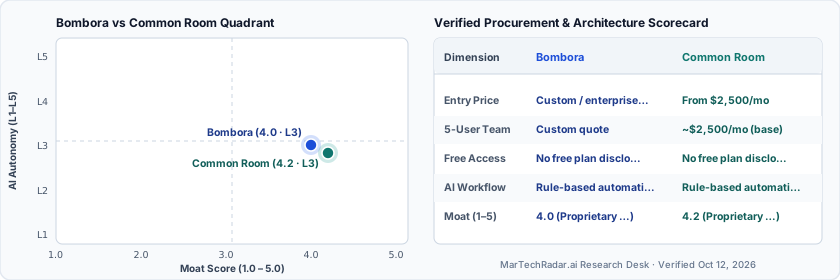
How Bombora and Common Room differ
- Pricing model: Bombora is enterprise / quote, Common Room is subscription.
- Common Room publishes an entry price (From $2,500/mo); Bombora does not (Custom / enterprise pricing).
- Moat score: Common Room scores 4.2/5.0 vs. Bombora at 4.0/5.0 (Proprietary moat).
- Delivery: Bombora is a API / SDK product; Common Room is a Web SaaS product.
- Bombora was founded earlier (2014) than Common Room (2020).
- Headquarters: Bombora in New York, Common Room in Seattle, Washington.
- Verified backing: Bombora records $20M (StarVest Partners); Common Room records $52.9M (Index Ventures, 01 Advisors, Greylock, Madrona, Next Play Ventures).
- Company headcount: Bombora is 201-500 employees; Common Room is 51-200 employees.
Computed from the fields below. Only editor-verified ratings and vendor-sourced prices are compared.
When to choose Bombora vs Common Room (and when to walk away)
Choose Bombora if
- Target ICP & Stack Fit: You operate as B2B SaaS, DTC / eCommerce and Enterprise Brands requiring a API / SDK deployment for ABM.
- L3 Architecture & Defensibility: Proprietary Data Co-op network encompassing thousands of premium B2B publishers, governed by direct consent mechanisms and a ten-year longitudinal baseline of organizational content consumption.
- Commercial Model Fit: Your procurement budget aligns with Custom / enterprise pricing.
Walk away from Bombora if
- Walk away if you require transparent self-serve monthly billing or your budget ceiling is under $1,000/mo (Bombora requires sales-gated custom quoting).
- Walk away if your workflow cannot tolerate domain identification attribution lag: Remote-work network masking and dynamic IP allocations periodically disrupt reverse-DNS matching, delaying account attribution or attributing intent to generic internet service providers.
- Walk away if taxonomy granularity constraints is a deal-breaker for your team: Intent surges correlate to pre-indexed categorical tags, causing false-positive signals when emerging technical terminology is mapped onto generalized, parent-level topic definitions.
Choose Common Room if
- Target ICP & Stack Fit: You operate as B2B SaaS requiring a Web SaaS deployment for ABM, with verified ecosystem connectivity for Salesforce, HubSpot, Outreach, Slack.
- L3 Architecture & Defensibility: Multi-source identity resolution engine bridging developer, social, and product touchpoints into unified account records paired with native automated orchestration.
- Commercial Model Fit: Your procurement budget aligns with From $2,500/mo.
Walk away from Common Room if
- Walk away if your team is at early validation stage with a <$250/mo tool budget (Common Room starts at From $2,500/mo before seat or usage expansion).
- Walk away if your workflow cannot tolerate API rate limits: High-volume data collection across third-party endpoints like GitHub and LinkedIn faces strict platform throughput caps, resulting in ingestion delays during burst community activity.
- Walk away if identity resolution drift is a deal-breaker for your team: Disparate developer aliases and non-corporate email handles can create edge-case false positives during automated contact merging, demanding periodic manual deduplication.
Side-by-side facts
| Field | Bombora | Common Room |
|---|---|---|
| Subtrack | Buyer Intent Data & Account-Based Marketing | Buyer Intent Data & Account-Based Marketing |
| Pricing | Custom / enterprise pricing | From $2,500/mo |
| Pricing model | Enterprise / quote | Subscription |
| Published pricing tiers | Enterprise / Custom (Custom quote) | — |
| Free access | No free plan disclosed | No free plan disclosed |
| Enterprise plan | Yes | Not recorded |
| AI autonomy level | L3 · Conditional automation | L3 · Conditional automation |
| Moat tier & score | 4.0 / 5.0 · Proprietary moat | 4.2 / 5.0 · Proprietary moat |
| Delivery | API / SDK | Web SaaS |
| Audience | B2B SaaS, DTC / eCommerce, Enterprise Brands | B2B SaaS |
| Ecosystem integrations | — | Salesforce, HubSpot, Outreach, Slack, LinkedIn, Webflow |
| Compliance & governance | GDPR, CCPA | GDPR |
| Funding & backing | $20M · Backed by StarVest Partners | $52.9M · Backed by Index Ventures, 01 Advisors, Greylock, Madrona, Next Play Ventures · Acquired by Zoom |
| Founders | Erik Matlick, Mike Burton, Rob Armstrong, Stephen Lilly | Francis Luu, Linda Lian, Tom Kleinpeter, Viraj Mody |
| Company size | 201-500 employees | 51-200 employees |
| Founded | 2014 | 2020 |
| Headquarters | New York | Seattle, Washington |
| Fact-checked | MarTechRadar Research Desk, Oct 12, 2026 | MarTechRadar Research Desk, Oct 12, 2026 |
| Governance & docs | Terms ↗ · Privacy ↗ | Trust & Security ↗ · API & Docs ↗ · Terms ↗ · Privacy ↗ |
Bombora vs Common Room: TCO & constraint stress test
Test how both tools behave under your team size, monthly budget ceiling, CRM ecosystem, and governance guardrails.
Bombora
High Deal-Risk · Constraint Mismatch- Opaque Enterprise Quoting vs. SMB/Mid-Market Budget: Bombora does not disclose a public self-serve floor (Custom / enterprise pricing). Buyers with a $800/mo cap face high sales-qualification friction.
- Sales-Gated Contract Terms: Bombora operates under a direct subscription model without standard public tiers.
- Primary Operational Bottleneck: Domain Identification Attribution Lag: Remote-work network masking and dynamic IP allocations periodically disrupt reverse-DNS matching, delaying account attribution or attributing intent to generic internet service providers.
Walk-Away Rule: Walk away if you require transparent self-serve monthly billing or your budget ceiling is under $1,000/mo (Bombora requires sales-gated custom quoting).
Negotiation Lever: Demand a 30- to 60-day paid pilot opt-out clause in the Bombora order form before signing a 12-month enterprise commitment.
Common Room
High Deal-Risk · Constraint Mismatch- Budget Ceiling Breached ($2,500/mo vs. $800/mo cap): At 5 seats, Common Room's verified entry floor (From $2,500/mo) exceeds your $800/mo budget before add-ons or overages.
- Published Self-Serve Entry Floor: Common Room publishes a transparent entry point (From $2,500/mo) for initial validation before committing.
- Primary Operational Bottleneck: Credit Consumption Caps: Fixed quotas on RoomieAI enrichment and Prospector discovery credits require strict query budgeting to avoid mid-billing-cycle prospecting throttles.
Walk-Away Rule: Walk away if your team is at early validation stage with a <$250/mo tool budget (Common Room starts at From $2,500/mo before seat or usage expansion).
Negotiation Lever: Negotiate price-lock protection on additional seats and overage credits above the From $2,500/mo entry tier.
Limitations
Bombora
Operational considerations and platform boundaries include: Domain Identification Attribution Lag: Remote-work network masking and dynamic IP allocations periodically disrupt reverse-DNS matching, delaying account attribution or attributing intent to generic internet service providers.Full limitations in the Bombora review
Common Room
Operational considerations and platform boundaries include: API Rate Limits: High-volume data collection across third-party endpoints like GitHub and LinkedIn faces strict platform throughput caps, resulting in ingestion delays during burst community activity.Full limitations in the Common Room review
Official vendor architectural differentiators & migration proof
To help buyers evaluate real-world switching costs, verified founders, solutions architects, and PMMs at both Bombora and Common Room can submit up to 3 evidence-backed architectural differentiators or verified customer migration case studies.
Why teams choose Bombora over Common Room
Work at Bombora? Verify your official domain email to publish 3 technical differentiators, migration benchmarks, or a head-to-head buyer sandbox offer on this comparison page:
+ Submit Bombora Official Differentiators & Case Study →Why teams choose Common Room over Bombora
Work at Common Room? Verify your official domain email to publish 3 technical differentiators, migration benchmarks, or a head-to-head buyer sandbox offer on this comparison page:
+ Submit Common Room Official Differentiators & Case Study →Pricing notes & tier schedules
Bombora: Custom / enterprise pricing
Bombora operates under a direct subscription model without standard public tiers. Commercial pricing is available on request through tailored enterprise sales quotes based on organizational scale and seats, total tracked target accounts, and the quantity of monitored intent topics.
- Enterprise / Custom (Custom quote, 15–50+ seats (Enterprise SLA)): Sales-negotiated annual contract for custom volume, SSO/RBAC governance, and dedicated SLA.
- Domain Identification Attribution Lag: Remote-work network masking and dynamic IP allocations periodically disrupt reverse-DNS matching, delaying account attribution or attributing intent to generic internet service providers.
- Taxonomy Granularity Constraints: Intent surges correlate to pre-indexed categorical tags, causing false-positive signals when emerging technical terminology is mapped onto generalized, parent-level topic definitions.
Common Room: From $2,500/mo
Commercial procurement operates on an annual subscription tiers framework. Entry into the platform begins at $2500/month on the Essential tier, which covers 5 seats, up to 100k contacts, and dedicated allocations of 5k RoomieAI research credits and 2.5k Prospector credits.
- Annual Billing Headline vs. Monthly Premium: Headline entry rates reflect annual billing commitments; month-to-month flexibility carries a higher effective monthly rate or requires annual prepayment.
- Credit & Usage Burn Multiplier: Workflows on Common Room consume metered credits or usage quotas; voice/media minutes, multi-step synthesis, or high-frequency runs can exhaust base allocations and trigger mid-cycle top-up packs.
Frequently asked questions: Bombora vs Common Room
How does Bombora pricing compare to Common Room in 2026?
Bombora is listed at Custom / enterprise pricing (enterprise / quote, no free plan disclosed), whereas Common Room is listed at From $2,500/mo (subscription, no free plan disclosed).
How do Bombora and Common Room compare on AI autonomy and moat depth?
On the MarTechRadar L1–L5 scale, Bombora is rated L3 · Conditional automation with a Proprietary moat moat (4.0/5.0), while Common Room is rated L3 · Conditional automation with a Proprietary moat moat (4.2/5.0).
Which teams are Bombora and Common Room built for?
Bombora is a API / SDK product in Buyer Intent Data & Account-Based Marketing designed for B2B SaaS, DTC / eCommerce, Enterprise Brands. Common Room is a Web SaaS product in Buyer Intent Data & Account-Based Marketing designed for B2B SaaS.
What are the main limitations of Bombora vs Common Room?
For Bombora: Operational considerations and platform boundaries include: Domain Identification Attribution Lag: Remote-work network masking and dynamic IP allocations periodically disrupt reverse-DNS matching, delaying account attribution or attributing intent to generic internet service providers. For Common Room: Operational considerations and platform boundaries include: API Rate Limits: High-volume data collection across third-party endpoints like GitHub and LinkedIn faces strict platform throughput caps, resulting in ingestion delays during burst community activity.
What are the hidden TCO drivers and contract negotiation levers for Bombora vs Common Room?
For Bombora: Domain Identification Attribution Lag (Remote-work network masking and dynamic IP allocations periodically disrupt reverse-DNS matching, delaying account attribution or attributing intent to generic internet service providers.) Negotiation lever: Demand a 30- to 60-day paid pilot opt-out clause in the Bombora order form before signing a 12-month enterprise commitment. For Common Room: Annual Billing Headline vs. Monthly Premium (Headline entry rates reflect annual billing commitments; month-to-month flexibility carries a higher effective monthly rate or requires annual prepayment.) Negotiation lever: Negotiate price-lock protection on additional seats and overage credits above the From $2,500/mo entry tier.
Excerpts are quoted verbatim from each fact-checked review. Last updated Oct 12, 2026.