Mailshake Review (2026): AI Calling Pricing, Pros & Cons
Bottom line
Mailshake is a Web SaaS tool for AI Calling (Conversational Voice Calling Agents) in AI SDR & Outbound. Pricing: From $12/mo. Best suited to B2B SaaS and Creators / Solo. Editor ratings: AI autonomy L2 (workflow copilot); moat score 4.1/5.0 (Proprietary moat). Fact-checked by MarTechRadar Research Desk on Oct 15, 2026.
Sales engagement and outbound automation platform orchestrating multi-channel email sequencing, cold outreach deliverability, integrated VoIP calling.
Is Mailshake worth it in 2026? Buyer fit & when to walk away
Choose Mailshake if (Best Fit)
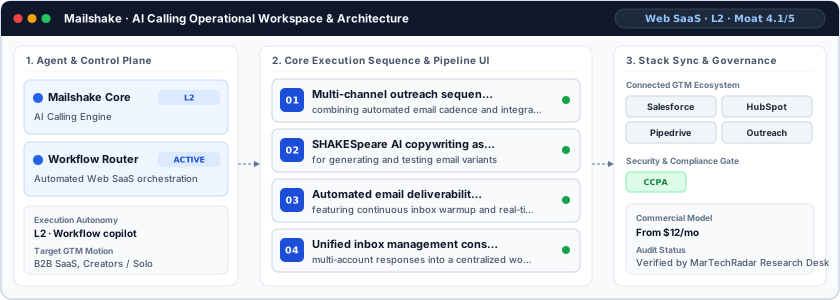
- Target ICP & Stack Fit: You operate as B2B SaaS and Creators / Solo requiring a Web SaaS deployment for AI Calling, with verified ecosystem connectivity for Salesforce, HubSpot, Pipedrive, Outreach.
- L2 Architecture & Defensibility: Mailshake maintains defensive defensibility through integrated automated email warmup networks, high-throughput deliverability heuristics, native telephony dialers, and an established distribution footprint among SMB outbound teams.
- Commercial Model Fit: Your procurement budget aligns with From $12/mo.
Walk away from Mailshake if (Deal-Breakers)
- Walk away if your workflow cannot tolerate autonomous conversational voice capabilities: Unlike dedicated voice agents that conduct autonomous bi-directional speech conversations, the calling component is an assistive softphone that requires direct human execution.
- Walk away if multi-tenant deliverability throttling is a deal-breaker for your team: Aggressive sequence scheduling remains strictly bounded by individual mailbox provider limits (e.g., Google Workspace or Microsoft 365 daily caps), risking domain burn if warmups are rushed.
Mailshake pricing, free plan & scorecard at a glance
| Pricing | From $12/moVendor pricing page |
|---|---|
| Free plan | No / not disclosed |
| Delivery | Web SaaS |
| Audience | B2B SaaS, Creators / Solo |
| AI autonomy level | L2 · Workflow copilotEditor-verified |
| Moat tier & score | 4.1 / 5.0 · Proprietary moatEditor-verified |
| Funding | Acquired |
| Founders | Bob Senoff, Colin Mathews, Sujan Patel |
| Company size | 11-50 employees |
| Ecosystem integrations | Salesforce, HubSpot, Pipedrive, Outreach, Google Workspace, Zapier |
| Compliance & governance | CCPA |
| Governance & docs | Trust & Security ↗ · API & Docs ↗ · Terms ↗ · Privacy ↗ |
| Headquarters | Austin, Texas |
| Founded | 2015 |
| Last verified | Oct 15, 2026 |
Mailshake pros & cons: strengths vs. operational limitations
Pros: core strengths & capabilities
- Multi-channel outreach sequencing: combining automated email cadence and integrated VoIP dialer tasks
- SHAKESpeare AI copywriting assistant: for generating and testing email variants
- Automated email deliverability suite: featuring continuous inbox warmup and real-time list verification
- Unified inbox management consolidating: multi-account responses into a centralized workflow
Cons: operational limitations & risks
- Autonomous Conversational Voice Capabilities: Unlike dedicated voice agents that conduct autonomous bi-directional speech conversations, the calling component is an assistive softphone that requires direct human execution.
- Multi-Tenant Deliverability Throttling: Aggressive sequence scheduling remains strictly bounded by individual mailbox provider limits (e.g., Google Workspace or Microsoft 365 daily caps), risking domain burn if warmups are rushed.
- Complex Enterprise Workflow Branching: Lacks the advanced account-based scoring matrices and multi-object CRM field writeback dependencies found in broader enterprise revenue platforms.
Mailshake TCO & deal-breaker stress test
Simulate 12-month stepped TCO, hidden cost multipliers, contract lock-in exposure, and stack failure modes using only facts verified by MarTechRadar Research Desk on 2026-10-15 · Capture SHA 54d2388a.
Mailshake aligns with your 5-seat / $800/mo profile. Review the walk-away triggers and contract levers below before deployment.
- Moat Score
- 4.1 / 5.0
- AI Autonomy
- L2
- Free Tier / Trial
- None disclosed
Triggered audit signals & failure modes
- Published Self-Serve Entry FloorVerified Pricing Ledger
Mailshake publishes a transparent entry point (From $12/mo) for initial validation before committing.
- Linear Per-Seat Scaling (5 Seats × $12/seat/mo)Commercial Model Audit
Base license scales linearly with operator headcount ($60/mo for 5 seats on Entry Per-Seat Tier).
- Primary Operational Bottleneck: Autonomous Conversational Voice CapabilitiesAudit by MarTechRadar Research Desk
Unlike dedicated voice agents that conduct autonomous bi-directional speech conversations, the calling component is an assistive softphone that requires direct human execution.
Test a custom Mailshake budget or stack constraint
Fits within $800/mo budget ($100–$4,500/mo · Enterprise plan)
Mailshake integrations, API, security & compliance stack
Mailshake AI moat & AI Calling positioning
Mailshake maintains defensive defensibility through integrated automated email warmup networks, high-throughput deliverability heuristics, native telephony dialers, and an established distribution footprint among SMB outbound teams.
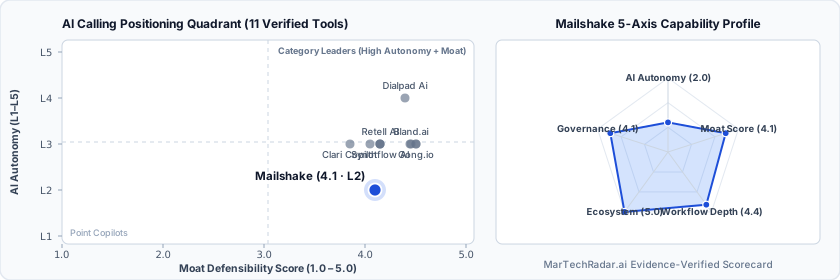
Mailshake in-depth review, pricing & architecture analysis
Editor sign-off: Oct 15, 2026. How profiles are made.
What is Mailshake? Overview & background
Established in 2015 in Austin, Texas, Mailshake solves the mechanical challenge of executing predictable, multi-channel outbound sequences without the infrastructure overhead of heavy enterprise revenue suites. Built for growth-stage sales development reps, agency operators, and inbound-lean demand teams, the platform consolidates list hygiene, email scheduling, and basic voice calling into an approachable operational interface. Mailshake focuses on reliable message transit and campaign execution for lean commercial teams requiring rapid time-to-value.
How Mailshake works: architecture & workflow
Mailshake operates as a Level 2 autonomous outreach orchestration layer. It ingests recipient tables via CSV imports or CRM integrations, subjecting lists to inline verification algorithms before dispatch. Message transit utilizes direct SMTP/IMAP protocol bindings across individual user accounts rather than shared marketing servers, protecting sender domains. Sequence logic triggers dynamic branching on opens, link interactions, and replies. For voice touches, the platform incorporates a browser-based VoIP module that creates sequential call queues alongside automated email tasks, alongside native workflow integrations for Salesforce, HubSpot, Pipedrive, and Zapier under verified CCPA governance controls.
Mailshake limitations, drawbacks & risks
Operational considerations and platform boundaries include:
- Autonomous Conversational Voice Capabilities: Unlike dedicated voice agents that conduct autonomous bi-directional speech conversations, the calling component is an assistive softphone that requires direct human execution.
- Multi-Tenant Deliverability Throttling: Aggressive sequence scheduling remains strictly bounded by individual mailbox provider limits (e.g., Google Workspace or Microsoft 365 daily caps), risking domain burn if warmups are rushed.
- Complex Enterprise Workflow Branching: Lacks the advanced account-based scoring matrices and multi-object CRM field writeback dependencies found in broader enterprise revenue platforms.
Mailshake pricing, plans & cost breakdown
Mailshake operates on a per-seat software-as-a-service model with access starting from $12/month. Functional tiers scale based on multi-channel voice capabilities and contact volumes, with plans such as the Starter tier published at $29/month. Each license includes automated warmup credits, campaign scheduling, and native verification features.
How Mailshake compares vs. competitors & alternatives
Compared to autonomous conversational voice systems like Bland.ai, Consio, and Dialpad Ai, Mailshake takes an operator-driven cadence approach rather than replacing human representatives on calls within the AI Calling segment. Where Bland.ai and Consio deploy synthetic speech models to automate telephone interactions, Mailshake serves sales teams that prioritize written cold outreach while retaining manual control over telephony tasks.
Direct competitors & market radar
Top algorithmic competitors based on category positioning, capability overlap, and ICP alignment.
Frequently asked questions about Mailshake
How much does Mailshake cost in 2026?
Mailshake pricing: From $12/mo. No free plan is publicly disclosed. Mailshake operates on a per-seat software-as-a-service model with access starting from $12/month.
What are the top Mailshake alternatives in AI Calling?
Verified AI Calling alternatives include Superleap (Custom / enterprise pricing), Invoca (Custom / enterprise pricing), Coval ($100–$4,500/mo · Enterprise plan), Air.ai (Custom / enterprise pricing). Compared to autonomous conversational voice systems like Bland.ai, Consio, and Dialpad Ai, Mailshake takes an operator-driven cadence approach rather than replacing human representatives on calls within the AI Calling segment.
What are the main limitations and trade-offs of Mailshake?
Operational considerations and platform boundaries include: Autonomous Conversational Voice Capabilities: Unlike dedicated voice agents that conduct autonomous bi-directional speech conversations, the calling component is an assistive softphone that requires direct human execution. Walk away if your workflow cannot tolerate autonomous conversational voice capabilities: Unlike dedicated voice agents that conduct autonomous bi-directional speech conversations, the calling component is an assistive softphone that requires direct human execution.
Verified sources & evidence trail
- Official product domain: https://mailshake.com
- Commercial pricing verification: https://mailshake.com/pricing/
- Verified corporate entity profiles (
sameAs): LinkedIn Company Profile · Crunchbase Entity Record - First-party governance & documentation links: Trust & Security · API & Docs · Terms · Privacy
- Editor sign-off: Oct 15, 2026 (how profiles are made).
