Rejourney Review (2026): Open-Source Marketing Agents Pricing, Pros & Cons
Bottom line
Rejourney is a Web SaaS tool for Open-Source Marketing Agents (Open-Source Marketing Agents & Prompts) in Agent & Marketing Ops. Pricing: Custom / enterprise pricing. Best suited to B2B SaaS. Editor ratings: AI autonomy L2 (workflow copilot); moat score 1.6/5.0 (Thin wrapper). Fact-checked by MarTechRadar Research Desk on Oct 16, 2026.
Open-source web and mobile app observability platform combining session replays, heatmaps, and AI funnel leak detection.
Is Rejourney worth it in 2026? Buyer fit & when to walk away
Choose Rejourney if (Best Fit)
- Target ICP & Stack Fit: You operate as B2B SaaS requiring a Web SaaS deployment for Open-Source Marketing Agents.
- L2 Architecture & Defensibility: Combines lightweight open-source and self-hostable mobile/web session replay with automated UX friction clustering and one-click coding-assistant context exports.
- Commercial Model Fit: Your procurement budget aligns with Custom / enterprise pricing.
Walk away from Rejourney if (Deal-Breakers)
- Walk away if you need published self-serve pricing: Rejourney is sold by custom quote.
- Walk away if your workflow cannot tolerate self-hosting storage overhead: Storing high-volume mobile and web session replays on self-hosted servers adds disk storage and DevOps maintenance overhead.
- Walk away if mobile SDK update cadence is a deal-breaker for your team: Tracking custom native mobile gestures requires keeping the client SDK updated across iOS and Android app store releases.
Rejourney pricing, free plan & scorecard at a glance
| Pricing | Custom / enterprise pricing |
|---|---|
| Free plan | No / not disclosed |
| Delivery | Web SaaS |
| Audience | B2B SaaS |
| AI autonomy level | L2 · Workflow copilotEditor-verified |
| Moat tier & score | 1.6 / 5.0 · Thin wrapperEditor-verified |
| Funding | Undisclosed |
| Headquarters | United States |
| Last verified | Oct 16, 2026 |
Rejourney pros & cons: strengths vs. operational limitations
Pros: core strengths & capabilities
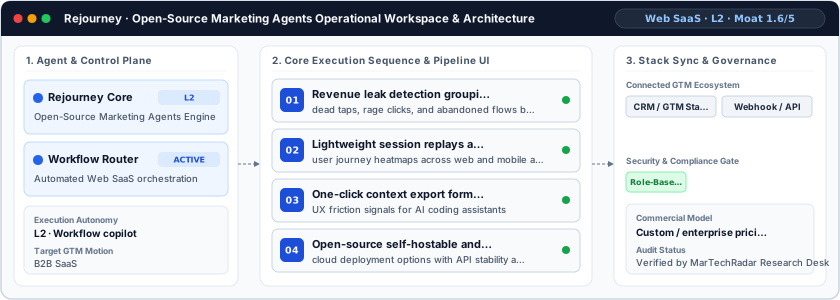
- Revenue leak detection grouping: dead taps, rage clicks, and abandoned flows by user impact
- Lightweight session replays and user journey heatmaps across web and mobile apps
- One-click context export formatting: UX friction signals for AI coding assistants
- Open-source self-hostable and managed: cloud deployment options with API stability alerts
Cons: operational limitations & risks
- Self-Hosting Storage Overhead: Storing high-volume mobile and web session replays on self-hosted servers adds disk storage and DevOps maintenance overhead.
- Mobile SDK Update Cadence: Tracking custom native mobile gestures requires keeping the client SDK updated across iOS and Android app store releases.
- No Built-In Ad Attribution: Rejourney finds in-app UX leaks and conversion drop-offs, but lacks multi-touch paid ad spend attribution.
Rejourney TCO & deal-breaker stress test
Simulate 12-month stepped TCO, hidden cost multipliers, contract lock-in exposure, and stack failure modes using only facts verified by MarTechRadar Research Desk on 2026-10-16.
Rejourney triggers high-severity friction under your 5-seat / $800/mo constraints. Benchmark the verified subtrack alternatives below before committing.
- Moat Score
- 1.6 / 5.0
- AI Autonomy
- L2
- Free Tier / Trial
- None disclosed
Triggered audit signals & failure modes
- Opaque Enterprise Quoting vs. SMB/Mid-Market BudgetVerified Pricing Ledger
Rejourney does not disclose a public self-serve floor (Custom / enterprise pricing). Buyers with a $800/mo cap face high sales-qualification friction.
- Sales-Gated Contract TermsFact-checked by MarTechRadar Research Desk
Rejourney offers an open-source self-hostable edition alongside managed cloud plans with custom commercial pricing available on request. Cloud plans scale with monthly recorded sessions, mobile app volume, data retention windows, and team seats.
- Primary Operational Bottleneck: Self-Hosting Storage OverheadAudit by MarTechRadar Research Desk
Storing high-volume mobile and web session replays on self-hosted servers adds disk storage and DevOps maintenance overhead.
Test a custom Rejourney budget or stack constraint
Lower 5-seat floor (~$49/mo vs. Custom Quote) · Transparent self-serve entry without mandatory annual lock-in
Lower 5-seat floor (~$20/mo vs. Custom Quote) · Transparent self-serve entry without mandatory annual lock-in
Rejourney AI moat & Open-Source Marketing Agents positioning
Combines lightweight open-source and self-hostable mobile/web session replay with automated UX friction clustering and one-click coding-assistant context exports.
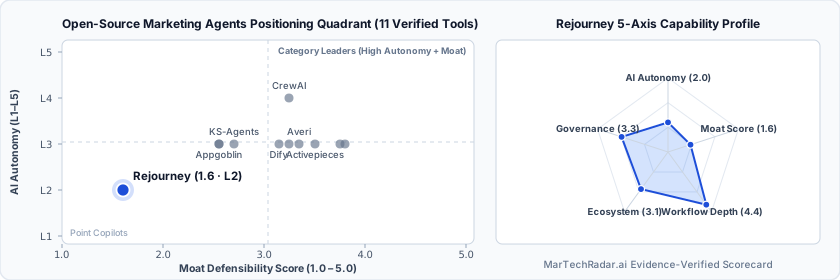
Rejourney in-depth review, pricing & architecture analysis
Editor sign-off: Oct 16, 2026. How profiles are made.
What is Rejourney? Overview & background
Built by a small team of 2 to 10 people, Rejourney (rejourney.co) is an open-source, self-hostable or hosted session replay and funnel leak tool for web and mobile apps. It serves growth engineers, mobile product managers, and technical marketers. Teams use it to spot where users drop off in checkout or sign-up flows without watching thousands of raw session videos by hand.
How Rejourney works: architecture & workflow
Operating at Level 2 (L2) autonomy, Rejourney captures lightweight session replays, touch heatmaps, user journey maps, and API stability metrics across web and mobile apps. Its Leaks engine groups UX friction signals—such as dead taps, failed image zooms, rage clicks, and form drop-offs—by how many users and conversions they hurt. Engineers and growth teams can then click "Copy context" to export the exact session signals and bug details straight into an AI coding assistant to ship a fix fast.
Rejourney limitations, drawbacks & risks
Limitations and trade-offs to weigh before choosing Rejourney:
- Self-Hosting Storage Overhead: Storing high-volume mobile and web session replays on self-hosted servers adds disk storage and DevOps maintenance overhead.
- Mobile SDK Update Cadence: Tracking custom native mobile gestures requires keeping the client SDK updated across iOS and Android app store releases.
- No Built-In Ad Attribution: Rejourney finds in-app UX leaks and conversion drop-offs, but lacks multi-touch paid ad spend attribution.
Rejourney pricing, plans & cost breakdown
Rejourney offers an open-source self-hostable edition alongside managed cloud plans with custom commercial pricing available on request. Cloud plans scale with monthly recorded sessions, mobile app volume, data retention windows, and team seats. Buyers contact the Rejourney team to scope hosted plans and enterprise support.
| Plan / Tier | Verified Price & Billing | Included Scope & Contract Terms |
|---|---|---|
| Enterprise / Custom | Custom quote | Custom-quoted plan; terms come from the vendor's sales team. |
How Rejourney compares vs. competitors & alternatives
In session replay, product analytics, and funnel leak tracking, Rejourney competes against alternatives like PostHog, Fullstory, LogRocket, Amplitude, and Mixpanel. Whereas Fullstory and Amplitude lock data inside costly closed cloud contracts, Rejourney gives mobile and web growth teams a lightweight, open-source tool that turns UX friction straight into AI-ready bug context.
Frequently asked questions about Rejourney
Does Rejourney publish pricing or require an enterprise quote?
Rejourney pricing: Custom / enterprise pricing. No free plan is publicly disclosed. Rejourney offers an open-source self-hostable edition alongside managed cloud plans with custom commercial pricing available on request.
What are the top Rejourney alternatives in Open-Source Marketing Agents?
Verified Open-Source Marketing Agents alternatives include Geocitation ($49–$299/mo), ThunderPhone v2 (Usage-based pricing), Rate My AI Site (Custom / enterprise pricing), Atlas Runa (Custom / enterprise pricing). In session replay, product analytics, and funnel leak tracking, Rejourney competes against alternatives like PostHog, Fullstory, LogRocket, Amplitude, and Mixpanel.
What are the main limitations and trade-offs of Rejourney?
Limitations and trade-offs to weigh before choosing Rejourney: Self-Hosting Storage Overhead: Storing high-volume mobile and web session replays on self-hosted servers adds disk storage and DevOps maintenance overhead. Walk away if you need published self-serve pricing: Rejourney is sold by custom quote.
Verified sources & evidence trail
- Official product domain: https://rejourney.co/demo/leaks
- Commercial pricing verification: Verified against official vendor pricing policy (Custom / enterprise pricing)
- Verified corporate entity profiles (
sameAs): LinkedIn Company Profile · Crunchbase Entity Record - Editor sign-off: Oct 16, 2026 (how profiles are made).
