CrewAI Review (2026): Open-Source Marketing Agents Pricing, Pros & Cons
Bottom line
CrewAI is a Web SaaS tool for Open-Source Marketing Agents (Open-Source Marketing Agents & Prompts) in Agent & Marketing Ops. Pricing: Custom / enterprise pricing. Best suited to B2B SaaS. Editor ratings: AI autonomy L4 (autonomous agent); moat score 3.3/5.0 (Workflow-embedded (strong)). Fact-checked by MarTechRadar Research Desk on Oct 7, 2026.
Open-source and enterprise multi-agent orchestration runtime enabling role-based autonomous collaboration, task delegation, and centralized enterprise.
Is CrewAI worth it in 2026? Buyer fit & when to walk away
Choose CrewAI if (Best Fit)
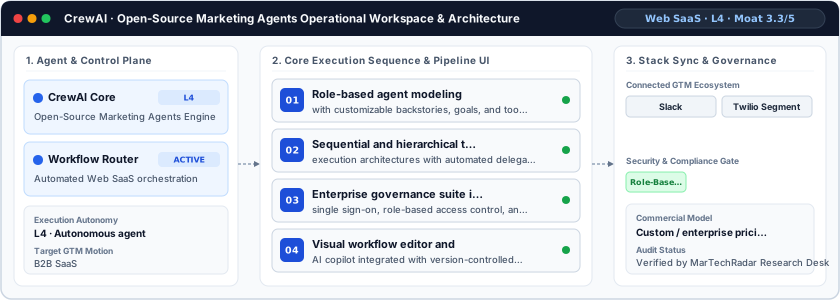
- Target ICP & Stack Fit: You operate as B2B SaaS requiring a Web SaaS deployment for Open-Source Marketing Agents, with verified ecosystem connectivity for Slack, Twilio Segment.
- L4 Architecture & Defensibility: CrewAI pairs high-adoption open-source primitives with a proprietary enterprise runtime featuring built-in governance, role-based access control, workload identity, and telemetry over multi-agent task execution graphs.
- Commercial Model Fit: Your procurement budget aligns with Custom / enterprise pricing.
Walk away from CrewAI if (Deal-Breakers)
- Walk away if you need published self-serve pricing: CrewAI is sold by custom quote.
- Walk away if your workflow cannot tolerate hierarchical delegation drift: Manager agents occasionally enter non-terminating delegation loops or fail to reach consensus during unstructured task decomposition, exhausting upstream token budgets.
- Walk away if context window degradation is a deal-breaker for your team: Extensive inter-agent conversational handoffs create cumulative context bloating, which degrades tool-calling precision and inflates operational inference latency.
CrewAI pricing, free plan & scorecard at a glance
| Pricing | Custom / enterprise pricing |
|---|---|
| Free plan | No / not disclosed |
| Delivery | Web SaaS |
| Audience | B2B SaaS |
| AI autonomy level | L4 · Autonomous agentEditor-verified |
| Moat tier & score | 3.3 / 5.0 · Workflow-embedded (strong)Editor-verified |
| Funding | Series A |
| Founders | Joao Moura, Rob Bailey |
| Company size | 11-50 employees |
| Ecosystem integrations | Slack, Twilio Segment |
| Governance & docs | Trust & Security ↗ · System Status ↗ · API & Docs ↗ · Terms ↗ · Privacy ↗ |
| Headquarters | San Francisco, United States |
| Founded | 2023 |
| Last verified | Oct 7, 2026 |
CrewAI pros & cons: strengths vs. operational limitations
Pros: core strengths & capabilities
- Role-based agent modeling: with customizable backstories, goals, and tooling integrations
- Sequential and hierarchical task: execution architectures with automated delegation loops
- Enterprise governance suite including: single sign-on, role-based access control, and PII redaction
- Visual workflow editor and AI copilot integrated with version-controlled repositories
Cons: operational limitations & risks
- Hierarchical Delegation Drift: Manager agents occasionally enter non-terminating delegation loops or fail to reach consensus during unstructured task decomposition, exhausting upstream token budgets.
- Context Window Degradation: Extensive inter-agent conversational handoffs create cumulative context bloating, which degrades tool-calling precision and inflates operational inference latency.
- Stateful Tool Failure Recovery: When downstream API integrations or third-party web scrapers fail mid-routine, the runtime lacks transactional rollback, requiring manual workflow resets.
CrewAI TCO & deal-breaker stress test
Simulate 12-month stepped TCO, hidden cost multipliers, contract lock-in exposure, and stack failure modes using only facts verified by MarTechRadar Research Desk on 2026-10-07.
CrewAI triggers high-severity friction under your 5-seat / $800/mo constraints. Benchmark the verified subtrack alternatives below before committing.
- Moat Score
- 3.3 / 5.0
- AI Autonomy
- L4
- Free Tier / Trial
- None disclosed
Triggered audit signals & failure modes
- Opaque Enterprise Quoting vs. SMB/Mid-Market BudgetVerified Pricing Ledger
CrewAI does not disclose a public self-serve floor (Custom / enterprise pricing). Buyers with a $800/mo cap face high sales-qualification friction.
- Sales-Gated Contract TermsFact-checked by MarTechRadar Research Desk
CrewAI maintains a dual-track distribution model anchored by an open-source framework and a hosted cloud runtime.
- Primary Operational Bottleneck: Hierarchical Delegation DriftAudit by MarTechRadar Research Desk
Manager agents occasionally enter non-terminating delegation loops or fail to reach consensus during unstructured task decomposition, exhausting upstream token budgets.
Test a custom CrewAI budget or stack constraint
Lower 5-seat floor (~$99/mo vs. Custom Quote) · Transparent self-serve entry without mandatory annual lock-in
Lower 5-seat floor (~$99/mo vs. Custom Quote) · Transparent self-serve entry without mandatory annual lock-in
CrewAI integrations, API, security & compliance stack
CrewAI AI moat & Open-Source Marketing Agents positioning
CrewAI pairs high-adoption open-source primitives with a proprietary enterprise runtime featuring built-in governance, role-based access control, workload identity, and telemetry over multi-agent task execution graphs.
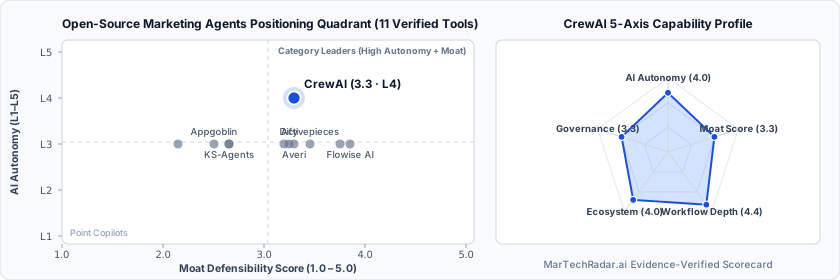
CrewAI in-depth review, pricing & architecture analysis
Editor sign-off: Oct 7, 2026. How profiles are made.
What is CrewAI? Overview & background
Architected to transition software organizations from isolated prompt completions to collaborative multi-agent execution graphs, CrewAI was established in 2023 in San Francisco, United States. The platform serves enterprise platform engineers, technical product teams, and marketing operations architects seeking to operationalize autonomous agent workforces. By abstracting task decomposition across specialized roles, the system structures complex workflows into programmatic agent networks.
How CrewAI works: architecture & workflow
At its architectural core, CrewAI operates as an agentic build and execution layer that coordinates role-playing software actors. Engineering teams configure individual agents with explicit personas, granular objectives, and restricted toolsets. The orchestration layer executes tasks using either sequential pipelines or hierarchical topologies where a manager agent algorithmically delegates assignments to worker agents. Execution state is tracked via deterministic loops, while the enterprise runtime injects security policies, identity management, and PII redaction into active memory contexts, alongside native workflow integrations for Slack.
CrewAI limitations, drawbacks & risks
Operational considerations and platform boundaries include:
- Hierarchical Delegation Drift: Manager agents occasionally enter non-terminating delegation loops or fail to reach consensus during unstructured task decomposition, exhausting upstream token budgets.
- Context Window Degradation: Extensive inter-agent conversational handoffs create cumulative context bloating, which degrades tool-calling precision and inflates operational inference latency.
- Stateful Tool Failure Recovery: When downstream API integrations or third-party web scrapers fail mid-routine, the runtime lacks transactional rollback, requiring manual workflow resets.
CrewAI pricing, plans & cost breakdown
CrewAI maintains a dual-track distribution model anchored by an open-source framework and a hosted cloud runtime. Self-hosted deployments utilize the open-source code base for localized development, while the hosted tier provides an entry-level free plan with capped monthly workflow executions. Commercial pricing for enterprise instances is available on request through tailored enterprise sales quotes based on organizational scale and seats, encompassing production governance, SSO, and dedicated deployment infrastructure.
| Plan / Tier | Verified Price & Billing | Included Scope & Contract Terms |
|---|---|---|
| Enterprise / Custom | Custom quote | Custom-quoted plan; terms come from the vendor's sales team. |
How CrewAI compares vs. competitors & alternatives
Within the agentic automation sector, CrewAI competes alongside systems like Alphie, Appgoblin, and Arda within the ChatGPT for Marketing segment. While specialized alternatives focus heavily on verticalized prompt catalogs or domain-specific scraping routines, CrewAI focuses on an infrastructure-first multi-agent protocol. This design offers flexibility for complex marketing intelligence pipelines but demands stricter software engineering rigor to deploy safely. The platform is best matched for enterprise engineering teams requiring governed, programmatic autonomy across production environments.
Direct competitors & market radar
Top algorithmic competitors based on category positioning, capability overlap, and ICP alignment.
Frequently asked questions about CrewAI
Does CrewAI publish pricing or require an enterprise quote?
CrewAI pricing: Custom / enterprise pricing. No free plan is publicly disclosed. CrewAI maintains a dual-track distribution model anchored by an open-source framework and a hosted cloud runtime.
What are the top CrewAI alternatives in Open-Source Marketing Agents?
Verified Open-Source Marketing Agents alternatives include GenAI Works (Custom / enterprise pricing), Appgoblin (From $99/mo), Alphie (Custom / enterprise pricing), Arda ($99/mo). Within the agentic automation sector, CrewAI competes alongside systems like Alphie, Appgoblin, and Arda within the ChatGPT for Marketing segment.
What are the main limitations and trade-offs of CrewAI?
Operational considerations and platform boundaries include: Hierarchical Delegation Drift: Manager agents occasionally enter non-terminating delegation loops or fail to reach consensus during unstructured task decomposition, exhausting upstream token budgets. Walk away if you need published self-serve pricing: CrewAI is sold by custom quote.
Verified sources & evidence trail
- Official product domain: https://crewai.com
- Commercial pricing verification: Verified against official vendor pricing policy (Custom / enterprise pricing)
- Verified corporate entity profiles (
sameAs): LinkedIn Company Profile · Crunchbase Entity Record - First-party governance & documentation links: Trust & Security · System Status · API & Docs · Terms · Privacy
- Editor sign-off: Oct 7, 2026 (how profiles are made).
