Flowise AI Review (2026): Open-Source Marketing Agents Pricing, Pros & Cons
Bottom line
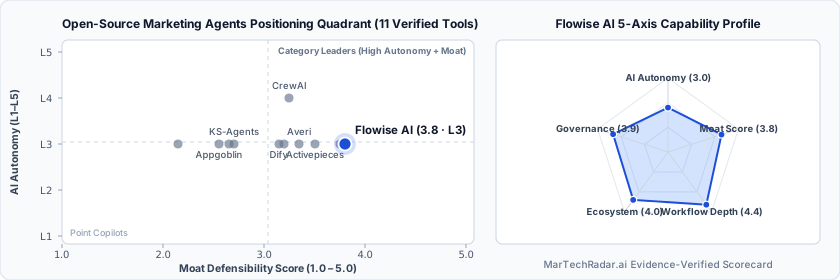
Flowise AI is a Open Source Repo tool for Open-Source Marketing Agents (Open-Source Marketing Agents & Prompts) in Agent & Marketing Ops. Pricing: Custom / enterprise pricing. Best suited to B2B SaaS and Creators / Solo. Editor ratings: AI autonomy L3 (conditional automation); moat score 3.8/5.0 (Proprietary moat). Fact-checked by MarTechRadar Research Desk on Oct 11, 2026.
Open-source visual orchestration framework enabling engineering and marketing operations teams to compose multi-agent LLM systems and retrieval pipelines.
Is Flowise AI worth it in 2026? Buyer fit & when to walk away
Choose Flowise AI if (Best Fit)
- Target ICP & Stack Fit: You operate as B2B SaaS and Creators / Solo requiring a Open Source Repo deployment for Open-Source Marketing Agents, with verified ecosystem connectivity for Slack, Notion.
- L3 Architecture & Defensibility: Strong developer community adoption and comprehensive LangChain integration, reinforced by early Y Combinator backing and enterprise acquisition by Workday.
- Commercial Model Fit: Your procurement budget aligns with Custom / enterprise pricing.
Walk away from Flowise AI if (Deal-Breakers)
- Walk away if you need published self-serve pricing: Flowise AI is sold by custom quote.
- Walk away if your workflow cannot tolerate memory and state drift: Complex multi-step graph traversals suffer from context degradation and token bloat during prolonged conversational sessions without aggressive token-trimming configurations.
- Walk away if vector ingestion latency is a deal-breaker for your team: High-volume batch document uploads across dynamic enterprise schemas encounter throughput bottlenecks due to synchronous chunking and embedding pipelines.
Flowise AI pricing, free plan & scorecard at a glance
| Pricing | Custom / enterprise pricing |
|---|---|
| Free plan | No / not disclosed |
| Delivery | Open Source Repo |
| Audience | B2B SaaS, Creators / Solo |
| AI autonomy level | L3 · Conditional automationEditor-verified |
| Moat tier & score | 3.8 / 5.0 · Proprietary moatEditor-verified |
| Funding | AcquiredAcquired by Workday |
| Total funding | $500KBacked by Y Combinator, Eight Capital |
| Founders | Chung Yau Ong, ZhenJing Heng |
| Company size | 2-10 employees |
| Ecosystem integrations | Slack, Notion |
| Governance & docs | API & Docs ↗ · Terms ↗ · Privacy ↗ |
| Headquarters | San Francisco, California |
| Founded | 2023 |
| Last verified | Oct 11, 2026 |
Flowise AI pros & cons: strengths vs. operational limitations
Pros: core strengths & capabilities
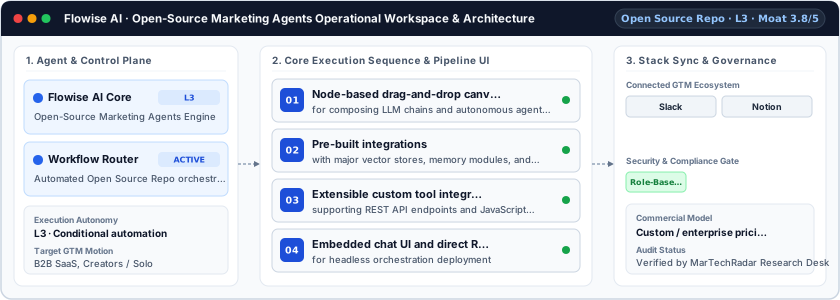
- Node-based drag-and-drop canvas: for composing LLM chains and autonomous agent workflows
- Pre-built integrations: with major vector stores, memory modules, and foundation model providers
- Extensible custom tool integration: supporting REST API endpoints and JavaScript functions
- Embedded chat UI and direct REST API export: for headless orchestration deployment
Cons: operational limitations & risks
- Memory and State Drift: Complex multi-step graph traversals suffer from context degradation and token bloat during prolonged conversational sessions without aggressive token-trimming configurations.
- Vector Ingestion Latency: High-volume batch document uploads across dynamic enterprise schemas encounter throughput bottlenecks due to synchronous chunking and embedding pipelines.
- Versioned Graph Drift: Direct production canvas edits lack native staging rollbacks, requiring external containerized pipeline management to prevent breaking API changes during runtime schema updates.
Flowise AI TCO & deal-breaker stress test
Simulate 12-month stepped TCO, hidden cost multipliers, contract lock-in exposure, and stack failure modes using only facts verified by MarTechRadar Research Desk on 2026-10-11.
Flowise AI triggers high-severity friction under your 5-seat / $800/mo constraints. Benchmark the verified subtrack alternatives below before committing.
- Moat Score
- 3.8 / 5.0
- AI Autonomy
- L3
- Free Tier / Trial
- None disclosed
Triggered audit signals & failure modes
- Opaque Enterprise Quoting vs. SMB/Mid-Market BudgetVerified Pricing Ledger
Flowise AI does not disclose a public self-serve floor (Custom / enterprise pricing). Buyers with a $800/mo cap face high sales-qualification friction.
- Sales-Gated Contract TermsFact-checked by MarTechRadar Research Desk
Flowise maintains an open-source core distributed under commercial-permissive licensing for self-hosted instances.
- Primary Operational Bottleneck: Memory and State DriftAudit by MarTechRadar Research Desk
Complex multi-step graph traversals suffer from context degradation and token bloat during prolonged conversational sessions without aggressive token-trimming configurations.
Test a custom Flowise AI budget or stack constraint
Lower 5-seat floor (~$245/mo vs. Custom Quote) · Transparent self-serve entry without mandatory annual lock-in
Lower 5-seat floor (~$100/mo vs. Custom Quote) · Transparent self-serve entry without mandatory annual lock-in
Flowise AI integrations, API, security & compliance stack
Flowise AI AI moat & Open-Source Marketing Agents positioning
Strong developer community adoption and comprehensive LangChain integration, reinforced by early Y Combinator backing and enterprise acquisition by Workday.
Flowise AI in-depth review, pricing & architecture analysis
Editor sign-off: Oct 11, 2026. How profiles are made.
What is Flowise AI? Overview & background
Established in 2023 in San Francisco, California, Flowise AI secured $500K in pre-seed funding before being acquired by Workday. Operating within open-source agentic application development, the platform addresses technical bottlenecks encountered by marketing engineers and operations architects who require modular orchestration of generative applications. Rather than building custom script-heavy orchestration layers, technical teams leverage Flowise to operationalize complex reasoning graphs across varied data backends, bridging developer-centric code frameworks and visual low-code automation.
How Flowise AI works: architecture & workflow
Flowise functions as a visual orchestration layer over LangChain and LlamaIndex runtimes, exposing an execution canvas built on Node.js and TypeScript. Engineers wire together modular components representing large language model endpoints, retrieval-augmented generation pipelines, external tool nodes, and persistent conversation memory buffers. The runtime engine translates visual graph topologies into structured execution chains, triggering sequential or parallel agentic tasks at Level 3 autonomy. Inputs ingest through modular webhooks and REST endpoints, which query connected vector stores and dispatch dynamic function calls to external third-party tools before returning structured responses to downstream clients, alongside native workflow integrations for Slack and Notion.
Flowise AI limitations, drawbacks & risks
Operational considerations and platform boundaries include:
- Memory and State Drift: Complex multi-step graph traversals suffer from context degradation and token bloat during prolonged conversational sessions without aggressive token-trimming configurations.
- Vector Ingestion Latency: High-volume batch document uploads across dynamic enterprise schemas encounter throughput bottlenecks due to synchronous chunking and embedding pipelines.
- Versioned Graph Drift: Direct production canvas edits lack native staging rollbacks, requiring external containerized pipeline management to prevent breaking API changes during runtime schema updates.
Flowise AI pricing, plans & cost breakdown
Flowise maintains an open-source core distributed under commercial-permissive licensing for self-hosted instances. For managed deployments and dedicated infrastructure, commercial pricing is available on request through tailored enterprise sales quotes based on organizational scale and seats. These custom packages provide dedicated support agreements, security compliance certifications, and managed cloud runtime orchestration.
| Plan / Tier | Verified Price & Billing | Included Scope & Contract Terms |
|---|---|---|
| Enterprise / Custom | Custom quote | Custom-quoted plan; terms come from the vendor's sales team. |
How Flowise AI compares vs. competitors & alternatives
Against market alternatives like Alphie, Appgoblin, and Arda, Flowise differentiates through direct integration with the LangChain developer ecosystem and deep visual graph extensibility within the ChatGPT for Marketing segment. While Appgoblin and Alphie emphasize packaged end-user conversational workflows with constrained automation bounds, Flowise delivers an unconstrained developer canvas tailored for technical architects. Arda focuses on specific operational routing scenarios, whereas Flowise functions as a horizontal agent runtime. The platform fits technical marketing operations teams requiring custom model routing, self-hosted data isolation, and programmatic control over production agent execution.
Frequently asked questions about Flowise AI
Does Flowise AI publish pricing or require an enterprise quote?
Flowise AI pricing: Custom / enterprise pricing. No free plan is publicly disclosed. Flowise maintains an open-source core distributed under commercial-permissive licensing for self-hosted instances.
What are the top Flowise AI alternatives in Open-Source Marketing Agents?
Verified Open-Source Marketing Agents alternatives include LangChain (Custom / enterprise pricing), Dify (Custom / enterprise pricing), KS-Agents (From $49/mo), Langflow (Custom / enterprise pricing). Against market alternatives like Alphie, Appgoblin, and Arda, Flowise differentiates through direct integration with the LangChain developer ecosystem and deep visual graph extensibility within the ChatGPT for Marketing segment.
What are the main limitations and trade-offs of Flowise AI?
Operational considerations and platform boundaries include: Memory and State Drift: Complex multi-step graph traversals suffer from context degradation and token bloat during prolonged conversational sessions without aggressive token-trimming configurations. Walk away if you need published self-serve pricing: Flowise AI is sold by custom quote.
Verified sources & evidence trail
- Official product domain: https://flowiseai.com
- Commercial pricing verification: Verified against official vendor pricing policy (Custom / enterprise pricing)
- Verified corporate entity profiles (
sameAs): LinkedIn Company Profile · Crunchbase Entity Record - First-party governance & documentation links: API & Docs · Terms · Privacy
- Editor sign-off: Oct 11, 2026 (how profiles are made).
