Dify Review (2026): Open-Source Marketing Agents Pricing, Pros & Cons
Bottom line
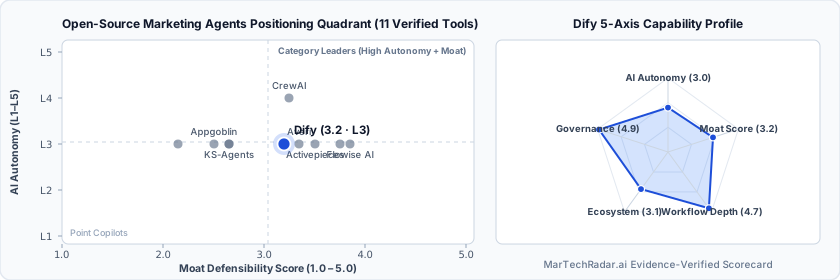
Dify is a Web SaaS tool for Open-Source Marketing Agents (Open-Source Marketing Agents & Prompts) in Agent & Marketing Ops. Pricing: Custom / enterprise pricing. Best suited to B2B SaaS. Editor ratings: AI autonomy L3 (conditional automation); moat score 3.2/5.0 (Workflow-embedded (strong)). Fact-checked by MarTechRadar Research Desk on Oct 11, 2026.
Open-source LLMOps and agent orchestration platform providing visual workflow canvases, hybrid RAG pipelines, and model management across cloud and on-prem.
Is Dify worth it in 2026? Buyer fit & when to walk away
Choose Dify if (Best Fit)
- Target ICP & Stack Fit: You operate as B2B SaaS requiring a Web SaaS deployment for Open-Source Marketing Agents.
- L3 Architecture & Defensibility: Open-source core architecture with widespread developer adoption, robust visual DAG orchestration, and hybrid deployment flexibility spanning cloud, VPC, and on-premises environments.
- Commercial Model Fit: Your procurement budget aligns with Custom / enterprise pricing and want a self-serve free tier for zero-cost initial validation.
Walk away from Dify if (Deal-Breakers)
- Walk away if you need published self-serve pricing: Dify is sold by custom quote.
- Walk away if your workflow cannot tolerate vector database ingestion bottlenecks: High-throughput document indexing triggers processing latency during peak ingestion windows, requiring dedicated asynchronous worker tuning for sustained document volumes.
- Walk away if self-hosted maintenance overhead is a deal-breaker for your team: Deploying the open-source distribution inside private VPC infrastructure requires manual orchestration of underlying PostgreSQL, Redis, and vector databases, demanding continuous DevOps maintenance.
Dify pricing, free plan & scorecard at a glance
| Pricing | Custom / enterprise pricingVendor pricing page |
|---|---|
| Free plan | Yes |
| Delivery | Web SaaS |
| Audience | B2B SaaS |
| AI autonomy level | L3 · Conditional automationEditor-verified |
| Moat tier & score | 3.2 / 5.0 · Workflow-embedded (strong)Editor-verified |
| Funding | Seed |
| Total funding | SeedBacked by Open Source Community |
| Company size | 51-200 employees |
| Compliance & governance | SOC 2, ISO 27001 |
| Governance & docs | API & Docs ↗ · Terms ↗ · Privacy ↗ |
| Headquarters | United States |
| Founded | 2023 |
| Last verified | Oct 11, 2026 |
Dify pros & cons: strengths vs. operational limitations
Pros: core strengths & capabilities
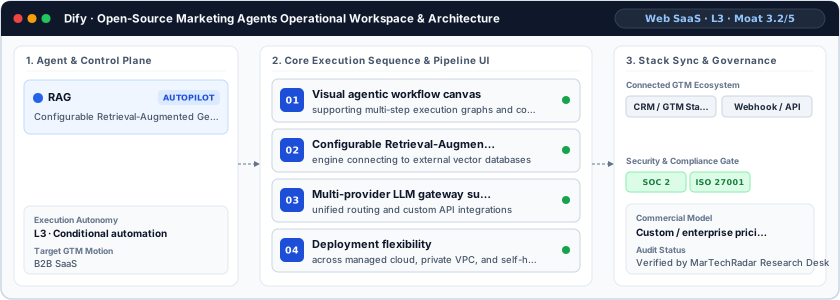
- Visual agentic workflow canvas: supporting multi-step execution graphs and conditional logic
- Configurable Retrieval-Augmented Generation (RAG): engine connecting to external vector databases
- Multi-provider LLM gateway supporting: unified routing and custom API integrations
- Deployment flexibility: across managed cloud, private VPC, and self-hosted open-source instances
Cons: operational limitations & risks
- Vector database ingestion bottlenecks: High-throughput document indexing triggers processing latency during peak ingestion windows, requiring dedicated asynchronous worker tuning for sustained document volumes.
- Self-hosted maintenance overhead: Deploying the open-source distribution inside private VPC infrastructure requires manual orchestration of underlying PostgreSQL, Redis, and vector databases, demanding continuous DevOps maintenance.
- Complex DAG debugging friction: Tracing nondeterministic outputs across deeply nested multi-agent branching structures introduces operational friction when diagnosing failures in third-party model responses.
Dify TCO & deal-breaker stress test
Simulate 12-month stepped TCO, hidden cost multipliers, contract lock-in exposure, and stack failure modes using only facts verified by MarTechRadar Research Desk on 2026-10-11 · Capture SHA 3d5cff53.
Dify is viable for 5 seats, but requires commercial or technical verification on the flagged items below.
- Moat Score
- 3.2 / 5.0
- AI Autonomy
- L3
- Free Tier / Trial
- Free plan
Triggered audit signals & failure modes
- Opaque Enterprise Quoting vs. SMB/Mid-Market BudgetVerified Pricing Ledger
Dify does not disclose a public self-serve floor (Custom / enterprise pricing). Buyers with a $800/mo cap face high sales-qualification friction.
- Published Self-Serve Entry FloorVerified Pricing Ledger
Dify publishes a transparent entry point (Custom / enterprise pricing) with a free tier for initial validation before committing.
- Primary Operational Bottleneck: Vector database ingestion bottlenecksAudit by MarTechRadar Research Desk
High-throughput document indexing triggers processing latency during peak ingestion windows, requiring dedicated asynchronous worker tuning for sustained document volumes.
Test a custom Dify budget or stack constraint
Lower 5-seat floor (~$245/mo vs. Custom Quote)
Lower 5-seat floor (~$100/mo vs. Custom Quote)
Dify integrations, API, security & compliance stack
Configurable Retrieval-Augmented Generation engine connecting to external vector databases
Dify AI moat & Open-Source Marketing Agents positioning
Open-source core architecture with widespread developer adoption, robust visual DAG orchestration, and hybrid deployment flexibility spanning cloud, VPC, and on-premises environments.
Dify in-depth review, pricing & architecture analysis
Editor sign-off: Oct 11, 2026. How profiles are made.
What is Dify? Overview & background
Architectural decoupling between proprietary model providers and enterprise application code defines the core proposition of Dify. Established in 2023 and headquartered in the United States, Dify delivers an open-source orchestration layer for technical marketing engineers and software architects building autonomous agents. Rather than hard-coding workflows into disparate vendor SDKs, systems teams use Dify as a visual control plane to manage prompts, vector retrieval, and tool invocation. The platform serves organizations seeking modular LLMOps without binding operational logic directly to third-party model providers.
How Dify works: architecture & workflow
At its functional core, Dify operates as a directed acyclic graph (DAG) execution engine paired with a hybrid Retrieval-Augmented Generation pipeline. The platform ingests unstructured enterprise documentation, chunks textual tokens, generates embeddings, and indexes them into vector stores for runtime retrieval. Within the visual canvas, nodes represent model completions, conditional branching, or tool calls via REST interfaces. Dify supports L3 conditional autonomy by executing multi-step agentic loops where models evaluate interim outputs to determine downstream API executions before returning final structured payloads under verified SOC 2 Type II and ISO 27001 governance controls.
Dify limitations, drawbacks & risks
Operational considerations and platform boundaries include:
- Vector database ingestion bottlenecks: High-throughput document indexing triggers processing latency during peak ingestion windows, requiring dedicated asynchronous worker tuning for sustained document volumes.
- Self-hosted maintenance overhead: Deploying the open-source distribution inside private VPC infrastructure requires manual orchestration of underlying PostgreSQL, Redis, and vector databases, demanding continuous DevOps maintenance.
- Complex DAG debugging friction: Tracing nondeterministic outputs across deeply nested multi-agent branching structures introduces operational friction when diagnosing failures in third-party model responses.
Dify pricing, plans & cost breakdown
Dify operates under a dual-track commercial model combining open-source software with managed cloud tiers. Self-hosted instances remain accessible for deployment on private servers without upfront licensing fees. For managed infrastructure, the vendor provides a free tier starting at $0, offering entry-level compute allocations for prototyping. Production teams scaling storage, execution logs, and collaborative workspaces transition into custom enterprise pricing tailored to enterprise governance and throughput requirements.
| Plan / Tier | Verified Price & Billing | Included Scope & Contract Terms | |
|---|---|---|---|
| Free / Sandbox | $0 | Free plan or free tier offered by the vendor. | |
| Enterprise / Custom | Custom quote | Custom-quoted plan; terms come from the vendor's sales team. | |
| Contract Watchout: Annual Billing Headline vs. Monthly Premium | The vendor pricing page advertises an annual-billing discount (Save 17%); month-to-month billing carries a higher effective monthly rate. | ||
How Dify compares vs. competitors & alternatives
Compared to niche domain tooling like Alphie, Appgoblin, and Arda, Dify provides deeper foundational flexibility by separating model orchestration from specific marketing vertical implementations within the ChatGPT for Marketing segment. Where single-purpose agents offer rigid templates, Dify demands higher engineering literacy to configure pipelines, maintain vector stores, and govern execution policies. The software serves mid-market to enterprise technology organizations that prioritize infrastructure control, customizable agentic pipelines, and private infrastructure deployments over turnkey commercial applications.
Direct competitors & market radar
Top algorithmic competitors based on category positioning, capability overlap, and ICP alignment.
Frequently asked questions about Dify
Does Dify publish pricing or require an enterprise quote?
Dify pricing: Custom / enterprise pricing. A permanent free plan is available. Published tiers: Free / Sandbox ($0); Enterprise / Custom (Custom quote). Dify operates under a dual-track commercial model combining open-source software with managed cloud tiers. Self-hosted instances remain accessible for deployment on private servers without upfront licensing fees.
What are the top Dify alternatives in Open-Source Marketing Agents?
Verified Open-Source Marketing Agents alternatives include Alphie (Custom / enterprise pricing), CrewAI (Custom / enterprise pricing), LangChain (Custom / enterprise pricing), KS-Agents (From $49/mo). Compared to niche domain tooling like Alphie, Appgoblin, and Arda, Dify provides deeper foundational flexibility by separating model orchestration from specific marketing vertical implementations within the ChatGPT for Marketing segment.
What are the main limitations and trade-offs of Dify?
Operational considerations and platform boundaries include: Vector database ingestion bottlenecks: High-throughput document indexing triggers processing latency during peak ingestion windows, requiring dedicated asynchronous worker tuning for sustained document volumes. Walk away if you need published self-serve pricing: Dify is sold by custom quote.
Verified sources & evidence trail
- Official product domain: https://dify.ai
- Commercial pricing verification: https://dify.ai/pricing
- Verified corporate entity profiles (
sameAs): LinkedIn Company Profile · Crunchbase Entity Record - First-party governance & documentation links: API & Docs · Terms · Privacy
- Editor sign-off: Oct 11, 2026 (how profiles are made).
