Appgoblin Review (2026): Open-Source Marketing Agents Pricing, Pros & Cons
Bottom line
Appgoblin is a Web SaaS tool for Open-Source Marketing Agents (Open-Source Marketing Agents & Prompts) in Agent & Marketing Ops. Pricing: From $99/mo. Best suited to B2B SaaS. Editor ratings: AI autonomy L3 (conditional automation); moat score 2.5/5.0 (Workflow-embedded). Fact-checked by MarTechRadar Research Desk on Oct 11, 2026.
Mobile app intelligence and SDK telemetry platform delivering automated App Store Optimization metrics, ad network tracking, and competitive install data.
Is Appgoblin worth it in 2026? Buyer fit & when to walk away
Choose Appgoblin if (Best Fit)
- Target ICP & Stack Fit: You operate as B2B SaaS requiring a Web SaaS deployment for Open-Source Marketing Agents, with verified ecosystem connectivity for Salesforce, Amplitude, Braze.
- L3 Architecture & Defensibility: Proprietary reverse-engineering parsers for mobile APK and IPA binaries that extract integrated third-party SDK footprints and ad network associations across global app stores.
- Commercial Model Fit: Your procurement budget aligns with From $99/mo.
Walk away from Appgoblin if (Deal-Breakers)
- Walk away if your workflow cannot tolerate SDK obfuscation and dynamic loading: Static binary decompilation fails to detect third-party libraries injected via server-driven dynamic code loading or aggressive custom package obfuscation.
- Walk away if store scraping latency is a deal-breaker for your team: Metadata propagation lags real-time store changes due to crawl-rate governance, delaying visibility into rapid keyword experiments and immediate version rollbacks.
Appgoblin pricing, free plan & scorecard at a glance
| Pricing | From $99/moVendor pricing page |
|---|---|
| Free plan | No / not disclosed |
| Delivery | Web SaaS |
| Audience | B2B SaaS |
| AI autonomy level | L3 · Conditional automationEditor-verified |
| Moat tier & score | 2.5 / 5.0 · Workflow-embeddedEditor-verified |
| Funding | Bootstrapped |
| Company size | 0-1 employees |
| Ecosystem integrations | Salesforce, Amplitude, Braze |
| Governance & docs | API & Docs ↗ |
| Headquarters | United States |
| Founded | 2023 |
| Last verified | Oct 11, 2026 |
Appgoblin pros & cons: strengths vs. operational limitations
Pros: core strengths & capabilities
- Mobile app store scraping and organic ranking telemetry across iOS and Android ecosystems
- Automated SDK detection: via binary decompilation identifying active analytics, attribution, and monetization libraries
- Competitive mobile advertising intelligence: revealing publisher ad networks and creative distribution patterns
- App Store Optimization keyword: difficulty analysis and organic visibility tracking
Cons: operational limitations & risks
- SDK Obfuscation and Dynamic Loading: Static binary decompilation fails to detect third-party libraries injected via server-driven dynamic code loading or aggressive custom package obfuscation.
- Store Scraping Latency: Metadata propagation lags real-time store changes due to crawl-rate governance, delaying visibility into rapid keyword experiments and immediate version rollbacks.
- API Rate Boundaries: Bulk enrichment pipelines encounter strict request throttles and monthly quota caps on standard tiers, restricting wide-scale programmatic catalog exports.
Appgoblin TCO & deal-breaker stress test
Simulate 12-month stepped TCO, hidden cost multipliers, contract lock-in exposure, and stack failure modes using only facts verified by MarTechRadar Research Desk on 2026-10-11 · Capture SHA 2dea91f6.
Appgoblin aligns with your 5-seat / $800/mo profile. Review the walk-away triggers and contract levers below before deployment.
- Moat Score
- 2.5 / 5.0
- AI Autonomy
- L3
- Free Tier / Trial
- None disclosed
Triggered audit signals & failure modes
- Published Self-Serve Entry FloorVerified Pricing Ledger
Appgoblin publishes a transparent entry point (From $99/mo) for initial validation before committing.
- Primary Operational Bottleneck: SDK Obfuscation and Dynamic LoadingAudit by MarTechRadar Research Desk
Static binary decompilation fails to detect third-party libraries injected via server-driven dynamic code loading or aggressive custom package obfuscation.
Test a custom Appgoblin budget or stack constraint
Fits within $800/mo budget (From $99/mo)
Fits within $800/mo budget ($99/mo)
Appgoblin integrations, API, security & compliance stack
Appgoblin AI moat & Open-Source Marketing Agents positioning
Proprietary reverse-engineering parsers for mobile APK and IPA binaries that extract integrated third-party SDK footprints and ad network associations across global app stores.
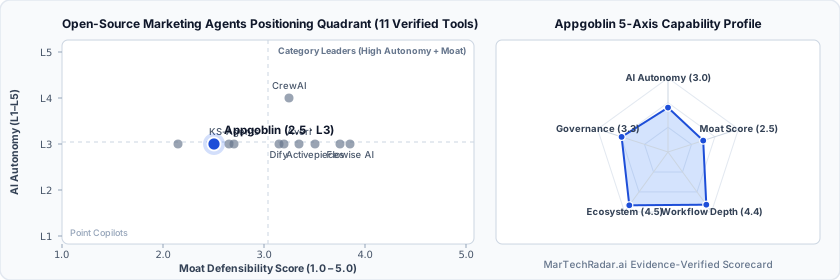
Appgoblin in-depth review, pricing & architecture analysis
Editor sign-off: Oct 11, 2026. How profiles are made.
What is Appgoblin? Overview & background
Mobile growth and business development teams require continuous visibility into third-party SDK installations and organic store movements without deploying manual reverse-engineering scripts. Headquartered in the United States and founded in 2023, Appgoblin addresses this operational burden by delivering automated mobile app intelligence and App Store Optimization analytics. The platform serves user acquisition leads, mobile product managers, and adtech sales representatives seeking systematic monitoring of rival application configurations, integrated third-party vendor frameworks, and cross-store ranking distributions across iOS and Android storefronts.
How Appgoblin works: architecture & workflow
The platform functions at an L3 autonomy profile, automating store scraping pipelines, binary decompilation, and metadata enrichment without manual operator intervention. The ingestion engine pulls application packages and store-level metadata across major marketplaces, passing downloaded packages through automated signature-detection routines that deconstruct code manifests to identify installed monetization, attribution, and analytics SDKs. Concurrently, Appgoblin computes keyword ranking deltas and creative ad placements, surfacing these signals through structured database dashboards and direct query endpoints for programmatic workflow ingestion, alongside native workflow integrations for Salesforce, Braze, and Amplitude.
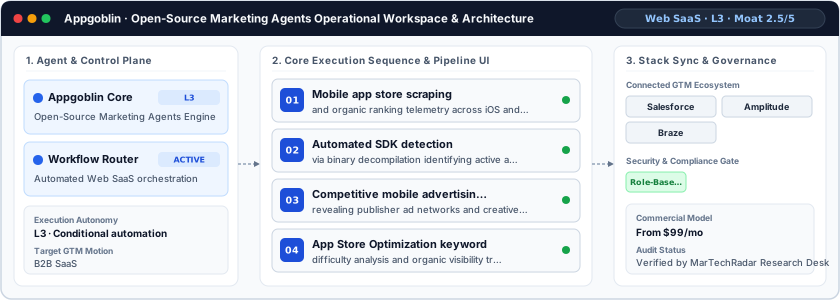
Appgoblin limitations, drawbacks & risks
Operational considerations and platform boundaries include:
- SDK Obfuscation and Dynamic Loading: Static binary decompilation fails to detect third-party libraries injected via server-driven dynamic code loading or aggressive custom package obfuscation.
- Store Scraping Latency: Metadata propagation lags real-time store changes due to crawl-rate governance, delaying visibility into rapid keyword experiments and immediate version rollbacks.
- API Rate Boundaries: Bulk enrichment pipelines encounter strict request throttles and monthly quota caps on standard tiers, restricting wide-scale programmatic catalog exports.
Appgoblin pricing, plans & cost breakdown
Commercial access is structured around tiered monthly and annual software-as-a-service subscriptions. Appgoblin provides a baseline free tier alongside paid subscriptions that start from $99/month. Higher-tier licensing incorporates expanded export volumes, prioritized SDK scanning requests, Net 30 invoicing terms, and programmatic REST API quotas, with billing handled via credit card, wire transfer, or PayPal.
How Appgoblin compares vs. competitors & alternatives
Within the ecosystem of automated marketing data agents, Appgoblin competes against general autonomous agent runtimes like AutoGPT, Alphie, and Arda within the ChatGPT for Marketing segment. While AutoGPT offers open-ended browser automation requiring complex prompt engineering and fragile scrapers, Appgoblin supplies purpose-built binary parsers and pre-indexed mobile store schemas. Conversely, execution frameworks such as Alphie and Arda emphasize cross-channel conversational workflows rather than deterministic SDK telemetry. Appgoblin fits growth-stage mobile developers and adtech intelligence units requiring turnkey app footprint analysis without building dedicated scraping clusters.
Frequently asked questions about Appgoblin
How much does Appgoblin cost in 2026?
Appgoblin pricing: From $99/mo. No free plan is publicly disclosed. Commercial access is structured around tiered monthly and annual software-as-a-service subscriptions. Appgoblin provides a baseline free tier alongside paid subscriptions that start from $99/month.
What are the top Appgoblin alternatives in Open-Source Marketing Agents?
Verified Open-Source Marketing Agents alternatives include Alphie (Custom / enterprise pricing), Arda ($99/mo), AutoGPT (Custom / enterprise pricing), CrewAI (Custom / enterprise pricing). Within the ecosystem of automated marketing data agents, Appgoblin competes against general autonomous agent runtimes like AutoGPT, Alphie, and Arda within the ChatGPT for Marketing segment.
What are the main limitations and trade-offs of Appgoblin?
Operational considerations and platform boundaries include: SDK Obfuscation and Dynamic Loading: Static binary decompilation fails to detect third-party libraries injected via server-driven dynamic code loading or aggressive custom package obfuscation. Walk away if your workflow cannot tolerate SDK obfuscation and dynamic loading: Static binary decompilation fails to detect third-party libraries injected via server-driven dynamic code loading or aggressive custom package obfuscation.
Verified sources & evidence trail
- Official product domain: https://appgoblin.info
- Commercial pricing verification: https://appgoblin.info/pricing
- Verified corporate entity profiles (
sameAs): LinkedIn Company Profile · Crunchbase Entity Record - First-party governance & documentation links: API & Docs
- Editor sign-off: Oct 11, 2026 (how profiles are made).
