Langflow Review (2026): Open-Source Marketing Agents Pricing, Pros & Cons
Bottom line
Langflow is a Open Source Repo tool for Open-Source Marketing Agents (Open-Source Marketing Agents & Prompts) in Agent & Marketing Ops. Pricing: Custom / enterprise pricing. Best suited to B2B SaaS. Editor ratings: AI autonomy L3 (conditional automation); moat score 3.8/5.0 (Proprietary moat). Fact-checked by MarTechRadar Research Desk on Oct 14, 2026.
Open-source visual framework and orchestration engine for building, prototyping, and deploying multi-agent AI systems, MCP servers, and RAG pipelines.
Is Langflow worth it in 2026? Buyer fit & when to walk away
Choose Langflow if (Best Fit)
- Target ICP & Stack Fit: You operate as B2B SaaS requiring a Open Source Repo deployment for Open-Source Marketing Agents, with verified ecosystem connectivity for Slack, Twilio Segment, Notion, Model Context Protocol (MCP).
- L3 Architecture & Defensibility: Deep integration with DataStax Astra DB and Apache Cassandra ecosystems, combined with a widely adopted open-source Python component runtime and native Model Context Protocol support.
- Commercial Model Fit: Your procurement budget aligns with Custom / enterprise pricing.
Walk away from Langflow if (Deal-Breakers)
- Walk away if you need published self-serve pricing: Langflow is sold by custom quote.
- Walk away if your workflow cannot tolerate memory and state serialization: Complex multi-agent graphs with cyclical logic risk state drift and high memory consumption when caching intermediate conversational payloads across stateless container environments.
- Walk away if vector database dependency latency is a deal-breaker for your team: RAG-driven workflows face execution bottlenecks and downstream timeouts if third-party vector store queries experience connection degradation or schema mismatches.
Langflow pricing, free plan & scorecard at a glance
| Pricing | Custom / enterprise pricing |
|---|---|
| Free plan | No / not disclosed |
| Delivery | Open Source Repo |
| Audience | B2B SaaS |
| AI autonomy level | L3 · Conditional automationEditor-verified |
| Moat tier & score | 3.8 / 5.0 · Proprietary moatEditor-verified |
| Funding | AcquiredAcquired by DataStax |
| Company size | 11-50 employees |
| Ecosystem integrations | Slack, Twilio Segment, Notion, Model Context Protocol (MCP) |
| Governance & docs | API & Docs ↗ |
| Headquarters | Uberlândia, Minas Gerais |
| Founded | 2020 |
| Last verified | Oct 14, 2026 |
Langflow pros & cons: strengths vs. operational limitations
Pros: core strengths & capabilities
- Visual node-based canvas: for assembling multi-agent graphs and retrieval-augmented generation pipelines
- Native Model Context Protocol (MCP): server creation and tool exposure
- Extensible component library supporting: major foundation models, vector stores, and custom Python execution
- Exportable execution graphs: for deployment as standalone API microservices
Cons: operational limitations & risks
- Memory and State Serialization: Complex multi-agent graphs with cyclical logic risk state drift and high memory consumption when caching intermediate conversational payloads across stateless container environments.
- Vector Database Dependency Latency: RAG-driven workflows face execution bottlenecks and downstream timeouts if third-party vector store queries experience connection degradation or schema mismatches.
- Custom Python Sandbox Isolation: Self-hosted deployments require manual container isolation boundaries to prevent resource exhaustion or arbitrary code execution vulnerabilities in user-defined script blocks.
Langflow TCO & deal-breaker stress test
Simulate 12-month stepped TCO, hidden cost multipliers, contract lock-in exposure, and stack failure modes using only facts verified by MarTechRadar Research Desk on 2026-10-14.
Langflow triggers high-severity friction under your 5-seat / $800/mo constraints. Benchmark the verified subtrack alternatives below before committing.
- Moat Score
- 3.8 / 5.0
- AI Autonomy
- L3
- Free Tier / Trial
- None disclosed
Triggered audit signals & failure modes
- Opaque Enterprise Quoting vs. SMB/Mid-Market BudgetVerified Pricing Ledger
Langflow does not disclose a public self-serve floor (Custom / enterprise pricing). Buyers with a $800/mo cap face high sales-qualification friction.
- Sales-Gated Contract TermsFact-checked by MarTechRadar Research Desk
Langflow is distributed as an open-source software project that engineering teams can self-host and modify freely.
- Primary Operational Bottleneck: Memory and State SerializationAudit by MarTechRadar Research Desk
Complex multi-agent graphs with cyclical logic risk state drift and high memory consumption when caching intermediate conversational payloads across stateless container environments.
Test a custom Langflow budget or stack constraint
Lower 5-seat floor (~$245/mo vs. Custom Quote) · Transparent self-serve entry without mandatory annual lock-in
Lower 5-seat floor (~$20/mo vs. Custom Quote) · Transparent self-serve entry without mandatory annual lock-in
Langflow integrations, API, security & compliance stack
Native Model Context Protocol server creation and tool exposure
Langflow AI moat & Open-Source Marketing Agents positioning
Deep integration with DataStax Astra DB and Apache Cassandra ecosystems, combined with a widely adopted open-source Python component runtime and native Model Context Protocol support.
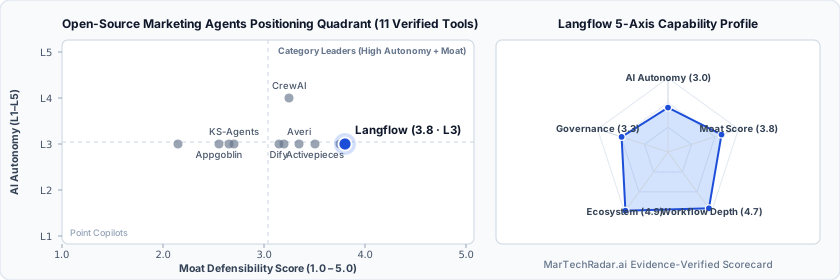
Langflow in-depth review, pricing & architecture analysis
Editor sign-off: Oct 14, 2026. How profiles are made.
What is Langflow? Overview & background
Architectural fragmentation across foundation models and retrieval stores creates technical friction for technical marketers and automation engineers seeking modular agent workflows. Headquartered in Uberlândia, Minas Gerais, and founded in 2020, Langflow addresses this structural challenge with a visual orchestration runtime for compound AI systems. Following its acquisition by DataStax, the project provides marketing engineers and RevOps teams with an extensible framework to design, inspect, and deploy autonomous workflows without hardcoded backend scaffolding.
How Langflow works: architecture & workflow
At Level 3 autonomy, Langflow operates as a visual Directed Acyclic Graph (DAG) canvas coupled with a Python execution engine. Ingestion pipelines pull structured inputs, documents, and unstructured event streams across external APIs, passing them through configurable retrieval-augmented generation (RAG) chains. The framework exposes native Model Context Protocol (MCP) endpoints and connects into vector databases, custom Python nodes, and major commercial LLMs. Agents autonomously execute multi-step tool calls, manage context memory, and route payload transformations via modular pipeline components, alongside native workflow integrations for Slack and Notion.
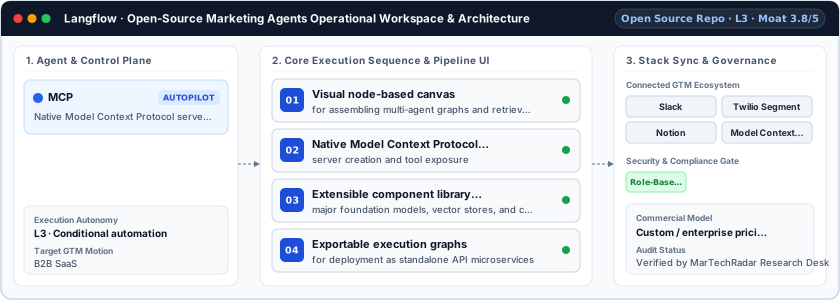
Langflow limitations, drawbacks & risks
Operational considerations and platform boundaries include:
- Memory and State Serialization: Complex multi-agent graphs with cyclical logic risk state drift and high memory consumption when caching intermediate conversational payloads across stateless container environments.
- Vector Database Dependency Latency: RAG-driven workflows face execution bottlenecks and downstream timeouts if third-party vector store queries experience connection degradation or schema mismatches.
- Custom Python Sandbox Isolation: Self-hosted deployments require manual container isolation boundaries to prevent resource exhaustion or arbitrary code execution vulnerabilities in user-defined script blocks.
Langflow pricing, plans & cost breakdown
Langflow is distributed as an open-source software project that engineering teams can self-host and modify freely. For managed enterprise deployments, centralized governance, and production SLA support, commercial pricing is available on request through tailored enterprise sales quotes based on organizational scale and seats.
| Plan / Tier | Verified Price & Billing | Included Scope & Contract Terms |
|---|---|---|
| Enterprise / Custom | Custom quote | Custom-quoted plan; terms come from the vendor's sales team. |
How Langflow compares vs. competitors & alternatives
Within the subtrack of open-source agent tooling, Langflow benchmarks against frameworks such as Alphie, Appgoblin, and Arda within the ChatGPT for Marketing segment. While specialized agents like Alphie and Appgoblin offer narrowly tuned, task-specific automation loops, Langflow prioritizes broad infrastructural composability and native MCP interoperability. Conversely, Arda emphasizes prescriptive workflow boundaries. Langflow represents the practical choice for data engineering and marketing operations teams requiring direct code transparency, multi-model flexibility, and enterprise database alignment.
Frequently asked questions about Langflow
Does Langflow publish pricing or require an enterprise quote?
Langflow pricing: Custom / enterprise pricing. No free plan is publicly disclosed. Langflow is distributed as an open-source software project that engineering teams can self-host and modify freely.
What are the top Langflow alternatives in Open-Source Marketing Agents?
Verified Open-Source Marketing Agents alternatives include Agents (Usage-based pricing), Dify (Custom / enterprise pricing), KS-Agents (From $49/mo), Flowise AI (Custom / enterprise pricing). Within the subtrack of open-source agent tooling, Langflow benchmarks against frameworks such as Alphie, Appgoblin, and Arda within the ChatGPT for Marketing segment.
What are the main limitations and trade-offs of Langflow?
Operational considerations and platform boundaries include: Memory and State Serialization: Complex multi-agent graphs with cyclical logic risk state drift and high memory consumption when caching intermediate conversational payloads across stateless container environments. Walk away if you need published self-serve pricing: Langflow is sold by custom quote.
Verified sources & evidence trail
- Official product domain: https://langflow.org
- Commercial pricing verification: Verified against official vendor pricing policy (Custom / enterprise pricing)
- Verified corporate entity profiles (
sameAs): LinkedIn Company Profile · Crunchbase Entity Record - First-party governance & documentation links: API & Docs
- Editor sign-off: Oct 14, 2026 (how profiles are made).
