Geocitation Review (2026): ChatGPT for Marketing Pricing, Limits & Alternatives
Bottom line
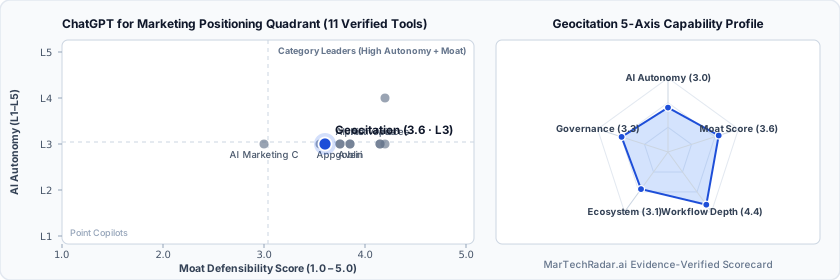
Geocitation is a Web SaaS tool for ChatGPT for Marketing (Open-Source Marketing Agents & Prompts) in Agent & Marketing Ops. Pricing: From $2.90/mo. Best suited to B2B SaaS. Editor ratings: AI autonomy L3 (conditional automation); moat score 3.6/5.0 (Proprietary moat). Fact-checked by Tim Fenolz on Oct 14, 2026.
White-label Generative Engine Optimization (GEO) and SEO audit API verifying Knowledge Graph alignment and AI citation trust.
Geocitation buyer fit verdict: when to choose vs. when to walk away
Choose Geocitation if (Best Fit)
- Target ICP & Stack Fit: You operate as B2B SaaS requiring a Web SaaS deployment for ChatGPT for Marketing.
- L3 Architecture & Defensibility: Algorithmic audit framework evaluating LLM trust signals, entity verification, and programmatic white-label reporting APIs for agencies.
- Commercial Model Fit: Your procurement budget aligns with From $2.90/mo.
Walk away from Geocitation if (Deal-Breakers)
- Walk away if your workflow requires uncapped enterprise volume on the From $2.90/mo entry plan without upgrading tiers.
- Walk away if your workflow cannot tolerate algorithmic black-box drift: Evaluation models depend on heuristic approximations of dynamic LLM retrieval behaviors, causing potential variance when proprietary foundational search models silently alter entity weighting weights.
- Walk away if API throughput limits is a deal-breaker for your team: High-volume batch auditing across large domain portfolios introduces queue latency during concurrent Knowledge Graph reconciliation calls.
Geocitation key facts & scorecard
| Pricing | From $2.90/moVendor pricing page |
|---|---|
| Free plan | No / not disclosed |
| Delivery | Web SaaS |
| Audience | B2B SaaS |
| AI autonomy level | L3 · Conditional automationEditor-verified |
| Moat tier & score | 3.6 / 5.0 · Proprietary moatEditor-verified |
| Funding | Open source |
| Company size | 2-10 employees |
| Governance & docs | Terms ↗ · Privacy ↗ |
| Headquarters | Paris, Île-de-France |
| Founded | 2026 |
| Last verified |
Geocitation pros & cons: strengths vs. operational limitations
Pros: core strengths & capabilities
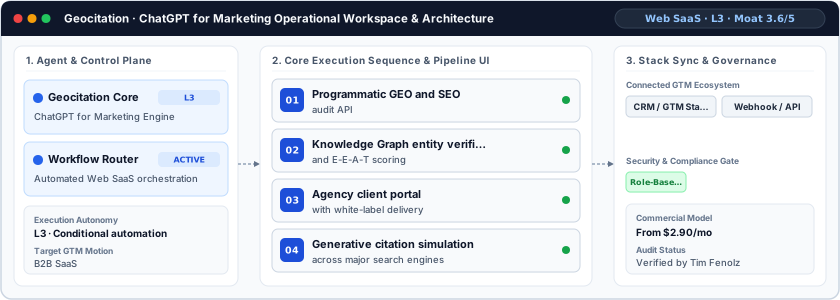
- Programmatic GEO and SEO: audit API
- Knowledge Graph entity verification: and E-E-A-T scoring
- Agency client portal: with white-label delivery
- Generative citation simulation: across major search engines
Cons: operational limitations & risks
- Algorithmic black-box drift: Evaluation models depend on heuristic approximations of dynamic LLM retrieval behaviors, causing potential variance when proprietary foundational search models silently alter entity weighting weights.
- API throughput limits: High-volume batch auditing across large domain portfolios introduces queue latency during concurrent Knowledge Graph reconciliation calls.
- Schema maintenance overhead: Organizations must continuously update nested JSON-LD structures to maintain parity with Geocitation's entity extraction benchmarks.
Geocitation TCO & deal-breaker stress test
Simulate 12-month stepped TCO, hidden cost multipliers, contract lock-in exposure, and stack failure modes using only facts verified by Tim Fenolz on · Capture SHA 055dc86c.
Geocitation is viable for 5 seats, but requires commercial or technical verification on the flagged items below.
| Plan / Tier | Verified Rate | Scale Fit | Scope & Quota Notes |
|---|---|---|---|
| Entry / Starter | $15/mo | 1–2 seats | Verified $15/mo tier from vendor pricing schedule. |
- Moat Score
- 3.6 / 5.0
- AI Autonomy
- L3
- Free Tier / Trial
- None disclosed
Triggered audit signals & failure modes
- Published Self-Serve Entry FloorVerified Pricing Ledger
Geocitation publishes a transparent entry point (From $2.90/mo) for initial validation before committing.
- Usage / Credit Burn VolatilityCommercial Model Audit
Geocitation uses credit or usage-metered billing (From $2.90/mo). High-volume automated workflows across 5 seats can trigger mid-cycle overage charges.
- Primary Operational Bottleneck: Algorithmic black-box driftAudit by Tim Fenolz
Evaluation models depend on heuristic approximations of dynamic LLM retrieval behaviors, causing potential variance when proprietary foundational search models silently alter entity weighting weights.
Hidden TCO Multipliers & Quota Gates
- Credit & Usage Burn Multiplier: Automated workflows consume metered credits/usage quotas; multi-step enrichment, voice minutes, or high-frequency agent runs can trigger mid-cycle top-up packs.
- Enterprise Governance & Add-On Gating: Advanced capabilities such as Single Sign-On (SSO), custom role permissions, or specialized analytics modules are gated behind upper tiers or paid add-ons.
When to Walk Away & Negotiation Levers
- Walk away if your workflow requires uncapped enterprise volume on the From $2.90/mo entry plan without upgrading tiers.
- Walk away if your workflow cannot tolerate algorithmic black-box drift: Evaluation models depend on heuristic approximations of dynamic LLM retrieval behaviors, causing potential variance when proprietary foundational search models silently alter entity weighting weights.
- Walk away if API throughput limits is a deal-breaker for your team: High-volume batch auditing across large domain portfolios introduces queue latency during concurrent Knowledge Graph reconciliation calls.
- Validate exact quota thresholds (seats, credits, or API calls) included in Geocitation's From $2.90/mo tier before converting from monthly to annual billing.
- Require a sandbox proof-of-concept testing algorithmic black-box drift against your live CRM/data schema before annual sign-off.
Ask a custom procurement or TCO stress-test question about Geocitation
Lower 5-seat floor (~$49/mo vs. Usage-Metered)
Lower 5-seat floor (~$99/mo vs. Usage-Metered)
Geocitation moat & subtrack positioning
Algorithmic audit framework evaluating LLM trust signals, entity verification, and programmatic white-label reporting APIs for agencies.
Editorial review
Fact-checked by Tim Fenolz (Lead AdTech, Programmatic & Attribution Analyst) on .
Background
To capture organic authority within generative search interfaces, digital agencies require programmatic verification that goes beyond legacy keyword density. Founded in 2026 in Paris, Île-de-France, Geocitation provides an automated audit engine engineered for search agencies and SaaS platforms navigating Generative Engine Optimization (GEO). The platform automates the evaluation of citation authority, targeting agency technical directors and organic search leads who must operationalize AI search visibility at scale.
How Geocitation works
Geocitation operates at Level 3 autonomy by executing programmatic audits through a dedicated REST API and white-label client portal. The engine ingests target URLs, parses structural markup, and evaluates content against entity registries to verify Knowledge Graph alignment. It tests whether web assets satisfy algorithmic trust thresholds and E-E-A-T markers necessary for citation synthesis across conversational search engines, returning structured citation-probability scores alongside technical remediation endpoints without manual oversight.
Limitations
Operational considerations and platform boundaries include:
- Algorithmic black-box drift: Evaluation models depend on heuristic approximations of dynamic LLM retrieval behaviors, causing potential variance when proprietary foundational search models silently alter entity weighting weights.
- API throughput limits: High-volume batch auditing across large domain portfolios introduces queue latency during concurrent Knowledge Graph reconciliation calls.
- Schema maintenance overhead: Organizations must continuously update nested JSON-LD structures to maintain parity with Geocitation's entity extraction benchmarks.
Geocitation pricing
Commercial access is structured around API consumption and agency seat volume, with public entry pricing starting from $2.90/month for baseline audit allowances. Higher tiers expand citation evaluation credits, white-label client portal endpoints, and programmatic webhook access for production environments.
How Geocitation compares
Within the automation category, Geocitation differentiates from broader agent ecosystems such as Alphie, Appgoblin, and Arda by specializing strictly in programmatic GEO audits rather than open-ended operational workflows. While alternatives offer horizontal prompt execution and marketing workflow routing, Geocitation provides a focused evaluation layer designed for agencies building recurring white-label search audit deliverables. Enterprise procurement teams evaluating deployment readiness should assess API webhook throughput, role-based access governance, and bilateral data synchronization latency against existing marketing technology infrastructure before committing to multi-year production rollouts.
Frequently asked questions about Geocitation
How much does Geocitation cost and what pricing tiers are available?
Published pricing summary for Geocitation: From $2.90/mo. A permanent free plan is not disclosed for Geocitation. Commercial access is structured around API consumption and agency seat volume, with public entry pricing starting from $2.90/month for baseline audit allowances. Higher tiers expand citation evaluation credits, white-label client portal endpoints, and programmatic webhook access for production environments.
How does Geocitation work and how autonomous is its AI architecture?
White-label Generative Engine Optimization (GEO) and SEO audit API verifying Knowledge Graph alignment and AI citation trust. Within ChatGPT for Marketing (Open-Source Marketing Agents & Prompts), MarTechRadar rates its execution architecture at L3 · Conditional automation with a verified Moat Score of 3.6 / 5.0 (Proprietary moat). Algorithmic audit framework evaluating LLM trust signals, entity verification, and programmatic white-label reporting APIs for agencies. Corporate profile: operating at 2-10 employees scale.
What are the main limitations of Geocitation and when should buyers walk away?
Based on our editorial technical audit, key operational considerations and boundaries for Geocitation include: (1) Algorithmic black-box drift: Evaluation models depend on heuristic approximations of dynamic LLM retrieval behaviors, causing potential variance when proprietary foundational search models silently alter entity weighting weights. (2) API throughput limits: High-volume batch auditing across large domain portfolios introduces queue latency during concurrent Knowledge Graph reconciliation calls. (3) Schema maintenance overhead: Organizations must continuously update nested JSON-LD structures to maintain parity with Geocitation's entity extraction benchmarks. Primary procurement walk-away rule: Walk away if your workflow requires uncapped enterprise volume on the From $2.90/mo entry plan without upgrading tiers.
What integrations, compliance certifications, and contract terms apply to Geocitation?
Key TCO multiplier to watch: Credit & Usage Burn Multiplier (Automated workflows consume metered credits/usage quotas; multi-step enrichment, voice minutes, or high-frequency agent runs can trigger mid-cycle top-up packs.) Before signing a contract, procurement teams should validate exact quota thresholds (seats, credits, or API calls) included in Geocitation's From $2.90/mo tier before converting from monthly to annual billing.
What are the best Geocitation alternatives and head-to-head competitors in 2026?
Top fact-checked alternatives to Geocitation in ChatGPT for Marketing (Open-Source Marketing Agents & Prompts) include Activepieces (Free plan · $0/mo · Enterprise plan), Averi (From $99/mo), KS-Agents (From $49/mo), Tessa Tech (From $100/mo). Within the automation category, Geocitation differentiates from broader agent ecosystems such as Alphie, Appgoblin, and Arda by specializing strictly in programmatic GEO audits rather than open-ended operational workflows.
Verified sources & evidence trail
- Official product domain: https://www.geocitation.io
- Commercial pricing verification: https://www.geocitation.io/en/pricing
- Verified corporate entity profiles (
sameAs): LinkedIn Company Profile - First-party governance & documentation links: Terms · Privacy
- Editorial audit sign-off: Fact-checked by Tim Fenolz on under the MarTechRadar Evidence-Ledger Protocol.