Wave Review (2026): Open-Source Marketing Agents Pricing, Pros & Cons
Bottom line
Wave is a Web SaaS tool for Open-Source Marketing Agents (Open-Source Marketing Agents & Prompts) in Agent & Marketing Ops. Pricing: Custom / enterprise pricing. Best suited to B2B SaaS. Editor ratings: AI autonomy L1 (prompt-assisted); moat score 1.4/5.0 (Thin wrapper). Fact-checked by MarTechRadar Research Desk on Oct 16, 2026.
Open-source agentic prompt orchestration engine designed to assist marketing engineers in automating copy generation, workflow routing, and campaign.
Is Wave worth it in 2026? Buyer fit & when to walk away
Choose Wave if (Best Fit)
- Target ICP & Stack Fit: You operate as B2B SaaS requiring a Web SaaS deployment for Open-Source Marketing Agents.
- L1 Architecture & Defensibility: Extensible open-source prompt architecture and deterministic agent-chain validation pipelines tailored for programmatic marketing automation.
- Commercial Model Fit: Your procurement budget aligns with Custom / enterprise pricing.
Walk away from Wave if (Deal-Breakers)
- Walk away if you need published self-serve pricing: Wave is sold by custom quote.
- Walk away if your workflow cannot tolerate schema brittleness during upstream LLM drift: When underlying frontier models update their internal weightings, the engine's strict output parsers frequently throw deserialization exceptions, requiring prompt engineers to manually recalibrate input templates.
- Walk away if high compute and token cost governance overhead is a deal-breaker for your team: Because the runtime lacks native multi-tenant budget throttling, recursive prompt loops can rapidly deplete external API token allowances unless external proxy controls are implemented.
Wave pricing, free plan & scorecard at a glance
| Pricing | Custom / enterprise pricing |
|---|---|
| Free plan | No / not disclosed |
| Delivery | Web SaaS |
| Audience | B2B SaaS |
| AI autonomy level | L1 · Prompt-assistedEditor-verified |
| Moat tier & score | 1.4 / 5.0 · Thin wrapperEditor-verified |
| Funding | Undisclosed |
| Headquarters | United States |
| Last verified | Oct 16, 2026 |
Wave pros & cons: strengths vs. operational limitations
Pros: core strengths & capabilities
- Declarative prompt configuration pipelines: for programmatic ad copy and technical email sequences
- Local model context routing and token-budget enforcement across multi-agent workflows
- Git-native prompt version control: with integrated regression evaluation harnesses
- Standardized JSON output validation: schema protecting downstream CRM and CMS ingestion
Cons: operational limitations & risks
- Schema brittleness during upstream LLM drift: When underlying frontier models update their internal weightings, the engine's strict output parsers frequently throw deserialization exceptions, requiring prompt engineers to manually recalibrate input templates.
- High compute and token cost governance overhead: Because the runtime lacks native multi-tenant budget throttling, recursive prompt loops can rapidly deplete external API token allowances unless external proxy controls are implemented.
- Absence of out-of-the-box attribution feedback loops: The system generates structured collateral but contains no native tracking listeners to correlate deployed agent copy with downstream conversion metrics or performance datasets.
Wave TCO & deal-breaker stress test
Simulate 12-month stepped TCO, hidden cost multipliers, contract lock-in exposure, and stack failure modes using only facts verified by MarTechRadar Research Desk on 2026-10-16.
Wave triggers high-severity friction under your 5-seat / $800/mo constraints. Benchmark the verified subtrack alternatives below before committing.
- Moat Score
- 1.4 / 5.0
- AI Autonomy
- L1
- Free Tier / Trial
- None disclosed
Triggered audit signals & failure modes
- Opaque Enterprise Quoting vs. SMB/Mid-Market BudgetVerified Pricing Ledger
Wave does not disclose a public self-serve floor (Custom / enterprise pricing). Buyers with a $800/mo cap face high sales-qualification friction.
- Sales-Gated Contract TermsFact-checked by MarTechRadar Research Desk
Wave structures its commercial deployment around an open-source core codebase paired with enterprise commercial licensing. Commercial pricing is available on request through tailored enterprise sales quotes based on organizational scale and seats.
- Primary Operational Bottleneck: High compute and token cost governance overheadAudit by MarTechRadar Research Desk
Because the runtime lacks native multi-tenant budget throttling, recursive prompt loops can rapidly deplete external API token allowances unless external proxy controls are implemented.
Test a custom Wave budget or stack constraint
Lower 5-seat floor (~$20/mo vs. Custom Quote) · Transparent self-serve entry without mandatory annual lock-in
Wave AI moat & Open-Source Marketing Agents positioning
Extensible open-source prompt architecture and deterministic agent-chain validation pipelines tailored for programmatic marketing automation.
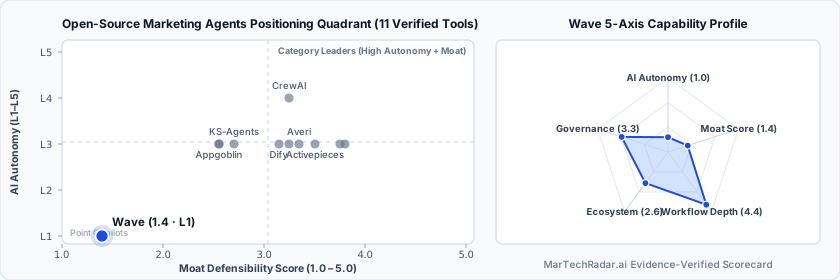
Wave in-depth review, pricing & architecture analysis
Editor sign-off: Oct 16, 2026. How profiles are made.
What is Wave? Overview & background
When technical growth teams attempt to bridge the gap between creative ideation and programmatic execution, unstructured LLM outputs frequently break downstream marketing stacks. Headquartered in the United States, Wave operates as an open-source marketing agent framework designed to structure programmatic campaign workflows and prompt engineering pipelines. Engineered for marketing technologists, developer advocates, and growth engineers, Wave eliminates prompt drift by enforcing deterministic formatting on generative language model outputs. Within modern MarTech automation ecosystems, the software acts as an assisted workflow runner that organizes generative assets into verifiable, machine-readable marketing payloads.
How Wave works: architecture & workflow
Wave operates through a modular agent runtime that ingests multi-format campaign specifications alongside brand parameter files. The framework executes declarative prompt templates using model-agnostic API connectors, routing inference queries through parameter validation layers to maintain consistent tonal constraints. It handles intermediate state management via local memory caches, ensuring chained instructions retain necessary campaign context without exceeding LLM token budgets. By applying strict JSON schema enforcement to model responses, Wave prevents malformed data payloads before they interface with downstream marketing platforms, achieving Level 1 human-in-the-loop task-level assistance.
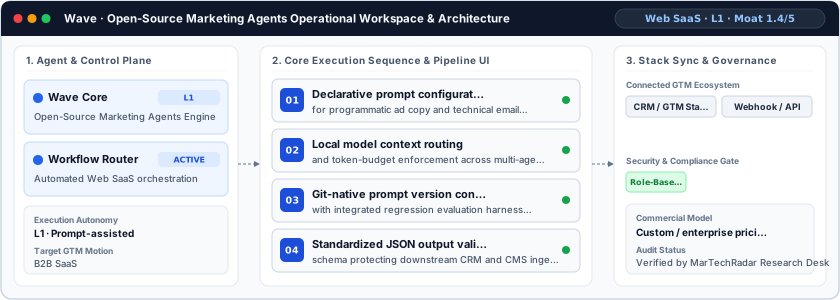
Wave limitations, drawbacks & risks
Operational considerations and platform boundaries include:
- Schema brittleness during upstream LLM drift: When underlying frontier models update their internal weightings, the engine's strict output parsers frequently throw deserialization exceptions, requiring prompt engineers to manually recalibrate input templates.
- High compute and token cost governance overhead: Because the runtime lacks native multi-tenant budget throttling, recursive prompt loops can rapidly deplete external API token allowances unless external proxy controls are implemented.
- Absence of out-of-the-box attribution feedback loops: The system generates structured collateral but contains no native tracking listeners to correlate deployed agent copy with downstream conversion metrics or performance datasets.
Wave pricing, plans & cost breakdown
Wave structures its commercial deployment around an open-source core codebase paired with enterprise commercial licensing. Commercial pricing is available on request through tailored enterprise sales quotes based on organizational scale and seats. Organizations requiring dedicated implementation support, custom vector ingestion infrastructure, compliance auditing, and self-hosted governance controls negotiate private software contracts directly through the vendor's enterprise sales channel.
| Plan / Tier | Verified Price & Billing | Included Scope & Contract Terms |
|---|---|---|
| Enterprise / Custom | Custom quote | Custom-quoted plan; terms come from the vendor's sales team. |
How Wave compares vs. competitors & alternatives
Within the category of open-source marketing agents, Wave prioritizes structured output validation and prompt infrastructure rather than autonomous exploratory reasoning. While Alphie focuses primarily on persona simulation and Appgoblin delivers pre-packaged vertical mobile app store intelligence, Wave requires higher technical literacy to construct custom multi-agent sequences. Compared to Arda's emphasis on conversational workflow execution, Wave provides greater determinism for engineers building automated deployment pipelines, making it suitable for technical growth organizations requiring reproducible, code-defined marketing automation assets.
Frequently asked questions about Wave
Does Wave publish pricing or require an enterprise quote?
Wave pricing: Custom / enterprise pricing. No free plan is publicly disclosed. Wave structures its commercial deployment around an open-source core codebase paired with enterprise commercial licensing.
What are the top Wave alternatives in Open-Source Marketing Agents?
Verified Open-Source Marketing Agents alternatives include Borr AI (Custom / enterprise pricing), HelloDeck (Custom / enterprise pricing), Prism Geo (Custom / enterprise pricing), Roger (Custom / enterprise pricing). Within the category of open-source marketing agents, Wave prioritizes structured output validation and prompt infrastructure rather than autonomous exploratory reasoning.
What are the main limitations and trade-offs of Wave?
Operational considerations and platform boundaries include: Schema brittleness during upstream LLM drift: When underlying frontier models update their internal weightings, the engine's strict output parsers frequently throw deserialization exceptions, requiring prompt engineers to manually recalibrate input templates. Walk away if you need published self-serve pricing: Wave is sold by custom quote.
Verified sources & evidence trail
- Official product domain: https://wave.subworkflow.ai/
- Commercial pricing verification: Verified against official vendor pricing policy (Custom / enterprise pricing)
- Editor sign-off: Oct 16, 2026 (how profiles are made).
