Volca Review (2026): AI Calling Pricing, Limits & Alternatives
Bottom line
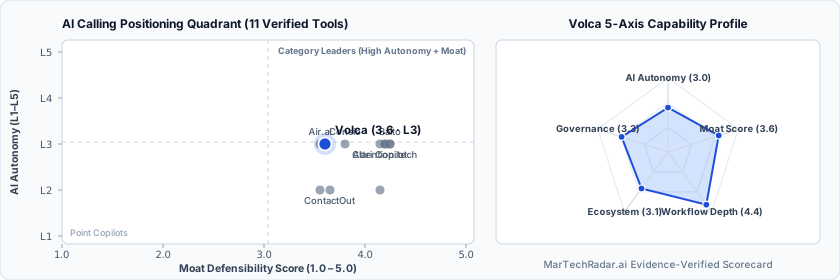
Volca is a Web SaaS tool for AI Calling (Conversational Voice Calling Agents) in AI SDR & Outbound. Pricing: Custom / enterprise pricing. Best suited to Growth Marketing Teams and Digital Marketing Leaders. Editor ratings: AI autonomy L3 (conditional automation); moat score 3.6/5.0 (Proprietary moat). Fact-checked by Anthony Hay on Oct 16, 2026.
Autonomous conversational voice agent platform orchestrating bidirectional outbound and inbound enterprise telephony workflows with real-time speech.
Volca buyer fit verdict: when to choose vs. when to walk away
Choose Volca if (Best Fit)
- Target ICP & Stack Fit: You operate as Growth Marketing Teams and Digital Marketing Leaders requiring a Web SaaS deployment for AI Calling, with verified ecosystem connectivity for Outreach.
- L3 Architecture & Defensibility: Proprietary conversational turn-taking engine paired with real-time audio pipeline optimization that minimizes end-to-end voice latency over standard SIP telephony networks.
- Commercial Model Fit: Your procurement budget aligns with Custom / enterprise pricing.
Walk away from Volca if (Deal-Breakers)
- Walk away if you require transparent self-serve monthly billing or your budget ceiling is under $1,000/mo (Volca requires sales-gated custom quoting).
- Walk away if your workflow cannot tolerate telephony latency jitter: Packet loss across carrier networks can degrade speech-to-text accuracy, introducing awkward response pauses during live turn-taking.
- Walk away if complex dialog state drifting is a deal-breaker for your team: Unscripted, multi-topic prospect tangents can cause the contextual memory layer to drop critical qualifying criteria midway through calls.
Volca key facts & scorecard
| Pricing | Custom / enterprise pricing |
|---|---|
| Free plan | No / not disclosed |
| Delivery | Web SaaS |
| Audience | Growth Marketing Teams, Digital Marketing Leaders |
| AI autonomy level | L3 · Conditional automationEditor-verified |
| Moat tier & score | 3.6 / 5.0 · Proprietary moatEditor-verified |
| Funding | Seed |
| Ecosystem integrations | Outreach |
| Headquarters | United States |
| Founded | 2024 |
| Last verified |
Volca pros & cons: strengths vs. operational limitations
Pros: core strengths & capabilities
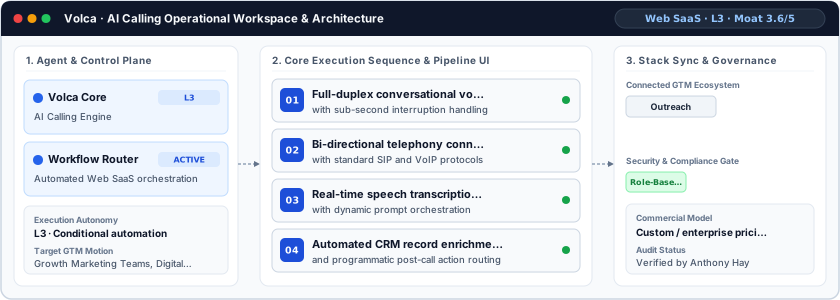
- Full-duplex conversational voice engine: with sub-second interruption handling
- Bi-directional telephony connectors integrating: with standard SIP and VoIP protocols
- Real-time speech transcription coupled: with dynamic prompt orchestration
- Automated CRM record enrichment: and programmatic post-call action routing
Cons: operational limitations & risks
- Telephony Latency Jitter: Packet loss across carrier networks can degrade speech-to-text accuracy, introducing awkward response pauses during live turn-taking.
- Complex Dialog State Drifting: Unscripted, multi-topic prospect tangents can cause the contextual memory layer to drop critical qualifying criteria midway through calls.
- Carrier Spam Flagging: High-volume outbound calling campaigns face continuous reputation degradation and carrier-level number flagging without strict telephony pacing controls.
Volca TCO & deal-breaker stress test
Simulate 12-month stepped TCO, hidden cost multipliers, contract lock-in exposure, and stack failure modes using only facts verified by Anthony Hay on .
Volca triggers high-severity friction under your 5-seat / $800/mo constraints. Benchmark the verified subtrack alternatives below before committing.
| Plan / Tier | Verified Rate | Scale Fit | Scope & Quota Notes |
|---|---|---|---|
| Enterprise / Custom | Custom quote | 15–50+ seats (Enterprise SLA) | Sales-negotiated annual contract for custom volume, SSO/RBAC governance, and dedicated SLA. |
- Moat Score
- 3.6 / 5.0
- AI Autonomy
- L3
- Free Tier / Trial
- None disclosed
Triggered audit signals & failure modes
- Opaque Enterprise Quoting vs. SMB/Mid-Market BudgetVerified Pricing Ledger
Volca does not disclose a public self-serve floor (Custom / enterprise pricing). Buyers with a $800/mo cap face high sales-qualification friction.
- Sales-Gated Contract TermsFact-checked by Anthony Hay
Commercial access to the platform operates exclusively under a custom enterprise licensing structure. Organizations must contact sales for tailored enterprise quotes based on expected call concurrency, minutes consumed, and seat requirements across their operational teams.
- Primary Operational Bottleneck: Telephony Latency JitterAudit by Anthony Hay
Packet loss across carrier networks can degrade speech-to-text accuracy, introducing awkward response pauses during live turn-taking.
Hidden TCO Multipliers & Quota Gates
- Profile / Workspace Quota Ceilings: Base tiers cap the number of connected profiles, workspaces, or contact records, forcing tier upgrades before seat limits are reached.
- Telephony Latency Jitter: Packet loss across carrier networks can degrade speech-to-text accuracy, introducing awkward response pauses during live turn-taking.
- Complex Dialog State Drifting: Unscripted, multi-topic prospect tangents can cause the contextual memory layer to drop critical qualifying criteria midway through calls.
When to Walk Away & Negotiation Levers
- Walk away if you require transparent self-serve monthly billing or your budget ceiling is under $1,000/mo (Volca requires sales-gated custom quoting).
- Walk away if your workflow cannot tolerate telephony latency jitter: Packet loss across carrier networks can degrade speech-to-text accuracy, introducing awkward response pauses during live turn-taking.
- Walk away if complex dialog state drifting is a deal-breaker for your team: Unscripted, multi-topic prospect tangents can cause the contextual memory layer to drop critical qualifying criteria midway through calls.
- Demand a 30- to 60-day paid pilot opt-out clause in the Volca order form before signing a 12-month enterprise commitment.
- Require a sandbox proof-of-concept testing telephony latency jitter against your live CRM/data schema before annual sign-off.
Ask a custom procurement or TCO stress-test question about Volca
Offers a free tier (Free plan · $0/mo · Enterprise plan) · Transparent self-serve entry without mandatory annual lock-in
Offers a free tier (Free plan · $0/mo · Enterprise plan) · Transparent self-serve entry without mandatory annual lock-in
Volca key entities, modules & ecosystem stack
Volca moat & subtrack positioning
Proprietary conversational turn-taking engine paired with real-time audio pipeline optimization that minimizes end-to-end voice latency over standard SIP telephony networks.
Editorial review
Fact-checked by Anthony Hay (Senior SEO, Search Intelligence & Content Operations Editor) on .
Background
Modern revenue teams frequently encounter operational throughput bottlenecks when scaling outbound phone outreach and inbound qualification without ballooning human headcount. Headquartered in the United States, Volca addresses this dilemma by deploying autonomous conversational voice agents designed for enterprise revenue teams, demand generation leaders, and customer operations specialists. The platform replaces rigid interactive voice response trees and manual cold qualification routines with responsive synthetic calling workflows.
How Volca works
Under the hood, the system coordinates full-duplex conversational turn-taking through a unified voice pipeline. Incoming audio packets stream across telephony trunks into a real-time speech-to-text engine, which feeds parsed intent into an LLM dialogue orchestrator. The runtime evaluates business logic, handles user interruptions with acoustic echo cancellation, and yields sub-second synthesized audio responses using streaming text-to-speech models. Downstream, the architecture executes programmatic webhook actions to write qualification parameters and transcripts into enterprise records.
Limitations
Operational considerations and platform boundaries include:
- Telephony Latency Jitter: Packet loss across carrier networks can degrade speech-to-text accuracy, introducing awkward response pauses during live turn-taking.
- Complex Dialog State Drifting: Unscripted, multi-topic prospect tangents can cause the contextual memory layer to drop critical qualifying criteria midway through calls.
- Carrier Spam Flagging: High-volume outbound calling campaigns face continuous reputation degradation and carrier-level number flagging without strict telephony pacing controls.
Volca pricing
Commercial access to the platform operates exclusively under a custom enterprise licensing structure. Organizations must contact sales for tailored enterprise quotes based on expected call concurrency, minutes consumed, and seat requirements across their operational teams. Pricing is available on request through tailored enterprise sales quotes, with custom enterprise tiers, subscription plans, and seat licenses structured around organizational scale and monthly workflow volume.
How Volca compares
Within the voice automation ecosystem, Volca competes against platforms like Bland.ai, Consio, and Dialpad Ai. Bland.ai provides raw programmable voice APIs targeted directly at software engineers building bespoke integrations, whereas Dialpad Ai concentrates on hybrid human-in-the-loop telephony workspaces. Volca targets revenue organizations requiring structured conversational automation that bridges turnkey enterprise workflow logic with low-latency synthetic calling architectures without demanding low-level infrastructure engineering. Enterprise procurement teams evaluating deployment readiness should assess API webhook throughput, role-based access governance, and bilateral data synchronization latency against existing marketing technology infrastructure before committing to multi-year production rollouts. It is best suited for enterprise marketing teams and growth practitioners seeking disciplined workflow orchestration.
Direct competitors & market radar
Top algorithmic competitors based on category positioning, capability overlap, and ICP alignment.
Frequently asked questions about Volca
How much does Volca cost and does it require a custom enterprise quote?
Published pricing summary for Volca: Custom / enterprise pricing. A permanent free plan is not disclosed for Volca. Commercial access to the platform operates exclusively under a custom enterprise licensing structure. Organizations must contact sales for tailored enterprise quotes based on expected call concurrency, minutes consumed, and seat requirements across their operational teams.
How does Volca work and how autonomous is its AI architecture?
Autonomous conversational voice agent platform orchestrating bidirectional outbound and inbound enterprise telephony workflows with real-time speech. Within AI Calling (Conversational Voice Calling Agents), MarTechRadar rates its execution architecture at L3 · Conditional automation with a verified Moat Score of 3.6 / 5.0 (Proprietary moat). Proprietary conversational turn-taking engine paired with real-time audio pipeline optimization that minimizes end-to-end voice latency over standard SIP telephony networks.
What are the main limitations of Volca and when should buyers walk away?
Based on our editorial technical audit, key operational considerations and boundaries for Volca include: (1) Telephony Latency Jitter: Packet loss across carrier networks can degrade speech-to-text accuracy, introducing awkward response pauses during live turn-taking. (2) Complex Dialog State Drifting: Unscripted, multi-topic prospect tangents can cause the contextual memory layer to drop critical qualifying criteria midway through calls. (3) Carrier Spam Flagging: High-volume outbound calling campaigns face continuous reputation degradation and carrier-level number flagging without strict telephony pacing controls. Primary procurement walk-away rule: Walk away if you require transparent self-serve monthly billing or your budget ceiling is under $1,000/mo (Volca requires sales-gated custom quoting).
What integrations, compliance certifications, and contract terms apply to Volca?
Verified ecosystem and stack integrations include Outreach. Key TCO multiplier to watch: Profile / Workspace Quota Ceilings (Base tiers cap the number of connected profiles, workspaces, or contact records, forcing tier upgrades before seat limits are reached.) Before signing a contract, procurement teams should demand a 30- to 60-day paid pilot opt-out clause in the Volca order form before signing a 12-month enterprise commitment.
What are the best Volca alternatives and head-to-head competitors in 2026?
Top fact-checked alternatives to Volca in AI Calling (Conversational Voice Calling Agents) include Samora AI (Pricing not disclosed), Terrakotta (Pricing not disclosed), Bland.ai (Free plan · $299/mo · Enterprise plan), Dialpad Ai ($15–$25/seat/mo · Enterprise plan). Within the voice automation ecosystem, Volca competes against platforms like Bland.ai, Consio, and Dialpad Ai. Bland.ai provides raw programmable voice APIs targeted directly at software engineers building bespoke integrations, whereas Dialpad Ai concentrates on hybrid human-in-the-loop telephony workspaces.
Verified sources & evidence trail
- Official product domain: https://www.volca.ai/
- Commercial pricing verification: Verified against official vendor pricing policy (Custom / enterprise pricing)
- Editorial audit sign-off: Fact-checked by Anthony Hay on under the MarTechRadar Evidence-Ledger Protocol.