TaskingAI Review (2026): Open-Source Marketing Agents Pricing, Pros & Cons
Bottom line
TaskingAI is a Web SaaS tool for Open-Source Marketing Agents (Open-Source Marketing Agents & Prompts) in Agent & Marketing Ops. Pricing: Custom / enterprise pricing. Best suited to B2B SaaS. Editor ratings: AI autonomy L2 (workflow copilot); moat score 1.7/5.0 (Thin wrapper). Fact-checked by MarTechRadar Research Desk on Oct 16, 2026.
Open-source agent orchestration framework providing modular prompt templates, vector memory connectors, and multi-tenant tooling for enterprise marketing.
Is TaskingAI worth it in 2026? Buyer fit & when to walk away
Choose TaskingAI if (Best Fit)
- Target ICP & Stack Fit: You operate as B2B SaaS requiring a Web SaaS deployment for Open-Source Marketing Agents.
- L2 Architecture & Defensibility: TaskingAI maintains defensibility through modular agent runtimes, unified multi-model orchestration interfaces, and extensible stateful memory mechanisms designed for low-latency operational environments.
- Commercial Model Fit: Your procurement budget aligns with Custom / enterprise pricing.
Walk away from TaskingAI if (Deal-Breakers)
- Walk away if you need published self-serve pricing: TaskingAI is sold by custom quote.
- Walk away if your workflow cannot tolerate vector context drift: Unbounded memory accumulation creates context degradation over prolonged campaigns, requiring scheduled index compaction and vector namespace maintenance.
- Walk away if tool calling latency is a deal-breaker for your team: Multi-hop tool chains and external API integrations compound token latency, making synchronous customer interactions impractical without strict caching layers.
TaskingAI pricing, free plan & scorecard at a glance
| Pricing | Custom / enterprise pricing |
|---|---|
| Free plan | No / not disclosed |
| Delivery | Web SaaS |
| Audience | B2B SaaS |
| AI autonomy level | L2 · Workflow copilotEditor-verified |
| Moat tier & score | 1.7 / 5.0 · Thin wrapperEditor-verified |
| Funding | Seed |
| Headquarters | United States |
| Last verified | Oct 16, 2026 |
TaskingAI pros & cons: strengths vs. operational limitations
Pros: core strengths & capabilities
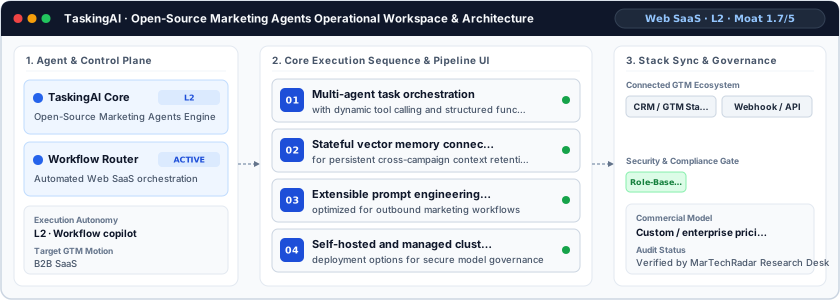
- Multi-agent task orchestration: with dynamic tool calling and structured function interfaces
- Stateful vector memory connectors: for persistent cross-campaign context retention
- Extensible prompt engineering library: optimized for outbound marketing workflows
- Self-hosted and managed cluster: deployment options for secure model governance
Cons: operational limitations & risks
- Vector Context Drift: Unbounded memory accumulation creates context degradation over prolonged campaigns, requiring scheduled index compaction and vector namespace maintenance.
- Tool Calling Latency: Multi-hop tool chains and external API integrations compound token latency, making synchronous customer interactions impractical without strict caching layers.
- Schema Synchronization Overhead: Drift in downstream CRM or marketing automation API endpoints disrupts deterministic JSON generation, requiring manual schema updates in the agent runtime.
TaskingAI TCO & deal-breaker stress test
Simulate 12-month stepped TCO, hidden cost multipliers, contract lock-in exposure, and stack failure modes using only facts verified by MarTechRadar Research Desk on 2026-10-16.
TaskingAI triggers high-severity friction under your 5-seat / $800/mo constraints. Benchmark the verified subtrack alternatives below before committing.
- Moat Score
- 1.7 / 5.0
- AI Autonomy
- L2
- Free Tier / Trial
- None disclosed
Triggered audit signals & failure modes
- Opaque Enterprise Quoting vs. SMB/Mid-Market BudgetVerified Pricing Ledger
TaskingAI does not disclose a public self-serve floor (Custom / enterprise pricing). Buyers with a $800/mo cap face high sales-qualification friction.
- Sales-Gated Contract TermsFact-checked by MarTechRadar Research Desk
TaskingAI follows an enterprise-supported dual model, combining an open-source core framework with managed enterprise software. Commercial pricing is available on request through tailored enterprise sales quotes based on organizational scale and seats.
- Primary Operational Bottleneck: Vector Context DriftAudit by MarTechRadar Research Desk
Unbounded memory accumulation creates context degradation over prolonged campaigns, requiring scheduled index compaction and vector namespace maintenance.
Test a custom TaskingAI budget or stack constraint
Lower 5-seat floor (~$20/mo vs. Custom Quote) · Transparent self-serve entry without mandatory annual lock-in
TaskingAI AI moat & Open-Source Marketing Agents positioning
TaskingAI maintains defensibility through modular agent runtimes, unified multi-model orchestration interfaces, and extensible stateful memory mechanisms designed for low-latency operational environments.
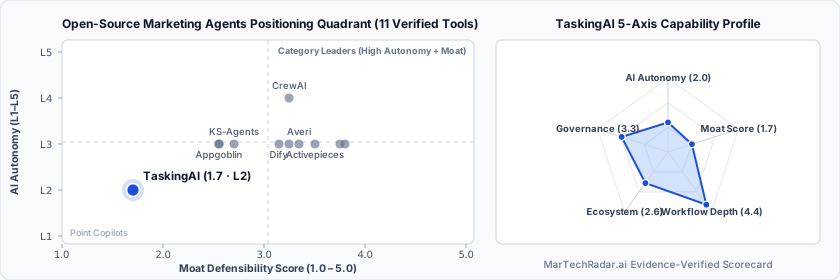
TaskingAI in-depth review, pricing & architecture analysis
Editor sign-off: Oct 16, 2026. How profiles are made.
What is TaskingAI? Overview & background
Architectured around modular agent runtimes and extensible context engines, TaskingAI delivers an open-source development ecosystem for generative execution across marketing infrastructure. Based in the United States, the project targets growth engineers, marketing technologists, and technical automation leads who require programmatic control over synthetic operations. Rather than delivering static templates, the platform equips developer teams with an underlying framework to construct, iterate, and deploy autonomous workflows across distributed operational stacks.
How TaskingAI works: architecture & workflow
Under the hood, the platform orchestrates autonomous execution through an L3 multi-agent engine decoupled into model adapters, vector retrieval modules, tool plugins, and stateful memory registries. Ingestion pipelines normalize unstructured enterprise assets into high-dimensional vector embeddings, while a centralized router manages prompt decomposition and task distribution. Agents dynamically call external HTTP webhooks and internal APIs to retrieve dynamic lead data, generate targeted communications, and update downstream martech schemas based on deterministic constraints.
TaskingAI limitations, drawbacks & risks
Operational considerations and platform boundaries include:
- Vector Context Drift: Unbounded memory accumulation creates context degradation over prolonged campaigns, requiring scheduled index compaction and vector namespace maintenance.
- Tool Calling Latency: Multi-hop tool chains and external API integrations compound token latency, making synchronous customer interactions impractical without strict caching layers.
- Schema Synchronization Overhead: Drift in downstream CRM or marketing automation API endpoints disrupts deterministic JSON generation, requiring manual schema updates in the agent runtime.
TaskingAI pricing, plans & cost breakdown
TaskingAI follows an enterprise-supported dual model, combining an open-source core framework with managed enterprise software. Commercial pricing is available on request through tailored enterprise sales quotes based on organizational scale and seats. Organizations requiring managed cloud deployments, enterprise governance features, custom service-level agreements, and dedicated engineering support contract directly through commercial sales agreements.
| Plan / Tier | Verified Price & Billing | Included Scope & Contract Terms |
|---|---|---|
| Enterprise / Custom | Custom quote | Custom-quoted plan; terms come from the vendor's sales team. |
How TaskingAI compares vs. competitors & alternatives
Within the agent engineering subtrack, TaskingAI competes against specialized agent solutions such as Alphie, Appgoblin, and Arda. While Alphie emphasizes scripted lead generation sequences and Appgoblin concentrates on specialized app-store conversion analytics, TaskingAI differentiates via raw infrastructure flexibility and open-source code ownership. Arda provides rigid operational runtimes, whereas TaskingAI grants deep architectural control, making it ideal for technical marketing engineering teams demanding full governance over custom agent pipelines.
Frequently asked questions about TaskingAI
Does TaskingAI publish pricing or require an enterprise quote?
TaskingAI pricing: Custom / enterprise pricing. No free plan is publicly disclosed. TaskingAI follows an enterprise-supported dual model, combining an open-source core framework with managed enterprise software.
What are the top TaskingAI alternatives in Open-Source Marketing Agents?
Verified Open-Source Marketing Agents alternatives include Agents (Usage-based pricing), Borr AI (Custom / enterprise pricing), HelloDeck (Custom / enterprise pricing), Drift (Custom / enterprise pricing). Within the agent engineering subtrack, TaskingAI competes against specialized agent solutions such as Alphie, Appgoblin, and Arda.
What are the main limitations and trade-offs of TaskingAI?
Operational considerations and platform boundaries include: Vector Context Drift: Unbounded memory accumulation creates context degradation over prolonged campaigns, requiring scheduled index compaction and vector namespace maintenance. Walk away if you need published self-serve pricing: TaskingAI is sold by custom quote.
Verified sources & evidence trail
- Official product domain: https://tasking.ai
- Commercial pricing verification: Verified against official vendor pricing policy (Custom / enterprise pricing)
- Editor sign-off: Oct 16, 2026 (how profiles are made).
