Rockerbox Review (2026): Marketing Mix Modeling Pricing, Pros & Cons
Bottom line
Rockerbox is a Web SaaS tool for Marketing Mix Modeling (Marketing Mix Modeling & Incremental Lift) in Analytics & Attribution. Pricing: Custom / enterprise pricing. Best suited to DTC / eCommerce and Enterprise Brands. Editor ratings: AI autonomy L3 (conditional automation); moat score 4.7/5.0 (Proprietary moat (category leader)). Fact-checked by MarTechRadar Research Desk on Oct 15, 2026.
Unified marketing attribution, incrementality testing, and marketing mix modeling platform built on a centralized first-party data foundation.
Is Rockerbox worth it in 2026? Buyer fit & when to walk away
Choose Rockerbox if (Best Fit)
- Target ICP & Stack Fit: You operate as DTC / eCommerce and Enterprise Brands requiring a Web SaaS deployment for Marketing Mix Modeling.
- L3 Architecture & Defensibility: Proprietary hybrid measurement methodology pairing granular first-party clickstream identity resolution with aggregate Bayesian marketing mix modeling to withstand browser tracking restrictions.
- Commercial Model Fit: Your procurement budget aligns with Custom / enterprise pricing.
Walk away from Rockerbox if (Deal-Breakers)
- Walk away if you need published self-serve pricing: Rockerbox is sold by custom quote.
- Walk away if your workflow cannot tolerate tag setup work: First-time setup requires first-party tracking tags and server event mapping, which takes direct time from data engineers.
- Walk away if walled garden delays is a deal-breaker for your team: Ad networks that hide raw impression logs or delay API reports by several days can slow down daily model updates.
Rockerbox pricing, free plan & scorecard at a glance
| Pricing | Custom / enterprise pricing |
|---|---|
| Free plan | No / not disclosed |
| Delivery | Web SaaS |
| Audience | DTC / eCommerce, Enterprise Brands |
| AI autonomy level | L3 · Conditional automationEditor-verified |
| Moat tier & score | 4.7 / 5.0 · Proprietary moat (category leader)Editor-verified |
| Funding | Series A |
| Compliance & governance | SOC 2 |
| Headquarters | New York, United States |
| Founded | 2013 |
| Last verified | Oct 15, 2026 |
Rockerbox pros & cons: strengths vs. operational limitations
Pros: core strengths & capabilities
- Unified multi-touch attribution and marketing mix modeling synthesis engine
- First-party identity resolution graph: capturing omni-channel customer journeys
- Geo-lift and incrementality experiment: orchestration framework
- Automated data warehouse syncing: across modern cloud data platforms
Cons: operational limitations & risks
- Tag Setup Work: First-time setup requires first-party tracking tags and server event mapping, which takes direct time from data engineers.
- Walled Garden Delays: Ad networks that hide raw impression logs or delay API reports by several days can slow down daily model updates.
- Past Spend History: Mix models need months of steady spend and sales history to set clean baselines, which limits accuracy during sudden budget shifts.
Rockerbox TCO & deal-breaker stress test
Simulate 12-month stepped TCO, hidden cost multipliers, contract lock-in exposure, and stack failure modes using only facts verified by MarTechRadar Research Desk on 2026-10-15.
Rockerbox triggers high-severity friction under your 5-seat / $800/mo constraints. Benchmark the verified subtrack alternatives below before committing.
- Moat Score
- 4.7 / 5.0
- AI Autonomy
- L3
- Free Tier / Trial
- None disclosed
Triggered audit signals & failure modes
- Opaque Enterprise Quoting vs. SMB/Mid-Market BudgetVerified Pricing Ledger
Rockerbox does not disclose a public self-serve floor (Custom / enterprise pricing). Buyers with a $800/mo cap face high sales-qualification friction.
- Sales-Gated Contract TermsFact-checked by MarTechRadar Research Desk
Rockerbox does not list public self-serve prices on its site. Pricing is available on request through custom enterprise sales quotes based on annual ad spend, data sources, chosen modules (Data Foundation, MTA, MMM, and Testing), and team seats.
- Primary Operational Bottleneck: Past Spend HistoryAudit by MarTechRadar Research Desk
Mix models need months of steady spend and sales history to set clean baselines, which limits accuracy during sudden budget shifts.
Test a custom Rockerbox budget or stack constraint
Transparent self-serve entry without mandatory annual lock-in
Rockerbox integrations, API, security & compliance stack
Rockerbox AI moat & Marketing Mix Modeling positioning
Proprietary hybrid measurement methodology pairing granular first-party clickstream identity resolution with aggregate Bayesian marketing mix modeling to withstand browser tracking restrictions.
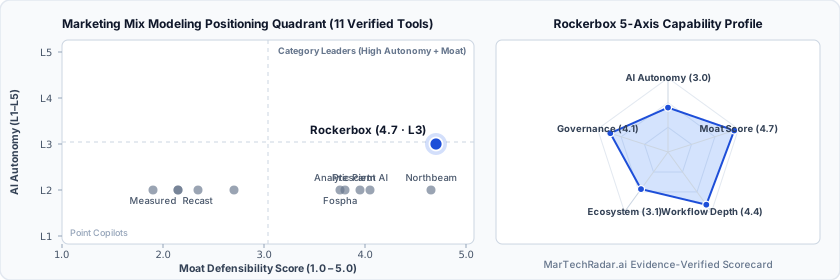
Rockerbox in-depth review, pricing & architecture analysis
Editor sign-off: Oct 15, 2026. How profiles are made.
What is Rockerbox? Overview & background
Growth teams struggle to measure ad ROI when cookies fail and ad networks over-claim conversions. Founded in 2013 and based in New York, United States, Rockerbox solves this problem. It combines multi-touch attribution (MTA), lift tests, and marketing mix models (MMM) on one SOC 2 data platform. Built for growth leads, media buyers, and finance teams, the software links daily ad reports to real business sales across online and offline channels.
How Rockerbox works: architecture & workflow
Rockerbox runs as a Level 3 conditional-autonomy measurement pipeline built on first-party data. The platform pulls web clicks, server events, ad spend logs, and offline orders through webhooks and cloud data warehouses. Its identity graph links buyer touches across channels and feeds both bottom-up MTA and top-down Bayesian MMM engines. Geo-lift and holdout tests tune these models each week so teams can see true sales lift without third-party cookies.
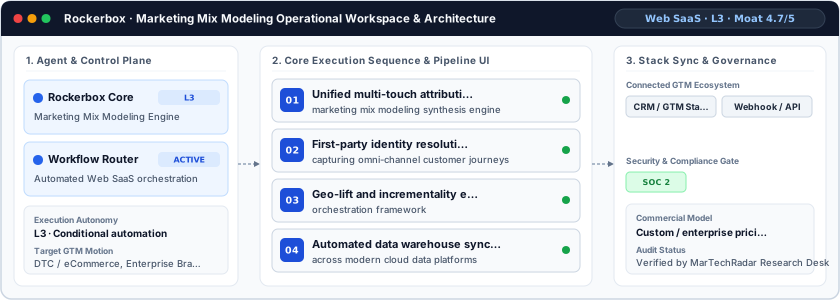
Rockerbox limitations, drawbacks & risks
Operational considerations and platform boundaries include:
- Tag Setup Work: First-time setup requires first-party tracking tags and server event mapping, which takes direct time from data engineers.
- Walled Garden Delays: Ad networks that hide raw impression logs or delay API reports by several days can slow down daily model updates.
- Past Spend History: Mix models need months of steady spend and sales history to set clean baselines, which limits accuracy during sudden budget shifts.
Rockerbox pricing, plans & cost breakdown
Rockerbox does not list public self-serve prices on its site. Pricing is available on request through custom enterprise sales quotes based on annual ad spend, data sources, chosen modules (Data Foundation, MTA, MMM, and Testing), and team seats. Buyers request a demo and custom quote from the Rockerbox sales team.
| Plan / Tier | Verified Price & Billing | Included Scope & Contract Terms |
|---|---|---|
| Enterprise / Custom | Custom quote | Custom-quoted plan; terms come from the vendor's sales team. |
How Rockerbox compares vs. competitors & alternatives
In the marketing measurement space, Rockerbox competes with Northbeam, Triple Whale, and Recast. Recast focuses only on Bayesian MMM without user click tracking, while Triple Whale targets Shopify direct-to-consumer stores. Rockerbox brings user-level MTA, geo-lift testing, and MMM together in one system. It fits mid-market and enterprise brands that need one source of truth for cross-channel ad spend.
Direct competitors & market radar
Top algorithmic competitors based on category positioning, capability overlap, and ICP alignment.
Frequently asked questions about Rockerbox
Does Rockerbox publish pricing or require an enterprise quote?
Rockerbox pricing: Custom / enterprise pricing. No free plan is publicly disclosed. Rockerbox does not list public self-serve prices on its site.
What are the top Rockerbox alternatives in Marketing Mix Modeling?
Verified Marketing Mix Modeling alternatives include Prescient AI (Custom / enterprise pricing), Triple Whale (Custom / enterprise pricing), Northbeam ($1,500–$3,500/mo · Enterprise plan), Recast (Custom / enterprise pricing). In the marketing measurement space, Rockerbox competes with Northbeam, Triple Whale, and Recast. Recast focuses only on Bayesian MMM without user click tracking, while Triple Whale targets Shopify direct-to-consumer stores.
What are the main limitations and trade-offs of Rockerbox?
Operational considerations and platform boundaries include: Tag Setup Work: First-time setup requires first-party tracking tags and server event mapping, which takes direct time from data engineers. Walk away if you need published self-serve pricing: Rockerbox is sold by custom quote.
Verified sources & evidence trail
- Official product domain: https://rockerbox.com
- Commercial pricing verification: Verified against official vendor pricing policy (Custom / enterprise pricing)
- Verified corporate entity profiles (
sameAs): LinkedIn Company Profile - Editor sign-off: Oct 15, 2026 (how profiles are made).
