Triple Whale Review (2026): Marketing Attribution Pricing, Pros & Cons
Bottom line
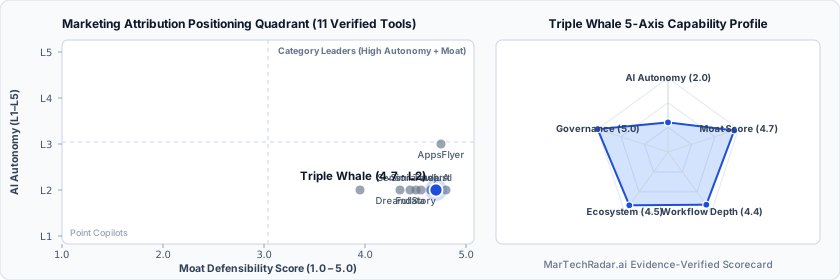
Triple Whale is a Web SaaS tool for Marketing Attribution (Multi-Touch Attribution & eCommerce Dashboards) in Analytics & Attribution. Pricing: Custom / enterprise pricing. Best suited to DTC / eCommerce. Editor ratings: AI autonomy L2 (workflow copilot); moat score 4.7/5.0 (Proprietary moat (category leader)). Fact-checked by MarTechRadar Research Desk on Oct 7, 2026.
Multi-touch attribution and eCommerce analytics platform utilizing server-side tracking to unify ad metrics and store profitability.
Is Triple Whale worth it in 2026? Buyer fit & when to walk away
Choose Triple Whale if (Best Fit)
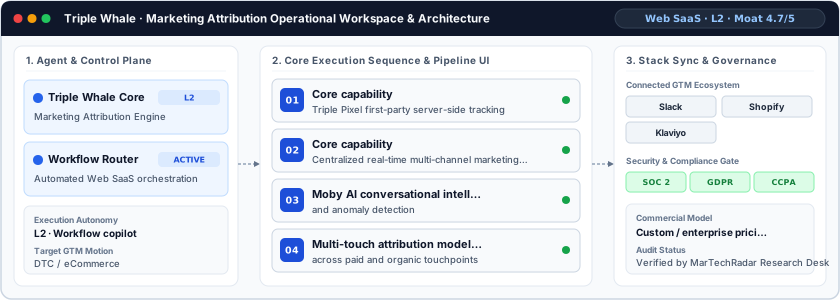
- Target ICP & Stack Fit: You operate as DTC / eCommerce requiring a Web SaaS deployment for Marketing Attribution, with verified ecosystem connectivity for Slack, Shopify, Klaviyo.
- L2 Architecture & Defensibility: First-party data capture through its proprietary Triple Pixel combined with direct connectors to core eCommerce platforms and advertising networks.
- Commercial Model Fit: Your procurement budget aligns with Custom / enterprise pricing.
Walk away from Triple Whale if (Deal-Breakers)
- Walk away if you need published self-serve pricing: Triple Whale is sold by custom quote.
- Walk away if your workflow cannot tolerate shopify-centric setup: Triple Whale works best out of the box on Shopify, while custom headless stores need extra developer setup.
- Walk away if ad API window shifts is a deal-breaker for your team: Delayed orders and ad network API sync windows can still shift trailing ROAS numbers over a 7-to-28-day lookback period.
Triple Whale pricing, free plan & scorecard at a glance
| Pricing | Custom / enterprise pricing |
|---|---|
| Free plan | No / not disclosed |
| Delivery | Web SaaS |
| Audience | DTC / eCommerce |
| AI autonomy level | L2 · Workflow copilotEditor-verified |
| Moat tier & score | 4.7 / 5.0 · Proprietary moat (category leader)Editor-verified |
| Funding | Venture-backed |
| Founders | AJ Orbach, Ivan Chernykh, Maxx Blank |
| Company size | 51-200 employees |
| Ecosystem integrations | Slack, Shopify, Klaviyo |
| Compliance & governance | SOC 2, GDPR, CCPA |
| Governance & docs | Trust & Security ↗ · Changelog ↗ · Terms ↗ · Privacy ↗ |
| Headquarters | Columbus, United States |
| Founded | 2021 |
| Last verified | Oct 7, 2026 |
Triple Whale pros & cons: strengths vs. operational limitations
Pros: core strengths & capabilities
- Core capability: Triple Pixel first-party server-side tracking
- Core capability: Centralized real-time multi-channel marketing dashboard
- Moby AI conversational intelligence and anomaly detection
- Multi-touch attribution modeling: across paid and organic touchpoints
Cons: operational limitations & risks
- Shopify-Centric Setup: Triple Whale works best out of the box on Shopify, while custom headless stores need extra developer setup.
- Ad API Window Shifts: Delayed orders and ad network API sync windows can still shift trailing ROAS numbers over a 7-to-28-day lookback period.
- In-App Browser Gaps: Shoppers moving between private mobile browsers and social apps where UTMs get stripped can still require model estimates.
Triple Whale TCO & deal-breaker stress test
Simulate 12-month stepped TCO, hidden cost multipliers, contract lock-in exposure, and stack failure modes using only facts verified by MarTechRadar Research Desk on 2026-10-07.
Triple Whale triggers high-severity friction under your 5-seat / $800/mo constraints. Benchmark the verified subtrack alternatives below before committing.
- Moat Score
- 4.7 / 5.0
- AI Autonomy
- L2
- Free Tier / Trial
- None disclosed
Triggered audit signals & failure modes
- Opaque Enterprise Quoting vs. SMB/Mid-Market BudgetVerified Pricing Ledger
Triple Whale does not disclose a public self-serve floor (Custom / enterprise pricing). Buyers with a $800/mo cap face high sales-qualification friction.
- Sales-Gated Contract TermsFact-checked by MarTechRadar Research Desk
Triple Whale prices its platform on tiered plans scaled by a brand's yearly gross merchandise value (GMV), alongside custom enterprise quotes. Higher tiers unlock longer historical data storage, Moby AI credits, advanced tracking models, and multi-store rollups.
- Primary Operational Bottleneck: Shopify-Centric SetupAudit by MarTechRadar Research Desk
Triple Whale works best out of the box on Shopify, while custom headless stores need extra developer setup.
Test a custom Triple Whale budget or stack constraint
Lower 5-seat floor (~$13/mo vs. Custom Quote) · Transparent self-serve entry without mandatory annual lock-in
Lower 5-seat floor (~$20/mo vs. Custom Quote)
Triple Whale integrations, API, security & compliance stack
Triple Whale AI moat & Marketing Attribution positioning
First-party data capture through its proprietary Triple Pixel combined with direct connectors to core eCommerce platforms and advertising networks.
Triple Whale in-depth review, pricing & architecture analysis
Editor sign-off: Oct 7, 2026. How profiles are made.
What is Triple Whale? Overview & background
Founded in 2021 and based in Columbus, Ohio, Triple Whale (triplewhale.com) is an e-commerce analytics and ad tracking platform. It serves D2C brand owners, media buyers, and growth leads. Instead of jumping between conflicting ad manager tabs and store reports, merchants use Triple Whale to see the full picture. It brings ad spend, first-party order tracking, and net store profit into one live dashboard.
How Triple Whale works: architecture & workflow
At Level 2 autonomy, Triple Whale uses its server-side first-party Triple Pixel to track shopper journeys across sessions and devices despite browser cookie blocks. The platform matches click IDs, UTM tags, and order records from stores like Shopify against ad APIs from Meta, Google, TikTok, and Klaviyo. Using multi-touch tracking models and Marketing Efficiency Ratio (MER) scores, the system shows which ads truly drive net profit. Teams also ask Moby AI in plain English to spot spend spikes, forecast stock needs, and send automated Slack reports under SOC 2 Type II, GDPR, and CCPA rules.
Triple Whale limitations, drawbacks & risks
Key platform limits and trade-offs include:
- Shopify-Centric Setup: Triple Whale works best out of the box on Shopify, while custom headless stores need extra developer setup.
- Ad API Window Shifts: Delayed orders and ad network API sync windows can still shift trailing ROAS numbers over a 7-to-28-day lookback period.
- In-App Browser Gaps: Shoppers moving between private mobile browsers and social apps where UTMs get stripped can still require model estimates.
Triple Whale pricing, plans & cost breakdown
Triple Whale prices its platform on tiered plans scaled by a brand's yearly gross merchandise value (GMV), alongside custom enterprise quotes. Higher tiers unlock longer historical data storage, Moby AI credits, advanced tracking models, and multi-store rollups.
| Plan / Tier | Verified Price & Billing | Included Scope & Contract Terms |
|---|---|---|
| Enterprise / Custom | Custom quote | Custom-quoted plan; terms come from the vendor's sales team. |
How Triple Whale compares vs. competitors & alternatives
In the e-commerce ad tracking and analytics space, Triple Whale competes with Northbeam, Rockerbox, Elevar, and Polar Analytics. Mobile app trackers like AppsFlyer focus on app installs, while Adverity builds raw data-warehouse pipes. By contrast, Triple Whale is built for D2C e-commerce brands that want fast Shopify profit tracking, server-side pixel data, and Moby AI insights in one app.
Direct competitors & market radar
Top algorithmic competitors based on category positioning, capability overlap, and ICP alignment.
Frequently asked questions about Triple Whale
Does Triple Whale publish pricing or require an enterprise quote?
Triple Whale pricing: Custom / enterprise pricing. No free plan is publicly disclosed. Triple Whale prices its platform on tiered plans scaled by a brand's yearly gross merchandise value (GMV), alongside custom enterprise quotes.
What are the top Triple Whale alternatives in Marketing Attribution?
Verified Marketing Attribution alternatives include Rockerbox (Custom / enterprise pricing), Adverity (Custom / enterprise pricing), Similarweb AI (Custom / enterprise pricing), Polar Analytics (Pricing not disclosed). In the e-commerce ad tracking and analytics space, Triple Whale competes with Northbeam, Rockerbox, Elevar, and Polar Analytics. Mobile app trackers like AppsFlyer focus on app installs, while Adverity builds raw data-warehouse pipes.
What are the main limitations and trade-offs of Triple Whale?
Key platform limits and trade-offs include: Shopify-Centric Setup: Triple Whale works best out of the box on Shopify, while custom headless stores need extra developer setup. Walk away if you need published self-serve pricing: Triple Whale is sold by custom quote.
Verified sources & evidence trail
- Official product domain: https://triplewhale.com
- Commercial pricing verification: Verified against official vendor pricing policy (Custom / enterprise pricing)
- Verified corporate entity profiles (
sameAs): LinkedIn Company Profile · Crunchbase Entity Record - First-party governance & documentation links: Trust & Security · Changelog · Terms · Privacy
- Editor sign-off: Oct 7, 2026 (how profiles are made).
