AppsFlyer Review (2026): Marketing Attribution Pricing, Pros & Cons
Bottom line
AppsFlyer is a API / SDK tool for Marketing Attribution (Multi-Touch Attribution & eCommerce Dashboards) in Analytics & Attribution. Pricing: Usage-based pricing. Best suited to DTC / eCommerce and Enterprise Brands. Editor ratings: AI autonomy L3 (conditional automation); moat score 4.7/5.0 (Proprietary moat (category leader)). Fact-checked by MarTechRadar Research Desk on Oct 11, 2026.
Enterprise cross-platform attribution and marketing analytics cloud providing mobile measurement, deep linking, fraud protection, and LTV modeling.
Is AppsFlyer worth it in 2026? Buyer fit & when to walk away
Choose AppsFlyer if (Best Fit)
- Target ICP & Stack Fit: You operate as DTC / eCommerce and Enterprise Brands requiring a API / SDK deployment for Marketing Attribution.
- L3 Architecture & Defensibility: Deep ecosystem integrations as a certified Mobile Measurement Partner across major ad networks, coupled with extensive historical device graph telemetry and privacy-preserving data clean room infrastructure.
- Commercial Model Fit: Your procurement budget aligns with Usage-based pricing.
Walk away from AppsFlyer if (Deal-Breakers)
- Walk away if you need published self-serve pricing: AppsFlyer is sold by custom quote.
- Walk away if your workflow cannot tolerate privacy framework latency: Aggregated conversion windows dictated by Apple SKAdNetwork introduce delayed postbacks spanning 24 to 72 hours, hindering real-time programmatic bidding feedback.
- Walk away if SDK footprint maintenance is a deal-breaker for your team: Embedding and maintaining cross-platform client-side libraries across iOS, Android, and web demands recurrent engineering overhead during platform OS updates.
AppsFlyer pricing, free plan & scorecard at a glance
| Pricing | Usage-based pricingVendor pricing page |
|---|---|
| Free plan | No / not disclosed |
| Delivery | API / SDK |
| Audience | DTC / eCommerce, Enterprise Brands |
| AI autonomy level | L3 · Conditional automationEditor-verified |
| Moat tier & score | 4.7 / 5.0 · Proprietary moat (category leader)Editor-verified |
| Funding | Venture-backed |
| Total funding | $1.7BBacked by General Atlantic, Salesforce Ventures |
| Founders | Oren Kaniel, Reshef Mann |
| Company size | 1,001-5,000 employees |
| Compliance & governance | SOC 2, GDPR |
| Governance & docs | Trust & Security ↗ · Privacy ↗ |
| Headquarters | San Francisco, CA |
| Founded | 2011 |
| Last verified | Oct 11, 2026 |
AppsFlyer pros & cons: strengths vs. operational limitations
Pros: core strengths & capabilities
- Cross-platform attribution engine spanning: mobile, web, CTV, and console touchpoints
- Deep linking suite supporting: web-to-app, QR, and deferred deep routing
- Privacy-preserving measurement tools configured: for Apple SKAdNetwork and Google Privacy Sandbox
- Data clean room framework: enabling secure partner data collaboration and audience activation
Cons: operational limitations & risks
- Privacy Framework Latency: Aggregated conversion windows dictated by Apple SKAdNetwork introduce delayed postbacks spanning 24 to 72 hours, hindering real-time programmatic bidding feedback.
- SDK Footprint Maintenance: Embedding and maintaining cross-platform client-side libraries across iOS, Android, and web demands recurrent engineering overhead during platform OS updates.
- Data Clean Room Query Complexity: Multi-party computation queries require dedicated data engineering capacity to align differing schemas and overcome differential privacy threshold suppression.
AppsFlyer TCO & deal-breaker stress test
Simulate 12-month stepped TCO, hidden cost multipliers, contract lock-in exposure, and stack failure modes using only facts verified by MarTechRadar Research Desk on 2026-10-11 · Capture SHA 2838e07c.
AppsFlyer triggers high-severity friction under your 5-seat / $800/mo constraints. Benchmark the verified subtrack alternatives below before committing.
- Moat Score
- 4.7 / 5.0
- AI Autonomy
- L3
- Free Tier / Trial
- None disclosed
Triggered audit signals & failure modes
- Opaque Enterprise Quoting vs. SMB/Mid-Market BudgetVerified Pricing Ledger
AppsFlyer does not disclose a public self-serve floor (Usage-based pricing). Buyers with a $800/mo cap face high sales-qualification friction.
- Sales-Gated Contract TermsFact-checked by MarTechRadar Research Desk
Commercial procurement scales on usage tiers linked directly to attribution volume.
- Usage / Credit Burn VolatilityCommercial Model Audit
AppsFlyer uses credit or usage-metered billing (Usage-based pricing). High-volume automated workflows across 5 seats can trigger mid-cycle overage charges.
- Primary Operational Bottleneck: Privacy Framework LatencyAudit by MarTechRadar Research Desk
Aggregated conversion windows dictated by Apple SKAdNetwork introduce delayed postbacks spanning 24 to 72 hours, hindering real-time programmatic bidding feedback.
Test a custom AppsFlyer budget or stack constraint
Lower 5-seat floor (~$24/mo vs. Custom Quote) · Transparent self-serve entry without mandatory annual lock-in
AppsFlyer integrations, API, security & compliance stack
AppsFlyer AI moat & Marketing Attribution positioning
Deep ecosystem integrations as a certified Mobile Measurement Partner across major ad networks, coupled with extensive historical device graph telemetry and privacy-preserving data clean room infrastructure.
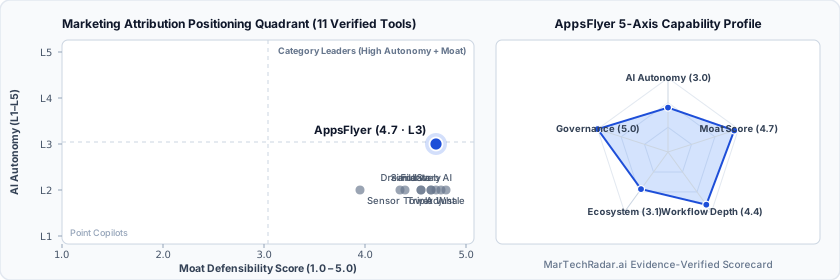
AppsFlyer in-depth review, pricing & architecture analysis
Editor sign-off: Oct 11, 2026. How profiles are made.
What is AppsFlyer? Overview & background
AppsFlyer operates as an attribution and marketing measurement platform engineered to resolve cross-device customer acquisition journeys. Headquartered in San Francisco, CA, and founded in 2011, the company has secured $1.7B in aggregate capital funding. The infrastructure serves enterprise growth leaders, performance marketing directors, and app product managers who require neutral verification of paid media spend across distributed advertising channels.
How AppsFlyer works: architecture & workflow
Operating at an L3 autonomy profile, the platform ingests events via native client SDKs embedded across mobile, web, connected TV, and console applications. Ingestion pipelines normalize raw click and impression telemetry against post-install in-app conversion feeds. Under current privacy architectures, attribution resolution routes deterministically through platform APIs like Apple SKAdNetwork and Google Privacy Sandbox, supplemented by first-party ID graphs and deep linking redirect parameters. Downstream, automated rules process aggregate conversion schemas, calculate incrementality scores, and dispatch real-time postbacks to ad networks under verified SOC 2 and GDPR governance controls.
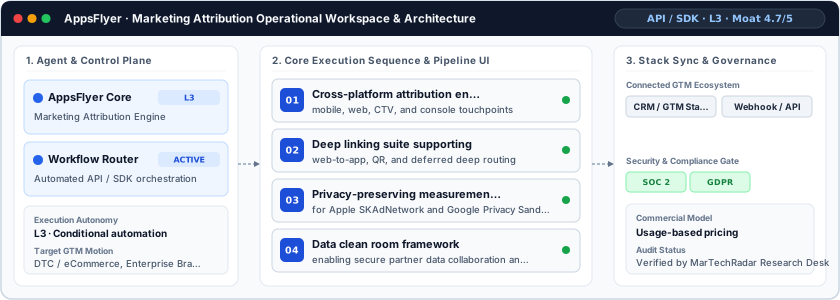
AppsFlyer limitations, drawbacks & risks
Operational considerations and platform boundaries include:
- Privacy Framework Latency: Aggregated conversion windows dictated by Apple SKAdNetwork introduce delayed postbacks spanning 24 to 72 hours, hindering real-time programmatic bidding feedback.
- SDK Footprint Maintenance: Embedding and maintaining cross-platform client-side libraries across iOS, Android, and web demands recurrent engineering overhead during platform OS updates.
- Data Clean Room Query Complexity: Multi-party computation queries require dedicated data engineering capacity to align differing schemas and overcome differential privacy threshold suppression.
AppsFlyer pricing, plans & cost breakdown
Commercial procurement scales on usage tiers linked directly to attribution volume. The platform features usage-metered licensing beginning at rates from $0.07 per active event conversion unit on entry self-serve tiers, while enterprise accounts require negotiated annual commitments based on non-organic install volume, active SDK features, and data clean room processing nodes.
| Plan / Tier | Verified Price & Billing | Included Scope & Contract Terms |
|---|---|---|
| Enterprise / Custom | Custom quote | Custom-quoted plan; terms come from the vendor's sales team. |
How AppsFlyer compares vs. competitors & alternatives
Within multi-touch attribution, AppsFlyer competes against native mobile measurement alternatives like Adjust, as well as broader marketing aggregation systems including Adverity and Coupler.io within the Marketing Attribution segment. While Adverity and Coupler.io emphasize scheduled ELT data pipelining into corporate data warehouses without native device telemetry, Adjust directly rivals AppsFlyer in mobile app ecosystem routing. AppsFlyer differentiates through its dedicated data clean room isolation and consolidated console attribution layers. It remains optimal for global enterprise organizations operating multi-channel mobile and desktop funnels.
Direct competitors & market radar
Top algorithmic competitors based on category positioning, capability overlap, and ICP alignment.
Frequently asked questions about AppsFlyer
How does AppsFlyer usage pricing work in 2026?
AppsFlyer pricing: Usage-based pricing. No free plan is publicly disclosed. Commercial procurement scales on usage tiers linked directly to attribution volume.
What are the top AppsFlyer alternatives in Marketing Attribution?
Verified Marketing Attribution alternatives include Segwise (Custom / enterprise pricing), Coupler.io (Free plan · $24–$199/mo), Adjust (Custom / enterprise pricing), Adverity (Custom / enterprise pricing). Within multi-touch attribution, AppsFlyer competes against native mobile measurement alternatives like Adjust, as well as broader marketing aggregation systems including Adverity and Coupler.io within the Marketing Attribution segment.
What are the main limitations and trade-offs of AppsFlyer?
Operational considerations and platform boundaries include: Privacy Framework Latency: Aggregated conversion windows dictated by Apple SKAdNetwork introduce delayed postbacks spanning 24 to 72 hours, hindering real-time programmatic bidding feedback. Walk away if you need published self-serve pricing: AppsFlyer is sold by custom quote.
Verified sources & evidence trail
- Official product domain: https://appsflyer.com
- Commercial pricing verification: https://www.appsflyer.com/pricing
- Verified corporate entity profiles (
sameAs): LinkedIn Company Profile · Crunchbase Entity Record - First-party governance & documentation links: Trust & Security · Privacy
- Editor sign-off: Oct 11, 2026 (how profiles are made).
