Sensor Tower Review (2026): Marketing Attribution Pricing, Pros & Cons
Bottom line
Sensor Tower is a Web SaaS tool for Marketing Attribution (Multi-Touch Attribution & eCommerce Dashboards) in Analytics & Attribution. Pricing: Custom / enterprise pricing. Best suited to DTC / eCommerce and Enterprise Brands. Editor ratings: AI autonomy L2 (workflow copilot); moat score 4.4/5.0 (Proprietary moat (category leader)). Fact-checked by MarTechRadar Research Desk on Oct 10, 2026.
Sensor Tower provides digital economy intelligence and app analytics, synthesizing mobile app telemetry, digital advertising signals, and audience.
Is Sensor Tower worth it in 2026? Buyer fit & when to walk away
Choose Sensor Tower if (Best Fit)
- Target ICP & Stack Fit: You operate as DTC / eCommerce and Enterprise Brands requiring a Web SaaS deployment for Marketing Attribution, with verified ecosystem connectivity for Twilio Segment, Model Context Protocol (MCP).
- L2 Architecture & Defensibility: Extensive historical app ecosystem telemetry, proprietary statistical estimation models, large-scale consumer panel integrations, and Model Context Protocol (MCP) connectivity for LLM-driven intelligence workflows.
- Commercial Model Fit: Your procurement budget aligns with Custom / enterprise pricing.
Walk away from Sensor Tower if (Deal-Breakers)
- Walk away if you need published self-serve pricing: Sensor Tower is sold by custom quote.
- Walk away if your workflow cannot tolerate statistical estimation divergence: Because competitor download and revenue metrics rely on panel extrapolation rather than deterministic first-party server logs, accuracy varies significantly across low-volume regional niches and smaller publishers.
- Walk away if walled garden creative ingestion is a deal-breaker for your team: Automated ad tracking depends on continuous scraping and panel-observed impressions, which encounter periodic coverage lags when ad platforms modify internal rendering engines or obfuscate tracking tags.
Sensor Tower pricing, free plan & scorecard at a glance
| Pricing | Custom / enterprise pricing |
|---|---|
| Free plan | No / not disclosed |
| Delivery | Web SaaS |
| Audience | DTC / eCommerce, Enterprise Brands |
| AI autonomy level | L2 · Workflow copilotEditor-verified |
| Moat tier & score | 4.4 / 5.0 · Proprietary moat (category leader)Editor-verified |
| Funding | Venture-backed |
| Total funding | $46.0MBacked by Riverwood Capital |
| Founders | Alex Malafeev, Oliver Yeh |
| Company size | 501-1,000 employees |
| Ecosystem integrations | Twilio Segment, Model Context Protocol (MCP) |
| Governance & docs | Trust & Security ↗ · Terms ↗ · Privacy ↗ |
| Headquarters | San Francisco, California |
| Founded | 2013 |
| Last verified | Oct 10, 2026 |
Sensor Tower pros & cons: strengths vs. operational limitations
Pros: core strengths & capabilities
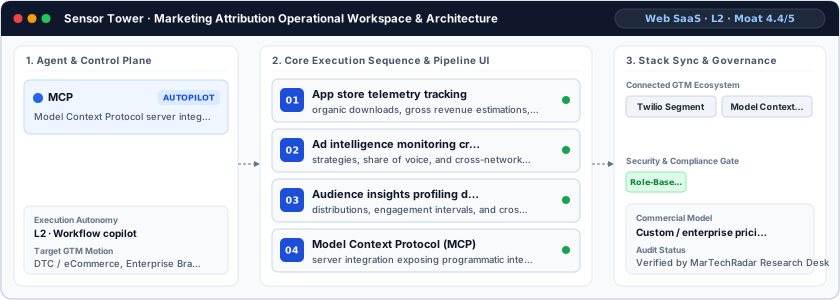
- App store telemetry tracking: organic downloads, gross revenue estimations, and search keyword trends
- Ad intelligence monitoring creative: strategies, share of voice, and cross-network spend allocation
- Audience insights profiling demographic: distributions, engagement intervals, and cross-app usage overlap
- Model Context Protocol (MCP): server integration exposing programmatic intelligence to enterprise agentic workflows
Cons: operational limitations & risks
- Statistical Estimation Divergence: Because competitor download and revenue metrics rely on panel extrapolation rather than deterministic first-party server logs, accuracy varies significantly across low-volume regional niches and smaller publishers.
- Walled Garden Creative Ingestion: Automated ad tracking depends on continuous scraping and panel-observed impressions, which encounter periodic coverage lags when ad platforms modify internal rendering engines or obfuscate tracking tags.
- API Rate Throttling: High-volume data warehousing synchronization frequently triggers strict throughput quotas, requiring data engineers to build client-side backoff pipelines and batch caching layers for enterprise downstream analytics.
Sensor Tower TCO & deal-breaker stress test
Simulate 12-month stepped TCO, hidden cost multipliers, contract lock-in exposure, and stack failure modes using only facts verified by MarTechRadar Research Desk on 2026-10-10.
Sensor Tower triggers high-severity friction under your 5-seat / $800/mo constraints. Benchmark the verified subtrack alternatives below before committing.
- Moat Score
- 4.4 / 5.0
- AI Autonomy
- L2
- Free Tier / Trial
- None disclosed
Triggered audit signals & failure modes
- Opaque Enterprise Quoting vs. SMB/Mid-Market BudgetVerified Pricing Ledger
Sensor Tower does not disclose a public self-serve floor (Custom / enterprise pricing). Buyers with a $800/mo cap face high sales-qualification friction.
- Sales-Gated Contract TermsFact-checked by MarTechRadar Research Desk
Commercial pricing is available on request through tailored enterprise sales quotes based on organizational scale and seats.
- Primary Operational Bottleneck: Statistical Estimation DivergenceAudit by MarTechRadar Research Desk
Because competitor download and revenue metrics rely on panel extrapolation rather than deterministic first-party server logs, accuracy varies significantly across low-volume regional niches and smaller publishers.
Test a custom Sensor Tower budget or stack constraint
Lower 5-seat floor (~$44/mo vs. Custom Quote) · Transparent self-serve entry without mandatory annual lock-in
Offers a free tier (Custom / enterprise pricing) · Transparent self-serve entry without mandatory annual lock-in
Sensor Tower integrations, API, security & compliance stack
Model Context Protocol server integration exposing programmatic intelligence to enterprise agentic workflows
Sensor Tower AI moat & Marketing Attribution positioning
Extensive historical app ecosystem telemetry, proprietary statistical estimation models, large-scale consumer panel integrations, and Model Context Protocol (MCP) connectivity for LLM-driven intelligence workflows.
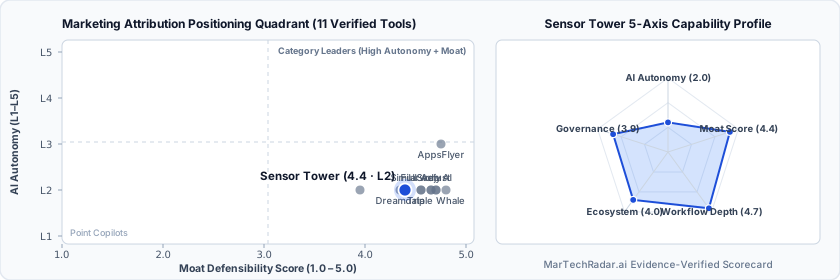
Sensor Tower in-depth review, pricing & architecture analysis
Editor sign-off: Oct 10, 2026. How profiles are made.
What is Sensor Tower? Overview & background
Architected around cross-platform mobile telemetry and digital market intelligence, Sensor Tower delivers competitive performance data across mobile application ecosystems, digital advertising networks, and web channels. Established in 2013 in San Francisco, California, the company has secured $46.0M in equity financing to advance its data infrastructure. The platform is targeted at digital analytics directors, performance marketing leaders, and enterprise product strategists who require comparative market share visibility and granular app store economics beyond self-reported attribution metrics.
How Sensor Tower works: architecture & workflow
Sensor Tower combines data pipelines ingesting public app store metadata, SDK telemetry, digital advertising feeds, and proprietary consumer panels. These disparate inputs feed statistical modeling pipelines that extrapolate competitive revenue estimates, net downloads, and impression share across global markets. The technical framework incorporates a Model Context Protocol server, enabling enterprise LLM clients to programmatically query mobile performance datasets. The processing engine reconciles complex cross-channel signals into structured views, automating cohort sizing and competitor baseline scoring without direct access to third-party internal data lakes.
Sensor Tower limitations, drawbacks & risks
Operational considerations and platform boundaries include:
- Statistical Estimation Divergence: Because competitor download and revenue metrics rely on panel extrapolation rather than deterministic first-party server logs, accuracy varies significantly across low-volume regional niches and smaller publishers.
- Walled Garden Creative Ingestion: Automated ad tracking depends on continuous scraping and panel-observed impressions, which encounter periodic coverage lags when ad platforms modify internal rendering engines or obfuscate tracking tags.
- API Rate Throttling: High-volume data warehousing synchronization frequently triggers strict throughput quotas, requiring data engineers to build client-side backoff pipelines and batch caching layers for enterprise downstream analytics.
Sensor Tower pricing, plans & cost breakdown
Commercial pricing is available on request through tailored enterprise sales quotes based on organizational scale and seats. Contracts operate on custom annual software-as-a-service subscriptions scaled according to modular platform access, including specific vertical coverage, geographical data packages, API call volume thresholds, and seat quotas.
| Plan / Tier | Verified Price & Billing | Included Scope & Contract Terms |
|---|---|---|
| Enterprise / Custom | Custom quote | Custom-quoted plan; terms come from the vendor's sales team. |
How Sensor Tower compares vs. competitors & alternatives
While deterministic mobile measurement partners like AppsFlyer and Adjust rely on device-level SDKs to measure direct-response conversion funnels, Sensor Tower focuses on external competitive intelligence and market-level extrapolation within the Marketing Attribution segment, and is frequently benchmarked by buyers against Similarweb AI. Adverity centers on unifying enterprise data warehouses via extract-transform-load connectors, whereas Sensor Tower supplies pre-modeled benchmark datasets directly. The platform provides the highest return for enterprise brand strategists and app publishers needing competitive visibility into external industry trends, category shifts, and peer monetization benchmarks.
Direct competitors & market radar
Top algorithmic competitors based on category positioning, capability overlap, and ICP alignment.
Frequently asked questions about Sensor Tower
Does Sensor Tower publish pricing or require an enterprise quote?
Sensor Tower pricing: Custom / enterprise pricing. No free plan is publicly disclosed. Commercial pricing is available on request through tailored enterprise sales quotes based on organizational scale and seats.
What are the top Sensor Tower alternatives in Marketing Attribution?
Verified Marketing Attribution alternatives include Similarweb AI (Custom / enterprise pricing), Adverity (Custom / enterprise pricing), Segwise (Custom / enterprise pricing), Triple Whale (Custom / enterprise pricing). While deterministic mobile measurement partners like AppsFlyer and Adjust rely on device-level SDKs to measure direct-response conversion funnels, Sensor Tower focuses on external competitive intelligence and market-level extrapolation within the Marketing Attribution segment, and is frequently benchmarked by buyers against Similarweb AI.
What are the main limitations and trade-offs of Sensor Tower?
Operational considerations and platform boundaries include: Statistical Estimation Divergence: Because competitor download and revenue metrics rely on panel extrapolation rather than deterministic first-party server logs, accuracy varies significantly across low-volume regional niches and smaller publishers. Walk away if you need published self-serve pricing: Sensor Tower is sold by custom quote.
Verified sources & evidence trail
- Official product domain: https://sensortower.com
- Commercial pricing verification: Verified against official vendor pricing policy (Custom / enterprise pricing)
- Verified corporate entity profiles (
sameAs): LinkedIn Company Profile · Crunchbase Entity Record - First-party governance & documentation links: Trust & Security · Terms · Privacy
- Editor sign-off: Oct 10, 2026 (how profiles are made).
