FullStory Review (2026): Marketing Attribution Pricing, Pros & Cons
Bottom line
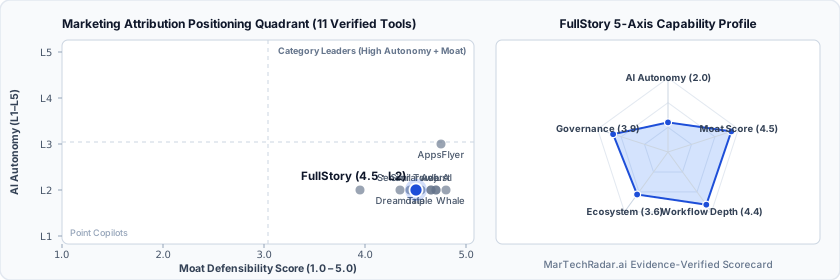
FullStory is a Web SaaS tool for Marketing Attribution (Multi-Touch Attribution & eCommerce Dashboards) in Analytics & Attribution. Pricing: Custom / enterprise pricing. Best suited to B2B SaaS, DTC / eCommerce and Enterprise Brands. Editor ratings: AI autonomy L2 (workflow copilot); moat score 4.5/5.0 (Proprietary moat (category leader)). Fact-checked by MarTechRadar Research Desk on Oct 11, 2026.
Behavioral analytics and digital experience intelligence platform utilizing tagless autocapture, retroactive indexing, and session replay to diagnose.
Is FullStory worth it in 2026? Buyer fit & when to walk away
Choose FullStory if (Best Fit)
- Target ICP & Stack Fit: You operate as B2B SaaS, DTC / eCommerce and Enterprise Brands requiring a Web SaaS deployment for Marketing Attribution, with verified ecosystem connectivity for Twilio Segment.
- L2 Architecture & Defensibility: Patented tagless autocapture paired with retroactive behavioral indexing and robust client-side PII masking infrastructure provides high data fidelity without manual event instrumentation.
- Commercial Model Fit: Your procurement budget aligns with Custom / enterprise pricing.
Walk away from FullStory if (Deal-Breakers)
- Walk away if you need published self-serve pricing: FullStory is sold by custom quote.
- Walk away if your workflow cannot tolerate client-side overhead: High-frequency DOM mutations and canvas-heavy Single Page Applications can induce CPU overhead and increase main-thread blocking times during aggressive recording sessions.
- Walk away if pii whitelisting maintenance is a deal-breaker for your team: Dynamic UI shifts and continuously updated component libraries demand recurring governance audits to ensure private user data is not leaked into session captures.
FullStory pricing, free plan & scorecard at a glance
| Pricing | Custom / enterprise pricing |
|---|---|
| Free plan | No / not disclosed |
| Delivery | Web SaaS |
| Audience | B2B SaaS, DTC / eCommerce, Enterprise Brands |
| AI autonomy level | L2 · Workflow copilotEditor-verified |
| Moat tier & score | 4.5 / 5.0 · Proprietary moat (category leader)Editor-verified |
| Funding | Series C+ |
| Total funding | $197.2MBacked by Permira, Kleiner Perkins |
| Founders | Bruce Johnson, Joel Webber, Scott Voigt |
| Company size | 501-1,000 employees |
| Ecosystem integrations | Twilio Segment |
| Governance & docs | API & Docs ↗ · Privacy ↗ |
| Headquarters | Atlanta, Georgia |
| Founded | 2014 |
| Last verified | Oct 11, 2026 |
FullStory pros & cons: strengths vs. operational limitations
Pros: core strengths & capabilities
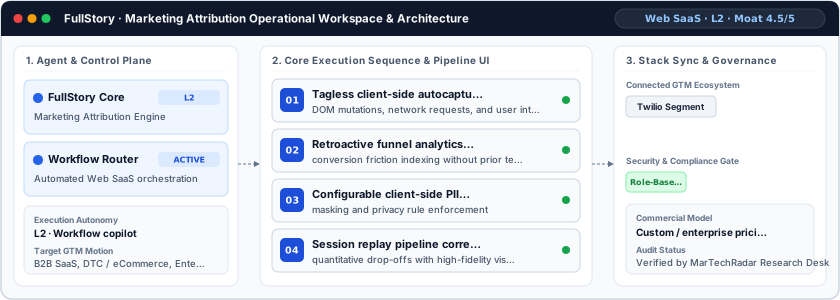
- Tagless client-side autocapture recording: DOM mutations, network requests, and user interactions
- Retroactive funnel analytics and conversion friction indexing without prior telemetry tagging
- Configurable client-side PII data: masking and privacy rule enforcement
- Session replay pipeline correlating: quantitative drop-offs with high-fidelity visual interaction logs
Cons: operational limitations & risks
- Client-Side Overhead: High-frequency DOM mutations and canvas-heavy Single Page Applications can induce CPU overhead and increase main-thread blocking times during aggressive recording sessions.
- PII Whitelisting Maintenance: Dynamic UI shifts and continuously updated component libraries demand recurring governance audits to ensure private user data is not leaked into session captures.
- Attribution Boundary Limitations: The system lacks native multi-touch algorithmic ad spend attribution, requiring data warehouse extraction to merge session engagement with external marketing acquisition touchpoints.
FullStory TCO & deal-breaker stress test
Simulate 12-month stepped TCO, hidden cost multipliers, contract lock-in exposure, and stack failure modes using only facts verified by MarTechRadar Research Desk on 2026-10-11.
FullStory triggers high-severity friction under your 5-seat / $800/mo constraints. Benchmark the verified subtrack alternatives below before committing.
- Moat Score
- 4.5 / 5.0
- AI Autonomy
- L2
- Free Tier / Trial
- None disclosed
Triggered audit signals & failure modes
- Opaque Enterprise Quoting vs. SMB/Mid-Market BudgetVerified Pricing Ledger
FullStory does not disclose a public self-serve floor (Custom / enterprise pricing). Buyers with a $800/mo cap face high sales-qualification friction.
- Sales-Gated Contract TermsFact-checked by MarTechRadar Research Desk
FullStory operates under an enterprise licensing structure where commercial pricing is available on request through tailored enterprise sales quotes based on organizational scale and seats.
- Primary Operational Bottleneck: Client-Side OverheadAudit by MarTechRadar Research Desk
High-frequency DOM mutations and canvas-heavy Single Page Applications can induce CPU overhead and increase main-thread blocking times during aggressive recording sessions.
Test a custom FullStory budget or stack constraint
Lower 5-seat floor (~$44/mo vs. Custom Quote) · Transparent self-serve entry without mandatory annual lock-in
Transparent self-serve entry without mandatory annual lock-in
FullStory integrations, API, security & compliance stack
FullStory AI moat & Marketing Attribution positioning
Patented tagless autocapture paired with retroactive behavioral indexing and robust client-side PII masking infrastructure provides high data fidelity without manual event instrumentation.
FullStory in-depth review, pricing & architecture analysis
Editor sign-off: Oct 11, 2026. How profiles are made.
What is FullStory? Overview & background
Architected around tagless client-side autocapture rather than manual telemetry schemas, FullStory was founded in 2014 in Atlanta, Georgia, and has secured $197.2M in total funding. The platform provides behavioral analytics and digital experience intelligence for digital product managers, UX engineers, and eCommerce optimization leaders seeking granular visibility into customer paths. By recording interactions without requiring upfront instrumentation, the system provides retrospective behavioral auditing across web and native mobile properties.
How FullStory works: architecture & workflow
At its architectural core, FullStory deploys a lightweight browser and mobile SDK that captures client-side events via DOM mutation observers and touch listeners. Instead of relying on pre-configured event tracking tags, the ingestion pipeline serializes UI states, clicks, scrolls, and network payloads into an event stream, stripping sensitive PII via client-side masking rules before transmission. In the ingestion cluster, these interaction streams are indexed into a columnar datastore, enabling retroactive query analysis where teams can define funnels and calculate friction scores across historical interaction data without redeploying code under verified GDPR and CCPA governance controls.
FullStory limitations, drawbacks & risks
Operational considerations and platform boundaries include:
- Client-Side Overhead: High-frequency DOM mutations and canvas-heavy Single Page Applications can induce CPU overhead and increase main-thread blocking times during aggressive recording sessions.
- PII Whitelisting Maintenance: Dynamic UI shifts and continuously updated component libraries demand recurring governance audits to ensure private user data is not leaked into session captures.
- Attribution Boundary Limitations: The system lacks native multi-touch algorithmic ad spend attribution, requiring data warehouse extraction to merge session engagement with external marketing acquisition touchpoints.
FullStory pricing, plans & cost breakdown
FullStory operates under an enterprise licensing structure where commercial pricing is available on request through tailored enterprise sales quotes based on organizational scale and seats. Contracts are scaled according to recorded monthly session volume, retained historical event windows, and provisioned analytical seat tiers, complemented by premium add-ons for mobile SDK coverage and enterprise data warehouse sync connectors.
| Plan / Tier | Verified Price & Billing | Included Scope & Contract Terms |
|---|---|---|
| Enterprise / Custom | Custom quote | Custom-quoted plan; terms come from the vendor's sales team. |
How FullStory compares vs. competitors & alternatives
While mobile attribution platforms like AppsFlyer and Adjust specialize in deterministic mobile install attribution and deterministic SKAdNetwork aggregate reporting, and Adverity focuses on automated multi-channel marketing data transformation, FullStory operates entirely within post-click behavioral analytics within the Marketing Attribution segment. It sacrifices cross-channel advertising spend ingestion in favor of deep qualitative session replay and conversion funnel diagnostics, making it optimal for enterprise eCommerce organizations needing to resolve application friction rather than mobile ad attribution.
Direct competitors & market radar
Top algorithmic competitors based on category positioning, capability overlap, and ICP alignment.
Frequently asked questions about FullStory
Does FullStory publish pricing or require an enterprise quote?
FullStory pricing: Custom / enterprise pricing. No free plan is publicly disclosed. FullStory operates under an enterprise licensing structure where commercial pricing is available on request through tailored enterprise sales quotes based on organizational scale and seats.
What are the top FullStory alternatives in Marketing Attribution?
Verified Marketing Attribution alternatives include Contentsquare (€39–€79/mo), Conversion Maker (Custom / enterprise pricing), Adjust (Custom / enterprise pricing), Adverity (Custom / enterprise pricing). While mobile attribution platforms like AppsFlyer and Adjust specialize in deterministic mobile install attribution and deterministic SKAdNetwork aggregate reporting, and Adverity focuses on automated multi-channel marketing data transformation, FullStory operates entirely within post-click behavioral analytics within the Marketing Attribution segment.
What are the main limitations and trade-offs of FullStory?
Operational considerations and platform boundaries include: Client-Side Overhead: High-frequency DOM mutations and canvas-heavy Single Page Applications can induce CPU overhead and increase main-thread blocking times during aggressive recording sessions. Walk away if you need published self-serve pricing: FullStory is sold by custom quote.
Verified sources & evidence trail
- Official product domain: https://fullstory.com
- Commercial pricing verification: Verified against official vendor pricing policy (Custom / enterprise pricing)
- Verified corporate entity profiles (
sameAs): LinkedIn Company Profile · Crunchbase Entity Record - First-party governance & documentation links: API & Docs · Privacy
- Editor sign-off: Oct 11, 2026 (how profiles are made).
