Haus Review (2026): Marketing Mix Modeling Pricing, Limits & Alternatives
Bottom line
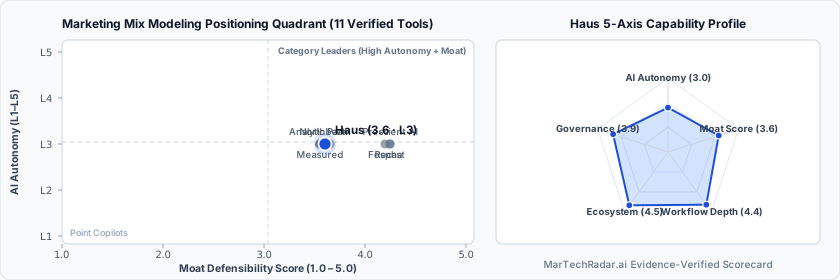
Haus is a Web SaaS tool for Marketing Mix Modeling (Marketing Mix Modeling & Incremental Lift) in Analytics & Attribution. Pricing: Pricing not disclosed. Best suited to B2B SaaS and Growth Teams. Editor ratings: AI autonomy L3 (conditional automation); moat score 3.6/5.0 (Proprietary moat). Fact-checked by Jagmeet Sine on Oct 16, 2026.
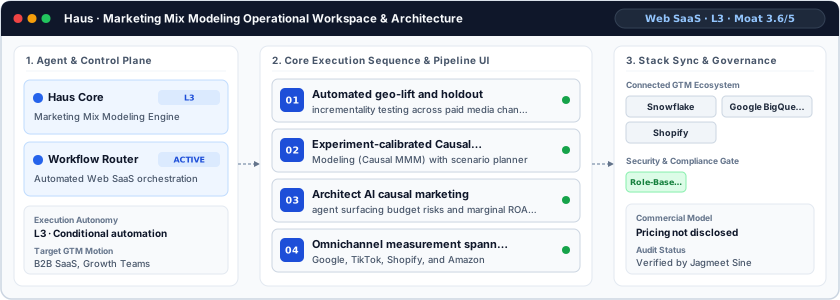
Causal marketing intelligence platform combining geo-lift incrementality experiments, Causal MMM, and an AI media optimization agent.
Haus buyer fit verdict: when to choose vs. when to walk away
Choose Haus if (Best Fit)
- Target ICP & Stack Fit: You operate as B2B SaaS and Growth Teams requiring a Web SaaS deployment for Marketing Mix Modeling, with verified ecosystem connectivity for Snowflake, Google BigQuery, Shopify.
- L3 Architecture & Defensibility: Anchoring Bayesian marketing mix models directly to empirical geo-holdout lift experiments creates a proprietary causal truth dataset that observational attribution tools cannot easily replicate.
- Commercial Model Fit: Your procurement budget aligns with Pricing not disclosed.
Walk away from Haus if (Deal-Breakers)
- Walk away if you require transparent self-serve monthly billing or your budget ceiling is under $1,000/mo (Haus requires sales-gated custom quoting).
- Walk away if your workflow cannot tolerate holdout opportunity cost trade-off: A fundamental methodological trade-off is that executing statistically valid geo-holdout tests requires temporarily withholding paid media in control regions, creating internal friction during peak seasonal promotions.
- Walk away if low-spend statistical power limitation is a deal-breaker for your team: Brands with modest monthly ad budgets or concentrated single-region footprints face a cold start limitation, as the model struggles with insufficient geographic variance to detect small lift effects.
Haus key facts & scorecard
| Pricing | Pricing not disclosed |
|---|---|
| Free plan | No / not disclosed |
| Delivery | Web SaaS |
| Audience | B2B SaaS, Growth Teams |
| AI autonomy level | L3 · Conditional automationEditor-verified |
| Moat tier & score | 3.6 / 5.0 · Proprietary moatEditor-verified |
| Funding | Series B |
| Total funding | $61.1M |
| Founders | Zach Epstein |
| Company size | 201-500 employees |
| Ecosystem integrations | Snowflake, Google BigQuery, Shopify |
| Governance & docs | Trust & Security ↗ · Terms ↗ · Privacy ↗ |
| Headquarters | San Francisco, CA |
| Founded | 2021 |
| Last verified |
Haus pros & cons: strengths vs. operational limitations
Pros: core strengths & capabilities
- Automated geo-lift and holdout: incrementality testing across paid media channels
- Experiment-calibrated Causal Marketing Mix: Modeling (Causal MMM) with scenario planner
- Architect AI causal marketing: agent surfacing budget risks and marginal ROAS actions
- Omnichannel measurement spanning Meta,: Google, TikTok, Shopify, and Amazon
Cons: operational limitations & risks
- Holdout Opportunity Cost Trade-Off: A fundamental methodological trade-off is that executing statistically valid geo-holdout tests requires temporarily withholding paid media in control regions, creating internal friction during peak seasonal promotions.
- Low-Spend Statistical Power Limitation: Brands with modest monthly ad budgets or concentrated single-region footprints face a cold start limitation, as the model struggles with insufficient geographic variance to detect small lift effects.
- Enterprise Procurement Governance Barrier: Because commercial access requires custom scoping and historical warehouse data onboarding, smaller growth teams encounter a learning curve and onboarding latency compared to plug-and-play pixel trackers.
Haus TCO & deal-breaker stress test
Simulate 12-month stepped TCO, hidden cost multipliers, contract lock-in exposure, and stack failure modes using only facts verified by Jagmeet Sine on · Capture SHA e2f5d71c.
Haus triggers high-severity friction under your 5-seat / $800/mo constraints. Benchmark the verified subtrack alternatives below before committing.
| Plan / Tier | Verified Rate | Scale Fit | Scope & Quota Notes |
|---|---|---|---|
| Enterprise / Custom | Custom quote | 15–50+ seats (Enterprise SLA) | Sales-negotiated annual contract for custom volume, SSO/RBAC governance, and dedicated SLA. |
- Moat Score
- 3.6 / 5.0
- AI Autonomy
- L3
- Free Tier / Trial
- None disclosed
Triggered audit signals & failure modes
- Opaque Enterprise Quoting vs. SMB/Mid-Market BudgetVerified Pricing Ledger
Haus does not disclose a public self-serve floor (Pricing not disclosed). Buyers with a $800/mo cap face high sales-qualification friction.
- Sales-Gated Contract TermsFact-checked by Jagmeet Sine
Pricing is available on request through enterprise sales quotes, with customized tiers based on seat counts or usage volume.
- Primary Operational Bottleneck: Holdout Opportunity Cost Trade-OffAudit by Jagmeet Sine
A fundamental methodological trade-off is that executing statistically valid geo-holdout tests requires temporarily withholding paid media in control regions, creating internal friction during peak seasonal promotions.
Hidden TCO Multipliers & Quota Gates
- Enterprise Governance & Add-On Gating: Advanced capabilities such as Single Sign-On (SSO), custom role permissions, or specialized analytics modules are gated behind upper tiers or paid add-ons.
- Holdout Opportunity Cost Trade-Off: A fundamental methodological trade-off is that executing statistically valid geo-holdout tests requires temporarily withholding paid media in control regions, creating internal friction during peak seasonal promotions.
- Low-Spend Statistical Power Limitation: Brands with modest monthly ad budgets or concentrated single-region footprints face a cold start limitation, as the model struggles with insufficient geographic variance to detect small lift effects.
When to Walk Away & Negotiation Levers
- Walk away if you require transparent self-serve monthly billing or your budget ceiling is under $1,000/mo (Haus requires sales-gated custom quoting).
- Walk away if your workflow cannot tolerate holdout opportunity cost trade-off: A fundamental methodological trade-off is that executing statistically valid geo-holdout tests requires temporarily withholding paid media in control regions, creating internal friction during peak seasonal promotions.
- Walk away if low-spend statistical power limitation is a deal-breaker for your team: Brands with modest monthly ad budgets or concentrated single-region footprints face a cold start limitation, as the model struggles with insufficient geographic variance to detect small lift effects.
- Demand a 30- to 60-day paid pilot opt-out clause in the Haus order form before signing a 12-month enterprise commitment.
- Require a sandbox proof-of-concept testing holdout opportunity cost trade-off against your live CRM/data schema before annual sign-off.
Ask a custom procurement or TCO stress-test question about Haus
Lower 5-seat floor (~$125/mo vs. Custom Quote)
Verified Marketing Mix Modeling peer (Custom / enterprise pricing · Moat 4.2/5.0)
Haus key entities, modules & ecosystem stack
Haus moat & subtrack positioning
Anchoring Bayesian marketing mix models directly to empirical geo-holdout lift experiments creates a proprietary causal truth dataset that observational attribution tools cannot easily replicate.
Editorial review
Fact-checked by Jagmeet Sine (Senior MarTech Infrastructure & Agentic Workflow Architect) on .
Background
Founded in 2021 by former Google economist Zach Epstein and headquartered in San Francisco, CA (with operations in Mountain View, California), Haus is a causal marketing intelligence and incrementality measurement platform built for chief marketing officers, VP-level growth leads, and marketing science teams. Backed by $61.1M in total funding across Series B financing from Insight Partners, BoxGroup, Haystack, MANTIS Venture Capital, and 01 Advisors, the 201-to-500-employee organization addresses the collapse of cookie-based multi-touch tracking. Haus enables consumer and enterprise brands to measure true incremental return on ad spend by automating controlled geographic holdout experiments and using those empirical ground-truth results to calibrate continuous media mix models.
How Haus works
Haus operates at Level 3 autonomy through its Causal Intelligence (cAI) architecture. The platform ingests commerce, retail, and ad spend telemetry from Shopify, Amazon, cloud data warehouses (Snowflake, BigQuery), and major paid media networks including Meta, Google, YouTube, and TikTok. Its econometric engine designs power-calculated geo-lift experiments, partitions statistically matched treatment and control Designated Market Areas (DMAs), and calculates true incremental lift across online and offline channels. These experimental priors continuously calibrate Haus's Causal MMM and its Architect AI agent, which runs counterfactual budget simulations to surface diminishing marginal returns and reallocation actions.
Limitations
Operational limitations and technical trade-offs include:
- Holdout Opportunity Cost Trade-Off: A fundamental methodological trade-off is that executing statistically valid geo-holdout tests requires temporarily withholding paid media in control regions, creating internal friction during peak seasonal promotions.
- Low-Spend Statistical Power Limitation: Brands with modest monthly ad budgets or concentrated single-region footprints face a cold start limitation, as the model struggles with insufficient geographic variance to detect small lift effects.
- Enterprise Procurement Governance Barrier: Because commercial access requires custom scoping and historical warehouse data onboarding, smaller growth teams encounter a learning curve and onboarding latency compared to plug-and-play pixel trackers.
Haus pricing
Pricing is available on request through enterprise sales quotes, with customized tiers based on seat counts or usage volume. Haus structures its commercial engagements around four tailored packages—Basics for Shopify, Core, Plus, and Enterprise—aligned to a brand's annual media spend and channel complexity, bundling dedicated marketing science support, cloud warehouse connectors, and access to the Architect causal AI agent.
How Haus compares
Within the Marketing Mix Modeling & Incremental Lift category, Haus competes against modern econometric and attribution platforms such as Recast, Prescient AI, and Fospha. While observational MMM vendors rely primarily on historical regression priors without active holdout validation, Haus differentiates itself by anchoring its Bayesian models directly to recurring geo-lift experiments. Omnichannel brands spending heavily across Meta, TikTok, and retail marketplaces adopt Haus for board-level incrementality verification, whereas early-stage Shopify stores with limited spend typically rely on lighter pixel-blended attribution dashboards.
Frequently asked questions about Haus
How much does Haus cost and does it require a custom enterprise quote?
Published pricing summary for Haus: Pricing not disclosed. A permanent free plan is not disclosed for Haus. Pricing is available on request through enterprise sales quotes, with customized tiers based on seat counts or usage volume.
How does Haus work and how autonomous is its AI architecture?
Causal marketing intelligence platform combining geo-lift incrementality experiments, Causal MMM, and an AI media optimization agent. Within Marketing Mix Modeling (Marketing Mix Modeling & Incremental Lift), MarTechRadar rates its execution architecture at L3 · Conditional automation with a verified Moat Score of 3.6 / 5.0 (Proprietary moat). Anchoring Bayesian marketing mix models directly to empirical geo-holdout lift experiments creates a proprietary causal truth dataset that observational attribution tools cannot easily replicate. Corporate profile: Founded by Zach Epstein, operating at 201-500 employees scale.
What are the main limitations of Haus and when should buyers walk away?
Based on our editorial technical audit, key operational considerations and boundaries for Haus include: (1) Holdout Opportunity Cost Trade-Off: A fundamental methodological trade-off is that executing statistically valid geo-holdout tests requires temporarily withholding paid media in control regions, creating internal friction during peak seasonal promotions. (2) Low-Spend Statistical Power Limitation: Brands with modest monthly ad budgets or concentrated single-region footprints face a cold start limitation, as the model struggles with insufficient geographic variance to detect small lift effects. (3) Enterprise Procurement Governance Barrier: Because commercial access requires custom scoping and historical warehouse data onboarding, smaller growth teams encounter a learning curve and onboarding latency compared to plug-and-play pixel trackers. Primary procurement walk-away rule: Walk away if you require transparent self-serve monthly billing or your budget ceiling is under $1,000/mo (Haus requires sales-gated custom quoting).
What integrations, compliance certifications, and contract terms apply to Haus?
Verified ecosystem and stack integrations include Snowflake, Google BigQuery, Shopify. First-party governance and developer endpoints verified on domain include: Trust/Security (https://trust.haus.io). Key TCO multiplier to watch: Enterprise Governance & Add-On Gating (Advanced capabilities such as Single Sign-On (SSO), custom role permissions, or specialized analytics modules are gated behind upper tiers or paid add-ons.) Before signing a contract, procurement teams should demand a 30- to 60-day paid pilot opt-out clause in the Haus order form before signing a 12-month enterprise commitment.
What are the best Haus alternatives and head-to-head competitors in 2026?
Top fact-checked alternatives to Haus in Marketing Mix Modeling (Marketing Mix Modeling & Incremental Lift) include Recast (Custom / enterprise pricing), Analytic Partners (Custom / enterprise pricing), Scout (Pricing not disclosed), Voyantis (Custom / enterprise pricing). Within the Marketing Mix Modeling & Incremental Lift category, Haus competes against modern econometric and attribution platforms such as Recast, Prescient AI, and Fospha.
Verified sources & evidence trail
- Official product domain: https://haus.io
- Commercial pricing verification: Verified against official vendor pricing policy (Pricing not disclosed)
- Verified corporate entity profiles (
sameAs): LinkedIn Company Profile · Crunchbase Entity Record - First-party governance & documentation links: Trust & Security · Terms · Privacy
- Editorial audit sign-off: Fact-checked by Jagmeet Sine on under the MarTechRadar Evidence-Ledger Protocol.