Fospha Review (2026): Marketing Mix Modeling Pricing, Pros & Cons
Bottom line
Fospha is a Web SaaS tool for Marketing Mix Modeling (Marketing Mix Modeling & Incremental Lift) in Analytics & Attribution. Pricing: From $1,500/yr. Best suited to DTC / eCommerce. Editor ratings: AI autonomy L2 (workflow copilot); moat score 3.7/5.0 (Proprietary moat). Fact-checked by MarTechRadar Research Desk on Oct 11, 2026.
Marketing measurement and attribution platform combining first-party server-side tracking with marketing mix modeling for direct-to-consumer and retail.
Is Fospha worth it in 2026? Buyer fit & when to walk away
Choose Fospha if (Best Fit)
- Target ICP & Stack Fit: You operate as DTC / eCommerce requiring a Web SaaS deployment for Marketing Mix Modeling, with verified ecosystem connectivity for Salesforce, Shopify, Webflow, Google Analytics 4 (GA4).
- L2 Architecture & Defensibility: Fospha leverages tenured first-party data pipelines paired with retail-specific Bayesian attribution frameworks that reconcile impression-level media spend against transactional revenue without reliance on ad platform self-reporting.
- Commercial Model Fit: Your procurement budget aligns with From $1,500/yr.
Walk away from Fospha if (Deal-Breakers)
- Walk away if your workflow cannot tolerate offline channel integration latency: Ingesting brick-and-mortar point-of-sale data requires custom ETL pipelines, introducing reporting lags compared to purely digital ecommerce event streams.
- Walk away if high ad-spend calibration threshold is a deal-breaker for your team: The probabilistic attribution and mix models require consistent baseline conversion density, causing statistical variance when analyzing low-volume ad accounts.
Fospha pricing, free plan & scorecard at a glance
| Pricing | From $1,500/yrVendor pricing page |
|---|---|
| Free plan | No / not disclosed |
| Delivery | Web SaaS |
| Audience | DTC / eCommerce |
| AI autonomy level | L2 · Workflow copilotEditor-verified |
| Moat tier & score | 3.7 / 5.0 · Proprietary moatEditor-verified |
| Funding | Venture-backed |
| Total funding | £5.3MBacked by Blenheim Chalcot |
| Founders | Charles Mindenhall, Dom Devlin, Keith Robinson, Manoj Badale |
| Company size | 51-200 employees |
| Ecosystem integrations | Salesforce, Shopify, Webflow, Google Analytics 4 (GA4) |
| Governance & docs | Changelog ↗ |
| Headquarters | Austin, TX |
| Founded | 2014 |
| Last verified | Oct 11, 2026 |
Fospha pros & cons: strengths vs. operational limitations
Pros: core strengths & capabilities
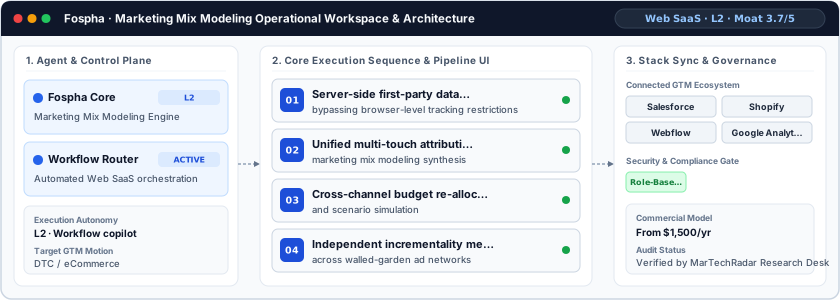
- Server-side first-party data ingestion: bypassing browser-level tracking restrictions
- Unified multi-touch attribution and marketing mix modeling synthesis
- Cross-channel budget re-allocation forecasting and scenario simulation
- Independent incrementality measurement: across walled-garden ad networks
Cons: operational limitations & risks
- Offline Channel Integration Latency: Ingesting brick-and-mortar point-of-sale data requires custom ETL pipelines, introducing reporting lags compared to purely digital ecommerce event streams.
- High Ad-Spend Calibration Threshold: The probabilistic attribution and mix models require consistent baseline conversion density, causing statistical variance when analyzing low-volume ad accounts.
- Walled-Garden API Dependency: Frequent updates to upstream ad network reporting schemas necessitate continuous connector maintenance to prevent synthetic signal distortion.
Fospha TCO & deal-breaker stress test
Simulate 12-month stepped TCO, hidden cost multipliers, contract lock-in exposure, and stack failure modes using only facts verified by MarTechRadar Research Desk on 2026-10-11 · Capture SHA f0bf7567.
Fospha is viable for 5 seats, but requires commercial or technical verification on the flagged items below.
- Moat Score
- 3.7 / 5.0
- AI Autonomy
- L2
- Free Tier / Trial
- None disclosed
Triggered audit signals & failure modes
- Annual Contract Lock-in Risk DetectedFact-checked by MarTechRadar Research Desk
Fospha operates on an annual subscription framework tiered by tracked annual revenue and media spend volume.
- Tier Fit for 5-Seat Scale: Lite ($1500/yr)Verified Tier Schedule
Total monthly media spend: $100k–$500k
- Primary Operational Bottleneck: Offline Channel Integration LatencyAudit by MarTechRadar Research Desk
Ingesting brick-and-mortar point-of-sale data requires custom ETL pipelines, introducing reporting lags compared to purely digital ecommerce event streams.
Test a custom Fospha budget or stack constraint
Transparent self-serve entry without mandatory annual lock-in
Verified Marketing Mix Modeling peer (Custom / enterprise pricing · Moat 3.9/5.0)
Fospha integrations, API, security & compliance stack
Fospha AI moat & Marketing Mix Modeling positioning
Fospha leverages tenured first-party data pipelines paired with retail-specific Bayesian attribution frameworks that reconcile impression-level media spend against transactional revenue without reliance on ad platform self-reporting.
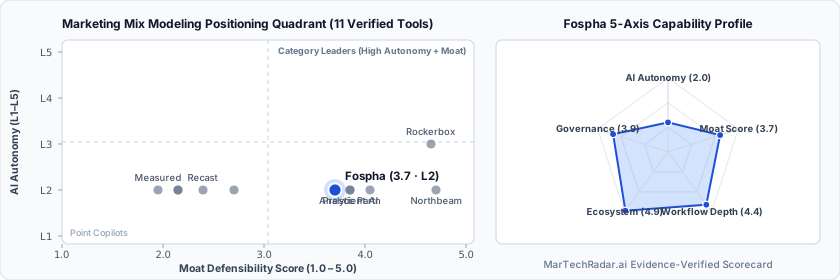
Fospha in-depth review, pricing & architecture analysis
Editor sign-off: Oct 11, 2026. How profiles are made.
What is Fospha? Overview & background
For direct-to-consumer and retail commerce organizations confronting signal degradation from client-side tracking restrictions, Fospha delivers an independent marketing measurement framework. Headquartered in Austin, TX, and founded in 2014, the company has secured £5.3M in venture funding. Built specifically for chief marketing officers and performance growth leads, the platform replaces platform-biased reporting with objective, full-funnel attribution and predictive budget allocation across digital advertising channels.
How Fospha works: architecture & workflow
Fospha operates at an L2 autonomy profile, functioning as an automated decision-support system that ingests first-party transaction records, raw web events via server-side connectors, and paid media spend via ad platform APIs. The ingestion pipeline cleanses and normalizes cross-network impression, click, and revenue telemetry. Its analytical engine synthesizes multi-touch event reconstruction with aggregated Bayesian media mix modeling, resolving customer journey paths without third-party cookies. The platform continuously computes marginal return on ad spend and outputs scenario forecasts that guide tactical media budget reallocation, alongside native workflow integrations for Salesforce, Shopify, Webflow, and Google Analytics.
Fospha limitations, drawbacks & risks
Operational considerations and platform boundaries include:
- Offline Channel Integration Latency: Ingesting brick-and-mortar point-of-sale data requires custom ETL pipelines, introducing reporting lags compared to purely digital ecommerce event streams.
- High Ad-Spend Calibration Threshold: The probabilistic attribution and mix models require consistent baseline conversion density, causing statistical variance when analyzing low-volume ad accounts.
- Walled-Garden API Dependency: Frequent updates to upstream ad network reporting schemas necessitate continuous connector maintenance to prevent synthetic signal distortion.
Fospha pricing, plans & cost breakdown
Fospha operates on an annual subscription framework tiered by tracked annual revenue and media spend volume. Commercial agreements start From $1,500/year for baseline tracking packages, scaling upward based on custom connector deployments, enterprise data warehouse synchronization, and dedicated econometric model recalibrations.
| Plan / Tier | Verified Price & Billing | Included Scope & Contract Terms |
|---|---|---|
| Lite | $1500/yr | Total monthly media spend: $100k–$500k |
| Pro | $2000/yr | + % of media spend / month |
How Fospha compares vs. competitors & alternatives
Within the marketing mix modeling and incrementality landscape, Fospha competes with Prescient AI, Recast, and Northbeam. While Recast emphasizes pure high-frequency econometric modeling without click tracking, and Northbeam focuses heavily on direct-to-consumer click-level multi-touch attribution, Fospha blends server-side event collection with top-down media mix modeling. The system fits mid-market and enterprise retail brands spending heavily across paid social and search that require objective, cross-channel verification to govern paid media allocation.
Direct competitors & market radar
Top algorithmic competitors based on category positioning, capability overlap, and ICP alignment.
Frequently asked questions about Fospha
How much does Fospha cost in 2026?
Fospha pricing: From $1,500/yr. No free plan is publicly disclosed. Published tiers: Lite ($1500/yr); Pro ($2000/yr). Fospha operates on an annual subscription framework tiered by tracked annual revenue and media spend volume.
What are the top Fospha alternatives in Marketing Mix Modeling?
Verified Marketing Mix Modeling alternatives include Prescient AI (Custom / enterprise pricing), Recast (Custom / enterprise pricing), Northbeam ($1,500–$3,500/mo · Enterprise plan), Odins.ai (Custom / enterprise pricing). Within the marketing mix modeling and incrementality landscape, Fospha competes with Prescient AI, Recast, and Northbeam.
What are the main limitations and trade-offs of Fospha?
Operational considerations and platform boundaries include: Offline Channel Integration Latency: Ingesting brick-and-mortar point-of-sale data requires custom ETL pipelines, introducing reporting lags compared to purely digital ecommerce event streams. Walk away if your workflow cannot tolerate offline channel integration latency: Ingesting brick-and-mortar point-of-sale data requires custom ETL pipelines, introducing reporting lags compared to purely digital ecommerce event streams.
Verified sources & evidence trail
- Official product domain: https://fospha.com
- Commercial pricing verification: https://www.fospha.com/pricing
- Verified corporate entity profiles (
sameAs): LinkedIn Company Profile · Crunchbase Entity Record - First-party governance & documentation links: Changelog
- Editor sign-off: Oct 11, 2026 (how profiles are made).
