Proxis Review (2026): Cold Email Pricing, Limits & Alternatives
Bottom line
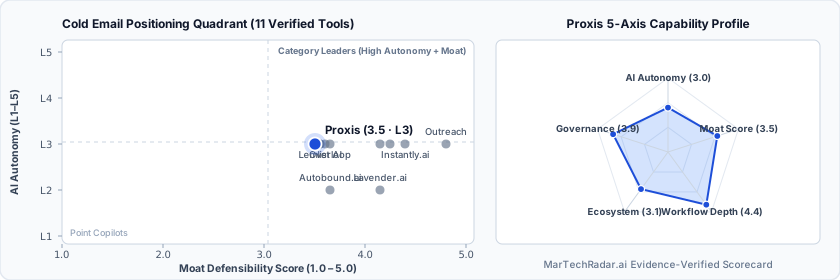
Proxis is a Web SaaS tool for Cold Email (Cold Email Sequences & Mailbox Infra) in AI SDR & Outbound. Pricing: Free plan · $0/seat/mo · Enterprise plan. Best suited to B2B SaaS and Marketing & Growth Teams. Editor ratings: AI autonomy L3 (conditional automation); moat score 3.5/5.0 (Proprietary moat). Fact-checked by Jagmeet Sine on Oct 16, 2026.
Enterprise AI email agent and internal operations automation platform that handles inbound and outbound inbox workflows to close deals on autopilot.
Proxis buyer fit verdict: when to choose vs. when to walk away
Choose Proxis if (Best Fit)
- Target ICP & Stack Fit: You operate as B2B SaaS and Marketing & Growth Teams requiring a Web SaaS deployment for Cold Email.
- L3 Architecture & Defensibility: Deploying distilled, domain-tuned LLM email agents directly inside enterprise inboxes and internal operational workflows automates high-volume deal closing and back-office triage.
- Commercial Model Fit: Your procurement budget aligns with Free plan · $0/seat/mo · Enterprise plan and want a self-serve free tier for zero-cost initial validation.
Walk away from Proxis if (Deal-Breakers)
- Walk away if your workflow requires uncapped enterprise volume on the Free plan · $0/seat/mo · Enterprise plan entry plan without upgrading tiers.
- Walk away if your workflow cannot tolerate animated pricing ui transparency friction: On Proxis's public pricing page, per-seat dollar figures render as animated rolling digit counters (0 through 9), creating a pricing transparency bottleneck that requires prospective buyers to initiate onboarding or contact sales for exact seat rates.
- Walk away if internal tool integration latency is a deal-breaker for your team: Connecting autonomous email agents to legacy on-premise ERPs and custom internal tools in traditional enterprises introduces initial API integration latency compared to cloud-native SaaS connectors.
Proxis key facts & scorecard
| Pricing | Free plan · $0/seat/mo · Enterprise planVendor pricing page |
|---|---|
| Free plan | Yes |
| Delivery | Web SaaS |
| Audience | B2B SaaS, Marketing & Growth Teams |
| AI autonomy level | L3 · Conditional automationEditor-verified |
| Moat tier & score | 3.5 / 5.0 · Proprietary moatEditor-verified |
| Funding | Pre-seed |
| Total funding | $500K |
| Founders | Jackson Stokes, Liam Collins |
| Company size | 2-10 employees |
| Headquarters | San Francisco, California |
| Founded | 2024 |
| Last verified |
Proxis pros & cons: strengths vs. operational limitations
Pros: core strengths & capabilities
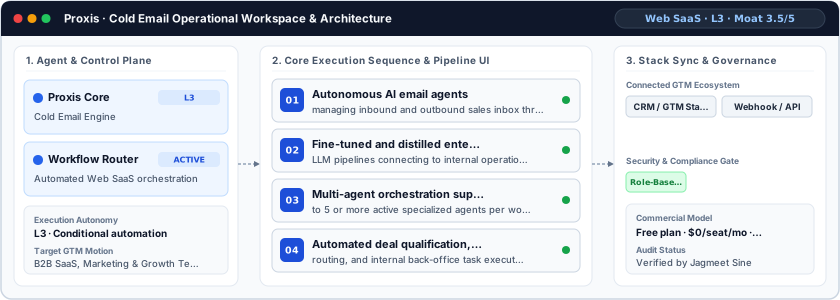
- Autonomous AI email agents: managing inbound and outbound sales inbox threads end-to-end
- Fine-tuned and distilled enterprise: LLM pipelines connecting to internal operational databases
- Multi-agent orchestration supporting up: to 5 or more active specialized agents per workspace
- Automated deal qualification, quote: routing, and internal back-office task execution
Cons: operational limitations & risks
- Animated Pricing UI Transparency Friction: On Proxis's public pricing page, per-seat dollar figures render as animated rolling digit counters (0 through 9), creating a pricing transparency bottleneck that requires prospective buyers to initiate onboarding or contact sales for exact seat rates.
- Internal Tool Integration Latency: Connecting autonomous email agents to legacy on-premise ERPs and custom internal tools in traditional enterprises introduces initial API integration latency compared to cloud-native SaaS connectors.
- Autonomous Inbox Governance Barrier: Allowing AI agents to send binding commercial replies and pricing quotes from corporate email domains requires strict human-in-the-loop escalation thresholds and compliance governance guardrails.
Proxis TCO & deal-breaker stress test
Simulate 12-month stepped TCO, hidden cost multipliers, contract lock-in exposure, and stack failure modes using only facts verified by Jagmeet Sine on · Capture SHA bde5e013.
Proxis is viable for 5 seats, but requires commercial or technical verification on the flagged items below.
| Plan / Tier | Verified Rate | Scale Fit | Scope & Quota Notes |
|---|---|---|---|
| Free / Sandbox | $0 | 1–2 seats (Evaluation) | Entry free tier with capped usage or feature quotas for initial workflow testing. |
| Enterprise / Custom | Custom quote | 15–50+ seats (Enterprise SLA) | Sales-negotiated annual contract for custom volume, SSO/RBAC governance, and dedicated SLA. |
- Moat Score
- 3.5 / 5.0
- AI Autonomy
- L3
- Free Tier / Trial
- Free plan
Triggered audit signals & failure modes
- Opaque Enterprise Quoting vs. SMB/Mid-Market BudgetVerified Pricing Ledger
Proxis does not disclose a public self-serve floor (Free plan · $0/seat/mo · Enterprise plan). Buyers with a $800/mo cap face high sales-qualification friction.
- Published Self-Serve Entry FloorVerified Pricing Ledger
Proxis publishes a transparent entry point (Free plan · $0/seat/mo · Enterprise plan) with a free tier for initial validation before committing.
- Primary Operational Bottleneck: Animated Pricing UI Transparency FrictionAudit by Jagmeet Sine
On Proxis's public pricing page, per-seat dollar figures render as animated rolling digit counters (0 through 9), creating a pricing transparency bottleneck that requires prospective buyers to initiate onboarding or contact sales for exact seat rates.
Hidden TCO Multipliers & Quota Gates
- Per-Seat Linear Scaling: Proxis prices licenses on a per-user/seat basis (Free plan · $0/seat/mo · Enterprise plan); expanding from 2 to 15+ operators multiplies base recurring spend linearly.
- Annual Billing Headline vs. Monthly Premium: Headline entry rates reflect annual billing commitments (Save 20%); month-to-month flexibility carries a higher effective monthly rate or requires annual prepayment.
When to Walk Away & Negotiation Levers
- Walk away if your workflow requires uncapped enterprise volume on the Free plan · $0/seat/mo · Enterprise plan entry plan without upgrading tiers.
- Walk away if your workflow cannot tolerate animated pricing ui transparency friction: On Proxis's public pricing page, per-seat dollar figures render as animated rolling digit counters (0 through 9), creating a pricing transparency bottleneck that requires prospective buyers to initiate onboarding or contact sales for exact seat rates.
- Walk away if internal tool integration latency is a deal-breaker for your team: Connecting autonomous email agents to legacy on-premise ERPs and custom internal tools in traditional enterprises introduces initial API integration latency compared to cloud-native SaaS connectors.
- Validate exact quota thresholds (seats, credits, or API calls) included in Proxis's Free plan · $0/seat/mo · Enterprise plan tier before converting from monthly to annual billing.
- Require a sandbox proof-of-concept testing animated pricing ui transparency friction against your live CRM/data schema before annual sign-off.
Ask a custom procurement or TCO stress-test question about Proxis
Lower 5-seat floor (~$50/mo vs. Custom Quote)
Lower 5-seat floor (~$69/mo vs. Custom Quote)
Proxis moat & subtrack positioning
Deploying distilled, domain-tuned LLM email agents directly inside enterprise inboxes and internal operational workflows automates high-volume deal closing and back-office triage.
Editorial review
Fact-checked by Jagmeet Sine (Senior MarTech Infrastructure & Agentic Workflow Architect) on .
Background
Founded in 2024 by Liam Collins and Jackson Stokes and headquartered in San Francisco, California, Proxis (proxis.ai) is an enterprise AI email agent and internal operations automation platform built for commercial revenue teams and traditional enterprises modernizing their workflows. Operating with a team of 2 to 10 employees and backed by $500K in Pre-Seed funding from Y Combinator (S24) and Pioneer Fund, the company builds autonomous inbox and back-office agents that qualify replies, coordinate internal data lookups, and close transactions automatically.
How Proxis works
Proxis operates at Level 3 autonomy by combining fine-tuned, distilled enterprise language models with a full-stack workflow execution runtime. Rather than offering a standalone chat interface, Proxis embeds directly into corporate email inboxes and internal operational tools. When a prospect or customer emails a sales or operations alias, Proxis's active agents read the thread, query connected internal databases or CRM records to verify inventory, pricing, or account status, and execute the required response or transaction step without human intervention.
Limitations
Operational limitations and technical trade-offs include:
- Animated Pricing UI Transparency Friction: On Proxis's public pricing page, per-seat dollar figures render as animated rolling digit counters (0 through 9), creating a pricing transparency bottleneck that requires prospective buyers to initiate onboarding or contact sales for exact seat rates.
- Internal Tool Integration Latency: Connecting autonomous email agents to legacy on-premise ERPs and custom internal tools in traditional enterprises introduces initial API integration latency compared to cloud-native SaaS connectors.
- Autonomous Inbox Governance Barrier: Allowing AI agents to send binding commercial replies and pricing quotes from corporate email domains requires strict human-in-the-loop escalation thresholds and compliance governance guardrails.
Proxis pricing
Proxis structures its commercial model around Monthly and Yearly (20% discount) per-seat tiers across Growth (for early-stage teams), Scale (for fast-moving startups, starting free at $0/seat to begin building), and Enterprise (supporting up to 5 or more active agents with custom security and sales scoping).
How Proxis compares
Within the Cold Email Sequences & Mailbox Infra and Inbox Automation category, Proxis competes against AI email and workflow alternatives such as DryMerge, Cassidy, and Lindy. Versus top-of-funnel cold email blasters like Instantly, Proxis differentiates itself by focusing on fine-tuned enterprise inbox execution and internal operational automation that carries incoming threads all the way to deal closure. Traditional enterprises and operations-heavy commercial teams choose Proxis to automate high-volume inbox workflows.
Frequently asked questions about Proxis
How much does Proxis cost per seat and does it have a free plan?
Published pricing summary for Proxis: Free plan · $0/seat/mo · Enterprise plan. Proxis includes a free tier or sandbox entry point. Verified tier schedule: Free / Sandbox ($0 for 1–2 seats (Evaluation)); Enterprise / Custom (Custom quote for 15–50+ seats (Enterprise SLA)). Proxis structures its commercial model around Monthly and Yearly (20% discount) per-seat tiers across Growth (for early-stage teams), Scale (for fast-moving startups, starting free at $0/seat to begin building), and Enterprise (supporting up to 5 or more active agents with custom security and sales scoping).
How does Proxis work and how autonomous is its AI architecture?
Enterprise AI email agent and internal operations automation platform that handles inbound and outbound inbox workflows to close deals on autopilot. Within Cold Email (Cold Email Sequences & Mailbox Infra), MarTechRadar rates its execution architecture at L3 · Conditional automation with a verified Moat Score of 3.5 / 5.0 (Proprietary moat). Deploying distilled, domain-tuned LLM email agents directly inside enterprise inboxes and internal operational workflows automates high-volume deal closing and back-office triage. Corporate profile: Founded by Jackson Stokes, Liam Collins, operating at 2-10 employees scale.
What are the main limitations of Proxis and when should buyers walk away?
Based on our editorial technical audit, key operational considerations and boundaries for Proxis include: (1) Animated Pricing UI Transparency Friction: On Proxis's public pricing page, per-seat dollar figures render as animated rolling digit counters (0 through 9), creating a pricing transparency bottleneck that requires prospective buyers to initiate onboarding or contact sales for exact seat rates. (2) Internal Tool Integration Latency: Connecting autonomous email agents to legacy on-premise ERPs and custom internal tools in traditional enterprises introduces initial API integration latency compared to cloud-native SaaS connectors. (3) Autonomous Inbox Governance Barrier: Allowing AI agents to send binding commercial replies and pricing quotes from corporate email domains requires strict human-in-the-loop escalation thresholds and compliance governance guardrails. Primary procurement walk-away rule: Walk away if your workflow requires uncapped enterprise volume on the Free plan · $0/seat/mo · Enterprise plan entry plan without upgrading tiers.
What integrations, compliance certifications, and contract terms apply to Proxis?
Key TCO multiplier to watch: Per-Seat Linear Scaling (Proxis prices licenses on a per-user/seat basis (Free plan · $0/seat/mo · Enterprise plan); expanding from 2 to 15+ operators multiplies base recurring spend linearly.) Before signing a contract, procurement teams should validate exact quota thresholds (seats, credits, or API calls) included in Proxis's Free plan · $0/seat/mo · Enterprise plan tier before converting from monthly to annual billing.
What are the best Proxis alternatives and head-to-head competitors in 2026?
Top fact-checked alternatives to Proxis in Cold Email (Cold Email Sequences & Mailbox Infra) include Pipl AI (Free plan · $0/mo · Enterprise plan), Verbiflow ($50/mo), Overloop (From $69/mo), Meticulate (Pricing not disclosed). Within the Cold Email Sequences & Mailbox Infra and Inbox Automation category, Proxis competes against AI email and workflow alternatives such as DryMerge, Cassidy, and Lindy.
Verified sources & evidence trail
- Official product domain: https://www.proxis.ai/
- Commercial pricing verification: https://www.proxis.ai/pricing
- Verified corporate entity profiles (
sameAs): LinkedIn Company Profile · Crunchbase Entity Record - Editorial audit sign-off: Fact-checked by Jagmeet Sine on under the MarTechRadar Evidence-Ledger Protocol.